
For years, SEO was often treated like a keyword exercise. Find the right phrase, add it to the title, repeat it in the copy, build a few links, and hope the page moves up. That approach may have worked better in the past, but search has moved on.
Google is no longer only looking at the exact words on a page. It is trying to understand what the page is really about, who is behind it, and how that information connects with other trusted sources. This is where entities matter.
An entity is a clear, identifiable thing. It can be a person, business, place, product, topic, service, or idea. For example, “Apple” can mean a fruit or a technology company. Search engines use context to work out which one the user means.
That matters because modern SEO is not just about ranking for isolated keywords. It is about helping search engines understand your brand as a real, trusted part of a wider topic. This is also why services such as AI SEO are becoming more important for businesses that want to be found in both normal search results and AI-driven answers.
Search Has Moved From Words to Meaning
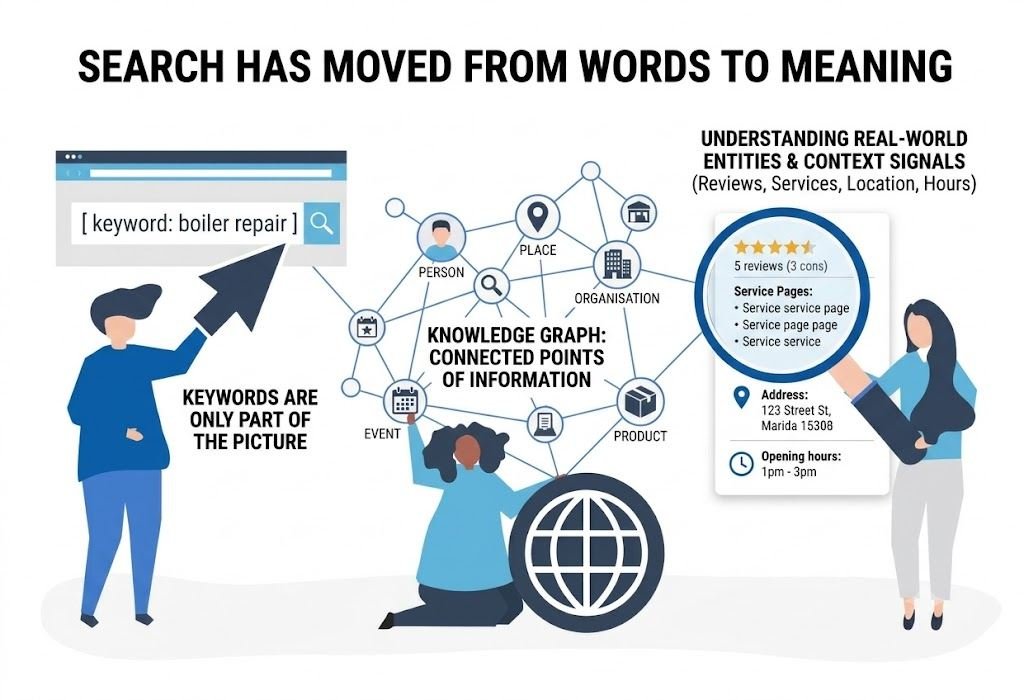
A keyword still matters. People still type words into Google. But keywords are now only part of the picture.
If someone searches for “best boiler repair company near me”, Google does not only look for pages repeating that phrase. It also looks at the business, the location, reviews, service pages, contact details, opening hours, and other signals that help confirm whether the company is real and relevant.
Google’s own Knowledge Graph documentation explains how real-world entities such as people, places, organisations, events, and products can be understood as connected points of information.
This is the main shift. Search engines are trying to understand things, not just strings of text.
What Entity SEO Means in Plain English
Entity SEO means making your business easy to understand online.
It means Google should be able to answer basic questions about your brand without confusion:
- What is the business called?
- What does it do?
- Where is it based?
- Who is responsible for the website?
- Which services does it offer?
- Which topics is it known for?
- Where else is the brand mentioned online?
For a UK business, this is especially important in local and service-based search. A solicitor in Manchester, a dental clinic in Leeds, or a plumbing company in Birmingham should not look vague online. Their website, Google Business Profile, social profiles, directory listings, and external mentions should all support the same clear identity.
If your brand details are messy, inconsistent, or thin, search engines have less confidence in you.
Why Keywords Alone Are Not Enough
A keyword-led article often feels forced. You can spot it quickly. The same phrase appears too many times. The page says a lot, but does not really help the reader. It sounds like it was written for a ranking tool instead of a person.
An entity-led page feels different. It covers the topic properly. It explains related terms. It links to useful supporting pages. It shows who created the content and why the reader should trust it.
For example, a page about “solar panel installation” should not only repeat that phrase. It should naturally cover related areas such as roof suitability, inverter types, maintenance, grants, planning rules, warranties, and energy savings. That gives search engines a much clearer picture of the topic.
This is how a website starts to build topical authority.
Your Website Needs a Clear Entity Home
Every serious business website needs a strong “entity home”. This is usually the homepage or About page. It should clearly explain who you are and why people should trust you.
A weak About page says something generic like, “We are passionate about delivering quality solutions.” That does not tell users or search engines very much.
A stronger About page includes real details, such as:
- The official business name
- The location or service area
- The people behind the business
- The company’s experience
- Industry memberships or qualifications
- Contact details
- Links to trusted external profiles
- Clear information about the services offered
Google’s Search Quality Rater Guidelines place importance on understanding who is responsible for a website and who created the content, especially when the subject can affect people’s money, health, safety, or major decisions. The public version of those guidelines is available through Google’s Search Quality Rater Guidelines.
This does not mean an About page alone will rank your site. It means clear identity helps support trust.
Structured Data Helps Search Engines Understand You
Structured data is code that explains parts of your website in a format search engines can read more easily. It can identify your organisation, articles, products, reviews, local business details, FAQs, authors, and more.
Google’s structured data guide says structured data gives Google explicit clues about the meaning of a page. That is useful because you are not leaving everything to guesswork.
For business websites, Organisation and LocalBusiness schema can be especially useful. Schema.org also provides an official Organisation schema type, which helps define details such as business name, logo, contact details, address, and related profiles.
Schema is not a magic ranking button. But it does help organise information in a way search engines can process more clearly.
Consistency Builds Trust
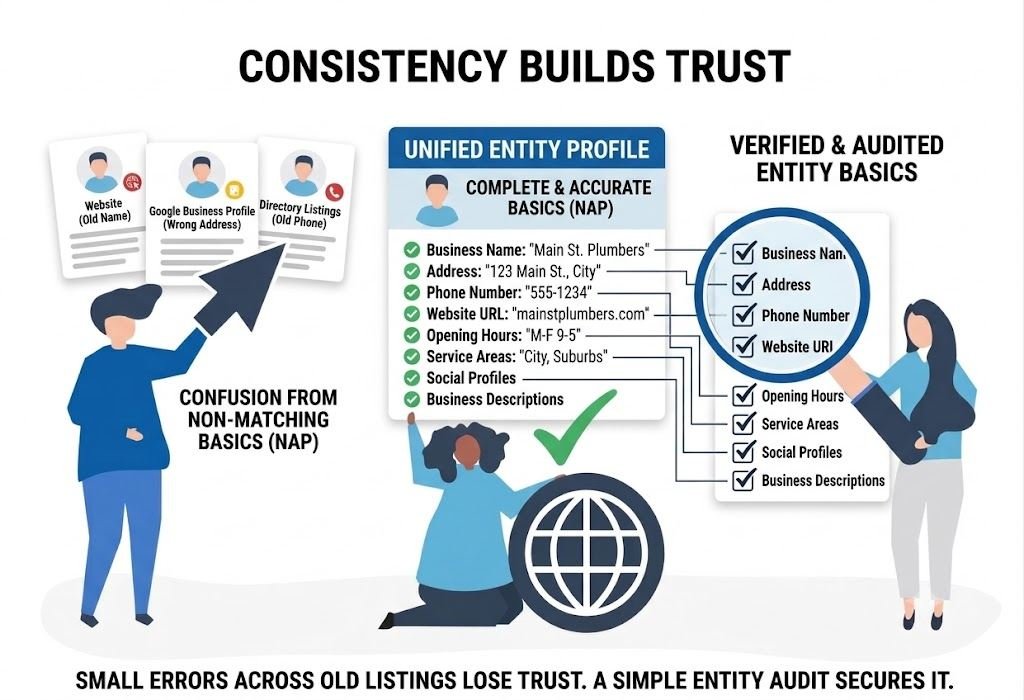
Entity SEO is not only about your website. It is also about how your brand appears across the web.
If your website says one address, your Google Business Profile shows another, and your directory listings use an old phone number, that creates confusion. The same applies if your business name is written differently on every platform.
For local businesses, Google’s Business Profile guidelines make it clear that a business should be represented as it is known in the real world. That includes accurate names, addresses, categories, and service details.
A simple entity audit can help. Check your main profiles and make sure the basics match:
- Business name
- Address
- Phone number
- Website URL
- Opening hours
- Service areas
- Social profiles
- Business descriptions
Many businesses lose trust signals due to small errors across old listings.
Build Content Around Topics, Not Random Posts
One blog post rarely proves authority. Search engines want to see depth.
If your business wants to be known for a topic, build a proper content cluster around it. A main pillar page should cover the broad subject, while supporting pages answer more specific questions.
For example, a website about commercial cleaning could build a cluster like this:
- Commercial cleaning services
- Office cleaning checklist
- Deep cleaning for workplaces
- Cleaning rules for healthcare settings
- Eco-friendly cleaning products
- How often offices should be cleaned
- Cleaning contracts for UK businesses
Each page supports the others. Internal links help users move through the topic. Search engines can also see that the website covers the subject in a complete and organised way.
This is more useful than publishing ten separate posts that all chase similar keywords.
E-E-A-T Still Matters
E-E-A-T stands for Experience, Expertise, Authoritativeness, and Trustworthiness. It is not something you add with one plugin. It is built through the whole website.
You can show it by including real author details, expert review where needed, clear sourcing, case studies, original examples, customer support information, and honest business details.
For UK websites in finance, health, legal, property, insurance, or safety-related niches, this is even more important. Readers need to know they are getting reliable information from a real source.
A page written by a named professional, checked for accuracy, and supported by trusted references is much stronger than a vague article with no author, no date, and no proof.
Google’s SEO Starter Guide also encourages website owners to create useful, reliable, people-first content rather than content made mainly to attract search traffic.
What This Means for AI Search
AI search tools need clear information to give useful answers. If your brand is not well defined online, it is harder for these systems to understand when your business should be mentioned.
This does not mean stuffing pages with AI-related phrases. It means doing the basics properly:
- Make your business identity clear
- Use structured data
- Build strong topic clusters
- Earn trustworthy mentions
- Keep brand details consistent
- Publish content that answers real questions
- Show who created or checked the content
The sites that do this well are easier for both search engines and AI systems to understand.
Final Thoughts
Entity SEO is not a trick. It is a better way to build a search presence.
Instead of asking, “How many times should we use this keyword?”, ask better questions:
- Does Google clearly understand who we are?
- Does our website explain what we do?
- Do our pages cover the topic properly?
- Can users trust the people behind the content?
- Are our business details consistent across the web?
- Are we connected to trusted sources in our industry?
Keywords still have a place, but they are no longer enough on their own. A strong entity gives your website a clearer identity, stronger trust signals, and a better chance of being understood in modern search.
For UK businesses, this is practical work. It means clearer pages, better structure, stronger proof, and fewer vague claims. That is what helps a brand move from being another result on Google to becoming a trusted source people and search engines can recognise.