
Somewhere in the UK this quarter, a designer will open a results-day social card at 3,000 pixels wide, crop it to a square for LinkedIn, and remove a risk warning without noticing. The numbers will be correct. The chart will be correct. The compliance officer signed off the version that no longer exists.
That is the shape of almost every graphics failure in regulated reporting. Nobody falsifies anything. A visual improvement lands after the facts were agreed, and it quietly changes what the audience is told. Generative editing tools have not created this problem, but they have made it considerably faster to produce, and rather harder to spot.
Where The Edit Belongs In The Chain
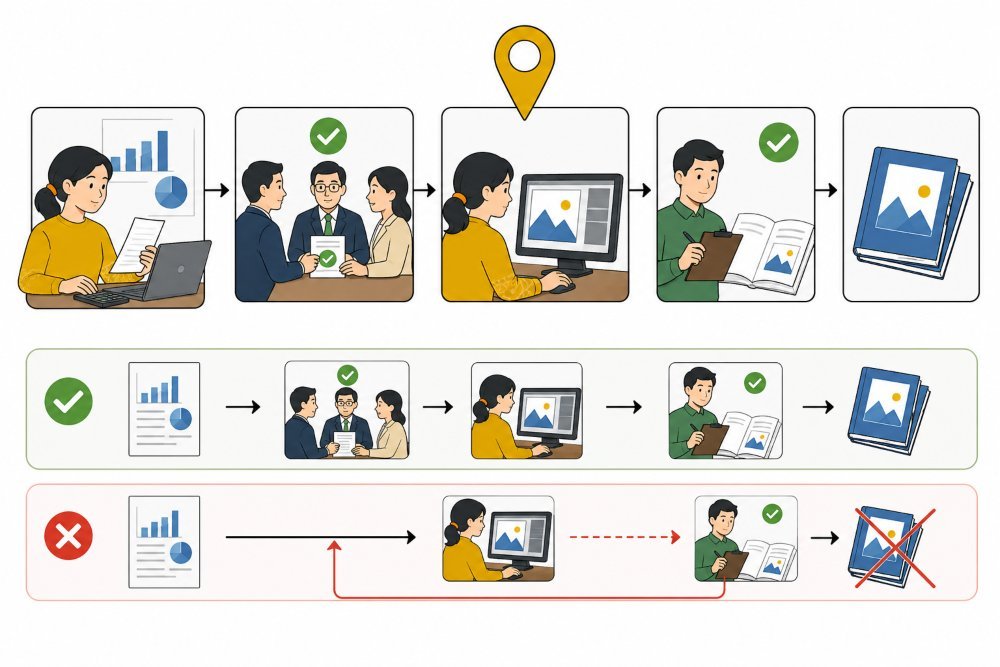
The sequencing matters more than the tooling. A photo edit sits after factual sign-off and before final publication review. It never sits inside the process that decides what the facts mean.
This is not a stylistic preference. Under section 393 of the Companies Act 2006, directors must not approve accounts unless satisfied they give a true and fair view. That obligation belongs to the board, not to whoever assembled the cover artwork. Once approved figures leave the finance function and enter a design workflow, the only legitimate job of that workflow is presentation. Any change that alters meaning has to travel back upstream, not get resolved in the layout.
Design teams tend to find this frustrating, and understandably so, because most of what they do is entirely harmless, which is exactly why the classification step has to happen first.
Sort Every Element Into Controlled Or Decorative
Before anything is uploaded anywhere, split the frame into two categories.
Controlled content covers figures, dates, percentages, currency symbols, legal entity names, axis labels, legends, footnote markers, basis of preparation notes, risk warnings, auditor wording, and any qualification line. These are approved outputs. They are reproduced, never regenerated.
Illustrative content covers background texture, gradients, section dividers, non-data iconography, generic photography, and cover imagery. This is where an AI editor earns its keep, and it is a genuinely useful place to save time.
The distinction sounds obvious written down. It stops being obvious at 7 pm the night before an announcement, which is precisely when it needs to hold.
Freeze The Numbers Outside The Editor
Keep the source workbook, the signed-off copy deck, and the chart specification entirely outside the image tool. Export a clean chart only once values and labels are approved, and treat that export as read-only from then on.
One rule with no exceptions: never ask a model to recreate a table of figures from a screenshot. Text rendering in generative models is plausible rather than accurate, and a transposed digit in a five-year revenue series will survive three rounds of review because it looks completely normal. If a graphic contains controlled text, that text gets typeset manually in the layout tool.
Write Briefs That Say What Must Not Change
Reference-based tools have made it straightforward to edit a photo by describing the change in plain language rather than working with selections and layers. The convenience is real. So is the trap, because a prompt is a request, not a mask.
Write the brief so that the protected zone is explicit. Something like: replace only the neutral background behind the chart, keeping the chart, axes, legend, qualification line, logo, brand colours and all text unchanged. Then have a human inspect the entire frame anyway, at full resolution, against the approved source.
If the model has touched controlled content, reject the output. Do not patch it. A repaired region is untraceable within a week, and the reviewer who inherits the file has no way of knowing what was corrected by hand and what came out of the model.
Aspect Ratio Is A Compliance Decision
This is the point most teams get wrong, and it is the one with the sharpest UK regulatory edge.
The FCA’s finalised guidance on financial promotions on social media is emphatic that the rules are media neutral and that each promotion must stand alone. Key information has to be prominent, and it must not be obscured or truncated. A platform that crops a landscape image to a square is not a mitigating circumstance. Neither is a carousel that hides the second frame behind a swipe.
So the destination has to be chosen before generation, not after. Report cover, presentation slide, investor portal tile and social card are four different constraints, and reviewers should assess every draft inside the destination template rather than as a standalone image on a large monitor.
The annual report itself has changed too, and plenty of production teams have not caught up. UK issuers on regulated markets must now publish annual financial reports in XHTML with iXBRL tagging of the primary statements rather than as a designed PDF. The FRC’s structured digital reporting insights review keeps finding tagging and consistency issues in filed reports. A graphic that behaves beautifully in a print layout may reflow, rescale or lose its caption relationship in a browser rendering, and that is now the filed version of record.
Keep Generated Work Out Of The Master File
Save generated concepts in a separate folder that is clearly not production. Once a direction is accepted, rebuild the controlled text and data in the normal layout tool. This stops an attractive draft becoming the only editable master, and it gives a reviewer a clean view of what was generated and what came from approved sources.
Maintain a short asset manifest for each report listing the controlled source, the approved export, any generated background, the prompt record, and the final composed file. Five lines per asset. It takes minutes, and it means an audit question two years later does not depend on the memory of a contractor who has since left.
Data Protection Comes Before The Prompt Box
Uploading an image is processing. If that image contains personal data, unpublished price-sensitive information, or client material, the organisation remains the controller regardless of what the vendor’s settings say.
The ICO’s guidance on AI and data protection sets the expectations here, including data minimisation and documented assessment before deployment. Supplier assurance sits alongside it, and the National Cyber Security Centre publishes practical material on assessing third parties in a supply chain. A public visibility toggle inside a product interface is a feature, not a control. It does not substitute for classification, permission, transfer safeguards or an approved vendor review.
The sensible pilot uses material that is already published. Test the prompts, the naming conventions, the review time and the export paths on last year’s results deck. Only once the controls demonstrably work should a governance owner decide whether anything more sensitive is permitted, and that decision does not belong to the production team.
Provenance Is Becoming Table Stakes
Regulators and platforms are moving towards machine-readable provenance rather than trust by assertion. The Coalition for Content Provenance and Authenticity standard attaches signed content credentials describing how an image was made and edited. It is worth understanding now, because a corporate communications function that can demonstrate which assets were generated and which were photographed is in a considerably better position than one relying on institutional memory.
The Advertising Standards Authority has also been active on misleading imagery in marketing communications, and a stylised or generated visual that implies a capability, a facility or a level of certainty the business does not have is a familiar route to a ruling.
Cost The Review, Not The Subscription
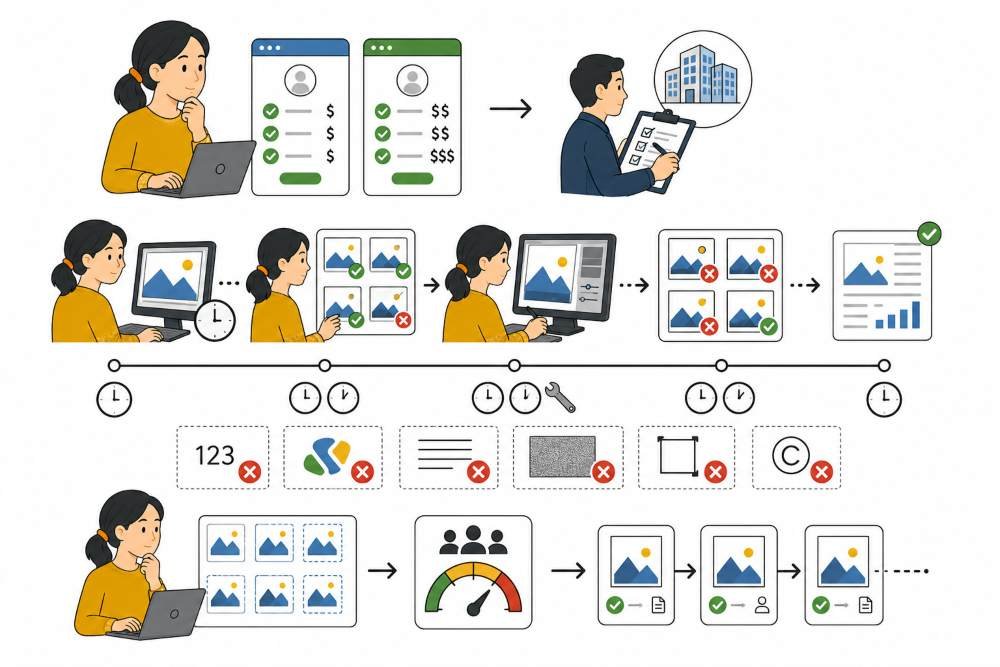
Tool pricing is the least interesting number in the business case. Most editors, including this category, sell tiered monthly and annual plans with credit allowances and different limits on concurrent generations, and the marketing comparison rarely matches the checkout figure once billing period and licence scope are confirmed. Have procurement verify that directly.
The metric that actually predicts whether this works is review minutes per accepted asset. Track generation time, comparison time, corrections, rejected outputs and final layout work across a small pilot of ten to twenty assets. Tag every rejection with a code: changed number, altered logo, missing qualification, false texture, weak crop, rights concern. The pattern shows up quickly, and it is usually the same conclusion. Generate the background, typeset the controlled content by hand, and treat every photo edit as an artefact with a record attached.
Concurrency deserves the same scepticism. More simultaneous generations can help a busy desk, but they can also produce more versions than reviewers can govern. Set a work-in-progress limit and do not start a new batch until the previous one has an owner, a decision and a recorded final file.
Adoption Test
These tools fit a narrow and legitimate job in regulated reporting: background treatment, format variants and concept imagery, applied after the facts are fixed. They are not charting software, they are not a source-data control, and they are certainly not a substitute for proofing.
The test is simple. Six months from now, can the team reconstruct why an image was changed, what settings produced it, and who approved the result? If yes, the workflow is doing its job. If that record has evaporated into a shared drive full of untitled exports, the speed gained is not worth what it costs.