Spend an evening scrolling engagement rings and a strange thing happens. The listings blur. Round stone, six prongs, plain band, next. Oval stone, hidden halo, pavé band, next. By the fortieth tab you are not comparing rings anymore, you are comparing photographs of the same idea.
That sameness is not a failure of taste on the buyer’s part. It is baked into the category. Classical bridal design is drawn from geometric ideals, and geometric ideals repeat perfectly by definition. A round brilliant is a round brilliant. Nature-inspired design is the one corner of the bridal market where that logic breaks, and it breaks for a structural reason rather than a marketing one.
Why Nature Refuses To Repeat Itself
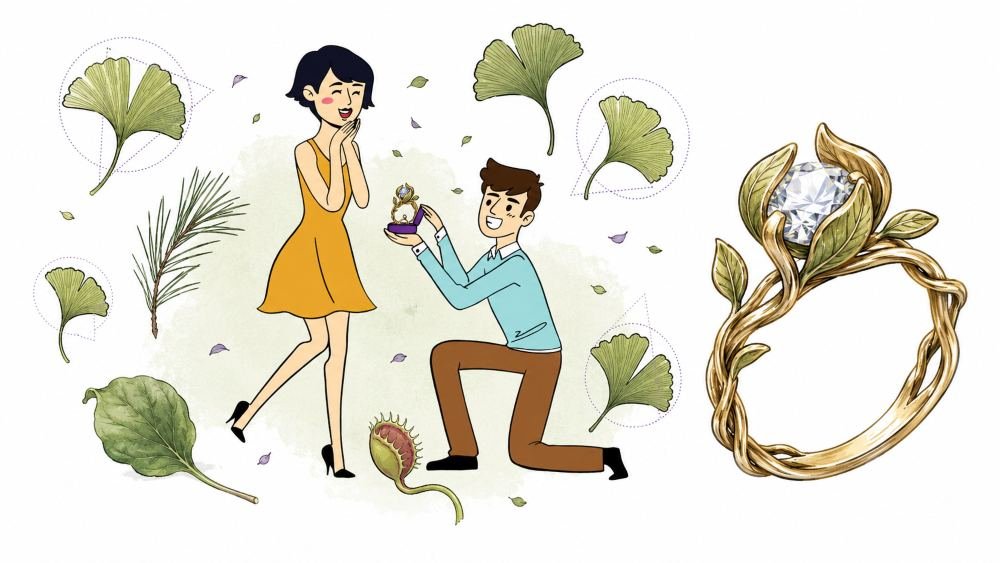
Botany does not deal in templates. Plant scientists studying how leaves acquire their shapes have found that small shifts in gene expression can send a leaf toward a flat blade, a needle, or the cup-shaped trap of a carnivorous species, and that minor genetic changes produce dramatic differences in form. Variation is not noise in the system. It is the system.
The variation holds even within a single organism. When mathematicians and paleobotanists set out to quantify it, they built a dataset of hundreds of ginkgo leaves and had to develop dedicated geometric methods just to measure how much the shapes differ from one another. One tree, one species, one growing season, and still no two outlines you could stack cleanly on top of each other.
A ring built on those forms inherits that logic. Two leaf-prong settings from the same workshop will read differently depending on how the leaves curl and where they meet the stone. A vine-wrapped shank is a decision about where the vine goes, and there are a great many places it could go. The design language itself resists standardization.
Motifs That Go Past Leaf And Vine
Leaf and vine are the entry point, not the ceiling. The wider vocabulary includes bare winter branches, twigs with visible bark texture, seed pods, berry clusters, thistles, wheat sheaves, moss, mushroom caps, feathers, and the increasingly popular hybrids that fold botanical detail into celestial settings so a ring reads as forest and night sky at once.
None of this is new territory. Around the turn of the twentieth century, designers working in the Art Nouveau idiom pulled their forms directly from botanical study and built entire careers on it. The Metropolitan Museum of Art notes that the movement took its cues from the unruly rather than the orderly side of nature, with the famous whiplash curve derived in part from plant illustration. The Victoria and Albert Museum’s survey of Art Nouveau glass and jewelry shows how far makers pushed that instinct once they stopped treating a gemstone as the only thing worth looking at.
That history matters for a practical reason. It means the unusual motif you are drawn to almost certainly has precedent, craft technique, and a hundred years of solved problems behind it. You are not asking a jeweler to invent something from scratch.
Stones That Bring Their Own Weather
Setting is only half the equation. Pair an organic setting with a stone that has visual behavior of its own and the individuality compounds.
Moss agate is the obvious case: the green dendritic inclusions are mineral growths that happen to look like lichen and undergrowth, and every slice is a different landscape. Salt-and-pepper diamonds turn the usual clarity hierarchy on its head by making inclusions the point. Moonstone shifts light across its surface. Alexandrite changes hue between daylight and lamplight. Rutilated quartz carries golden needles suspended mid-stone.
Museum collections have been making this argument for a long time. The Smithsonian’s National Gem Collection keeps a display of unusual gems including benitoite, kornerupine, euclase, and titanite, stones most jewelry buyers will never encounter in a mall case, precisely because rarity and strangeness are their own kind of value.
Makers who work primarily in this style tend to build their inventory around it rather than treating it as a sideline. Aquamarise is one example, pairing stones like moss agate, alexandrite, and salt-and-pepper diamonds with leaf, vine, and celestial settings in sterling silver, gold vermeil, and solid gold.
One caution worth taking seriously. Distinctive stones are frequently softer or more structurally fragile than the diamonds and sapphires the bridal industry defaults to, and hardness alone will not tell you whether a stone survives daily wear. The Gemological Institute of America frames durability as three separate properties: hardness, toughness, and stability, meaning resistance to scratching, to chipping, and to heat, light, chemicals, and humidity. A stone can score well on one and poorly on another. Moonstone and opal are the classic examples of gems that reward a protective setting and a bit of restraint about when you wear them.
Asymmetry As A Design Decision
Much of what makes these rings feel alive is deliberate irregularity. Leaves cluster on one side of the shank. A branch thickens where a branch would thicken. Accent stones sit at intervals that look grown rather than calculated. The eye reads this as handwork even when it was cast, because perfect bilateral symmetry is a signal of machinery and nothing else.
This is a real aesthetic choice with a real consequence: asymmetric designs have a front and a back, and they need to be oriented correctly on the hand. Worth confirming how a given piece sits before ordering, particularly if you wear a stacking band alongside it.
Metal, Texture, And The Value Of Mixing
Texture does as much work here as motif. A hammered or bark-finished shank against a high-polish leaf. A brushed matte band with a single bright-cut vine. Two-tone construction where a rose gold branch supports a white gold blossom, the color break doing the job that an outline would do in a drawing.
Mixed metals are also where marketing language gets slippery, so it pays to read specifications rather than adjectives. In the United States, claims about gold content, vermeil, plating, quality marks, and the word “handmade” are all addressed in the Federal Trade Commission’s Guides for the Jewelry, Precious Metals, and Pewter Industries, which set out what sellers can and cannot say. Solid 14K and gold vermeil are both legitimate products at very different price points and with very different lifespans. A listing should tell you which one you are buying without you having to ask twice.
Who These Rings Actually Suit
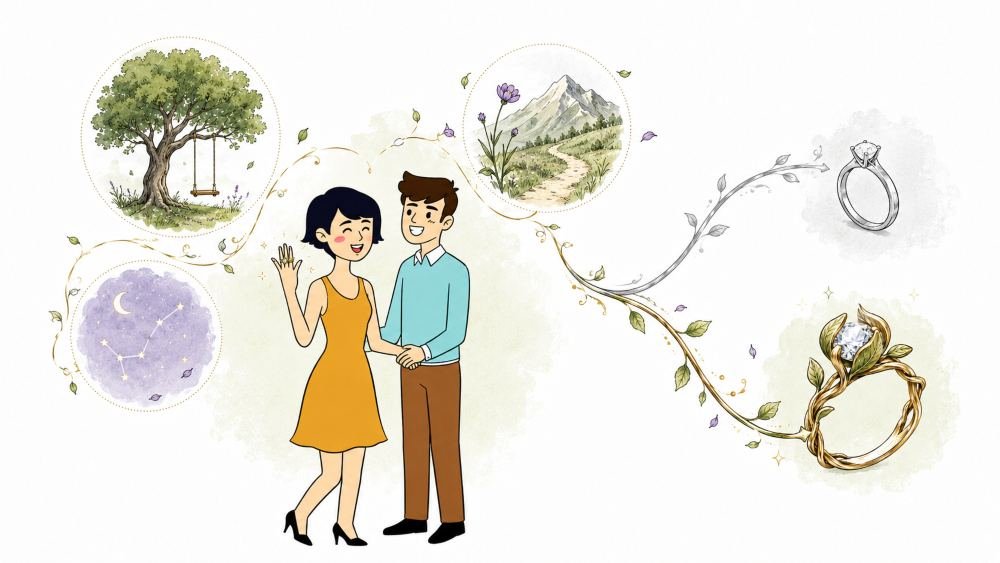
People who have already decided that the conventional ring is not for them, and who would rather explain their ring than have it recognized. The style sits comfortably with alternative, bohemian, folkloric, and fantasy-adjacent aesthetics, and it works particularly well for anyone who wants the ring to carry a specific reference: the tree in a childhood yard, the wildflower from a first hike, the constellation over a proposal.
It suits less well anyone who wants a ring that will be instantly legible as expensive, or anyone who is buying primarily as a store of value. That is not a criticism of either position, just a genuine fork in the road.
What To Check Before You Commit
Detailed organic bands are harder to resize than plain ones, because cutting through a vine or a row of leaves means rebuilding the pattern. Ask about resizing range before purchase. Ask about refinishing too: hammered and matte textures wear smooth over years and need periodic restoration, which is routine but not free.
Then insure it properly. Standard homeowners and renters policies cap jewelry coverage well below the value of most engagement rings, and the Insurance Information Institute explains how floaters and endorsements extend coverage for scheduled valuables beyond those built-in limits. Unusual stones and custom settings are exactly the pieces where a generic replacement will not do, so document the ring with photographs and a written specification while it is still new.
Finding The One That Reads As Yours
Start from the reference rather than the format. Decide what natural thing you actually care about, then work outward to motif, stone, and metal. Browsing a full range of unique nature inspired engagement rings is useful mainly as calibration: it shows how wide the vocabulary runs and which parts of it your eye keeps returning to.
The right one usually announces itself by being slightly harder to explain than the alternatives. That is generally a good sign.
Closing Note
A nature-inspired engagement ring is a bet that specificity outlasts trend. It probably does. The rings that people still wear at forty years are rarely the ones that looked most current at the time of purchase, they are the ones that looked most like a particular decision made by particular people. Take the extra week to get the stone, the setting, and the metal right, then stop comparing.
Disclaimer
This article is provided for general editorial and informational purposes only. It does not constitute gemological, appraisal, financial, insurance, or purchasing advice, and it is not a substitute for guidance from a qualified jeweler, certified gemologist, licensed appraiser, or licensed insurance professional. Product characteristics, metal composition, stone treatments, warranty coverage, and return terms vary by seller and should be confirmed directly with the retailer before purchase. Insurance availability, coverage limits, and terms vary by insurer, policy, and jurisdiction. Regulatory guidance referenced here applies to the United States and may differ in other markets. External sources are cited for context and were accurate as of the access date shown; the publisher is not responsible for subsequent changes to third-party content.