Turn a diamond ninety degrees, and the ring stops pointing and starts spanning. Same stone, same carat weight, same band. What changes is the direction your eye travels when someone reaches across the table for the salt.
That one rotation sits behind the most persistent shift in British bridal design of the past two years. Unlike most things filed under “trend”, it has not run out of road yet.
What Actually Makes A Ring East-West
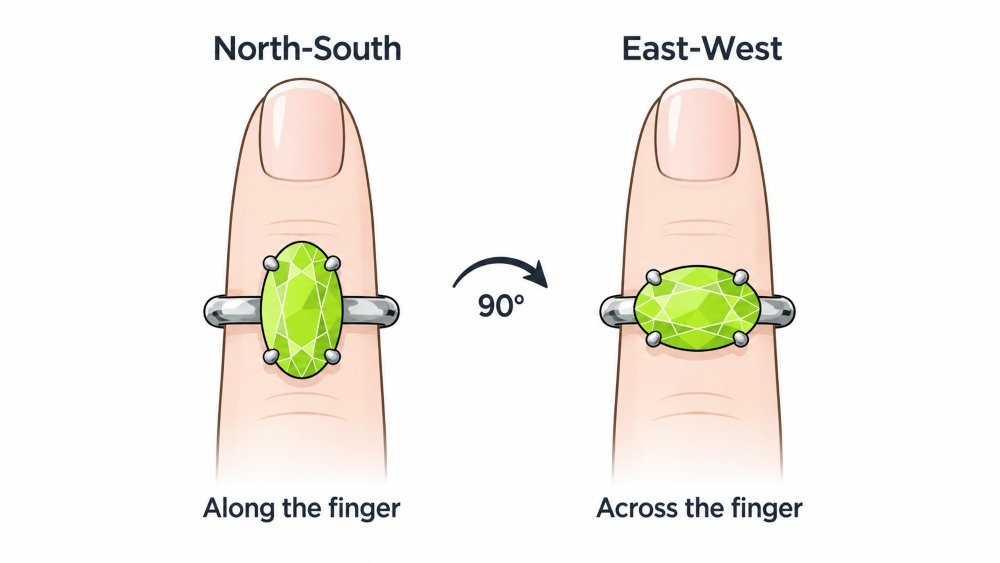
The default orientation for a centre stone is north-south. The long axis of the stone runs up and down the finger, in line with the bone, which is how almost every solitaire in every high street window is built. An east-west setting turns that stone a quarter circle so its length lies across the finger instead.
Described in a sentence, it sounds like nothing. In metal it is the difference between a ring that aims at the person opposite you and a ring that draws a line across the back of your hand.
The idea is not new either. Flat planes, hard symmetry and geometry were the working vocabulary of the interwar years, the period the V&A’s history of jewellery covers in detail, right down to the dense gemstone settings of Art Deco and the return of gold from about 1933 when platinum grew expensive. East-west settings borrow that instinct. They treat the stone as a shape first and a sparkle second.
Why UK Couples Are Choosing It Over The Classic Solitaire
Start with scale. There were 231,949 marriages and civil partnerships in England and Wales in 2023, according to Office for National Statistics figures. That is an enormous number of rings and, on Instagram at least, a fairly small number of silhouettes. Solitaires dominate for sound reasons, but ubiquity has a cost. An east-west ring reads as deliberate without tipping into costume.
The current wave also has a clear starting gun. Zendaya wore an east-west set stone at the Golden Globes in January 2025, and jewellery writers immediately read it as Georgian by way of Art Deco: low-set, clean, with the whole design standing back to let the diamond do the talking, as Forbes reported at the time. London jeweller Jessica McCormack was widely named as the maker, though the couple never confirmed the specifics. Search traffic moved within days. British showrooms moved within months.
If you want a sense of how much variation lives inside a single orientation, the East-West Rings from Cullen Jewellery UK collection is a useful place to calibrate. It runs across ovals, emeralds, marquises, radiants and elongated cushions in both claw and rubover mounts, priced in pounds and made to order in lab-grown diamond, moissanite or lab-grown sapphire. Scrolling twenty of them in a row makes something obvious that no single photograph does: each cut behaves completely differently once it is lying down.
Which Cuts Take The Turn Well
Elongated shapes are the natural candidates, because the whole point is that horizontal line. Emerald cuts are arguably the easiest win. They are already architectural, and turning one sideways gives you something that looks closer to a piece of design than a piece of jewellery. Elongated cushions and radiants are close behind.
Ovals, marquises and pears work too, with caveats worth knowing before you commit. The GIA’s guidance on fancy-shaped diamonds flags the bow-tie, a dark band across the centre of brilliant-cut elongated stones that you want minimised in a face-up view. It also puts the preferred length-to-width ratio for a marquise at roughly 1.75 to 2.25 to 1, and for a pear at roughly 1.50 to 1.75 to 1, and notes that pointed shapes need V-shaped claws to protect the tips. Turning a stone sideways does not change any of that. It just makes the bow-tie sit where you are more likely to notice it.
How It Actually Sits On The Hand
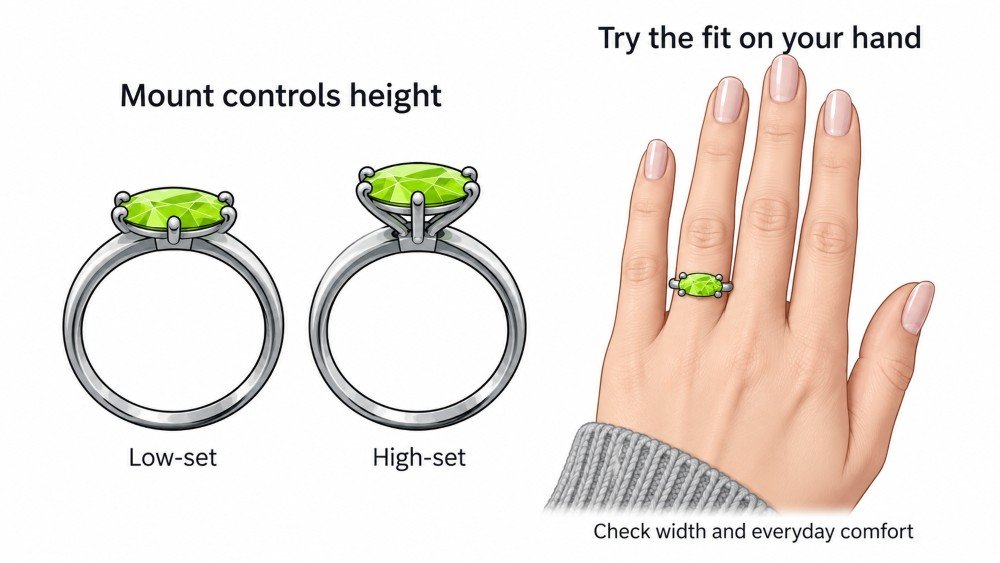
One claim gets repeated so often it has hardened into fact: that east-west rings sit lower. They frequently do, but not because of the rotation. A stone lying flat still needs a mount, and the height comes from whether that mount is low-set or high-set. If a low profile is what you want, ask for it in those terms rather than assuming the orientation delivers it.
Finger length is worth thinking about honestly. A north-south elongated stone lengthens the finger visually. Turned sideways, the same stone emphasises width instead. Longer fingers carry that without any effort. Shorter fingers absolutely can wear one, but the balance shifts, and a stone that looks perfect on a screen sits differently once it is on you. This is the part of the process that genuinely rewards a fitting.
That is not hard to arrange. The National Association of Jewellers directory lists member firms across London, Birmingham, Manchester, Glasgow, Leeds, Cardiff, Bristol and Belfast, all bound by the association’s code of conduct. Hatton Garden and Birmingham’s Jewellery Quarter remain the obvious concentrations if you want to see several in an afternoon. Plenty of online-first brands now run UK appointments too, which is worth asking about before you decide anything from photographs.
While you are there, think about the ordinary week. A horizontal stone lives across the finger, which means it interacts with jumper sleeves, coat pockets, gloves and the strap of whatever you carry to work. Some people find the low, wide profile easier to live with than a tall setting. Others find the extra width across the finger catches in ways a narrow solitaire never did. There is no universal answer, only your hands.
Setting Question
Ask your jeweller directly how the stone will be held. Rubover settings, called bezel settings elsewhere but rubover across most of the UK trade, wrap a rim of metal around the stone’s edge. They suit east-west orientations especially well, both for security and for the clean, uninterrupted line they produce. Claws work too, but they have to be positioned for a stone lying on its side rather than standing on end, and pointed cuts need V-tips at the ends.
Ask one more question while you are at it: has this bench actually set stones east-west before? A vertical design does not transfer sideways by default. Angles, claw placement and the seat the stone sits in all change.
Think about the wedding band at the same time, not eighteen months later. A horizontal stone changes what sits neatly beside it, and shaped or contoured bands are often the answer—deciding that early is cheaper than solving it afterwards.
Hallmarks, Sourcing And The Unglamorous Paperwork
In the UK, precious metal jewellery has to be hallmarked, and it is not optional above modest weight thresholds: gold and palladium over one gram, platinum over half a gram, silver over 7.78 grams. As the Goldsmiths’ Company Assay Office explains, a UK hallmark carries three compulsory marks covering the sponsor, the fineness and the assay office, with the leopard’s head for London, the anchor for Birmingham, the rose for Sheffield and the castle for Edinburgh. Check for it. It takes five seconds.
Sourcing deserves the same directness. Ask where the stone and the metal come from before you pay, not after, and treat vague environmental language as a prompt for a follow-up question rather than an answer. The CMA’s Green Claims Code requires businesses marketing to UK consumers to make environmental claims that are accurate, clear and properly substantiated, which means a retailer should be able to explain what a phrase like carbon neutral or responsibly sourced actually covers.
Then insure it properly. Most contents policies carry a single item limit, and the Association of British Insurers illustrates the trap plainly in its guidance on valuing home contents: if your limit is £1,500 and a £2,500 piece is stolen, £1,500 is what you get. Specify the ring, keep the valuation current, and check whether cover extends beyond the front door.
Sideways Is Still Serious
None of this is really about diamonds lying flat. It is about the fact that the most conventional object in the entire ritual has quietly opened up, and rotating a stone through ninety degrees turns out to be one of the cheapest ways to make a familiar thing look like a decision rather than a default.
Sideways does not mean less serious. It just means the ring says something slightly different about the person wearing it.
This article is for general information only and does not constitute financial, insurance or legal advice. Prices, stock and specifications change. Confirm details with the retailer, and speak to a qualified jeweller, valuer or insurance adviser before buying or insuring.