
Here is the honest answer before we get into it. In 2026, this is barely a choice any more. Soft-close has become the default on almost everything sold in the UK above the very cheapest end of the market; the price gap has narrowed to a few pounds on a like-for-like seat, and most new WCs now arrive with a soft-close seat already fitted.
Which makes “soft close or standard” the wrong question to spend your energy on.
The question that actually determines whether you are still happy with your seat in three years is a different one: will it fit, what are the hinges made of, and can you take it off to clean it? Almost nobody regrets buying a soft-close seat. Plenty of people regret buying a soft-close seat that was the wrong shape for the pan, wobbles because the fixings work loose, or has a damper that gave up after eighteen months.
Soft Close Vs Standard: The Practical Differences
| Soft close | Standard | |
| Closing action | Damped, controlled descent | Free, gravity-fed |
| Noise | Near silent | Loud if dropped |
| Parts that can fail | Damper cartridge, hinges, fixings | Hinges, fixings |
| Typical service life | 3 to 10 years depending on quality | Often outlasts the pan |
| Power required | None for a conventional seat | None |
| Quick closing | Not possible, will not be forced | Instant |
| Cleaning around hinges | Bulkier hinge housings | Slimmer, fewer parts |
| Cost premium | Small, often a few pounds | Baseline |
What A Soft Close Hinge Actually Is
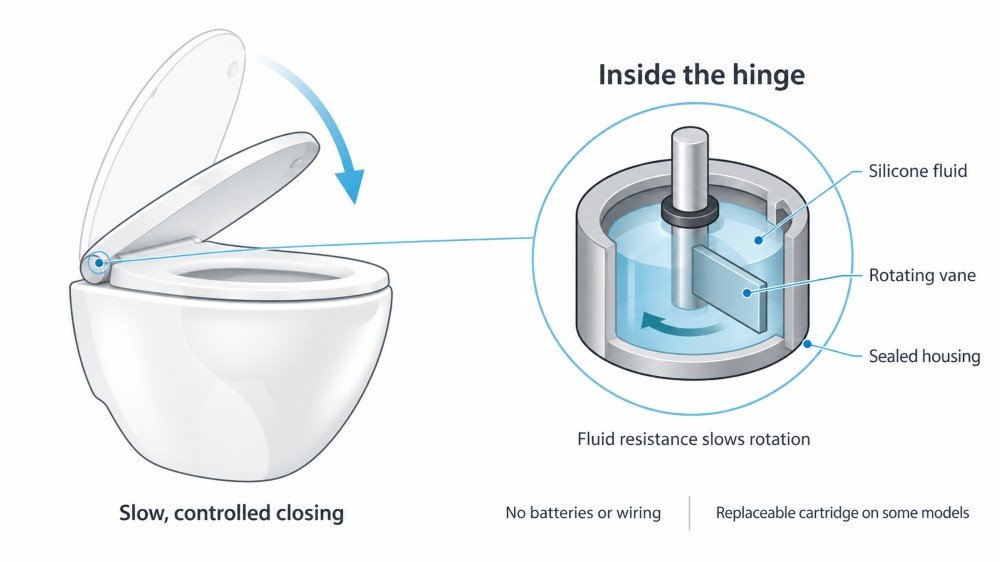
There are no electronics in a conventional soft-close seat. Inside each hinge sits a small rotary damper, usually a sealed cylinder containing silicone fluid and a vane. Push the lid past the tipping point, and the fluid resists the vane’s rotation, letting the seat descend at a controlled rate. That is the whole mechanism.
Two things follow from that, and both matter.
First, no batteries and no wiring. Anyone worried that a soft-close seat brings electrical complications into the bathroom can relax; it is a purely mechanical part.
Second, and less often mentioned by retailers, the damper is a consumable. Silicone fluid degrades, seals wear, and the closing action gradually gets faster until one day the lid drops. A standard seat has essentially nothing in it to fail apart from the fixings. This is the genuine trade-off, and it is not the one most articles lead with.
The good news is that on better seats the damper is a replaceable cartridge rather than a sealed unit, so a failed soft close is often a five-minute fix rather than a new seat. Worth asking about before you buy.
It is also worth knowing that BS 1254, the British Standard covering plastics WC seats, dates from 1981. It sets out requirements for seat strength, materials and fixings, and it was written well before damped hinges became common on domestic seats. So a seat can be perfectly compliant and still have a mediocre damper. Compliance tells you about the seat; it does not tell you much about the closing mechanism.
Argument For Soft Close That Nobody Makes
Every article about soft-close seats leads on noise. Fair enough, and if your cloakroom shares a wall with the sitting room, you will notice the difference immediately.
But there is a better argument, and it is about the lid rather than the closing.
When a toilet flushes, the turbulence in the bowl throws up an aerosol of fine droplets. This used to be dismissed as a curiosity until a team at the University of Colorado Boulder made the plume visible using laser light and published the results in Scientific Reports. They measured a jet leaving the bowl at over two metres per second, carrying particles up to around 1.5 metres within eight seconds of the flush.
Two honest caveats. That experiment used a lidless commercial flushometer toilet of the type found in North American public washrooms, not a domestic British close-coupled WC, and the researchers themselves note that closing the lid reduces the plume without eliminating it, since droplets still escape around the gap. For a healthy household using its own bathroom, this is a matter of good practice rather than alarm.
Still, the practical conclusion is straightforward. Flushing with the lid down is sensible, particularly if the toilet sits near a toothbrush holder or an open towel rail, which in a compact British bathroom it very often does.
And here is where the hinge comes in. Closing a standard lid quietly means holding it all the way down with your hand. Most people cannot be bothered, so they either drop it or leave it up. A soft-close lid gets closed because closing it costs nothing. The mechanism does not make the lid more hygienic; it makes you more likely to use it. That is a behavioural argument, not an engineering one, and it is the strongest case for the upgrade.
Where A Standard Seat Still Wins
A balanced guide has to name these, because they are real.
- Nothing to break. In a holiday let, a rental, an allotment building or a workshop WC, a plain thermoset seat with metal fixings will outlast three soft-close seats and costs a fraction to replace.
- Speed. A soft-close lid cannot be hurried. If you try to force it, you shorten the damper’s life. In a busy household with a queue outside the door, some people find the deliberate pace mildly irritating.
- Cleaning access. Soft-close hinge housings are bulkier and sit higher off the pan, which creates a wider gap and more shapes for grime to collect in. This is the opposite of what most product copy implies. A slim standard hinge is easier to wipe around, unless the soft-close seat has a quick-release function, in which case the soft-close wins outright.
- Cheap ones are genuinely bad. A budget soft-close seat with a plastic hinge body and a non-replaceable damper is a worse purchase than a decent standard seat at the same price. If the budget is tight, buy a good standard seat rather than a poor soft-close one.
Measurements That Decide Everything
More returned toilet seats come down to fit than to mechanism. Take four measurements before you order anything, ideally with the old seat removed so you can get a tape onto the pan itself.
- Fixing centres. The distance between the centres of the two holes at the back of the pan. Most UK toilets use 155mm, which is why so many seats are sold as universal, but it is not guaranteed. Continental and designer pans, and some older British ones, vary.
- Length. From the centre line of the fixing holes to the front edge of the pan. UK seats typically run between about 420mm and 460mm.
- Width. Across the widest point of the bowl, outer edge to outer edge, usually somewhere between 350mm and 380mm.
- Shape. Round, oval, D-shape and square pans are not interchangeable, and a seat that is dimensionally close can still look wrong by ten millimetres at the front.
Then there is the one that catches people out most often: the fixing method. Bottom-fix seats use a bolt dropped through from above and tightened with a nut underneath. Top-fix seats are tightened entirely from above, usually with an expanding fitting. Checkatrade has a clear explanation of whether a top-fix seat can replace a bottom-fix one, and the short version is that it usually works one way but not the other.
This matters enormously in modern British bathrooms. Back-to-wall and wall-hung pans generally have no accessible underside at all, so they require top-fix seats. If you have boxed in your WC or fitted a furniture unit around it, check before you buy.
One last fitting note: over-tightening cracks ceramic. Hand-tight plus a quarter turn, alternating between the two bolts, is enough.
Materials And Hinges Matter More Than The Mechanism
Seat material determines how the thing ages far more than the hinge type does.
- Thermoset plastic (often labelled urea formaldehyde or duroplast) is dense, hard, scratch resistant and holds its colour. It is the standard for good reason and what most quality seats use.
- Thermoplastic, usually polypropylene, is lighter, cheaper and warmer to sit on, but scratches more easily and can discolour over years of bleach exposure.
- MDF with a decorative wrap looks convincing in the showroom and swells at the edges once moisture gets past the coating. Avoid in a family bathroom.
- Solid wood is heavy and handsome, needs the hinges to be rated for the weight, and wants a wipe rather than a soak.
On hinges, look for stainless steel rather than chrome-plated zinc, and check the grade if you live near the coast. Then look for two features that pay for themselves: quick release, which lets you lift the whole seat off in seconds for proper cleaning, and adjustable or non-slip fixings, which stop the seat creeping sideways.
If a seat is going to annoy you, nine times out of ten it will be because it slides when you sit on it, not because it closes too slowly.
Who Uses The Bathroom Changes The Answer
This is where the decision stops being about preference.
- Young children. A falling lid is a genuine finger trap, and the damped descent meaningfully reduces that risk. It does not eliminate it, and it is not a substitute for supervision, but it is a real safety benefit rather than a marketing one.
- Reduced grip or strength. Anyone who struggles to hold a lid steady on the way down benefits directly, because the mechanism does the controlling for them.
- Visual impairment or dementia. Here the hinge is close to irrelevant, and the colour is what counts. The Alzheimer’s Society advises using a contrasting colour to help someone identify the toilet, giving the example of a black seat on a white base. A white seat on a white pan against a white wall in a white bathroom can be genuinely difficult to locate.
This is not a fringe consideration. The same principle underpins accessible design in public buildings, where colour-contrasted sanitaryware is standard practice, and it appears in the accessibility guidance set out in Approved Document M of the Building Regulations. Those rules bite on new dwellings in England rather than on a refurbishment, but the design thinking is worth borrowing regardless of whether anything obliges you to.
If you are specifying a bathroom for an older relative, a contrasting soft-close seat is the combination worth paying for.
If You Are Replacing The Whole WC
If the seat is only part of the problem and you are replacing the toilet itself, the decision widens, and the seat becomes the smallest part of it.
- Check the old one for leaks first. This is the most useful thing in this article for anyone on a water meter. Water industry research highlighted by Waterwise found that between five and eight per cent of UK toilets leak, overwhelmingly dual-flush models, with an estimated 400 million litres lost every day nationally. A single leaking loo can waste several hundred litres a day, silently, down the back of the pan. Drop a little food colouring into the cistern, leave it half an hour without flushing, and look in the bowl. Colour in the bowl means a leak.
- Rimless versus rimmed. A rimless pan removes the enclosed channel around the top of the bowl where limescale and bacteria accumulate. It is a genuine cleaning improvement and, in hard-water areas across the south and east of England, arguably a bigger quality-of-life upgrade than the seat.
- Close-coupled remains the sensible default for most British bathrooms. Familiar, serviceable, and any plumber can work on it.
- Wall-hung frees the floor for cleaning and looks considerably tidier, but the cistern hides inside a frame in the wall. That means a supporting frame, a stud or built-out wall to take it, and an access panel for the future. Almost always a top-fix seat.
- A tankless toilet does away with the visible cistern entirely and feeds from the mains supply directly. Visually it is the cleanest option available, and it saves real space in a small cloakroom. The catch is that it depends on your incoming mains flow rate and pressure being adequate, which in older properties with narrow supply pipes is not a given. Have this checked before you commit, not after.
Whichever you choose, water efficiency is covered by Approved Document G of the Building Regulations, which sets a whole-dwelling limit of 125 litres per person per day for new homes in England, with a tighter optional standard of 110 litres where planning conditions require it. It applies to new build and material change of use rather than a straight swap, but it is the reason dual flush is now near-universal. Wales, Scotland and Northern Ireland have their own equivalents.
Jaquar’s UK sanitaryware ranges supply soft-close seats as standard across their WCs, including the tankless models, which removes the question from the equation entirely if you are buying a complete unit.
Smart And Bidet Seats Are A Different Purchase Entirely
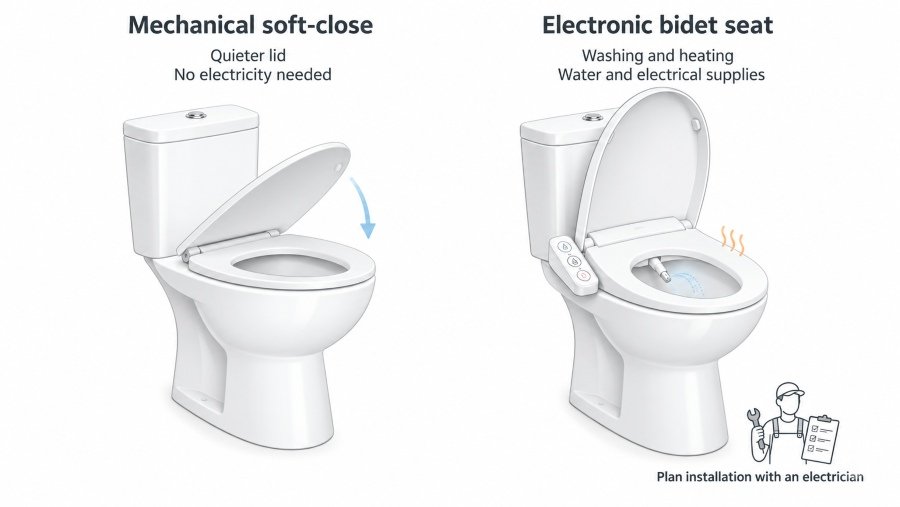
Worth separating clearly, because the two get conflated constantly.
A conventional soft-close seat is a mechanical part you can fit yourself in ten minutes. An electronic bidet or smart seat, with warm water washing, a heated seat, a dryer and often a night light, is a piece of electrical equipment in a wet room. Those are not comparable purchases.
Bathrooms are treated as special locations under the wiring regulations, with defined zones and minimum ingress protection ratings depending on proximity to the bath or shower, and standard 13A sockets are not permitted. NICEIC’s householder guidance on bathrooms and electrics sets out how the zones work. In England and Wales, this work is normally notifiable under Part P of the Building Regulations, which means it needs a registered electrician or a building control notification. Scotland works to its own building standards.
So the honest advice is this. If you want a quieter lid, buy a soft-close seat for twenty or thirty pounds. If you want washing and heating, budget for the seat plus an electrician plus a suitable supply, and specify it at the design stage of a renovation rather than bolting it on afterwards.
A Buying Checklist
- Measure fixing centres, length, width and shape, with the old seat off.
- Confirm whether your pan needs top-fix or bottom-fix.
- Choose thermoset over thermoplastic for a family bathroom.
- Insist on stainless steel hinges.
- Prioritise quick release; it does more for cleaning than any other feature.
- Ask whether the damper cartridge is replaceable.
- Consider colour contrast if anyone in the house has failing sight or dementia.
- If you are changing the whole WC, dye-test the old cistern for leaks before you throw it out.
Final Thoughts
Choose soft close. That is the recommendation for most households, most of the time, because the premium is now small, the child-safety benefit is real, and a lid that closes easily is a lid that gets closed.
But do not treat the mechanism as the decision. A soft-close seat in the wrong shape, with plastic hinges and no quick release, is a worse buy than a well-made standard seat that fits properly and can be lifted off to clean. Get the measurements right, buy the better hinges, and the closing action will look after itself.
Disclaimer: This article is provided for general information only and does not constitute professional plumbing, electrical, building control or medical advice. Building Regulations, water efficiency requirements and electrical notification rules differ between England, Wales, Scotland and Northern Ireland and may change over time. Electrical work in bathrooms should always be carried out by a suitably qualified and registered electrician. Always check manufacturer specifications and fitting instructions before purchasing or installing sanitaryware.