
In the marketplace, customer expectations sit higher than ever. British shoppers, patients, and clients no longer judge a business solely on its product. They judge it on the entire experience, from the first Google search to the follow-up email three weeks after delivery. Customer experience, usually shortened to CX, has quietly become the deciding factor between businesses that grow steadily and those that stall.
For UK companies, this shift is particularly sharp. According to the Institute of Customer Service’s UK Customer Satisfaction Index, British customers are increasingly willing to switch providers after just one disappointing interaction, and they are vocal about it on Trustpilot, Google Reviews, and social media. A single unresolved complaint can ripple across thousands of potential buyers within hours.
This article unpacks what customer experience really means in practice, why it matters more than ever for UK businesses, and how organizations of any size can quietly raise their game without spending fortunes on consultants.
What Customer Experience Actually Means
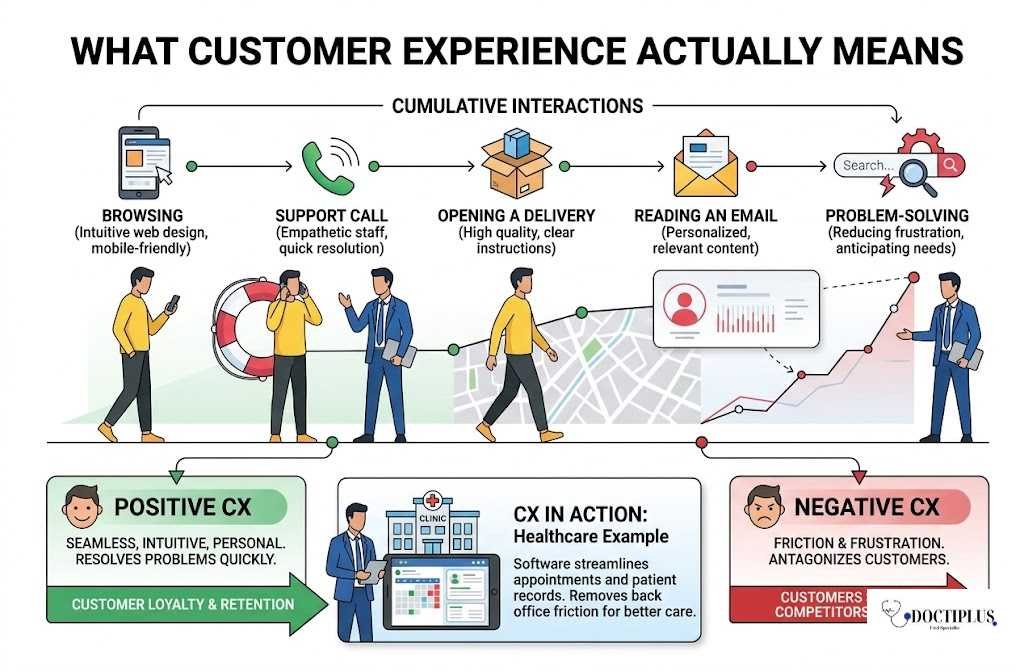
Customer experience is the cumulative impression a person forms through every interaction with a business. That includes browsing your website on a phone during a lunch break, ringing customer support, opening a delivery, reading an email two months later, or simply searching for your contact number when something has gone wrong.
A positive customer experience feels seamless, intuitive, and quietly personal. It anticipates needs and resolves problems quickly. A negative one, even a small one, sends customers straight to competitors who are usually a single tap away.
The impact is especially visible in industries where operational efficiency and personal service intersect. Healthcare providers using good clinic management software, for instance, can streamline appointments, keep patient records accurate, and reduce the friction that turns ordinary admin into a frustrating ordeal. By removing friction from the back office, businesses free up energy to focus on the moments that actually shape how customers feel.
Touchpoints That Shape How a UK Customer Feels About Your Brand
| Stage | Typical Touchpoint | What It Should Feel Like |
|---|---|---|
| Discovery | Google search, social media, word of mouth | Easy to find, clearly described, trustworthy |
| Consideration | Website browsing, reviews, FAQs | Fast loading, honest, mobile-friendly |
| Purchase | Online checkout, in-store visit, phone inquiry | Smooth, secure, predictable |
| Delivery | Packaging, installation, first use | On time, well-presented, easy to set up |
| Support | Live chat, email, phone, returns | Quick, human, problem actually solved |
| Retention | Newsletters, loyalty schemes, follow-ups | Useful, not spammy, easy to opt out |
| Advocacy | Reviews, referrals, repeat purchases | Worth recommending to others |
Every row in that table is an opportunity to either build trust or quietly chip away at it. The businesses that thrive treat each touchpoint as deliberately as the last.
Why CX Matters More in 2026 Than It Did Five Years Ago
The digital age has fundamentally changed how British consumers behave. Endless options, instant comparison, and no-hassle returns mean a single poor experience can lose a customer for life. Three forces sit behind this:
- The cost of switching providers has dropped to almost zero across most categories
- Online reviews and word-of-mouth now travel faster than any marketing campaign
- Younger consumers, particularly Gen Z, expect personalization and treat its absence as a red flag
Businesses that prioritize CX benefit in ways that show up clearly on the balance sheet. They retain customers longer, since loyal buyers spend more and recommend more readily. They earn pricing power because customers are willing to pay more for a better experience. And they build a brand reputation that protects them when things occasionally go wrong, as they inevitably do.
For broader thinking on how digital habits are reshaping British business, FsiBlog’s guides and tips section covers practical reads on online shopping behavior and digital marketing fundamentals worth a look.
Role of Technology in Enhancing CX
Technology has become the spine of modern customer experience strategy, though it is rarely the whole story. From AI-powered chatbots handling routine queries to data analytics tools surfacing patterns no human would spot, the digital layer enables faster, smarter, more empathetic service when used well.
In retail and ecommerce, recommendation engines tailor the shopping journey to individual preferences, surfacing the products a particular shopper is most likely to want rather than burying them under irrelevant noise. The same logic applies in finance, hospitality, healthcare, and education. Done thoughtfully, this kind of personalization feels helpful. Done badly, it feels intrusive.
A few practical guidelines for UK businesses thinking about adding tech to their CX stack:
- Start with the customer problem, not the tool. Buying software because it is fashionable rarely ends well.
- Keep humans available for the moments that matter, particularly complaints and complex queries.
- Comply with UK GDPR rules as set out by the Information Commissioner’s Office before collecting or using personal data for personalization.
- Test small, measure honestly, and roll out only what genuinely improves outcomes.
- Train staff alongside any new tool, since technology without adoption is just expensive shelfware.
The honest principle is that technology should complement the human element, never replace it entirely. The best UK customer experiences in 2026 still rely on a real person being available when it counts.
Personalization: Heart of a Memorable Experience
One of the most powerful CX levers is personalization, which today’s consumers actively expect rather than passively appreciate. Personalization can take many forms:
- Addressing customers by name in communications without overdoing it
- Recommending products based on past behavior and stated preferences
- Recalling past support interactions so customers do not have to repeat themselves
- Tailoring offers to genuine life stages rather than generic demographics
- Surfacing relevant content rather than dumping everything on the homepage
In service-based industries, personalization often means remembering small details that matter to a particular client. A solicitor who remembers a client’s previous matter without being prompted, a beauty therapist who recalls a skin sensitivity, or a hotel that notes a guest’s preference for a quiet room all create the kind of impression that earns repeat business.
By using modern customer relationship management tools sensibly, businesses can track interactions more effectively and personalize without crossing into uncomfortable territory. The line between thoughtful and creepy is real, and worth thinking about deliberately.
Building a Customer-Centric Culture
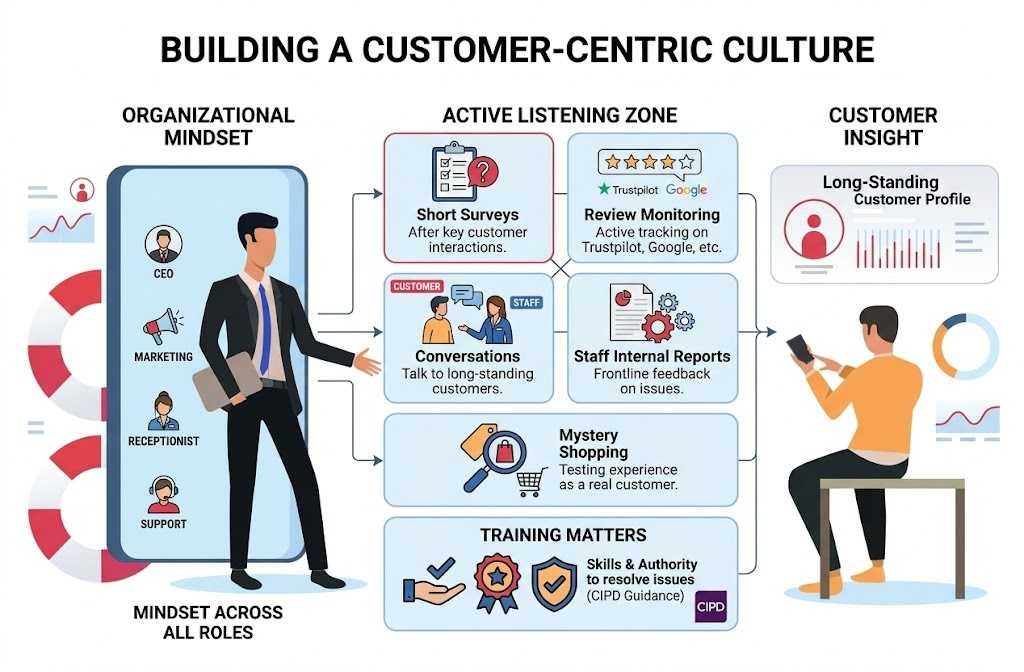
Exceptional customer experiences require more than software. They require a customer-centric mindset across the entire organization, from the receptionist taking the first call to the chief executive setting strategy. Every role, every team, every meeting should at some level connect back to what the customer actually needs.
This starts with listening properly. UK businesses should actively seek feedback through:
- Short, well-designed customer satisfaction surveys after key interactions
- Regular review monitoring across Trustpilot, Google, and industry-specific platforms
- Direct conversations with long-standing customers, not just new ones
- Internal reports from frontline staff about recurring complaints
- Mystery shopping exercises that test the experience as a real customer would
Training matters as much as listening. Staff need both the skills and the authority to resolve issues without escalating every minor problem. The Chartered Institute of Personnel and Development publishes useful guidance on developing customer-facing capability across UK organizations of all sizes.
Empowerment is the unsung hero here. A frontline employee who can refund £40 on the spot to retain a £4,000 annual customer is worth more than any policy manual. Trust your people, train them well, and most of the time they will exceed your expectations.
Measuring and Improving CX
Continuous improvement requires honest measurement. The metrics that have proven their worth include:
| Metric | What It Measures | Best For |
|---|---|---|
| Customer Satisfaction (CSAT) | Satisfaction with a specific interaction | Tactical fixes after touchpoints |
| Net Promoter Score (NPS) | Likelihood to recommend the brand | Long-term loyalty trends |
| Customer Effort Score (CES) | How hard it was to get something done | Identifying friction points |
| First Contact Resolution | Issues resolved on the first contact | Support team efficiency |
| Customer Lifetime Value | Total revenue from a customer over time | Strategic investment decisions |
| Churn Rate | Percentage of customers leaving over a period | Spotting CX problems early |
These figures only matter if leaders actually act on them. Regular review meetings, transparent dashboards, and a willingness to invest in the weak spots are what turn data into improvement. The Office for National Statistics also publishes useful UK business benchmarks against which companies can compare their broader operational health.
Practical First Steps for UK Businesses
If your business is new to taking CX seriously, you do not need a six-figure consultancy engagement to start. A sensible 90-day plan looks something like this:
- Week 1 to 2: map every customer touchpoint honestly, including the awkward ones
- Week 3 to 4: gather baseline feedback through a short survey and review monitoring
- Week 5 to 6: identify the top three friction points, not thirty
- Week 7 to 8: fix the easiest one with the biggest impact
- Week 9 to 10: train frontline staff on the change and empower them to flag more
- Week 11 to 12: measure the difference, share results internally, and start the next cycle
Long-Term Payoff of Exceptional CX
Investing in customer experience is a long game, and the dividends are substantial. UK businesses that consistently deliver strong experiences build the kind of customer relationships that competitors struggle to break. Loyal customers spend more, refer more, and forgive the occasional slip. They also generate user-generated content, reviews, and word of mouth that no advertising budget can replicate.
A focus on CX also drives genuine innovation. By understanding what customers actually need rather than what marketing assumes they want, businesses develop products and services that better fit the market. Innovation rooted in customer truth tends to land better than innovation driven by internal cleverness.
Eventually, customer experience is about creating value on both sides of the transaction. It is good for the customer, who gets a smoother life. It is good for the business, which gets a more loyal customer base. In a UK economy where genuine differentiation is increasingly hard to come by, that mutual value is one of the few sustainable competitive advantages left.
Elevating CX as a Lasting Competitive Advantage
The importance of customer experience in modern British business cannot really be overstated. Competition is intensifying, switching costs are evaporating, and consumer expectations are climbing every year. Businesses that focus only on product quality will find that quality alone is no longer enough.
The path forward is straightforward to describe and harder to execute. Use technology where it genuinely helps, embrace personalization without crossing into intrusion, and build a culture where every team member treats the customer as the reason the business exists. None of this requires a revolution. It requires consistent attention over years rather than weeks.
Whether through clever tools or thoughtful human interactions, the goal stays the same: build lasting relationships that keep customers coming back, telling friends, and forgiving the occasional misstep. That is what real customer experience looks like, and that is what separates British businesses that endure from those that fade.
Final Consluion
Customer experience is no longer a supporting function in modern business; it is the foundation on which long-term success is built. In an environment where customers can switch providers in seconds and share their opinions just as quickly, every interaction matters. Businesses that consistently deliver seamless, thoughtful, and responsive experiences earn more than just transactions; they earn trust, loyalty, and advocacy.
The real advantage lies in consistency. Not occasional excellence, but reliable, everyday competence across every touchpoint. When organizations combine the smart use of technology with genuine human understanding, they create experiences that feel effortless for customers and valuable for the business.
Finally, companies that treat customer experience as a continuous priority rather than a one-time initiative position themselves to grow sustainably. Those who ignore it risk becoming irrelevant, regardless of how strong their products may be.