
There is a reason a British reader ends up on a page about New Zealand payment methods, and it is rarely idle curiosity. The two countries are unusually tangled. At the 2023 Census, people born in England made up 4.2 percent of New Zealand’s population, the largest overseas birthplace group in the country. Add the working holiday route, the number of Britons who hold both passports, and the steady traffic of people who spend a winter in Wanaka and a summer in Wiltshire, and you get a large group of people whose financial life spans two hemispheres.
Neteller is one of the few things in that life that does not need repapering when you land. The wallet moves with you. What does not move with you is the rulebook, and that distinction turns out to be the whole story.
Wallet Travels, The Regulator Does Not
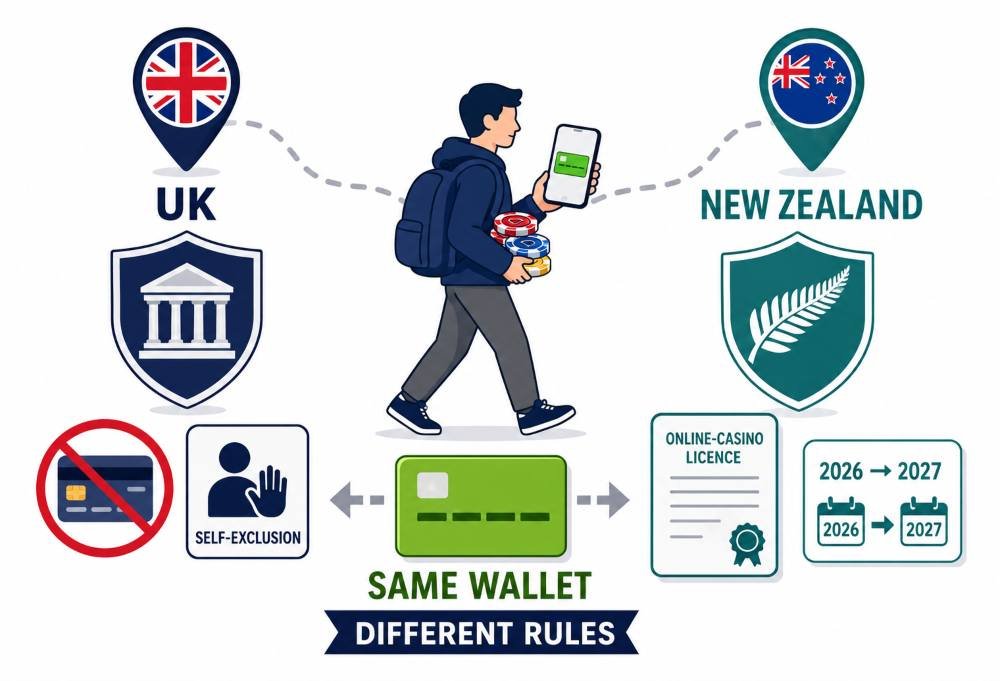
Where you are physically sitting decides which regulator is responsible for you. Nothing about your Neteller account changes that.
Sit in Manchester, and the Gambling Commission’s licensing regime covers you. That brings the Licence Conditions and Codes of Practice, mandatory participation in GAMSTOP, and the credit card ban that has been in force since April 2020. That last rule is worth understanding properly, because it is the one people assume a wallet gets around. It does not. The Commission’s guidance on preventing credit card use extends the prohibition to payments made by credit card through any money service business, including e-wallets, and tells operators to satisfy themselves that money arriving from a wallet was not loaded from a credit card in the first place. Funding a Neteller balance with a credit card and then depositing at a British-licensed site is precisely the route the condition was written to close.
Sit in Christchurch, and the picture has just been redrawn. The Online Casino Gambling Act 2026 came into force on 1 May 2026 and created New Zealand’s first licensing regime for online casino gambling, with up to 15 licences awarded through a competitive process. The Department of Internal Affairs is phasing the regime in and does not expect it to be fully operational until 2027. Operators that have not applied for a licence must stop serving New Zealand customers from 1 December 2026, and the Act reaches offshore operators regardless of where they are incorporated.
For anyone mapping the New Zealand side of that market, a directory of Casinos with Neteller is a useful starting point, though it is a New Zealand resource and should be read as one. A British resident gambling from Britain should be checking the Gambling Commission’s public register instead. The two lists are not interchangeable, and treating them as though they were is how people end up outside every protection they thought they had.
What The Wallet Actually Is
Strip away the marketing, and Neteller is a holding layer. Money goes in once from a bank account or a debit card, sits in a balance, and then flows out to merchants without your card details ever reaching them. The casino sees an account ID and an email address. Your bank sees a Paysafe entry.
That last point is the one people mention most and understand least. The privacy is real but partial. Your bank cannot tell which merchant you paid, but the wallet operator can, and so can anyone with lawful access to its records. It is discretion from your bank’s fraud team, not anonymity.
The entity behind the wallet matters more than the branding. Neteller launched in 1999 and now sits within the Paysafe group. The issuing entity, Paysafe Financial Services Limited, is authorised by the Financial Conduct Authority under the Electronic Money Regulations 2011 with firm reference number 900015. For a British reader, that is genuinely reassuring, and it is also the source of a misunderstanding worth clearing up immediately.
Paragraph British Readers Should Read Twice
FCA authorisation is not the same as bank protection. Money held with an electronic money institution is not covered by the deposit guarantee. The Financial Services Compensation Scheme is explicit that it cannot protect money held with e-money institutions and payment providers, and that funds could be tied up during an insolvency process even where the firm is properly regulated.
What protects the balance instead is safeguarding, which requires customer money to be held separately from the firm’s own. The regime has been strengthened: the FCA confirmed new safeguarding rules for payment and e-money firms that took effect in May 2026, with annual audits and tighter segregation requirements. The direction of travel is good. The conclusion for an individual is unchanged.
Treat the wallet as a corridor, not a vault. Move money through it and back out to a bank. Do not let a balance accumulate there because it feels tidier, and certainly do not park a lump sum in it while you are between countries.
Opening And Verifying An Account
Registration takes a few minutes and needs details that match your documents exactly, because a mismatch surfaces later at the worst possible moment.
You will enter your name, address and date of birth, choose an account currency, confirm your email, and link a funding source. Then you verify, and verification is the step people postpone and regret. Unverified accounts run under tight ceilings on what they can send and receive, and at most operators, the payout side stays shut until the check clears.
The document requirements are unremarkable. A UK passport or a photocard driving licence covers identity—a bank statement or utility bill dated within the last three months covers address. Approval usually lands within a day. If you have moved between countries recently, expect a slower review and have the paperwork for both addresses ready rather than discovering halfway through that your name is still on a Bristol tenancy agreement.
Do this before your first deposit, not after your first win. The order matters enormously to how the experience feels.
Currency Question Nobody Puts On The Homepage
This is where a British reader loses money quietly.
Neteller’s standard foreign exchange fee is 4.49 percent on transactions requiring a conversion, applied on top of its own reference rate. If you hold sterling and play at a site denominated in New Zealand dollars, that charge can land twice, once going in and once coming out, and it will dwarf anything you notice on a transaction fee line.
The wallet’s Exchange feature lets you hold secondary balances alongside your primary currency, which is the sensible way to handle a genuinely two-country situation. Whether New Zealand dollars appear in that list depends on your account and region, so confirm it inside the app rather than assuming. If NZD is not available to you, the honest answer is that a GBP balance against an NZD site will cost you a conversion, and you should price that in before deciding the wallet is cheaper than a bank transfer.
One related trap: if you use a Net+ card abroad, decline the terminal’s offer to bill you in your card’s currency. Dynamic currency conversion at the point of sale is consistently worse than letting the wallet handle it.
What It Actually Costs
Charges appear at several points rather than one. These are the figures published on Neteller’s own fee schedule at the time of writing.
| Transaction | Published Fee |
| Funding the wallet by card or international bank transfer | 2.5 percent |
| Funding by local bank deposit | 0 to 1 percent |
| Depositing to a merchant site | No charge |
| Withdrawal to a bank account | USD 10 flat |
| Withdrawal to a Visa or Mastercard | 0 to 7.5 percent |
| Sending money to another Neteller user | 2.99 percent, minimum USD 0.50 |
| Currency conversion | 4.49 percent, lower for VIP members |
| Inactivity service fee | USD 5 per month after six months of no login or transaction |
| Chargeback | GBP 25 |
Two of those deserve comment. The bank withdrawal is a flat ten dollars rather than a percentage, which makes the wallet expensive for small cash-outs and reasonable for larger ones. And the inactivity clock runs at six months, not a year, which catches out precisely the person who opens a wallet for a trip and forgets about it. Log in occasionally or empty it.
VIP Levels And Who Reaches Them
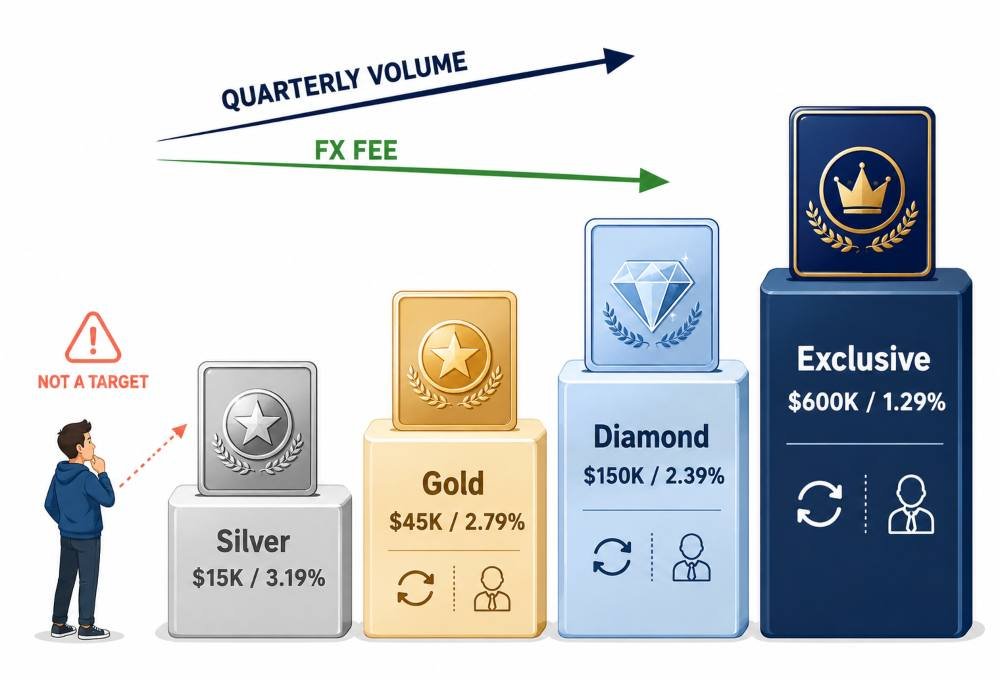
Neteller’s VIP programme runs on quarterly volume rather than annual turnover, and the tiers are Silver, Gold, Diamond and Exclusive.
| Level | Quarterly Volume | Foreign Exchange Fee |
| Silver | USD 15,000 | 3.19 percent |
| Gold | USD 45,000 | 2.79 percent |
| Diamond | USD 150,000 | 2.39 percent |
| Exclusive | USD 600,000 | 1.29 percent |
Silver and above bring free money transfers, a dedicated manager and discounted deposits and withdrawals. It is worth being blunt about the arithmetic, though. Entry level requires fifteen thousand US dollars moving to merchants in a single quarter. For a recreational player, that figure is not a target to aim at, and any guide that presents VIP status as a sensible way to reduce fees has quietly stopped writing for ordinary readers.
Deposits, Payouts And Timing
A casino deposit costs nothing at the wallet’s end and lands in the game balance immediately.
Coming back the other way, licensed operators apply matched-method rules, which means winnings return by the route the money arrived. This is an anti-money-laundering requirement rather than an inconvenience invented to annoy you, and it is the reason your first deposit method effectively chooses your withdrawal method. At operators with round-the-clock finance teams, funds reach the wallet within hours. At others, expect a pending window measured in days during which the payment can be reversed if you log back in, which is a design feature worth being aware of.
From the wallet to a New Zealand or UK bank account, allow one to three business days.
Bonus Exclusions Are The Norm, Not The Exception
A meaningful share of operators exclude wallet deposits from welcome offers, and Neteller usually appears on that list alongside its sister product. The mechanics are unforgiving: deposit by an excluded route and no bonus attaches, with no retrospective fix available.
The promotions page lists barred methods next to the qualifying minimum. Read it before the payment rather than after, and if the wording is ambiguous, ask live chat and keep the transcript. This is a sixty-second check that prevents a problem nobody can solve for you afterwards.
Settings Worth Ten Minutes
Turn on Secure ID, which adds a six-digit code to outgoing payments, and enable two-factor authentication on the login itself. Both sit in the security section. An e-wallet holding a balance and linked to a bank account is a more attractive target than most people assume, and neither setting costs anything.
What The Wallet Will Not Do
A wallet is a payment rail. It is not a control tool, and it should never be treated as one.
If you have registered with GAMSTOP, that exclusion covers operators licensed by the Gambling Commission. It has no reach over sites licensed elsewhere, and no e-wallet will supply the block that the exclusion was meant to provide. If you find yourself looking at offshore options specifically because a self-exclusion is working as intended, the useful response is device-level blocking software and confidential support, not a different payment method. The National Gambling Helpline is free and available around the clock on 0808 8020 133.
Short Version
Neteller does one job well for people who move between Britain and New Zealand: it is a stable, FCA-authorised holding layer that keeps a casino off your bank statement and moves money faster than a bank transfer. Verify it early, hold the right currency, keep the balance low because it is not FSCS-protected, and check the promotion terms before you deposit rather than after.
The wallet crosses the border without friction. The regulator does not, and it is the regulator, not the payment method, that determines what protection you actually have.
This article is for information only and is not financial, legal or gambling advice. Fees, tiers and regulatory timelines change; confirm current terms with the provider and the relevant regulator before acting. Gambling is restricted to those aged 18 and over in Great Britain and 18 and over for online casino gambling in New Zealand. If gambling is causing you harm, contact the National Gambling Helpline on 0808 8020 133 in the UK, or the Gambling Helpline on 0800 654 655 in New Zealand.