
It usually happens on the morning that matters. There is a white shirt on the board, a train to catch or an interview at ten, and the iron coughs out a spurt of water with brown specks in it. Or the steam that used to roll out in a soft, steady cloud now comes in weak, spitting bursts that leave the collar damp rather than smooth.
The obvious conclusion is that the iron is on its way out, and a search for a replacement follows soon after. Yet in a lot of these cases the heating element and the thermostat are working perfectly well. What has actually gone wrong is limescale, and it is something you can plan around before you buy and slow down once the iron is in your cupboard.
What Goes Wrong First
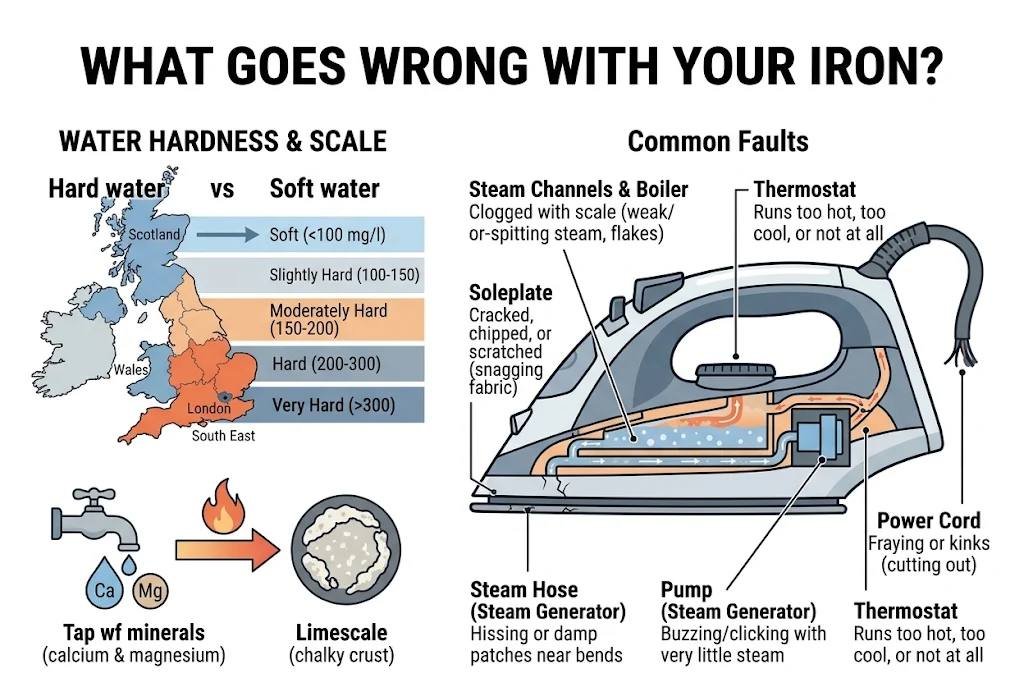
Tap water is never just water. Depending on the rock it has passed through on its way to your tap, it carries dissolved calcium and magnesium. When an iron heats that water into steam, the water leaves and the minerals stay behind. The result is limescale, the same chalky crust you find inside a kettle or around the base of a shower head. The Drinking Water Inspectorate’s guidance on hard water names electric irons alongside kettles and hot water systems as things that scale up, and points out that scale on heating elements shortens their life and makes appliances less efficient.
In a standard steam iron, scale collects in the water chamber and in the narrow channels that carry steam down to the holes in the soleplate. Those channels are small to begin with, so it does not take much to narrow them. Less steam gets through, the iron starts to spit, and flakes of scale break loose and land on the fabric. White flakes are usually plain scale. Brown ones are often scale that has picked up residue from starch, scorched fibres or the inside of the iron itself.
Steam generators fail in a slightly different way. They have a separate boiler in the base that holds water under pressure, and the scale forms on the boiler walls and around the heating element. The first sign is often a test of patience rather than a mess on your clothes: the machine takes longer to reach full steam, then struggles to hold it through a long ironing session.
How quickly any of this happens depends mostly on where you live. Your water company publishes the hardness of its supply, usually through a postcode search on its website, and the Drinking Water Inspectorate sorts the results into five bands, measured in milligrams of calcium carbonate per litre. The right-hand column below is a rough guide drawn from everyday experience, not a manufacturer’s specification, but it gives you a fair idea of what to expect.
| Band | Typical Range | What It Tends To Mean For Your Iron |
| Soft | Up to 100 mg/l | Scale builds very slowly, and many irons go years without trouble |
| Slightly hard | 100 to 150 mg/l | Occasional descaling keeps the steam steady |
| Moderately hard | 150 to 200 mg/l | Scale becomes noticeable within months of regular use |
| Hard | 200 to 300 mg/l | How the iron handles scale starts to matter more than its steam output |
| Very hard | More than 300 mg/l | Expect regular descaling or filter changes, and neglect shows quickly |
As a broad pattern, supplies across London, the South East, East Anglia and parts of the Midlands come from chalk and limestone and run hard, while much of Scotland, Wales, Northern Ireland, the North West, Devon and Cornwall is soft. There are plenty of local exceptions, so the postcode search is worth thirty seconds of your time. It is also worth noting the figure down: some steam generators come with a test strip or ask you to set a water hardness level when you first switch them on, and your water company’s number is the one to use.
If you would rather not look anything up, your kettle will tell you. When it needs descaling every few weeks, your iron is building the same crust inside, in places you cannot see.
Scale is the usual first problem, but it is not the only one. Once an iron has had a few years of regular use, the faults that turn up are fairly predictable.
| What Fails | What You Notice | Can It Usually Be Put Right? |
| Steam channels or boiler clogged with scale | Weak or spitting steam, flakes on clothes, slow heat-up on steam generators | Often, if caught early and descaled the way the manual describes |
| Soleplate cracked, chipped or badly scratched | Snagging on fabric, uneven steam, marks on clothes | Only if the brand sells the soleplate or the iron unit as a part |
| Steam hose on a steam generator | Hissing or damp patches near the point where the hose bends | Yes, where the hose is sold on its own |
| Pump on a steam generator | Buzzing or clicking with very little steam, even after descaling | Usually a job for a repairer |
| Power cord | Fraying or kinks near the iron or the plug, or the iron cutting out | Stop using it, then have a repairer replace it if the part is available |
| Thermostat | The iron runs too hot, too cool, or not at all | A repairer’s job, parts permitting |
Look down that first column and very little of it is complicated. Most of these are ordinary, fairly cheap parts. Whether you can replace them has much more to do with the brand’s attitude to spare parts than with the price on the box.
Checks Worth Making Before You Pay
Packaging and product pages love numbers: grams of steam per minute, a shot-of-steam figure, bar pressure for steam generators. Those figures describe how the iron performs on the day you unbox it. They say very little about how it will perform in its fourth year, in a flat in Croydon or Cambridge where the kettle furs up in a fortnight.
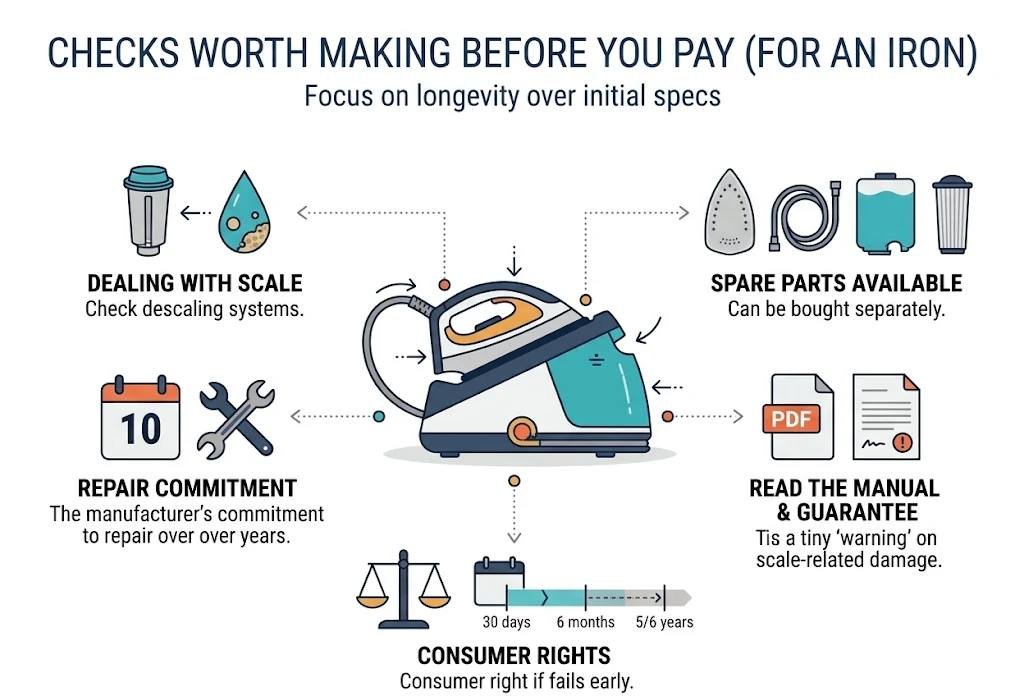
Three things tell you far more about how long an iron will last than any steam figure:
- How it deals with scale. Some irons and steam generators use a removable anti-scale filter or cartridge that you replace from time to time. Others rely on a self-clean or rinse function, a removable scale collector in the boiler, or a descaling solution that you run through yourself. None of these is automatically better than the others, but you should know which one you are signing up for and roughly what the filters or descaler will cost you each year.
- Whether parts are sold separately. A soleplate, a hose, a water tank, a filter: if any one of these can be bought on its own, a single broken part does not have to mean a whole new iron.
- How long the manufacturer commits to repairing it. A few brands now state a repair commitment in years. If you cannot find one on the website, ask before you buy rather than after something breaks.
A brand’s product listing is often the quickest place to check all three. The range of Laurastar products, for example, puts anti-scale filters, ironing board covers and spare parts alongside the steam generators and steamers themselves, so you can see before you buy that a worn part can be replaced on its own, and the same site states that the brand will repair its products for at least ten years. That is the kind of information to look for on any brand’s site: a spare parts section sitting next to the irons, and a clear line on repairs, before you start comparing steam output.
It also pays to download the manual before you hand over any money. Most manufacturers publish them as PDFs, and the descaling page is the one to read. It tells you how often the iron expects attention, whether it needs a branded cartridge, and what kind of water it was designed for. Some irons are built to run on ordinary tap water, some suggest mixing in demineralised water in hard water areas, and many warn against water from a tumble dryer or scented ironing water. General advice online is no substitute for what your particular model’s manual says.
While you are reading, check the guarantee as well, and in particular what it leaves out. Damage caused by scale is commonly excluded, which makes the descaling routine part of the bargain rather than an optional extra. Pick the iron up in the shop if you can, too. A tank that is easy to fill and easy to empty is one you will actually empty after each session, and that small habit matters more for the iron’s lifespan than most people expect.
Finally, know where you stand if it fails early. Under the Consumer Rights Act 2015, goods must be of satisfactory quality, and that includes being reasonably durable. Citizens Advice’s guide to returning faulty goods sets out the timings. Within 30 days you can usually reject a faulty item for a full refund. Within six months, the retailer has to accept that the fault was there when you bought it unless they can show otherwise. After that, you can still make a claim for up to six years in England and Wales, or five in Scotland, if it is reasonable to expect the item to have lasted that long. A manufacturer’s guarantee sits on top of those rights rather than replacing them, but bear in mind that an iron which has never been descaled may well be treated as worn rather than faulty.
Irons Fall Outside The Right To Repair Rules
“Right to repair” gets used loosely, and it is easy to assume it covers every appliance in the house. It does not. The House of Commons Library briefing on the right to repair regulations sets out who the rules apply to. The regulations were made in June 2021, and most of their provisions came into force in Great Britain on 1 July that year (Northern Ireland follows the EU’s own ecodesign rules). They require manufacturers of washing machines, washer-dryers, dishwashers, fridges and freezers, and televisions and other electronic displays to make spare parts available to professional repairers for between seven and ten years after a model stops being sold, depending on the appliance and the part. Manufacturers were given a grace period of up to two years to get those parts in place, and a handful of simpler parts, such as door hinges and seals on some machines, have to be sold to householders as well.
Irons, steam generators and garment steamers are not on the list. That looks a little strange once you consider what actually breaks on them: a soleplate cracked when the iron tipped off the board, a hose split at the point where it bends every time you lift the iron, a worn pump inside a steam generator, a frayed cord. These are ordinary parts, not specialist electronics. But because no law requires anyone to stock them, whether you can still buy a replacement soleplate or hose in five or eight years’ time depends entirely on the manufacturer’s own policy.
The more you spend, the more that matters. A £30 iron that gives up after three years is irritating. A steam generator costing several hundred pounds that cannot be repaired because nobody sells a replacement hose is a different matter altogether, both for your wallet and for the pile of electrical waste the UK already produces.
So before you buy, put the question directly to the shop or to the brand’s customer service team. Ask which parts for that model they sell to customers and which only go to repairers, how long after the model is discontinued those parts will remain available, and whether they run their own repair service with set prices for common faults. A brand that answers quickly and specifically has usually thought about it. A vague answer tells you something too.
Keeping The One You Already Own
Most of what keeps an iron going is unglamorous, and it starts with the descaling page of the manual. If the paper copy went out with the packaging, the manufacturer will almost certainly have a PDF online. Methods vary far more than people realise. Some irons must never have liquid descaler poured into the tank, because it can damage seals or internal coatings. Others are built around a self-clean or rinse cycle that you are expected to run every few weeks. Some steam generators have a removable scale collector or a rinse point on the boiler, while others use a cartridge that you swap when a warning light comes on. Using the wrong method, such as a vinegar soak in an iron whose manual tells you to avoid it, can do more harm than the scale itself.
Beyond that, a handful of habits make a real difference:
- Empty the tank after every session. Water left sitting inside evaporates slowly and leaves its minerals behind. Unplug the iron, tip the water down the sink while it is still warm, and leave the filler cap open so the chamber can dry out.
- Change the filter when the manual says it is due, not when the steam starts to fade. By the time you notice weak steam, scale has already begun to settle in places a filter cannot reach.
- Keep a simple record. A note on your phone of when you last descaled or changed the filter is useful for you, and handy if you ever need to make a claim under the guarantee.
- Look after the soleplate. Let it cool, wipe it with a damp cloth, and keep scouring pads and metal scrapers well away. Zips, poppers and jeans rivets scratch a soleplate faster than anything, so iron round them rather than over them.
- Be gentle with the cord. Let the iron cool before winding the cable loosely. Wrapping it tightly around a hot iron weakens it where it joins the body, and that is exactly where cords tend to split.
If you have been handed down an iron or picked one up second-hand, run one more check. Electrical Safety First’s product recall checker lets you search for electrical items that have been recalled, and registering a new iron with its manufacturer means you will hear about any safety notice in future.
If a steam generator still produces weak steam after a proper descale, hold off on ordering a replacement. Take it to a repairer and ask them to look at the pump and the boiler first, since a worn pump or a heavily scaled boiler can often be sorted for a fraction of the price of a new machine. If you are not sure where to start, The Restart Project’s guide to repair options points to community repair events, repair directories and online repair guides, and the volunteers at a local repair café will often give you an honest view on whether a fault is worth paying a professional to fix. Anything involving the cord, the plug or the inside of the iron’s body should be left to someone qualified rather than tackled on the kitchen table.
And when an iron really has reached the end, keep it out of the household bin. Anything with a plug, battery or cable can be recycled, and Recycle Your Electricals has a postcode locator for drop-off points near you. Many retailers will also take your old iron back when you buy a new one from them.
An iron is not an exciting thing to buy, which is exactly why it is worth asking a few dull questions first. The ones that last are rarely the ones with the biggest steam figure on the box. They are the ones whose owners knew what was in their water, could buy a part when one wore out, and emptied the tank before putting it away.
This article is general guidance for readers in the UK and is not legal or electrical safety advice. Always follow the instructions in your iron’s manual, and check official sources for the latest position, as consumer law and product regulations can change.