
Crypto does not wait for a neat weekly review. A token can move sharply before lunch, liquidity can shift to another chain, and a wallet that has been quiet for weeks can suddenly start moving size.
That does not mean every move deserves a trade.
Most bad portfolio decisions in fast markets come from one simple mistake: reacting to the loudest signal instead of checking the full picture. Price matters, but it is not the whole story. Liquidity, trade size, wallet activity, order depth, fees, and timing all matter too.
Good portfolio management in crypto is not about chasing every move. It is about knowing when a move is worth attention and when it is just market noise.
Why Fast Crypto Markets Change Portfolio Decisions
A traditional portfolio review every few months may work for slower markets. Crypto is different. It trades all day, every day, and the mood can shift while the trader is asleep.
One coin may be up 18 percent, but that does not always mean strength. It may be moving on thin liquidity. Another token may look flat on the chart, but large wallets may be moving funds toward exchanges. A DEX pool may still show activity, but the actual Depth may be weaker than it was earlier.
This is why portfolio checks in crypto need more than a price chart.
| Signal | Why It Matters |
|---|---|
| Price Movement | Shows what the market is doing on the surface |
| Liquidity | Shows whether the position can be entered or exited cleanly |
| Wallet Movement | Shows whether larger holders may be active |
| Volume | Shows whether the move has enough support |
| Fees And Slippage | Shows whether the trade still makes sense after costs |
The SEC’s crypto asset page is a useful reminder that crypto assets can involve risk around custody, scams, and unclear protections, so traders should not treat market movement as the only thing that matters: SEC crypto asset information.
Do Not Confuse Speed With Control
Fast tools can make a trader feel more prepared, but speed alone does not create control. A quick chart, a fast alert, or a real-time dashboard can still lead to a poor decision if the trader has no clear plan.
This is where AI-powered crypto trading can help inside a portfolio workflow. The useful part is not asking software to “pick winners.” The useful part is sorting messy information faster.
For example, a trader may want to know:
| Question | Better Way To Check It |
|---|---|
| Is this token really gaining strength? | Compare price, volume, liquidity, and spread |
| Is this move caused by one large wallet? | Check wallet flow and transfer size |
| Can I exit without a bad fill? | Check pool depth and recent swaps |
| Is the whole portfolio now too exposed? | Review position size and total risk |
The system can organise the evidence. The trader still has to decide what the evidence means.
Set Risk Rules Before The Market Turns
Risk rules are easiest to follow before stress shows up. Once a position is already falling or pumping hard, most people do not think as clearly as they believe they will.
Simple rules are often better than complicated ones.
A trader can decide:
| Rule | Example |
|---|---|
| Maximum Token Size | No single token above 15 percent of the portfolio |
| Review Trigger | Review if a position moves more than 10 percent in a day |
| Liquidity Rule | Avoid increasing size if pool depth is too thin |
| Exit Rule | Reduce exposure if liquidity drops below a chosen level |
| Stable Reserve | Keep a set amount in stable assets for flexibility |
The point is not to remove risk. That is impossible in crypto. The point is to stop one rushed decision from damaging the whole portfolio.
The CFTC also warns that virtual currency trading can involve fraud, hacking, and limited recourse if funds are stolen, which makes risk planning even more important: CFTC virtual currency risk warning.
Live Data Matters, But Only When It Is Useful
A stale dashboard can make a portfolio look safer than it is. In fast markets, data latency can be a real problem because liquidity, spreads, and pool depth may change before the trader sees them.
Still, live data does not guarantee a smart decision. It only gives the trader a better chance to see what is actually happening.
Live data is most useful when it helps answer practical questions:
| Live Data Point | What It Can Show |
|---|---|
| Pool Depth | Whether the market can handle the order size |
| Recent Swaps | Whether buying or selling pressure is building |
| Wallet Flows | Whether large holders are moving |
| Spread Changes | Whether execution is getting worse |
| Volume Shifts | Whether the move has real participation |
FINRA’s crypto risk page explains that crypto assets can be highly volatile and risky, which is why live information should be treated as one part of the review, not as a reason to act automatically: FINRA crypto asset risks.
Rebalancing Should Not Become Panic Trading
A crypto portfolio does not need constant changes just because the market is active. Too many small changes can create extra fees, bad entries, poor exits, and stress.
A better method is threshold rebalancing.
That means the trader only reviews or adjusts when a position moves outside a chosen range. For example, if a token is meant to stay around 10 percent of the portfolio, the trader may review it if it moves above 13 percent or below 7 percent.
This keeps the portfolio close to the plan without forcing trades every time the market twitches.
| Rebalancing Style | Problem | Better Use |
|---|---|---|
| Fixed Calendar | May be too slow for crypto | Useful for calm periods |
| Daily Changes | Can create overtrading | Only useful for active strategies |
| Threshold Based | More practical | Reviews when the portfolio moves too far from plan |
In simple terms, allocation drift happens when market movement changes the shape of the portfolio. One token grows too large, another becomes too small, and the risk profile no longer matches the original plan.
Investopedia’s rebalancing guide explains this basic idea clearly: portfolio rebalancing guide.
Liquidity Can Matter More Than The Headline Price
A token can show a nice price move and still be hard to trade well. This is one of the biggest traps in crypto portfolio management.
The headline price tells you where the last trade happened. It does not always tell you how easy it is to enter or exit.
A thin market can make a position look better than it really is. If the trader tries to exit with size, the order may push the price down. During stress, this can happen faster than expected.
Liquidity dynamics like this aren’t unique to trading — they show up anywhere crypto moves fast, including in spaces like crypto casino bonuses, where payout speed and available balance depend on similar network conditions.
Before adjusting a position, check:
| Liquidity Check | Why It Matters |
|---|---|
| Pool Depth | Shows how much size the market can absorb |
| Recent Swaps | Shows whether activity is healthy or one-sided |
| Trade Size | Shows whether your order is too large for the market |
| Spread | Shows the cost of entering or exiting |
| Slippage | Shows how much the final fill may differ from the expected price |
CoinGecko’s liquidity research looks at market depth and how much capital may be needed to move prices, which is useful context for traders who only look at headline volume: CoinGecko crypto liquidity report.
Watch The Spread Before You Trust The Chart
Charts can look clean while execution is getting worse. That is why bid-ask spreads matter.
A tight spread usually means buyers and sellers are close together. A wide spread means the gap between what buyers want to pay and what sellers want to accept has grown. In fast or thin markets, this gap can widen quickly.
A wide spread can hurt the trade before the trader even starts.
| Spread Condition | What It May Mean |
|---|---|
| Tight Spread | Market is easier to trade |
| Wider Spread | Execution may cost more |
| Spread Widening Fast | Market stress may be building |
| Wide Spread With Low Depth | Exit risk may be high |
This is why a smaller order placed with patience can sometimes be smarter than one large market order during a volatile window.
Alerts Should Reduce Noise, Not Create More Of It
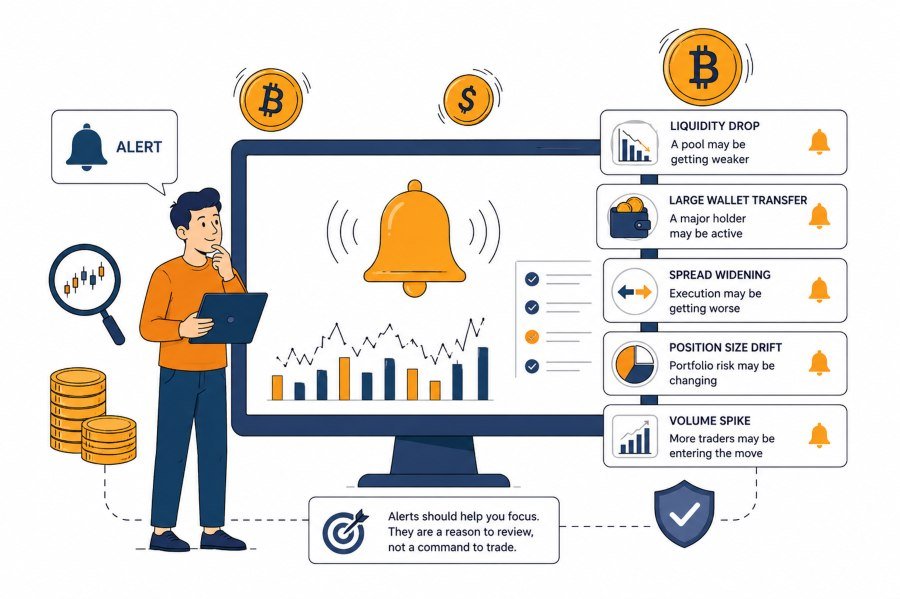
Bad alerts make a trader nervous. Good alerts make a trader focused.
An alert should not scream every time a token moves 2 percent. Crypto does that all the time. A useful alert should point to a behaviour that may actually change the portfolio decision.
Useful alerts can include:
| Alert Type | What It Means |
|---|---|
| Liquidity Drop | A pool may be getting weaker |
| Large Wallet Transfer | A major holder may be active |
| Spread Widening | Execution may be getting worse |
| Position Size Drift | Portfolio risk may be changing |
| Volume Spike | More traders may be entering the move |
The alert should not decide the trade. It should tell the trader, “This is worth checking.”
That small difference matters. A signal is not a command. It is only a reason to review.
Keep The Human Part Inside The Process
Better tools should protect human judgement, not replace it.
A dashboard can show that liquidity is falling. It cannot know whether the trader’s time horizon has changed. A wallet tracker can show a large transfer. It cannot always explain the reason behind it. An AI tool can group signals, but it cannot take responsibility for risk.
A strong workflow keeps the trader involved at the right points.
| Tool Can Help With | Trader Must Still Decide |
|---|---|
| Sorting Live Market Data | Whether the signal fits the plan |
| Highlighting Wallet Movement | Whether the movement matters |
| Tracking Liquidity | Whether the trade size is safe |
| Finding Unusual Activity | Whether action is needed |
| Reducing Manual Checks | Whether risk is acceptable |
This is important because more data can sometimes create false confidence. A signal may be early and still wrong. It may be correct but too small to matter. It may show real activity in a market too thin for the trade size.
Good judgement is not slow. It is careful.
A Simple Portfolio Review Flow For Fast Markets
A trader does not need a complicated system. The workflow can be simple enough to use during pressure.
Use this order:
| Step | Question To Ask |
|---|---|
| Check Price | What moved, and how much? |
| Check Liquidity | Can I enter or exit without a poor fill? |
| Check Volume | Is the move supported by real activity? |
| Check Wallet Flow | Are larger wallets doing anything unusual? |
| Check Portfolio Weight | Has this position become too large or too small? |
| Check Costs | Do fees, slippage, and bridges make the move worth it? |
| Decide | Does the evidence support action, or only attention? |
This kind of review helps stop emotional trading. It also keeps the trader from staring at one signal while ignoring the rest of the market.
Managing A Portfolio Without Chasing Every Move
Fast crypto markets reward preparation more than panic. A trader who already has risk limits, alert rules, and rebalancing triggers has less to invent when the market starts moving.
That does not make the market safe. It makes the decision process cleaner.
A good portfolio process does not treat every signal as a reason to trade. It gives the trader a way to slow down, check liquidity, read wallet activity, measure exposure, and decide whether the move is strong enough to matter.
Used carefully, AI can make this review less scattered. It can show what is moving, where liquidity is changing, and which parts of the portfolio need attention.
The goal is not to catch every fast move. The goal is to avoid making weak decisions just because the market is loud.
Final Note
This content is for education only and should not be treated as financial advice. Crypto markets can move quickly, and losses can happen even when the research looks strong. Traders should use their own risk rules, understand the tools they rely on, and avoid trading money they cannot afford to lose.
Disclaimer
This article is for educational and informational purposes only. It should not be taken as financial advice, investment advice, trading advice, tax advice, or legal advice.
Crypto assets are highly volatile and can lose value quickly. Market data, wallet activity, liquidity signals, AI tools, and trading alerts can help with research, but they do not guarantee profit or prevent losses. Any trading or portfolio decision should be based on personal research, risk tolerance, time horizon, and professional advice where needed.
Readers should never trade with money they cannot afford to lose. Past market behaviour does not guarantee future results.
References
- Koutmos, D. (2018). Liquidity uncertainty and Bitcoin’s market microstructure. Economics Letters, 172, 97–101. DOI: 10.1016/j.econlet.2018.08.041
- Leirvik, T. (2022). Cryptocurrency returns and the volatility of liquidity. Finance Research Letters, 44, 102031. DOI: 10.1016/j.frl.2021.102031
- Makarov, I., & Schoar, A. (2020). Trading and arbitrage in cryptocurrency markets. Journal of Financial Economics, 135(2), 293–319. DOI: 10.1016/j.jfineco.2019.07.001
- Katsiampa, P. (2019). Volatility co-movement between Bitcoin and Ether. Finance Research Letters, 30, 221–227. DOI: 10.1016/j.frl.2018.10.005
- Guesmi, K., Saadi, S., Abid, I., & Ftiti, Z. (2019). Portfolio diversification with virtual currency: Evidence from bitcoin. International Review of Financial Analysis, 63, 431–437. DOI: 10.1016/j.irfa.2018.03.004
- Akhtaruzzaman, M., Sensoy, A., & Corbet, S. (2020). The influence of Bitcoin on portfolio diversification and design. Finance Research Letters, 37, 101344. DOI: 10.1016/j.frl.2019.101344
- Liu, W. (2019). Portfolio diversification across cryptocurrencies. Finance Research Letters, 29, 200–205. DOI: 10.1016/j.frl.2018.07.010
- Koker, T. E., & Koutmos, D. (2020). Cryptocurrency trading using machine learning—Journal of Risk and Financial Management, 13(8), 178. DOI: 10.3390/jrfm13080178
- Bakry, W., Rashid, A., Al-Mohamad, S., & El-Kanj, N. (2021). Bitcoin and portfolio diversification: A portfolio optimization approach. Journal of Risk and Financial Management, 14(7), 282. DOI: 10.3390/jrfm14070282