
There’s a version of this story you’ve probably already heard. The one where a woman quits her corporate job, finally has “time freedom,” works from a sunny kitchen table with a coffee in hand, picks the kids up from school every day, and never looks back. I want to share the real version, as the sanitised version didn’t help me when I made this decision.
I left a stable, salaried role to freelance for reasons that will sound familiar to a lot of women reading this. I was tired of asking permission to leave early for a school assembly. Tired of watching less qualified colleagues get promoted while I was quietly labelled “not as committed” because I left at 5 pm to do pickup. Tired of the constant low-grade guilt of being neither fully present at work nor fully present at home. Freelancing felt like the answer to all of it. In some ways, it has been. In other ways, it handed me an entirely new set of problems that nobody warned me about.
Myth of “More Time”
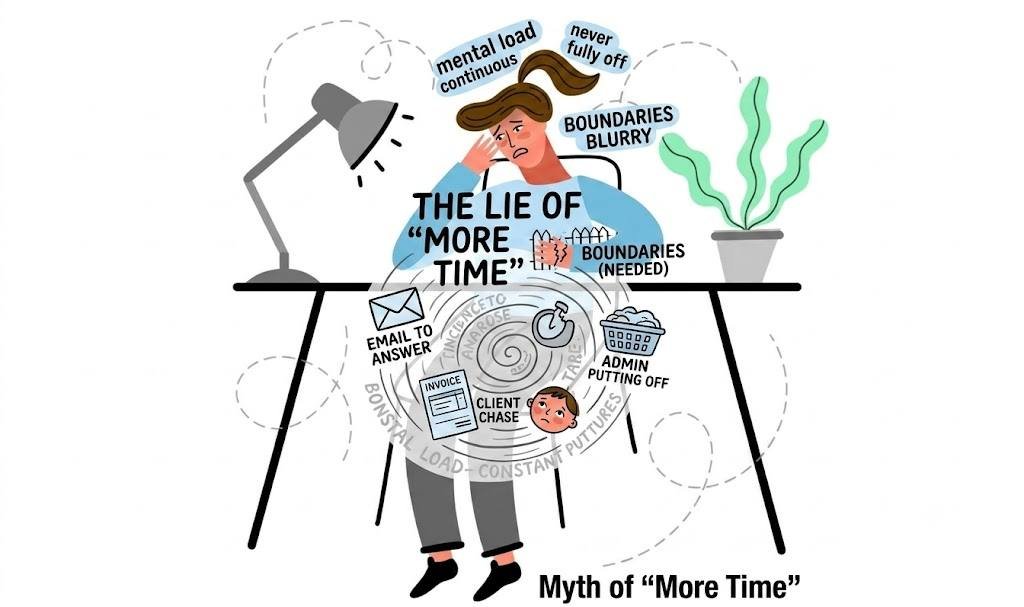
Let’s start here, because it’s the lie that gets the most women through the door. Freelancing does not automatically give you more time. What it gives you is more control over when you work, which is a genuinely different thing, and one that took me embarrassingly long to understand.
In my old job, my hours were fixed, but my mental load ended when I logged off. As a freelancer, I am never fully off. There is always an email I could answer, a client I could chase, a piece of admin I’ve been putting off. The boundary between “working mother” and “mother who is currently working” became blurry in a way I hadn’t anticipated, and it took real, deliberate effort to rebuild structure around something that had previously been imposed on me by an employer.
The flexibility is real. But flexibility without boundaries becomes a different kind of exhaustion, dressed up in nicer branding.
Income That Doesn’t Arrive on a Schedule
Nobody prepares you for what it actually feels like, emotionally, to go from a predictable monthly salary to income that arrives in irregular, unpredictable bursts. Some months I’d bill more than I ever earned in my old job. Other months, client payments would be delayed, projects would fall through, and I’d be staring at a much thinner number, doing rapid mental arithmetic about the mortgage and the kids’ shoes that were definitely going to need replacing soon.
This unpredictability hits differently as a woman managing a household, particularly if you’re the one who handles the bulk of the family’s financial planning, which, statistically, many of us still are. I had to build an entirely new relationship with money: separating personal income from business income, setting aside a percentage for taxes that nobody was automatically deducting for me anymore, and creating a buffer fund so that one slow month wouldn’t spiral into genuine panic.
Invoicing Is a Skill Nobody Teaches You
Here’s something embarrassingly basic that I had no idea how to do well when I started: chase money I was owed without feeling like I was being difficult.
In a traditional job, you never have to ask your employer to please pay you on time. As a freelancer, that conversation becomes your responsibility entirely, and it took me a long time to get comfortable with it. I undercharged for the first year because I was cautious about pricing. I let invoices go unpaid for too long because I found chasing them confrontational. I learned, slowly and sometimes painfully, that clear contracts, upfront deposits, and firm but polite payment terms aren’t aggressive. They’re professional. Women in particular are often socialised to avoid this kind of directness, and unlearning that has honestly been one of the more unexpectedly empowering parts of this whole journey.
Spreadsheet Chaos Nobody Warns You About
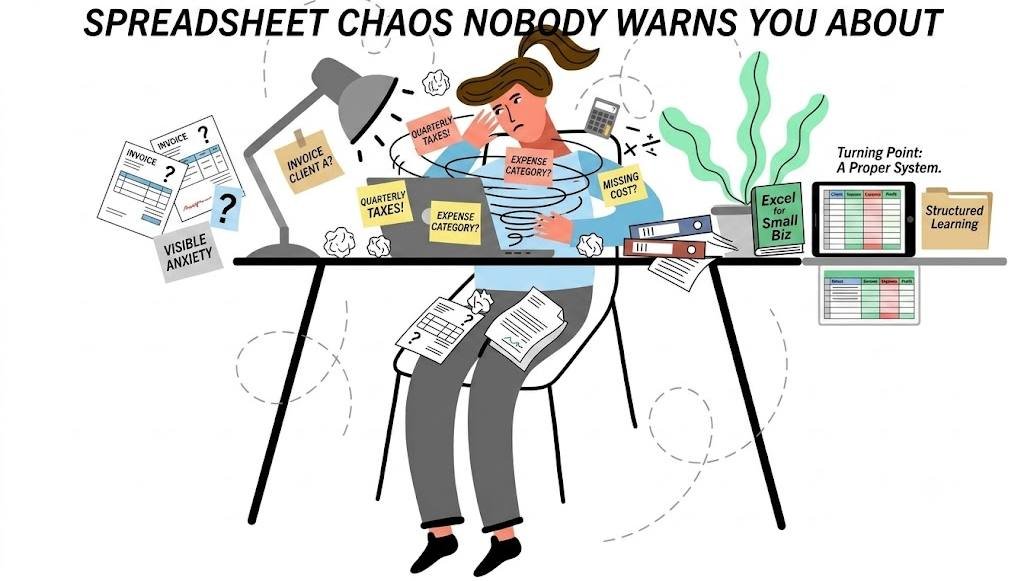
If there’s one area where I felt genuinely unprepared, it was tracking everything. In my old job, finance was someone else’s department. I never thought about invoicing systems, expense categories, or quarterly tax estimates; someone else handled all of it, quietly, in the background, and I never had to think twice.
Suddenly, I was that someone. And for the first few months, my “system” was a chaotic mess of sticky notes, half-finished documents, and a memory that, frankly, was not built to hold this much detail. I lost track of which clients had paid. I missed logging a few expenses, which cost me at tax time. I had no real visibility into which months were actually profitable once you accounted for the time I’d spent versus what I’d been paid.
The turning point came when I finally sat down and built myself a proper spreadsheet system tracking income by client, expenses by category, and a simple monthly summary so I could actually see, at a glance, how the business was doing rather than guessing based on vague anxiety. I’m not naturally a “numbers person,” and the early version of that spreadsheet was honestly a mess. It wasn’t until I worked through some structured Excel learning resources, specifically aimed at small business and freelance finance tracking, that things actually started to click. Formulas that had felt intimidating became genuinely useful once I understood the logic behind them, and within a couple of weeks I had something that finally gave me real clarity instead of constant low-level dread.
I share this not because I think every freelancer needs to become a spreadsheet expert, but because nobody told me this would be part of the job. The creative or skilled work you’re freelancing in is only half the picture. The other half is running a small business, whether you feel ready for that or not.
What I’d Tell Myself at the Start
If I could go back and talk to the version of myself who handed in her notice, nervous and excited in equal measure, here’s what I’d say.
The flexibility is real, but it has to be built, not assumed; set working hours for yourself, even if nobody’s enforcing them. Income will be unpredictable, so build a buffer before you need it, not after. Learning to invoice firmly and track your finances properly isn’t a side skill; it’s a core part of the job, so don’t be embarrassed if it takes you a while to get comfortable with it. And finally, the guilt doesn’t disappear just because you have more flexibility. It changes shape, but the work of managing it is ongoing, freelance or not.
Honest Verdict
Do I regret leaving my 9-to-5? No. But I went into it believing freelancing would solve the tension between work and motherhood, and what I found instead is that it simply changes the nature of that tension. It trades certain stresses for different ones, and hands you more control in exchange for more responsibility.
Nobody warned me how much of freelancing would be quiet, unglamorous admin work: invoices, spreadsheets, tax categories happening in the background while the “real” work gets the attention. But that unglamorous side is what actually keeps the whole thing standing. I wish someone had told me that, honestly, rather than letting me believe the sunny kitchen table photo was the whole story.