
There is a particular hour in most British households, somewhere between the end of the washing-up and the moment somebody finally gives up and goes to bed, when the phones come out. Nothing dramatic happens in that hour. One person checks whether the delivery slot has moved, another reads three paragraphs of a news story and abandons it, and a third opens a game. It is the least newsworthy thing in the country. It is also, added up across sixty-odd million people, one of the largest shifts in how Britain spends its free time since the arrival of the television set.
We tend to talk about online gaming as though it arrived from nowhere, an import from somewhere louder and less sensible than here. The truth is duller and more interesting. Britain already had the habit. What changed was the distance between wanting to play and being able to.
What Britain Actually Does With Its Evenings
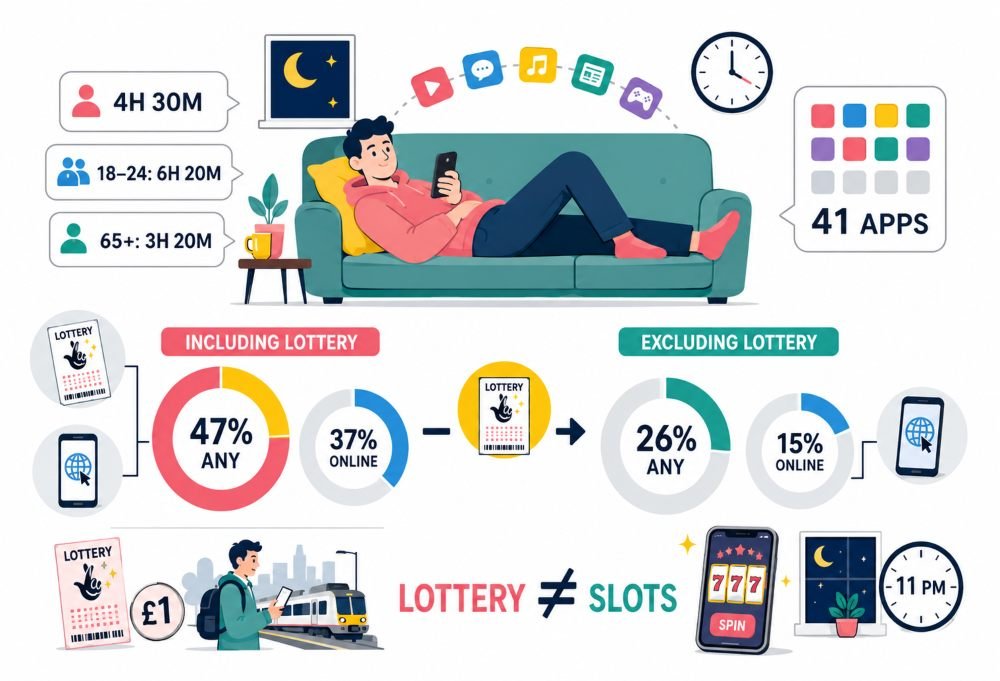
The scale is easier to grasp with a couple of solid figures rather than the recycled global market projections that turn up in every article on the subject.
According to Ofcom’s Online Nation research, the average UK adult now spends four and a half hours a day online outside of work, up ten minutes on the previous year. Adults aged 18 to 24 spend six hours and twenty minutes. The over-65s spend three hours and twenty minutes. Most of it happens on a phone, and the typical smartphone user opens around forty-one different apps in a month. Whatever we are doing with our evenings, we are doing a great deal of it lying at an awkward angle on the sofa.
Gambling sits inside that picture as a smaller and frequently misread slice. The Gambling Commission’s most recent Gambling Survey for Great Britain, which questioned 5,210 adults between late September 2025 and mid-January 2026, found that 47 per cent had gambled in some form in the previous four weeks, and 37 per cent had done so online. Those numbers sound enormous until you remove the people who only bought a lottery ticket. Do that and overall participation falls to 26 per cent, with online participation dropping to 15 per cent. Roughly one in five British adults gambles exclusively by buying into a draw on a Saturday night.
That distinction matters, because the two behaviours have almost nothing in common. Putting a pound on the Lottery on the way home from work is not the same activity as opening a slots app at eleven at night, and treating them as one statistic flatters both the industry and its critics.
Pier Arcade Never Closed, It Just Moved Indoors
Anyone who grew up being taken to Blackpool, Skegness or Barry Island in the rain already understands the appeal of the modern platform, because they have stood in front of a penny falls machine watching a shelf of two pence pieces refuse to tip. The bingo halls, the Grand National office sweepstake, the bookmakers on every high street between the Greggs and the charity shop: Britain has run a licensed, sociable and slightly grubby relationship with a flutter for a very long time.
What is genuinely new is not the appetite. It is the collapse of friction. A trip to the bookies used to involve weather, a walk, opening hours and the mild social cost of being seen going in. A thumbprint has replaced all of that. Removing friction from a habit is the single most reliable way to increase it, which is why the shift to mobile is the story rather than any particular game or platform.
Why The Design Feels So Familiar
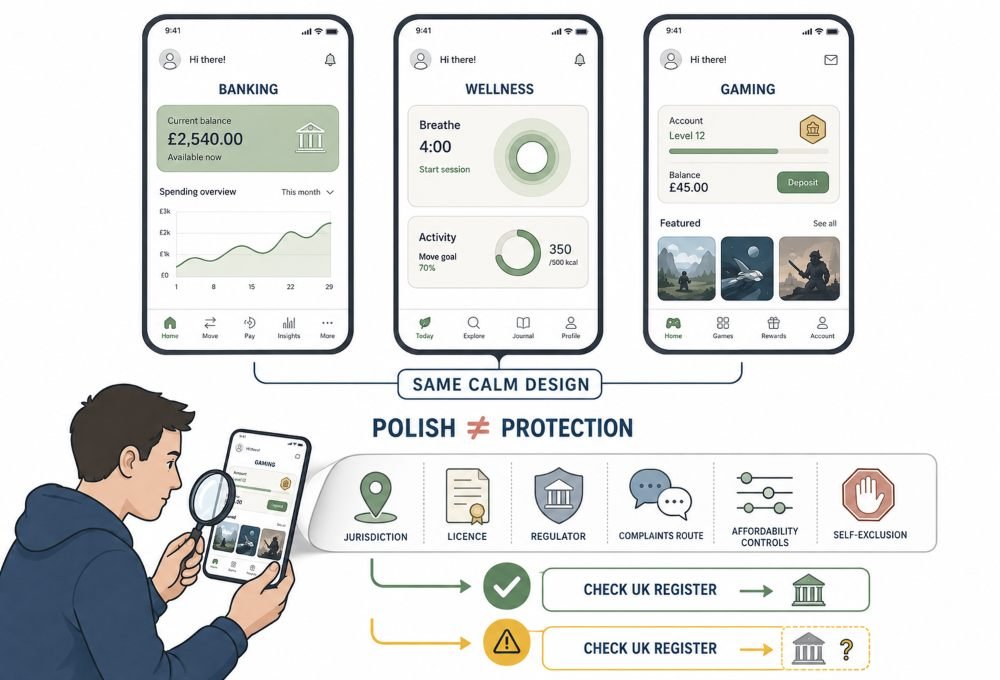
Open almost any modern gaming platform, and you will notice something odd. It does not look like a casino. It looks like a banking app, or a meditation app, or the sort of Scandinavian furniture site that sells you a lamp for two hundred pounds. Muted palettes, generous white space, a sans-serif typeface with the corners rounded off, a warm greeting using your first name.
This is deliberate, and it borrows directly from the lifestyle and wellness sector. Products designed to be opened daily use a visual language of calm and control, because calm and control keep people coming back. The Canadian online casino Charmius is a fair example of the convention as it appears in the Canadian market: clean navigation, a simplified account area, and the same reassuring quietness you would find in a fitness tracker. Whether that gentleness reflects an operator’s actual conduct is a separate question entirely, and one that the interface is not designed to answer.
For British readers, there is a practical point buried in this. Design polish tells you nothing about jurisdiction. A site licensed for players in Canada or elsewhere is not covered by British rules, which means no UK complaints route, no British affordability requirements and no participation in the national self-exclusion scheme. Before depositing anywhere, it is worth checking the operator’s entry on the Gambling Commission’s public register, which is free to search and takes about a minute.
Part That Does Not Fit The Lifestyle Framing
Most articles in this genre stop at the design compliment. That is where they stop being useful.
The Lancet Public Health Commission on gambling, published in 2024 by a group of researchers including academics from the University of Glasgow, concluded that commercial gambling should be understood as a public health issue rather than a straightforward leisure choice, and that the harms extend well past the individual account holder to partners, children and wider households. It is a long document and not a comfortable one, but it is the most serious piece of work available on the subject, and it is free to read.
The NHS agrees on the substance. Specialist gambling clinics now operate across England, and the NHS guidance on problems with gambling includes a short self-assessment worth taking honestly rather than optimistically. The questions are unglamorous. Have you needed to gamble larger amounts to get the same feeling? Have you chased losses? Has anyone told you they were worried?
None of this means that a person who plays a slots game for twenty minutes on a Thursday is in trouble. It means the risk is real, unevenly distributed, and not visible from the outside, which is exactly why it belongs in an article that also describes the pleasant bits.
Habits That Survive Contact With A Wet Wednesday
Advice on this topic tends to be worthless because it assumes a level of self-discipline that would make the advice unnecessary. The habits that actually hold are the ones that do not rely on willpower at the moment of temptation.
Set deposit limits when you open an account, not later. Every licensed British operator must offer them, and the limit you set on a calm afternoon will be more sensible than any decision you make at midnight. Reduction requests take effect immediately, while increases carry a cooling-off period, which is the whole point of the tool.
Give the money a name. MoneyHelper’s free budget planner, run by the government-backed Money and Pensions Service, will happily take a line for entertainment spending alongside the council tax and the broadband. A figure that sits in a budget behaves differently from a figure that lives in your head.
Use the blocking tools before you think you need them. GAMSTOP is free, takes a few minutes, and shuts off every operator licensed in Great Britain for a period you choose, from six months upwards. Most banks now offer a gambling transaction block in the app as well, usually with a delay before it can be switched off again.
Keep a number to hand. The National Gambling Helpline, run by GamCare, is on 0808 8020 133, free and open around the clock, and it is there for people who are worried about someone else’s gambling as much as their own. GambleAware hosts the wider support network and a fair amount of plain-language information about what treatment actually involves.
What Is Changing In The Rules
British regulation has moved considerably since the 2023 gambling white paper. A statutory levy on operators now funds research, prevention and treatment rather than the old voluntary arrangement. Stake limits on online slots were phased in during 2025, capping spins at five pounds for most adults and two pounds for players aged 18 to 24, on the reasonable basis that younger players are more exposed to harm. Operators are also expected to run financial vulnerability checks in the background rather than waiting for a customer to volunteer that something has gone wrong.
The direction of travel is clear enough. Britain is not moving towards prohibition, and there is very little political appetite for it. It is moving towards treating online gambling as a regulated consumer product with known risks, closer to how we handle alcohol licensing than how we handle a night at the cinema.
A Reasonable Way To Hold All Of This
The honest summary is that online gaming is neither the wellness-adjacent hobby that platform design implies nor the moral catastrophe that a certain kind of column suggests. It is a commercial product that a great many British adults use without incident, that a smaller number use at real cost to themselves and the people around them, and that is now available at every hour of every day from a device already in your hand.
Treat it the way you would treat any other line in the household budget that exists purely for enjoyment. Decide the number before you start. Notice if the sessions are getting longer or the reasons for opening the app are getting worse. And keep the distinction between playing because it is fun and playing because the evening has gone flat, because that distinction is usually the first thing to disappear and the most useful thing to protect.
Disclaimer: This article is intended for general information and is written for readers aged 18 and over. It is not financial, legal, medical or clinical advice, and it does not constitute a recommendation to gamble or to use any particular operator. Gambling involves risk, and losses should be expected. Regulations, statistics and support services change over time, so readers should confirm current details with the relevant organisation. If you are worried about your own gambling or someone else’s, contact the National Gambling Helpline on 0808 8020 133 or speak to your GP.
References
- Gambling Commission. Statistics on gambling participation, Wave 4, September 2025 to January 2026: Official statistics. Birmingham: Gambling Commission; 2026. Survey conducted by the National Centre for Social Research, fieldwork 22 September 2025 to 18 January 2026, n = 5,210 adults aged 18 and over. Available at: https://www.gamblingcommission.gov.uk/statistics-and-research/publication/statistics-on-gambling-participation-wave-4-september-2025-to-january-2026-official-statistics
- Ofcom. Online Nation 2025 Report. London: Office of Communications; published 10 December 2025. Available at: https://www.ofcom.org.uk/media-use-and-attitudes/online-habits/from-apps-to-ai-search-how-the-uk-goes-online-in-2025
- Wardle H, Degenhardt L, Marionneau V, Reith G, Livingstone C, Sparrow M, et al. The Lancet Public Health Commission on gambling. The Lancet Public Health. 2024;9(11):e950–e994. https://doi.org/10.1016/S2468-2667(24)00167-1
- Tran LT, Wardle H, Colledge-Frisby S, Taylor S, Lynch M, Rehm J, et al. The prevalence of gambling and problematic gambling: a systematic review and meta-analysis. The Lancet Public Health. 2024;9(8):e594–e613. https://doi.org/10.1016/S2468-2667(24)00126-9
- The Lancet Public Health. Time for a public health response to gambling (Editorial). The Lancet Public Health. 2024;9(11). https://doi.org/10.1016/S2468-2667(24)00248-2
- National Health Service. Help for problems with gambling. NHS website, Live Well: Addiction support. Available at: https://www.nhs.uk/live-well/addiction-support/gambling-addiction/
- GamCare. National Gambling Helpline. London: GamCare. Available at: https://www.gamcare.org.uk/
- GAMSTOP (National Online Self-Exclusion Scheme Ltd). Self-exclusion for online gambling in Great Britain. Available at: https://www.gamstop.co.uk/
- GambleAware. Information, advice and support for anyone affected by gambling harms. Available at: https://www.gambleaware.org/
- Money and Pensions Service. Budget planner. MoneyHelper. Available at: https://www.moneyhelper.org.uk/en/everyday-money/budgeting/budget-planner