The changing-room mirror is rarely the real problem. More often, it is the cut of the garment, the position of a seam or a waistband sitting two inches lower than expected. Understanding proportions makes getting dressed less uncertain because it shifts the question from “What is wrong with my shape?” to “What is this piece of clothing doing?”
That distinction matters. The logic behind a thoughtful hourglass style guide is not that everybody should try to resemble an hourglass. It is that clothes create lines, and those lines can define the waist, distribute volume and make an outfit feel visually settled.
It Is About Proportion, Not Dress Size
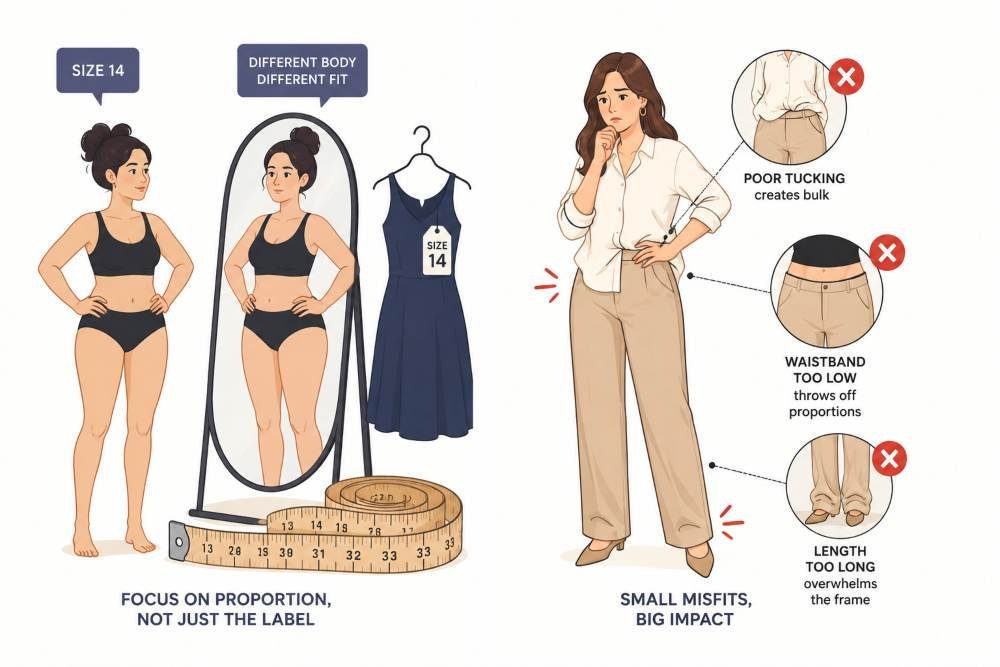
Two people can pick up the same size 14 dress on a British high street and experience completely different problems. One may find the shoulders too narrow while the skirt fits well. Another may have room at the bust but find that the waist seam sits too high. The label is the same, but the relationship between the garment and the body is not.
Dress sizes are useful starting points, not precise descriptions of shape. They cannot tell you how broad your shoulders are, how long your torso is or where your waist sits. They also vary between brands, which is why an outfit that works beautifully in one shop can feel completely wrong in the next.
This is one reason body-type language should be treated as a fitting tool rather than an identity. You do not have to decide that you are permanently an apple, pear, rectangle or hourglass. Your proportions can also change with age, pregnancy, hormones, disability, medication and ordinary fluctuations in life.
The Mental Health Foundation’s UK research on body image is a useful reminder that appearance pressure can affect how people feel about themselves. Styling advice should therefore make clothing easier to understand, not turn the body into another problem requiring correction.
Find the Waist Before Trying to Define It
The waist is not always where a retailer places a waistband. Some “high-rise” trousers stop below the smallest part of the torso, while some dresses position their waist seam unusually high to create an empire shape.
In dressmaking, the natural waist generally refers to the area where the torso bends or narrows naturally. That styling position should not be confused with a medical waist measurement. The British Heart Foundation explains that health measurements are taken using specific anatomical reference points between the ribs and hips, for a completely different purpose.
To locate your styling waist, stand comfortably rather than pulling in your stomach. Lean slightly to one side and notice where the body folds. That is usually close to the point where a belt, trouser waistband or shaped seam will create the clearest definition.
The most flattering position is not necessarily the narrowest possible one. Someone with a short torso might prefer a waistband slightly below that point because it creates more visual space between the bust and waist. Someone with a longer torso may feel better with a genuinely high-rise trouser that prevents the upper body from appearing disconnected from the legs.
The mirror is more useful than the measuring tape here. Look at the whole outfit rather than focusing closely on one area.
Waist Can Be Suggested Without Being Squeezed
Waist definition is often misunderstood as tightness. In reality, a waist can be created through contrast, construction and proportion without compressing the body at all.
A tucked shirt establishes a clear transition between the upper and lower halves of an outfit. A cropped cardigan ending near the waistband performs a similar job. A wrap dress creates diagonal movement towards the middle, while a tailored coat can shape the torso through seams rather than through a belt.
Belts work best when they look like part of the outfit rather than an emergency solution. A medium-width leather belt can give a knitted dress more structure. A slim belt may suit a light tea dress, while a fabric tie often works better with softer materials. Pulling any belt too tightly usually causes the fabric to bunch above and below it, which interrupts the line you were trying to create.
Garment construction can do even more. Darts remove excess fabric from selected areas, while princess seams shape a garment vertically through the bust and waist. A well-cut jacket may define the middle even when worn open because the front edges curve inward before moving back out over the hips.
Balance Is Visual, Not Mathematical
Balancing proportions does not mean forcing the shoulders and hips to have identical measurements. It means preventing one part of the outfit from carrying all the visual weight.
When the shoulders appear broader than the hips, volume lower down can create a more grounded silhouette. Wide-leg trousers, pleated skirts and gently flared dresses can do this without making the outfit feel theatrical. A softer shoulder line may also be more effective than removing all structure from the upper body.
When the hips are more prominent than the shoulders, detail near the neckline can draw the eye upwards. A boat neckline, textured knit, structured collar or jacket with a clear shoulder seam may be enough. Huge shoulder pads are rarely necessary. A few centimetres of visual width can change the entire relationship between the top and bottom halves.
A straighter shape may benefit from clothing that creates separate zones. A fitted knit with fuller trousers, a cropped jacket over a dress or a colour change at the waist can suggest shape without relying on tight garments.
For a fuller middle, waist definition does not have to sit directly across the stomach. An open jacket creates two vertical lines, while a softly draped blouse can meet a clean trouser waistband without clinging. A wrap effect placed slightly to one side can also create direction and movement.
Fashion writing aimed at curvy ladies often repeats rigid instructions about what should be hidden or highlighted. That approach misses the practical issue. Curves vary enormously, and the useful question is whether the garment has enough room where it is needed while still maintaining its intended shape.
Fabric Has a Vote
A design can look ideal on a hanger and behave completely differently once worn. Fabric weight, stretch and drape influence whether a garment follows the body, floats away from it or collapses around it.
Soft jersey can skim comfortably, although very thin jersey may catch on underwear or create lines that were not visible in the changing room. Ponte knit provides more structure while retaining stretch. Linen creates a relaxed, slightly architectural effect, but it will crease during a train journey or a day at the office. Crisp cotton holds volume, while viscose tends to fall more fluidly.
Bias-cut clothing deserves particular attention because it moves diagonally across the grain of the fabric. This allows the material to follow the body in a way that ordinary straight-grain construction may not. The V&A’s account of Madeleine Vionnet’s pioneering bias-cut dresses shows how fabric construction can produce shape through drape rather than rigid internal structure.
This is why fibre information matters when shopping. A photograph may show a flowing skirt, but the actual item may contain a high percentage of stiff polyester or have very little stretch. UK textile rules require labels to identify fibre content, so checking the composition label gives you more useful information than relying on the product name alone.
Not Every Outfit Needs a Visible Waist
A defined waist is one styling option, not a compulsory destination.
Some of the most memorable clothes deliberately remove it. Shift dresses, oversized shirts, column skirts, longline blazers and loose knitted sets create impact through shape, movement or simplicity rather than an obvious middle.
Cristóbal Balenciaga’s 1957 sack dress famously rejected the strongly waisted silhouette that had dominated the previous decade. The V&A describes how the design initially shocked both clients and the press before its straight, waistless shape moved into mainstream fashion.
A loose silhouette usually works best when another element provides intention. That might be a neat neckline, a visible wrist, a precise trouser hem, a strong shoe or a bag with a defined shape. Without one controlled point, oversized clothing can look accidental rather than relaxed.
The difference is not body type. It is styling clarity.
Where Otherwise Good Outfits Go Wrong
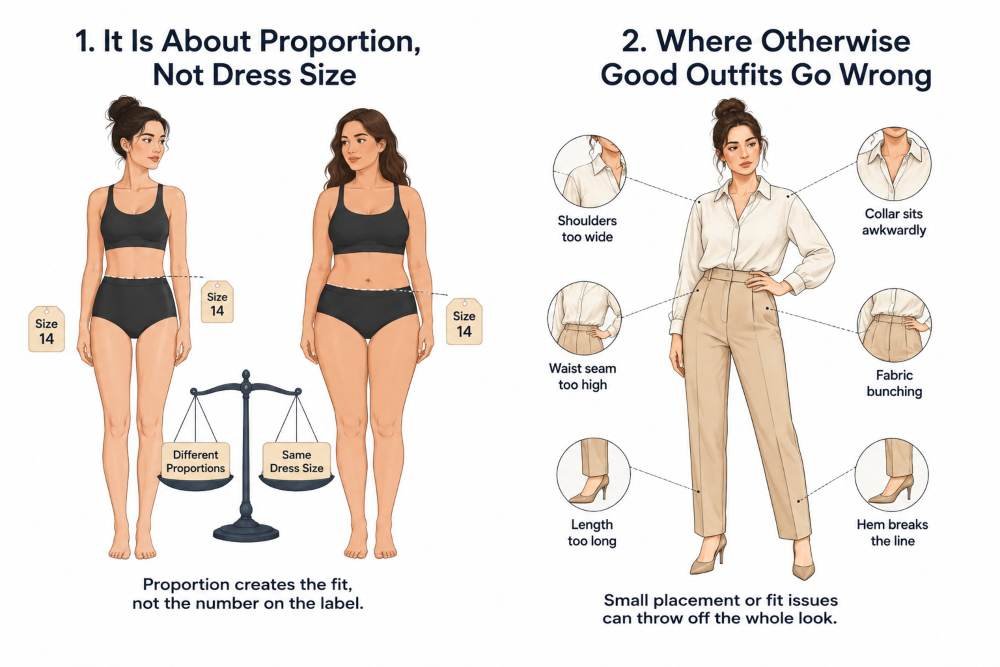
The most common fitting problem is not choosing the wrong body-type category. It is accepting a garment that fits badly in a high-impact area.
Shoulder seams are particularly important because they establish the frame of a shirt, coat or blazer. When they fall too far down the arm, the whole garment can appear oversized even when the waist and sleeves fit. When they pull inwards, the fabric may strain across the upper back.
Waist seams cause similar trouble. A dress designed to narrow at the waist cannot do its job if the seam sits across the ribs or drops towards the hips. A belt placed over the incorrect seam will not repair the proportion; it usually makes the mismatch more noticeable.
Trouser length also changes balance. Wide-leg trousers that finish too high may appear abruptly cut off, while excess fabric pooling heavily over the shoes can pull the outfit downwards. The right length depends on the footwear, which is why trousers should ideally be tried on with the type of shoe you expect to wear.
Then there is movement. Sit down, raise your arms, walk across the fitting room and bend to pick something up. Clothing that only looks balanced while you stand perfectly still is not properly fitted for daily life.
Shopping Online Without Turning Your Bedroom Into a Returns Department
Online shopping makes proportion harder to judge because product photographs rarely show every body shape, and garments are often pinned or adjusted during a shoot.
Before ordering, compare the actual garment measurements with an item you already own. Measuring a favourite blazer from shoulder to shoulder is often more useful than measuring your body and trying to interpret a general size chart. For trousers, compare the rise, waist, hip, inside leg and hem width. For dresses, look for the shoulder-to-waist measurement if the retailer provides it.
Read reviews for practical fit information, but be cautious with comments such as “flattering” or “unflattering”. These are personal judgements. Notes about sleeve length, fabric thickness, stretch, transparency and waistband gaping are far more useful.
Check the returns policy before buying several sizes. UK consumers generally have additional cancellation rights for most online purchases, although conditions and exceptions apply. Which?’s guidance on returning online purchases explains the main rules and timescales.
The Tailor Often Matters More Than the Trend
A garment does not need to fit perfectly straight from the rail to be worth buying. It does, however, need to fit in places that are difficult or expensive to reconstruct.
Sleeves and trouser hems are usually straightforward to shorten. Waistbands can often be taken in, while darts may be added to shirts or dresses that fit well elsewhere. Moving shoulders, changing armholes or rebuilding a jacket chest is much more complicated.
This is especially useful when the British high street gives you an almost-right fit. A £12 trouser alteration can make an existing pair more wearable than replacing it with another pair carrying the same problem. It may also be better for the wardrobe and the environment. WRAP’s work on extending the useful life of clothing shows why durability, repair and longer use matter within the UK clothing system.
A tailor cannot turn unsuitable fabric into suitable fabric, though. A waistband can be adjusted, but scratchy material will remain scratchy. A hem can be shortened, but a dress that pulls across the shoulders may need far more work than it is worth.
When Styling Advice Stops Being Helpful
There is a point where studying proportions becomes less useful rather than more useful. If every mirror produces a new perceived fault, every photograph triggers comparison and getting dressed consumes a large part of the day, the problem may no longer be the wardrobe.
The NHS explains that persistent distress about appearance, repeated comparisons and spending excessive time trying to conceal perceived flaws can be signs that additional support is needed. Its guidance on body dysmorphic disorder explains when speaking with a GP may be appropriate.
Clothes should support daily life. They should allow you to sit through a meeting, walk to the station, attend a wedding, carry the shopping home or spend an afternoon with friends without constantly adjusting yourself.
Final Note
Dressing for your proportions is not about winning an argument with your body. It is about noticing where a garment begins, where it narrows, where it adds volume and whether those decisions work with the person wearing it.
Define the waist when it gives the outfit clarity. Leave it undefined when a straighter or more relaxed silhouette feels right. Use belts, seams, fabric and tailoring as tools rather than rules. Once you stop treating the size label as a verdict and start reading the construction of the clothes, getting dressed becomes less like guesswork and more like a practical conversation between shape, comfort and personal style.