
For UK divers, the dream of learning to scuba dive in warm, clear water is never far away. While cold-water diving has its own appeal and a dedicated following here in Britain, there is a reason so many people choose to get their PADI Open Water certification abroad. The Caribbean offers conditions, biodiversity, and infrastructure that cannot be matched in home waters, and for a first-time diver, those factors matter enormously.
There are, of course, other dive destinations around the world pristine cenotes in Mexico, tropical reefs in Southeast Asia, and volcanic dive sites in the Azores. But if you are choosing deliberately, and you want your first experience learning to scuba dive to be genuinely extraordinary rather than merely adequate, the Caribbean makes a case for itself that is very difficult to argue with.
Why Caribbean Conditions Are Ideal for Beginner Scuba Divers
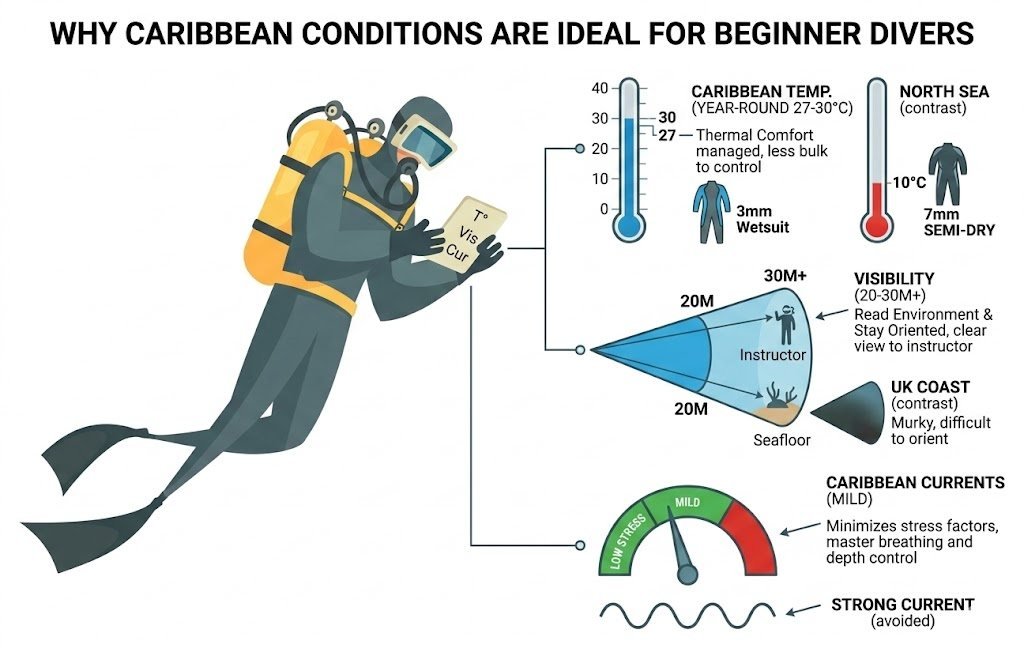
Learning to is significantly easier when the conditions cooperate, and this is where the Caribbean has an immediate advantage over most alternatives. Water temperatures typically range from 27 to 30 degrees Celsius year-round. For a British diver accustomed to the North Sea or even the Mediterranean in October, stepping into that warmth is a revelation. A thin 3mm wetsuit is usually sufficient, which means managing your thermal comfort is one less thing to worry about while mastering buoyancy and equalisation.
Visibility in popular Caribbean dive destinations regularly exceeds 20 to 30 metres. This is transformative for beginners. Being able to clearly see your instructor, your surroundings, and the seafloor below makes reading your environment and staying oriented far easier than in the murkier conditions common around UK coasts.
Currents at most beginner-friendly sites are mild. This matters more than many new divers initially appreciate. Strong currents introduce a variable that novices do not need while they are still learning to breathe calmly underwater, control their depth, and take in their surroundings. The best Caribbean dive sites for beginners are deliberately chosen to minimize as many stress factors as possible.
Utila, Honduras: One of the World’s Best Places to Learn to Dive
Among the Caribbean’s many dive destinations, scuba diving in Utila, a small Honduran island in the Bay Islands, has developed a global reputation as one of the finest places in the world to earn your Open Water certification. The reasons are straightforward: the diving is world-class, prices are among the most affordable in the entire Caribbean, and the island itself is essentially built around the diving community.
Utila’s reefs are teeming with reef fish, rays, moray eels, and seasonal whale sharks. The whale shark encounters alone are worth the flight. Dive sites are generally shallow and current-free enough for beginners, while also offering enough depth and complexity to keep advanced divers fully engaged. It is a rare combination, and it explains why so many divers arrive in Utila for their Open Water course and stay on for their Divemaster.
For UK divers, Utila is also genuinely good value. The low cost of diving relative to destinations like the Maldives or the Red Sea means you can do more dives, take more courses, and build confidence faster without stretching your budget.
Caribbean Marine Biodiversity: Why Learning Here Is So Motivating
One of the most underrated aspects of learning to dive in a beautiful location is the motivation factor. Being surrounded by sea turtles, parrotfish, angelfish, nurse sharks, and spotted eagle rays while you are still working through your basic skills makes every session feel like a reward rather than a test.
The Caribbean sustains around 10 percent of the world’s coral reefs and is home to endemic species found nowhere else on earth. Even a 30-minute training dive in five metres of water can feel like a genuine adventure when the reef below you is alive with colour and movement.
Compare that to learning in a cold quarry or a municipal swimming pool, which remains the reality for many UK-based beginner divers. Both get the job done, but the Caribbean experience builds the kind of love for diving that keeps people coming back for the rest of their lives.
World-Class Dive Infrastructure Across the Caribbean
Established Dive Centres and Qualified Instructors
The Caribbean has been the home of recreational diving for decades and is widely regarded as the birthplace of modern recreational dive tourism. Its dive centres, liveaboard operations, and resort infrastructure have been refined over generations. Five-star dive centres, patient instructors who teach in multiple languages, and small instructor-to-student ratios are the norm in established Caribbean destinations, not the exception.
For UK divers, this matters. Many instructors across the Caribbean are British themselves or are deeply familiar with British students and the standards set by organisations such as BSAC and PADI UK. Courses are frequently conducted in English, and qualifications earned in the Caribbean are fully internationally recognised.
Liveaboards and Resort Diving Options
Beyond shore-based dive centres, the Caribbean offers an extensive network of liveaboard vessels that allow divers to reach remote reefs and seamounts unreachable from land. For UK divers planning a dedicated dive holiday, a liveaboard is often the most efficient and rewarding way to maximise time in the water.
Year-Round Diving Accessibility for UK Holiday Planners
Unlike some dive destinations that have narrow optimal seasons, much of the Caribbean offers excellent conditions year-round. This is a significant practical advantage for UK divers working around annual leave allowances, school holidays, and the unpredictability of booking flights months in advance.
The ABC islands, Aruba, Bonaire, and Curaçao, sit outside the Atlantic hurricane belt entirely, offering reliably good conditions regardless of season. Bonaire, in particular, is considered one of the world’s shore-diving capitals, with an underwater marine park that protects some of the Caribbean’s healthiest and most accessible reef systems.
Beyond the ABC islands, the Caribbean is home to several world-class dive destinations worth considering. The Cayman Islands are famous for dramatic wall dives and sites like Stingray City. Cozumel offers fast-moving drift dives along vibrant coral reefs. Turks and Caicos is known for its pristine reefs and clear visibility, while St. Lucia provides a mix of volcanic underwater landscapes and marine biodiversity. The Bahamas also stand out for shark diving experiences and blue holes.
For a first dive trip, having season-independent reliability removes a real planning headache. UK travellers can book with confidence knowing that their trip is unlikely to be disrupted by poor conditions or unseasonal weather, while still having access to some of the best diving spots in the Caribbean.
Practical Tips for UK Travellers Planning a Caribbean Dive Holiday
Flights and Getting There
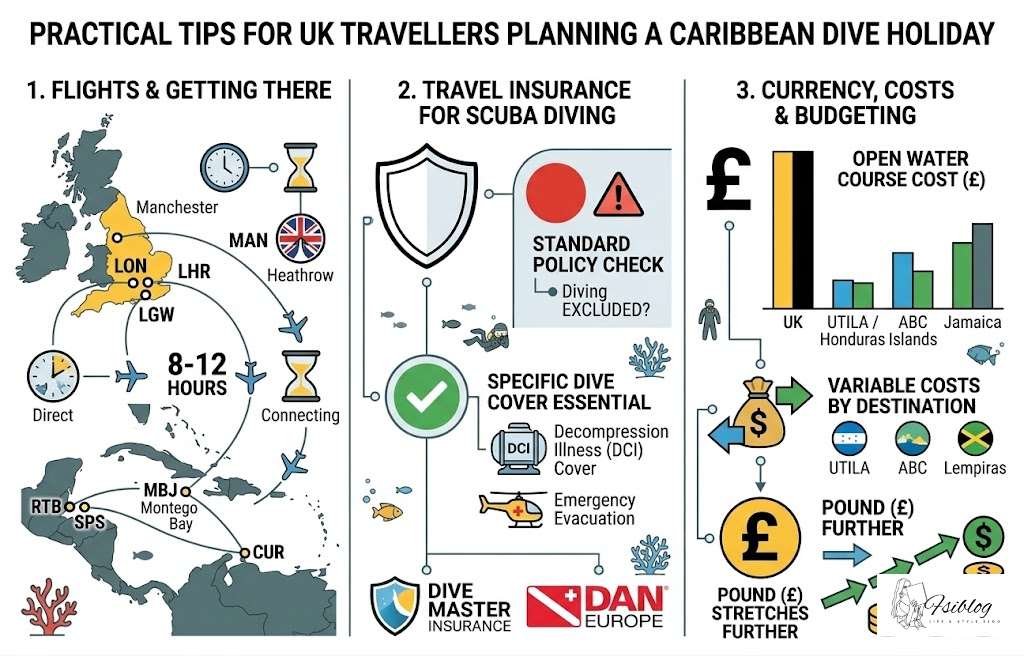
Direct and connecting flights from UK airports to major Caribbean hubs are widely available, with journey times typically 8 to 12 hours, depending on the destination. Gatwick, Heathrow, and Manchester all offer good connectivity. Flying into Roatan or San Pedro Sula for Utila, into Curacao for the ABC islands, or into Montego Bay for Jamaica are all well-established routes for dive travellers.
Travel Insurance for Scuba Diving
UK divers must ensure their travel insurance specifically covers scuba diving. Standard travel policies from high-street providers frequently exclude diving, and specialist cover is essential. Dive Master Insurance and DAN Europe are two well-regarded options among UK divers, offering policies that include decompression illness cover and emergency evacuation.
Currency, Costs and Budgeting
Costs vary considerably across Caribbean destinations. Utila and other Bay Islands destinations in Honduras are among the most affordable in the region, with Open Water courses available for significantly less than those in the UK or at premium Caribbean resorts. Budget-conscious UK divers do very well in Central American and Caribbean destinations, where the pound stretches further.
Conclusion
The Caribbean is not simply a pleasant backdrop for learning to scuba dive. For most divers, especially those from the UK, it is the single best place in the world to take that first breath underwater. The combination of warm, clear water, extraordinary marine life, well-established dive infrastructure, and year-round accessibility creates conditions as close to perfect as beginner divers are likely to find anywhere on Earth.
Whether you choose the budget-friendly reefs of Utila, the shore diving paradise of Bonaire, or one of the many other exceptional destinations scattered across the region, you are unlikely to regret making the Caribbean your introduction to the underwater world. Many UK divers who started their diving journey in the Caribbean never quite manage to give it up. Once you have seen a sea turtle glide past at five metres, everything else tends to pale in comparison.
Disclaimer
This article is intended for general informational and travel guidance purposes only. Scuba diving is an activity that carries inherent risks, and all divers should ensure they are medically fit to dive, properly certified by a recognised training agency, and covered by appropriate specialist dive insurance before entering the water. Conditions, prices, and operator details referenced in this article are subject to change. Always consult a qualified dive instructor and conduct your own research before booking any dive course or holiday. The external links included in this article are provided for reference only and do not constitute endorsement of any third-party organisation or service.