
Ask a group of club golfers with broad feet when their shoes start to hurt, and you will hear a surprisingly consistent answer: somewhere around the fourth or fifth hole. The first tee feels fine. The walk to the second is fine. Then the forefoot warms up, spreads a little, and the upper that felt snug in the shop starts to behave like a clamp.
The instinct is to blame the size and buy the next one up. It is an understandable instinct, and it is usually wrong. Length and width are separate measurements, and a golf shoe has to get both right if it is going to hold the heel, support the midfoot and leave the forefoot free to load and turn during the swing.
Length First, Width Second
Start with length, because everything else is built around it.
The FootJoy UK golf shoe fitting guide suggests leaving roughly half an inch, a little over a centimetre, beyond your longest toe. More important than that gap, though, is where the shoe bends. The guide asks you to check that the crease falls where your forefoot naturally flexes, and it explains why fitters using a Brannock device record two lengths: heel to toe, and heel to the ball of the foot, known as arch length. When those readings point to different sizes, FootJoy recommends taking the larger one so the ball of your foot sits over the shoe’s flex point.
That detail explains a lot of mystery discomfort. A shoe can pass the thumb-press test at the toe and still bend in the wrong place, which you feel as pressure across the joints every time you push off.
Half-Size Trap
Say you take a UK 9, which FootJoy’s chart lists as a US 10. You have ample room beyond your toes, but the shoe presses across the widest part of your foot. Go up to a 9.5, and you gain a sliver of width along with length you never needed. Your heel now has room to rise, and the flex point has moved forward of the ball of your foot.
FootJoy’s guide names this as the most common fit problem its fitters see: people going up a size because a shoe feels tight. Its advice is to try a wider width before a longer size. In this case, the better comparison is a wider UK 9.
Large-scale data shows why. A study published in Scientific Reports examined 1.2 million 3D foot scans from North America, Europe and Asia, grouping them into 5mm length bands. Within each band, width, instep height and heel width still varied considerably. For North American men whose feet measured about 270mm, close to a UK 8, the middle 90% of widths covered a range of nearly 16mm. The researchers concluded that shoes need at least three widths per length to fit 90% of customers properly.
If you are comparing mens’s extra-wide golf shoes, that is the mindset to bring with you: width is a measurement in its own right, not something to borrow from a longer size.
What The Letters On The Box Actually Tell You
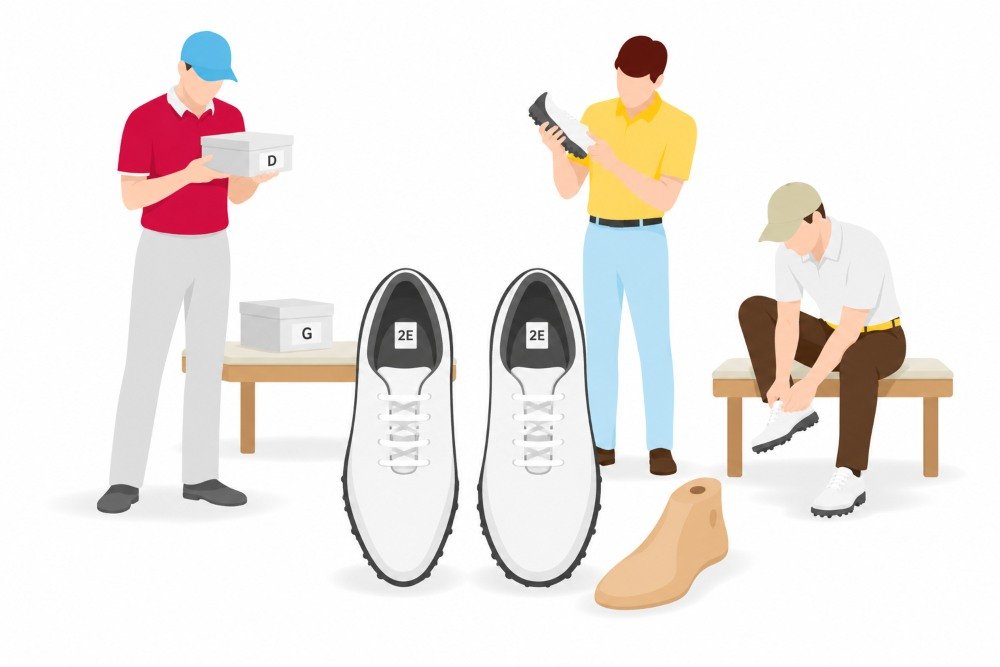
Width letters are helpful shorthand, but they are not standardised across the industry.
Many golf brands use American codes, where D is a men’s medium and each extra E adds room. FootJoy’s current men’s chart places C, D and E under Medium, E and 2E under Wide and 3E under X Wide, and its men’s range stops there. The letter E appearing in two groups is a neat reminder that the boundaries are fuzzy even within one company.
Plenty of British footwear uses a different alphabet altogether. On traditional UK fittings, F is standard for men, G is wide, and H is extra wide. An F is broadly comparable to an American D and a G to a 2E, but treat those as rough equivalents rather than exact conversions.
Then there is the last, the foot-shaped form a shoe is built on. It decides how quickly the toe tapers, how much volume sits over the instep and how deep the heel pocket is. Two shoes stamped 2E can fit very differently if their lasts differ, which is why the letter works best as a first filter rather than a guarantee.
Three Kinds Of “Wide” Foot
“I have wide feet” can mean at least three different things, and each needs a slightly different fix.
Research supports that distinction. A 3D analysis of healthy adult foot shape, based on scans of 31 women and 31 men in Belgium, found that once overall size was taken out of the picture, the largest differences between people lay in arch height, then in ball width combined with toe spread, and then in overall foot width. Big toe angle, toe shape and midfoot width completed the six main patterns, which together accounted for about 93% of the variation.
The first kind of wide foot is broad right across the forefoot, and that player needs a genuinely wider fitting. The second has a fairly ordinary midfoot but toes that fan out, so a shoe with a sharply tapering front will pinch even in a wide width; here, a rounded and roomy toe box matters as much as the letter. The third has a high instep, and the pressure arrives across the top of the foot under the laces rather than at the sides. FootJoy notes that a U-throat or blucher-style opening gives more instep room than a V-throat, and that higher arches may call for a wider, higher-volume shoe.
Working out which group you belong to saves a great deal of trial and error.
Heel Hold Without A Tourniquet
A golf shoe should hold your heel the way a good handshake holds a hand: firmly, without squeezing.
Your heel should stay down when you walk and when you swing. If it lifts on every step, friction builds, and on a hilly course that often ends in blisters.
FootJoy offers a simple visual check. With the shoe laced, the top eyelets should sit about a thumb’s width apart, although arch height can alter this. If they are pulled well apart, the shoe is likely too narrow. If they almost meet, it is probably too wide. The same guide lists other clues:
- Stretching around the toes points to a shoe that is too narrow.
- Bunched material across the top suggests too much width or length.
- A shoe you can slip off without loosening the laces is too big.
The one thing not to do is crank the laces to make an ill-fitting shoe feel stable. If the only way to stop heel slip is to tighten until your forefoot tingles, the shape is wrong for your foot.
Your Feet Are Part Of The Swing
It is tempting to think of golf shoes as walking shoes with grip. The research suggests they do rather more.
At the University of Chichester in West Sussex, researchers compared three golf shoe sole designs: a metal seven-spike shoe, an alternative seven-spike shoe and a flat-soled shoe. Eighteen right-handed golfers hit drives with their own clubs from force plates covered in natural grass, while pressure insoles recorded what happened inside each shoe. The results:
- The front foot produced higher peak vertical force and torque than the back foot, whichever shoe was worn.
- The metal-spiked shoe generated more back-foot torque than the flat sole.
- Pressure patterns inside the shoe changed with the outsole.
A separate study of 32 amateur golfers with handicaps between 2.7 and 25 found that higher clubhead speed went hand in hand with greater peak pressure on the outer side of the lead foot.
None of this proves that a snug shoe will cost you yards. It does show that your feet are actively loading and rotating through the swing, and that the outer side of the lead foot matters. That is also where a broad forefoot tends to collide with a narrow upper, around the little-toe joint. Stability that comes from compression is not the kind you want.
A Fitting Routine For British Golfers
Get measured later in the day. FootJoy notes that feet can swell as the day goes on, so an after-work fitting is more likely to reflect how your feet feel on the back nine than one first thing in the morning.
Measure both feet. According to FootJoy, most people’s feet are not identical in size, and you should fit to the larger one.
Sit for the measurement, then stand for the verdict. FootJoy measures with the golfer seated and the leg at about 45 degrees, so body weight does not spread the foot and skew the reading. The try-on should then happen standing and moving. NHS podiatry advice makes the same point from the other direction: feet lengthen when they take your weight, so walk around in new shoes before deciding.
Bring your golf socks. The Royal College of Podiatry’s advice on walking footwear warns that 100% cotton socks hold moisture against the skin and can cause painful blisters, and suggests wool, silk or microfibre blends instead. Anyone who has squelched up the 18th fairway in November will understand why. If you switch to thicker socks through the winter, try your shoes with those as well.
Then walk, and swing. Take a few laps of the shop, make some controlled practice swings and notice heel lift, forefoot pressure and where the upper creases. FootJoy says a correctly fitted shoe should be comfortable from the first wear, so pain in the forefoot is a fit problem rather than a break-in phase.
Signs You Have Outgrown Wide
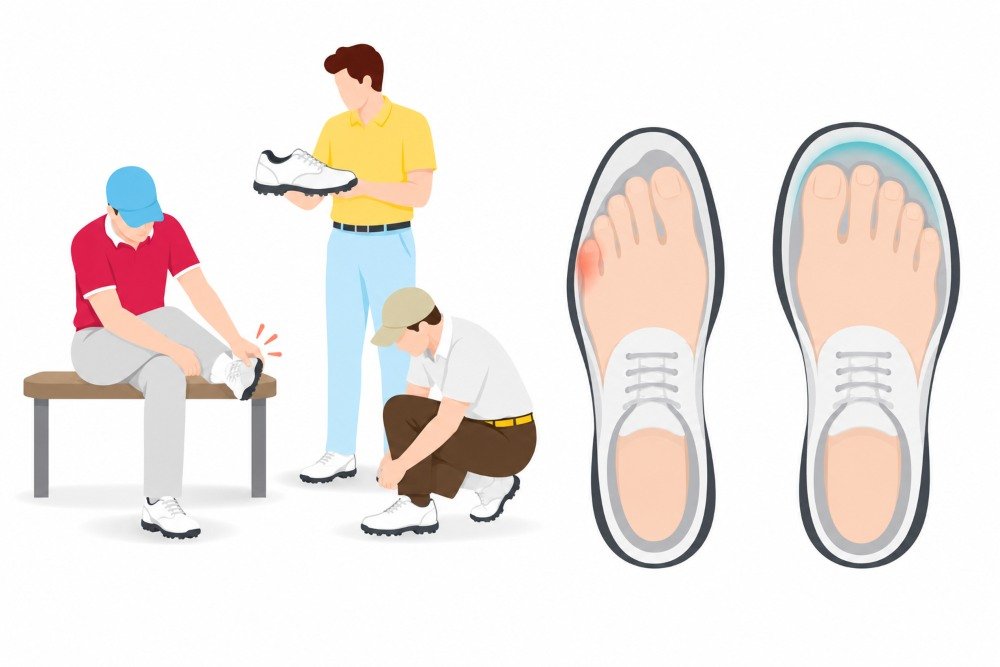
A properly sized wide shoe that still squeezes, or that only feels acceptable after plenty of lace adjustment, is telling you something. Look for:
- The upper straining over the little-toe joint.
- The forefoot visibly overhanging the edge of the sole.
- Numbness, burning or rubbing that returns in the same place round after round.
Those are width problems, not patience problems.
Moving up to extra-wide should not mean accepting a sloppy fit. The aim is more room at the front with the same secure heel and midfoot, and that is the standard to hold any pair of mens extra wide golf shoes to. Check that the model comes in a clearly named extra-wide option, such as 4E, rather than a vague promise of a generous fit.
Bunions add another layer. Guy’s and St Thomas’ NHS guidance on bunions suggests wide-fitting footwear, such as EE widths or wider, to accommodate the joint. If you have persistent pain, numbness or burning in the forefoot, have it assessed by your GP or a podiatrist rather than simply swapping shoes.
Soles, Spikes And Club Rules
Spiked and spikeless shoes follow the same fitting principles, but they rarely feel identical. Spiked designs often have firmer platforms and more structured uppers, while many spikeless shoes are built more like trainers. Different lasts, tongues, heel padding and upper materials mean the same width letter can feel noticeably different across the two.
It also pays to know the rules. The R&A’s equipment rules permit spikes, subject to the conditions of a competition. They do not permit shoe features designed to help build a stance or to help with alignment. Committees can also adopt Model Local Rule G-7, which bans traditional deep-penetrating spikes, and spikes with metal that could contact the course. Check what your club has in place.
Grip is useful. It is not a substitute for fit.
Before The Tags Come Off
Before you commit to a pair, run a final check at home. Lace both shoes fully, wear your golf socks and walk around indoors for several minutes so the soles stay clean enough to return. Make some practice swings rather than judging the fit from the sofa.
Your heel should stay down. The shoe should bend where your foot bends. Your toes should have room without your foot sliding forward on each step. If you wear an orthotic, test with it in place, because FootJoy points out that an insert thicker than the shoe’s own insole reduces the room inside.
Treat marketing words such as “roomy” or “comfort fit” with caution unless they come with a width letter. On their own, they do not tell you where the extra space is.
Common Questions About Golf Shoe Width
| Question | Answer |
|---|---|
| Does 2E Count As Wide Or Extra-Wide? | On FootJoy’s chart, 2E is Wide and 3E is X Wide. Other brands, including specialist wide-fit makers, label their widths differently, so check the letter rather than the description. In traditional British fittings, G usually means wide and H extra wide. |
| Should Golf Shoes Be Tighter Than My Trainers? | Firmer at the heel and midfoot, yes. Tighter across the forefoot, no. Secure and squeezed are not the same thing. |
| Do I Need A Bigger Size For Winter Golf Socks? | Not necessarily. Try your shoes with the socks you actually wear. If the length is right but the fit turns tight, look at a wider or higher-volume model before a longer one. |
| Can My Foot Width Change Over Time? | Yes. FootJoy notes that feet commonly flatten and widen as we age, so it is worth being remeasured every few years rather than relying on an old size. |
| What If My Feet Are Different Sizes? | Fit the larger foot. FootJoy adds that where feet differ by more than one size in length or two sizes in width, you may need a different size for each f |
Fit Before Features
Waterproofing, cushioning and grip all earn their place on a British course, but none of them can rescue a shoe that does not fit.
For broad-footed golfers, the classic mistake is fixing side pressure with extra length. Settle the length first, then let width, toe-box shape, instep volume and heel hold decide whether a shoe suits your foot.
The best golf shoes almost disappear. You notice them on the tee because they feel planted, and you forget about them on the walk between shots. If your forefoot is dominating your thoughts by the fifth hole, the answer is rarely more breaking in. It is a better fit.
Disclaimer: This article is for general information only and is not medical advice. If you have persistent foot pain, numbness, bunions, diabetes or another condition affecting your feet, speak to your GP or a registered podiatrist before choosing footwear. Brand sizing charts and product ranges change, so check the manufacturer’s current guidance before buying.