A five-minute outfit is not created by rushing. It becomes possible when the difficult decisions have already been removed.
The aim is not to own the perfect wardrobe or dress like the same person every day. It is to create a small, dependable system that works on ordinary British mornings, including late alarms, crowded commutes, school runs and weather that changes before you reach the end of the road.
Build a Working Wardrobe Rather Than a Perfect Capsule
The phrase “capsule wardrobe” can make getting dressed sound like an organisation project involving matching hangers, strict colour palettes and an exact number of garments.
It does not need to be that complicated.
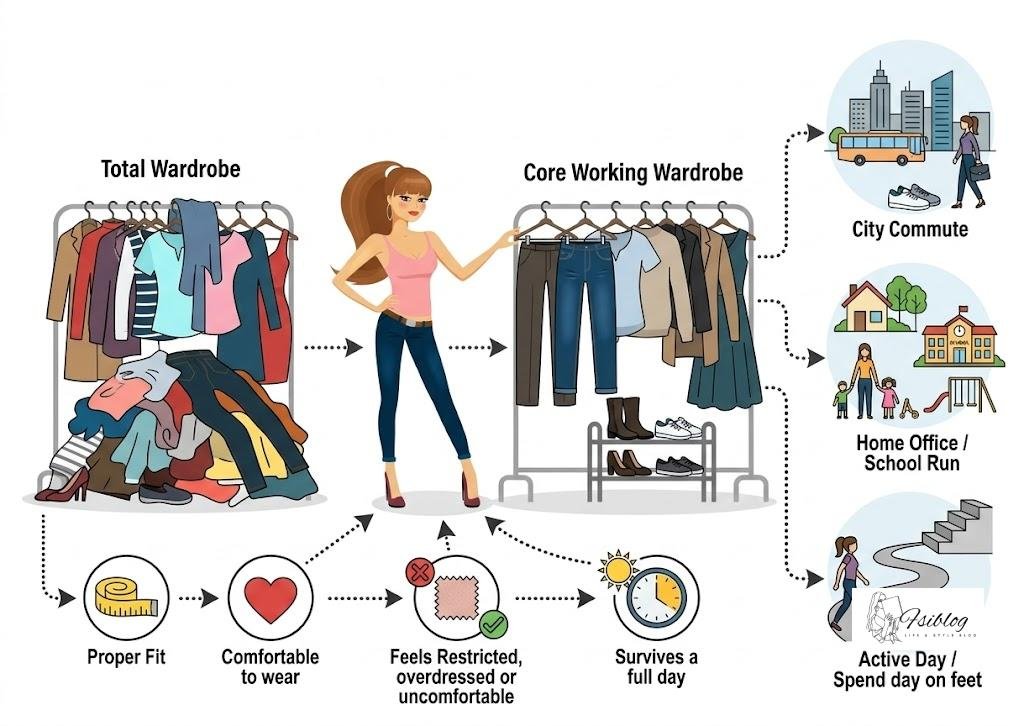
Your working wardrobe is simply the part of your wardrobe that reflects how you currently live. Someone commuting into Manchester three days a week needs different staples from someone working at home, managing a school run or spending most of the day on their feet.
Start by identifying the clothes you already reach for without hesitation. These might include:
- Two pairs of trousers that fit properly
- One reliable pair of jeans
- Three tops that work with every bottom
- A comfortable jumper
- A blazer, cardigan or lightweight jacket
- Two practical pairs of shoes
- One dress that can handle several occasions
Your best pieces are not necessarily the most expensive or fashionable ones. They are the garments that survive a full day without making you feel restricted, overdressed or uncomfortable.
The capsule guidance from Who What Wear UK makes an important distinction: a useful capsule should reflect personal taste and everyday life rather than somebody else’s idea of essential clothing.
Before buying anything new, place your most dependable items together on one rail or in one section of the wardrobe. This becomes your fast-dressing area. The remaining clothes can still be used, but they no longer compete for attention every morning.
Create Three-Part Outfit Formulas
Most outfits can be reduced to three decisions:
- The base
- The layer
- The finishing element
The base might be jeans and a T-shirt, tailored trousers and a fine-knit jumper, or a midi skirt and a fitted top. The layer could be a blazer, trench coat, denim jacket or cardigan. The finishing element might be loafers, a coloured bag, a belt or a pair of earrings.
Once you find a combination that works, record it rather than trying to invent something new the following week. Take a quick mirror photograph and save it in a folder on your phone called “Outfits”.
Useful formulas for a typical UK wardrobe include:
| Occasion | Outfit |
|---|---|
| For the office | Tailored trousers, a plain knit, and loafers |
| For hybrid working days | Dark jeans, a crisp shirt, and a relaxed blazer |
| For the school run | Straight-leg trousers, a sweatshirt, and clean trainers |
| For weekend plans | A midi skirt, a simple T-shirt, and a denim jacket |
| For an informal evening out | Dark denim, a soft blouse, and ankle boots |
An outfit formula is not a uniform. Colours, textures, shoes and accessories can change while the basic structure remains dependable.
Choose Clothes for the Day You Are Actually Having
One reason outfits take too long is that people dress for an imaginary version of the day.
A cream suit may look excellent in the bedroom mirror but become less appealing when the day includes a wet railway platform, a packed Tube carriage and a takeaway coffee. A delicate blouse may not be the right choice when you will carry a laptop across town or spend twenty minutes walking from the station.
Before opening the wardrobe, ask three practical questions:
- Where am I going?
- How much walking or travelling is involved?
- Will I need to move between different temperatures?
This immediately removes unsuitable options.
For a day involving an office, public transport and dinner afterwards, dark trousers, a breathable top and a structured jacket may work better than an outfit designed for only one part of the day. The jacket can be removed during the commute and added again when a smarter appearance is useful.
Clothes become effortless when they cooperate with your schedule.
Let One Piece Carry the Outfit
A quick outfit can still have personality. It simply needs one clear point of interest rather than five competing ideas.
That point might be:
- A bright shoulder bag
- A patterned midi skirt
- A textured jacket
- Red ballet flats
- Sculptural earrings
- A printed silk scarf
- A strong coat
- An unusual belt
Keep the remaining pieces quiet enough to support it. A cobalt bag has more impact beside navy, grey or cream than it does in an outfit already containing several prints and colours.
As Vogue UK notes, one statement piece or well-chosen accessory can update familiar wardrobe staples without requiring a completely new look.
This also gives you an easy rule when you are running late: choose one interesting item and stop. Adding more does not automatically make the outfit better.
Use One-and-Done Pieces on the Busiest Mornings
Some days do not leave enough time for even a familiar outfit formula. This is where dresses, jumpsuits and coordinated sets earn their space.
A good one-and-done garment creates the impression of a complete outfit without requiring separate tops and bottoms to be compared. It should also work with at least two types of footwear and one practical outer layer.
Look for:
- Shirt dresses that work with trainers, loafers or boots
- Knitted dresses that can be worn beneath a trench or long coat
- Midi dresses that suit work, lunch or a casual event
- Coordinated sets that can also be separated
- Jumpsuits with enough room for sitting and travelling comfortably
A small selection of Women’s dresses in versatile styles and lengths can provide useful reference points when deciding which shapes might serve several parts of your routine.
The key is to avoid buying a dress that only works in the exact styling shown online. Before choosing one, picture it with the shoes, bag and coat you already own. A versatile garment should join your wardrobe rather than demand an entirely new supporting cast.
Create Two or Three Colour Lanes
A neutral wardrobe is not essential, but some colour structure makes fast dressing much easier.
Instead of trying to make every colour work with every other colour, create two or three simple lanes. For example:
| Colour Lane | Core Colour Palette |
|---|---|
| Lane One | Navy, white, denim, and tan |
| Lane Two | Black, grey, cream, and burgundy |
| Lane Three | Olive, camel, ivory, and dark brown |
Most garments only need to work within their lane. This gives you variety without forcing you to test several uncertain colour combinations at 7.30 in the morning.
Prints can also be assigned to a lane. A navy floral skirt belongs naturally with white, denim and tan. A burgundy checked blazer may sit comfortably with black, grey and cream.
Colour lanes are particularly useful when buying coats, shoes and bags. These items should connect with a large proportion of the wardrobe because they are worn repeatedly.
Start With the Shoes When the Day Is Complicated
Shoes are often treated as the final decision, but on practical days they should come first.
A long commute, uneven pavement, rain or several hours of standing immediately rule out certain options. Once you have chosen appropriate shoes, the rest of the outfit becomes easier.
For example:
- White trainers can lead to straight-leg trousers and a relaxed shirt.
- Loafers can lead to ankle-length trousers and a fine knit.
- Ankle boots can lead to dark denim and a long coat.
- Ballet flats can lead to a midi skirt and cropped cardigan.
This method prevents the frustrating moment when a finished outfit has to be rebuilt because none of your comfortable shoes look right with it.
Keep frequently worn footwear clean and accessible. Five-minute dressing becomes impossible when the shoes you need are buried in a box, missing a lace or still covered in mud from the previous weekend.
Build Around British Weather
A useful UK outfit needs an adjustment plan.
The morning may begin cold, the train may feel overheated, lunchtime may be sunny, and the journey home may involve rain. Dressing for only the first temperature you experience often produces an uncomfortable day.
Light layers are more adaptable than one extremely heavy garment. The Met Office guidance on dressing in several light layers supports this approach during colder conditions because the layers trap warm air and can be adjusted as necessary.
A practical layering system might include:
- A breathable base top
- A shirt, knit or cardigan
- A blazer or lightweight jacket
- A weather-resistant outer coat
Keep one neutral trench, waterproof jacket or compact umbrella close to the front door. Weather protection should be part of the outfit system rather than a last-minute interruption to it.
Remove Small Wardrobe Frictions
Getting dressed often takes too long because of minor problems rather than difficult styling decisions.
The trousers need ironing. The shirt is missing a button. The only suitable bra is in the wash. The handbag is filled with receipts from last weekend. The jumper you wanted is hidden beneath clothes that have not been worn for months.
A ten-minute weekly reset can prevent most of this.
Return shoes to their usual place, steam two or three work garments, empty everyday bags and check the week’s likely weather. Place anything requiring repair in a separate basket rather than returning it to the wardrobe.
The British Fashion Council’s work on garment care and maintenance highlights how better care information can help people keep clothing usable for longer.
This matters for speed as well as sustainability. A smaller collection of clean, visible and wearable clothes is more useful than a crowded wardrobe containing unresolved problems.
Develop Personal Style Through Repetition
There is no need to create a new character every morning.
Personal style often becomes clearer through repeated choices. You may realise that you prefer cropped trousers, soft tailoring, long coats, silver jewellery or dresses with defined waists. These patterns are useful information, not evidence that your wardrobe is boring.
The V&A fashion collection can be a valuable source of visual reference because it shows how silhouettes, materials and styling ideas have changed across different periods.
Use inspiration to notice details rather than copy complete outfits. You might respond to the shape of a coat, the contrast between two colours or the way an accessory changes a simple dress. Translate that detail into clothes suited to your own budget and routine.
Style becomes easier when you know what you like without needing an algorithm to tell you each morning.
Follow the Five-Minute Dressing Routine
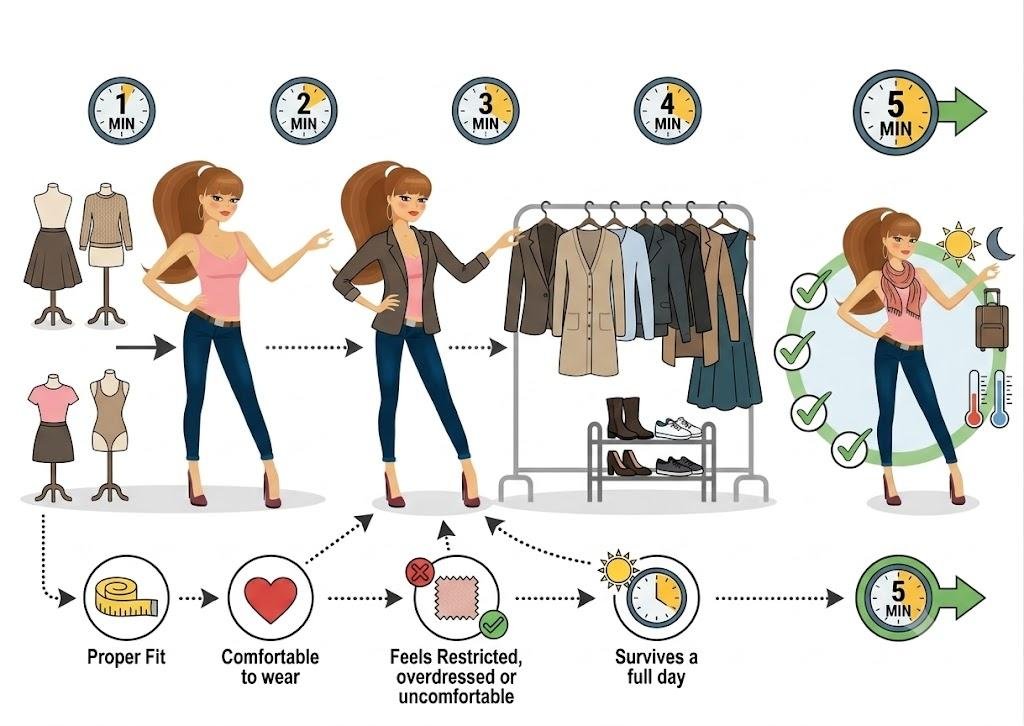
Once the foundations are in place, use the same sequence each morning.
| Minute | Action | Details |
|---|---|---|
| Minute One | Choose the base | Select trousers and a top, a skirt and knit, or a one-piece garment. |
| Minute Two | Add the layer | Choose the blazer, cardigan, jacket, or coat appropriate for the day. |
| Minute Three | Put on practical shoes | Base the choice on walking, weather, and the level of formality required. |
| Minute Four | Add one focal point | Use a bag, jewellery, scarf, belt, print, or strong colour. |
| Minute Five | Check the full day | Confirm that the outfit works for travelling, sitting, temperature changes, and any plans after work. |
Once these decisions are complete, stop editing. The extra seven minutes spent replacing earrings or comparing two nearly identical jumpers rarely change the result in a meaningful way.
Make Buying Less Part of the System
A fast wardrobe is not necessarily a new wardrobe.
Before buying something, ask whether it creates at least three outfits with clothes you already own. Also consider whether it solves a genuine problem. A smart waterproof coat may make dozens of outfits more practical. A fourth occasion dress may create another choice.
WRAP’s research into extending the usable life of clothing found that keeping garments in active use for an additional nine months could reduce their carbon, water and waste footprints by up to 20 per cent.
The Ellen MacArthur Foundation’s vision for circular fashion similarly places greater use of existing products at the centre of a less wasteful clothing system.
None of this requires dressing plainly. It simply means expecting more from each purchase and allowing favourite clothes to appear regularly.
The wardrobe that produces a polished outfit in five minutes is rarely the largest one. It is the wardrobe in which the useful pieces are visible, comfortable, cared for and connected to real life.
Build that structure once, and effortless dressing stops being a lucky morning. It becomes the normal way your wardrobe works.