
A couple from Leeds got engaged in December and wanted a legal marriage abroad before the summer. Neither of them wanted the full UK registry office experience. They’d seen Georgia mentioned in a few places, looked briefly at Denmark, and one of them had suggested Abu Dhabi after a work trip. Six weeks later, they were legally married in Tbilisi, and the whole thing cost less than a weekend in Copenhagen would have. But that outcome wasn’t inevitable; it depended on their understanding of which documents they actually needed as UK passport holders and which country’s process would work for their specific situation.
That’s the part most comparison articles skip. The three destinations genuinely do work differently for British couples, and the reasons have less to do with ceremony aesthetics and more to do with certificates, apostilles, and what the Home Office will accept when you get home.
What UK Law Actually Requires When You Marry Abroad
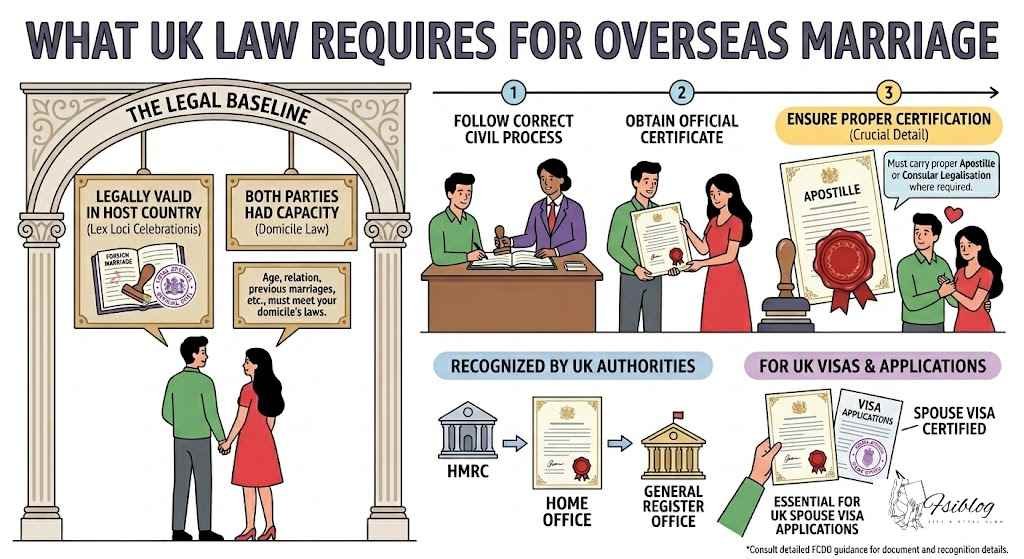
Before comparing destinations, it’s worth understanding the legal baseline. Under English and Welsh law and equivalently under Scots and Northern Irish law, a marriage conducted abroad is recognised in the UK if it was legally valid in the country where it took place, and if both parties had the capacity to marry under the law of their domicile.
In practice, this means that a marriage registered through a proper civil process in Georgia, Denmark, or Abu Dhabi will be recognised by UK authorities, including HMRC, the Home Office, and the General Register Office. What matters is that the foreign process was followed correctly, that you have the official certificate, and that it carries proper apostille certification or consular legalisation where required.
The FCDO publishes detailed guidance on marrying abroad as a UK national, and it is worth reading before committing to any destination, particularly the sections on document requirements and recognition. If you’re planning to use the marriage for a UK spouse or family visa application, which is one of the most common reasons British-Pakistani, British-Indian, or British-Filipino couples marry abroad, the Home Office requires the marriage to be legally recognised, not just ceremonially significant. Getting that right from the start saves a significant amount of trouble later.
Certificate of No Impediment: What It Is and Which Countries Actually Need It
One document trips up more UK couples than any other when planning a marriage abroad: the Certificate of No Impediment, or CNI.
A CNI is an official document confirming that there are no legal barriers to your marriage, that you’re not already married, that you’re of legal age, and so on. In England and Wales, you give notice at your local Register Office, wait 28 days, pay around £35 per person, and the certificate is issued after the notice period. If the destination country requires an apostille on the CNI, you submit it to the FCDO Legalisation Office, currently £30 per document, with a postal turnaround of roughly two to three weeks. Full details on the apostille process, including current fees and turnaround times, are available on the FCDO Legalisation Office guidance page.
The reason this matters is straightforward: Georgia doesn’t require a CNI from UK nationals. Denmark does. Abu Dhabi’s civil court asks for it at the documentation stage. If you’re in a hurry or if you haven’t budgeted several weeks for the CNI process before your trip, that distinction is significant.
Georgia: Why It Works So Well for British Couples Specifically
Georgia has quietly become the most popular destination for UK couples who want a fast, legally clean civil marriage abroad, and the reasons are specific rather than vague.
No CNI, No Waiting Period
The Public Service Development Agency in Georgia does not require British nationals to provide a Certificate of No Impediment. What you need is your valid UK passport and, if either partner has been married before, the original divorce decree with an apostille. That’s it for most couples.
There is no mandatory notice period, no cooling-off window, and no preliminary approval stage. Once your notarised passport translations are in order, a straightforward process that agencies handling UK clients are set up to manage quickly, the marriage can be registered the following working day. For couples working with a local specialist, a Georgia’s wedding agency experienced with British clients will handle the name transliteration, witness requirements, and PSDA coordination, removing the administrative risk from what is already a simple process.
Visa-Free and Easy to Reach
UK passport holders enter Georgia visa-free and can stay for up to a year. There are no Schengen day calculations to worry about, no 90/180 rules, and no entry requirements beyond a valid passport. Before travelling, it is worth checking the current FCDO travel advice for Georgia for any updated entry requirements or safety considerations. The page is updated regularly and takes five minutes to read.
Direct flights operate from London Heathrow and Gatwick to Tbilisi with multiple carriers, with return fares typically ranging from £280 to £550 depending on season and lead time. Tbilisi, Sighnaghi, a hilltop town in the Kakheti wine region that has built a specific reputation as a marriage destination and Batumi on the Black Sea coast all offer distinctly different settings. Accommodation in Tbilisi runs from £40 to £150 per night across a reasonable range of quality, and the overall cost of the trip, including the registration process and a few days in the country, is typically manageable for couples who would otherwise be budgeting for a UK venue deposit.
Post-Marriage Document Process
Georgia is a signatory to the Hague Apostille Convention. After the marriage is registered, an apostille can be obtained from the same Public Service Hall within a few days, making the certificate immediately valid for use in the UK and in over 120 other member countries. The full list of Hague Convention member states is maintained by the Hague Conference on Private International Law and is worth checking if you have plans to use the document in a third country. For Home Office purposes, for name change applications, or for any subsequent legal process in the UK, a Georgian marriage certificate with an apostille is a clean, unambiguous document.
Denmark: The Right Choice for Specific Situations But Slower Than Most Couples Expect
Denmark’s reputation as the European destination for straightforward international marriages is well-earned, but it’s specifically suited to a narrower set of circumstances than the general coverage suggests.
Obvious Case: Same-Sex Couples
Denmark legalised same-sex marriage in 1989, the first country in the world to do so, and its legal protections have been consistent and comprehensive ever since. For same-sex British couples who want a European civil marriage with unambiguous recognition across EU member states, Copenhagen remains the clearest option. Georgia does not permit same-sex civil marriage. Abu Dhabi’s framework is restricted to heterosexual couples. If this is your situation, Denmark is the answer.
EU Connection Advantage
If one or both partners have ongoing EU ties, residency, employment, or plans to relocate, a Danish marriage certificate issued in up to five languages carries automatic recognition across EU member states without consular legalisation. For a British-Spanish couple, a British-German couple, or any pairing where EU document recognition matters practically, that’s a genuine advantage worth the additional process time.
What the Process Actually Involves for UK Nationals
Post-Brexit, UK passport holders are subject to the Schengen 90/180 rule when visiting Denmark. This isn’t an obstacle for most couples; a short trip to Copenhagen sits well within the allowance, but it’s worth tracking if you’ve already spent time in Schengen countries earlier in the year.
The Danish process for a progressive wedding involves submitting your documents to the Agency of Family Law via their online portal, paying approximately €280 (around £240 at current rates), and waiting for approval. Processing typically takes two to four weeks. Once approved, you book a ceremony at any Danish municipal town hall. Copenhagen’s Rådhus is the most well-known, but smaller towns offer quicker appointment availability. Larger municipalities can provide official witnesses free of charge, so you don’t need to bring your own.
You will need a CNI from your UK Register Office, apostilled by the FCDO. Factor that into your timeline: 28 days’ notice at the Register Office, then FCDO apostille processing. Realistically, start the CNI process six to eight weeks before your intended trip.
The overall cost is higher than in Georgia when you add flights, Copenhagen accommodation (typically £150 to £250 per night), and the CNI preparation costs. Budget around £1,500 to £2,500 per couple for the full trip, not including any ceremony additions.
Abu Dhabi: Genuinely Useful for One Specific Type of UK Couple
The Abu Dhabi Civil Family Court, established under the 2021 civil marriage law, is a serious and well-run option. Still, it comes with eligibility restrictions and post-marriage administrative costs that make it the right choice for a narrow group rather than a general-purpose solution.
Who It Actually Works For
The civil weddings framework is available exclusively to non-Muslim couples. If either partner is a Muslim national or holds citizenship from a country where Islam is assigned by default in official documentation, the civil court will not accept the application. This restriction catches some British-Pakistani and British-Bangladeshi couples by surprise. It is not a cultural assumption; it is a formal eligibility check built into the application process.
Additionally, neither partner can be a UAE national. The framework is designed for expatriates and tourists, which covers most British couples travelling for this purpose.
UK passport holders enter the UAE visa-free for 30 days on arrival, with longer stays available through prior application. There are no Schengen complications.
Process and What It Costs
The standard online application costs 300 AED (approximately £65). The court typically schedules a ceremony within two to three weeks of approval. An express service is available for 2,500 AED (approximately £540), reducing the wait to one to three working days useful if you’re combining the marriage with a short trip and have limited flexibility on dates.
One practical advantage over Georgia and Denmark: Abu Dhabi’s civil court does not require physical witnesses at the ceremony. The couple appears before an Authentication Judge, and no supporting parties are needed.
Legalisation Problem for UK Use
This is where Abu Dhabi loses ground for most British couples. Marriage certificates issued by the civil court typically require multi-stage legalisation for use in the UK: certification by the UAE Ministry of Justice, then by the UAE Ministry of Foreign Affairs, and then legalisation at the UAE Embassy in London or the British Embassy in Abu Dhabi. This process takes several weeks and costs several hundred pounds in fees and courier costs, on top of the original registration fees.
For a couple who wants to use the marriage certificate quickly for a spouse visa application, a name change, or a mortgage application that legalisation delay is a material problem. For a couple who is primarily motivated by the destination experience and is not in a hurry to use the certificate domestically, it’s an inconvenience rather than a barrier.
Abu Dhabi makes sense if you are already travelling there, if the setting is genuinely part of what you want, and if you are not dependent on a fast turnaround on a UK-valid document.
Three Scenarios Which Country Actually Fits
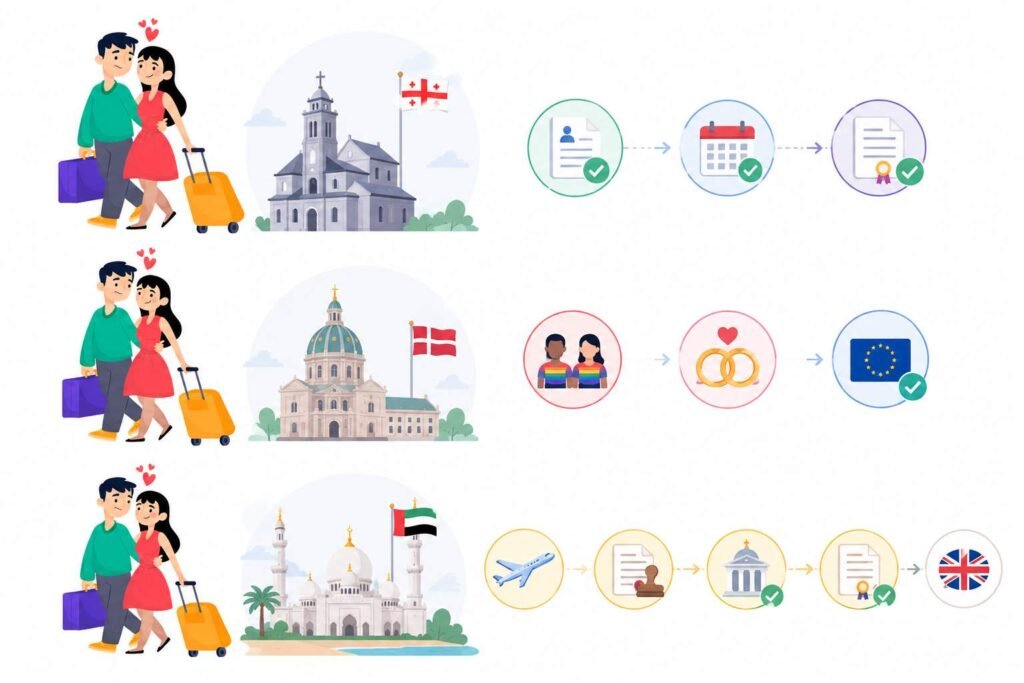
A British-Pakistani couple where one partner is on a visit visa and they want to marry quickly before a visa renewal deadline. Georgia. No CNI requirement, next working day registration, apostilled certificate available within days, clean document for Home Office use.
A same-sex British couple where one partner holds German residency and they want their marriage recognised across the EU. Denmark. The only option of the three that offers both same-sex legal marriage and automatic EU document recognition.
A British couple who regularly travel to Dubai for work have no time pressure on the certificate and want to combine the registration with a UAE trip they’re already planning. Abu Dhabi. Factor in the legalisation process and timeline before relying on the document for anything UK-specific.
One Thing Most UK Couples Get Wrong Before Booking
The most common mistake isn’t choosing the wrong country. It’s assuming the process is the same for everyone and not checking the specific requirements for UK nationals before committing to dates.
Georgia’s no-CNI advantage is real, but it applies to British nationals specifically and may differ for other nationalities. Denmark’s process is transparent, but the CNI preparation timeline catches couples who start too late. Abu Dhabi’s restrictions on Muslim applicants are firm and non-negotiable.
Before booking flights, confirm the document requirements for UK nationals directly with the relevant authority or a reputable local agency experienced with British clients. The broad outlines of each process are stable. Still, the details, particularly around divorced applicants, dual nationals, or couples where one partner is non-British, can vary in ways that matter.
The legal marriage itself is straightforward in all three destinations. Getting the preparation right before you arrive is where the real work happens.