
Florence is easy to fall in love with and surprisingly easy to misunderstand.
A weekend in the city is built around art, churches, restaurants, and views over the Arno. Daily life is built around a different set of questions. Can you afford a suitable home? Does the building have reliable heating and air conditioning? Can you legally work in Italy? Will your rental contract support a visa or residence application? How long will your commute take when the historic centre is crowded?
Living in Florence can offer an exceptional balance of culture, walkability, food, human scale and access to the rest of Tuscany.
Decide Whether Florence Suits Your Real Life
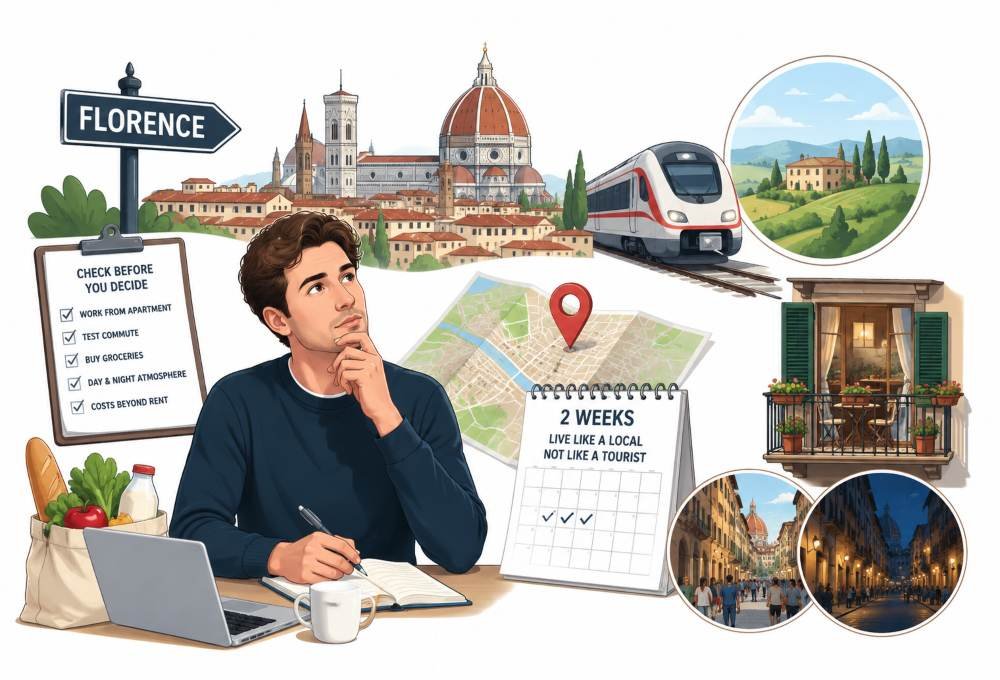
Florence works especially well for people who want the cultural depth of a major European destination without the physical scale of London, Paris or Rome. Much of the city can be crossed on foot, the railway connects Florence with other Italian cities, and the surrounding countryside is close enough for regular day trips.
Before signing a long contract, spend at least two normal working weeks in the area you are considering. Do not treat this period as a holiday. Buy groceries, test the commute, work from the apartment, return home after dark and notice how the street changes during the day.
A neighbourhood that feels atmospheric at lunchtime may be noisy at midnight. A quiet apartment may become uncomfortable in summer. A cheaper home may stop feeling economical after daily taxis or a long commute.
What Does It Cost To Rent In Florence?
Housing should be the starting point of your budget.
Recent property portal data for July 2026 placed average asking rents in Florence at roughly €21 to €22 per square metre each month. Central areas were closer to €25 to €26 per square metre. On that basis, a 50 square metre apartment could be advertised at about €1,050 to €1,120 per month across the city, or around €1,280 in a central location, before utilities and other charges. Furnished apartments, short contracts and particularly attractive properties can cost more. These figures describe advertised prices, not guaranteed final rents.
Do not build your budget from rent alone. Ask for a written breakdown covering:
- The monthly rent
- Condominium charges
- Heating costs and whether heating is independent or central
- Electricity, gas, water and internet
- Waste tax
- Agency fees
- The security deposit
- Any furniture, cleaning or contract charges
The most useful question is not, “How much are the utilities?” Ask to see bills from the previous twelve months. An inefficient historic apartment may be more expensive to heat and cool than a newer home with a higher advertised rent.
Italian law limits a rental security deposit to three months of rent. A residential lease lasting more than thirty days in the same year generally needs to be registered, and registration must normally occur within thirty days of signing or the earlier contract start date.
Prepare for a substantial initial payment. The first month of rent, deposit, agency commission, and utility activation can require several months of housing money at once. Keep this separate from your emergency fund.
Which Florence Neighbourhood Is Right For You?
There is no single best place to live in Florence. The right area depends on where you work, whether you have children, how often you travel, whether you want nightlife and whether you plan to own a car.
1. The Historic Centre And Santa Croce
This is the version of Florence most people imagine. You can walk to museums, restaurants, cafés and the main station. It suits people who value centrality more than space.
The disadvantages are higher rents, tourist crowds, evening noise, limited parking and buildings that may lack lifts or modern insulation. Before renting, check whether the street contains bars, restaurants, waste collection points or early morning delivery routes.
2. Santo Spirito And San Frediano
These areas combine historic character with a strong social life. They appeal to people who enjoy independent restaurants, artisan businesses and an active evening atmosphere.
Popularity creates pressure. Some streets are lively late into the night, and attractive apartments can be expensive. Visit the exact address on a Thursday or Saturday evening before making a decision.
3. Campo Di Marte And Coverciano
These areas often feel more residential and can offer larger homes than the historic core. Campo di Marte railway station is useful for some regional connections, while Coverciano offers a quieter atmosphere and easier access to the eastern side of the city.
Check event traffic and noise if the property is close to the stadium. In Coverciano, confirm the bus journey to your workplace rather than judging distance from a map.
4. Le Cure And The Bolognese Area
Le Cure has a neighbourhood market, local shops and a strong everyday identity. The surrounding areas become greener and more elevated as they move towards the hills.
These locations can be a good fit for people who want a calmer home while remaining reasonably close to the centre. Some streets are steep, and public transport convenience changes quickly from one address to another.
5. Novoli, Rifredi And Careggi
These districts are practical rather than postcard perfect. They can suit professionals connected with the university, hospital, airport or northern business areas.
Novoli benefits from the tram, and Rifredi has an important railway station. Careggi is useful for hospital access. These areas deserve attention from residents who value transport, modern services and everyday convenience over Renaissance views.
6. Scandicci And Sesto Fiorentino
Both are outside central Florence but form part of the wider metropolitan area. They may provide more space and lower asking rents, although the financial advantage depends on the exact commute.
Scandicci has tram access. Sesto Fiorentino has rail and bus connections. Test the whole journey at the time you expect to travel, including the walk to the stop and the final section after arrival.
Use Your Weekly Routine To Choose An Address
Do not choose a home by measuring the distance to the Duomo.
Write down the places you will use every week: workplace, school, supermarket, gym, railway station, airport, doctor, childcare and social activities. Then calculate the journey from each possible address.
Visit the street three times:
- Around 8 in the morning
- Around 6 in the evening
- Around 11 at night
Stand inside the apartment without speaking for several minutes. Open the windows, then close them. Listen for traffic, people, restaurant extraction systems, bells, deliveries, and waste collection.
This simple test can reveal more than a perfectly photographed property listing.
Ten Checks To Make Before Paying A Deposit
| # | What to Check | What to Do |
|---|---|---|
| 1 | Who Is Receiving the Money | Confirm the identity and authority of the landlord or agency. Ask for the proposed contract and written payment conditions before transferring a deposit. |
| 2 | Written, Registered Contract | Ask who will register the contract and when you will receive proof. A formal contract may be important for immigration, residence, banking or tax purposes. |
| 3 | Exit Clause | Check the contract duration, required notice, acceptable reasons for early departure and how notice must be served. |
| 4 | Additional Costs | Clarify condominium fees, utilities, waste tax, maintenance, internet, agency commission and inventory charges. Ask how estimated costs are calculated and reconciled. |
| 5 | Heating and Cooling | Ask for the APE (energy performance certificate). Check the heating system, boiler age, window quality and air conditioning. Consider insulation and building orientation as well as floor area. |
| 6 | Water, Electricity and Mobile Reception | Open taps, test hot water, inspect electrical sockets and check mobile reception in every room. |
| 7 | Internet at the Exact Address | Verify fibre or broadband availability for the specific apartment. If possible, ask the current occupant for a speed test and confirm who owns the router and line. |
| 8 | Access | Count the stairs and confirm whether the lift reaches the apartment floor. Check bicycle storage rules and whether deliveries can reach the entrance. |
| 9 | Condition of the Property | Photograph walls, floors, furniture, appliances and meter readings when receiving the keys. Attach a signed inventory to the handover record. |
| 10 | The Building | Ask about planned works, roof repairs, scaffolding, condominium disputes, central heating schedules a |
Immigration Comes Before Relocation
Choose your legal route before committing to a move. Possible routes can include employment, self employment, remote work, study, family reasons, elective residence or investment. The right route depends on what you will actually do in Italy, not on which visa appears easiest.
A foreign citizen entering with an Italian national visa generally needs to apply for the relevant residence permit within eight working days of arrival. Missing that early deadline can create avoidable problems.
Obtain a codice fiscale as early as possible. This Italian tax identification code is used in dealings with public authorities and is commonly needed for leases, utilities, banking and other contracts. Non-residents can request it through the Italian consular authorities, while eligible applicants can also obtain it in Italy through the relevant offices.
When immigration, property and tax issues overlap, professional advice before the move can be less expensive than correcting a defective application or contract afterwards. International residents can consult lawyers in Florence who assist foreign clients on immigration, contracts, property and related legal matters.
Remote Work Is Not Just A Laptop And An Apartment
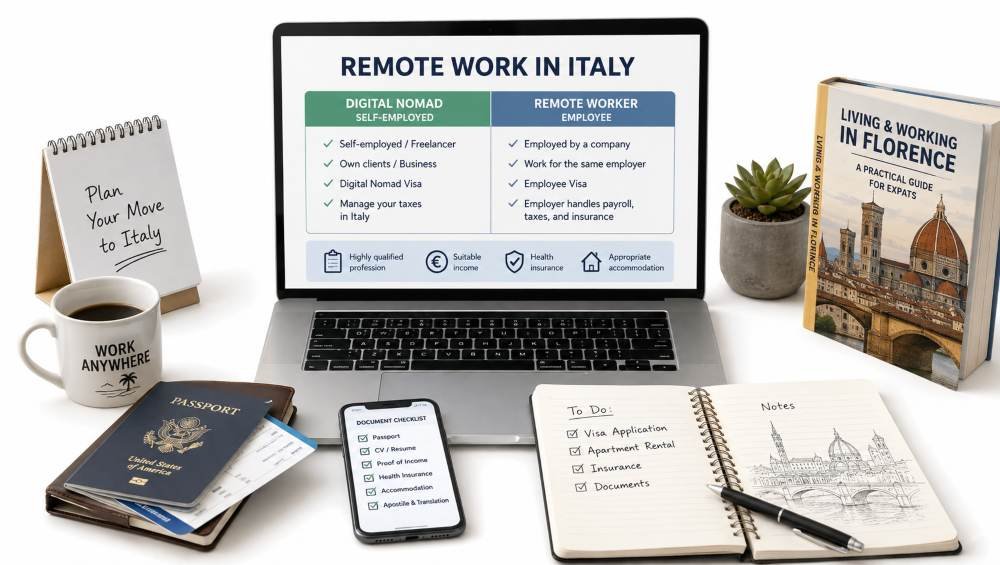
Italy distinguishes between a digital nomad who is self-employed and a remote worker who is an employee. Applying under the wrong category can waste time and money.
Current consular requirements include proof of a highly qualified profession, suitable income, relevant experience, health insurance and appropriate accommodation. Documents issued outside the European Union may require certification, an apostille and an Italian translation, depending on the evidence used.
A registered rental agreement can be important because the consulate asks for suitable lodging that corresponds with the proposed stay. This means housing and immigration planning must be coordinated rather than handled as completely separate tasks.
For a detailed overview of application preparation and practical setup, learn more about visa and relocation services for digital nomads in Florence.
Employees should obtain written approval from their employer before moving. The employer may need to consider Italian payroll, social security, insurance, employment law, and possible corporate tax consequences. A casual agreement with a manager is not a substitute for a formal review.
Freelancers should not assume that foreign clients keep their activity outside the Italian system. Depending on residence and work circumstances, they may need an Italian tax position, social security registration and regular invoicing arrangements.
183 Day Tax Shortcut Is Incomplete
People often say that you become an Italian tax resident only after spending more than 183 days in the country. The real test is broader.
Italy can treat an individual as a tax resident when, for most of the year, at least one relevant condition is met. These conditions include habitual residence in Italy, domicile understood through primary personal and family relationships, physical presence in Italy, or registration in the resident population register unless contrary facts are proven. Fractions of days can count.
This matters because working for a British, American, or other foreign employer does not automatically keep your income outside Italian taxation. A double taxation treaty is designed to allocate taxing rights and provide relief. Still, it does not normally allow a person to choose the more convenient country or avoid filing obligations.
The United Kingdom and Italy also use different tax years. Italy generally follows the calendar year, while the British tax year begins in April. The date of a move can therefore affect two reporting systems.
Arrange cross-border tax advice before your first working day in Florence, not after receiving the first Italian or foreign tax notice. Discuss salary, freelance income, pensions, investments, property, social security and any company interests.
Healthcare Depends On Your Residence Status
A visa application may require private medical insurance, but that does not answer every question about long term healthcare after arrival.
Eligibility for registration with the Italian National Health Service depends on citizenship, residence status and permit type.
After establishing the correct status, the practical sequence may include obtaining the codice fiscale, completing the residence permit process, registering an address, visiting the local health authority and choosing a family doctor where eligible.
Florence Is Often Easier Without A Car
For residents of the centre and many nearby districts, walking, tram services, buses and occasional taxis are often more practical than owning a car.
The T2 tram connects Florence Airport with the city and reaches the central area in about twenty minutes, while the full route continues to Piazza San Marco.
From August 2026, the ordinary Florence urban ticket costs €2 and is valid for 90 minutes after activation. It covers urban buses and tram services, and can also be used on regional trains between specified stations within the Florence urban network. The ordinary monthly urban pass costs €42.20. Fares can change, so confirm them when planning your budget.
A car becomes more useful if you live outside the best served areas, have complex family journeys or make frequent trips into rural Tuscany. In the historic centre, however, limited traffic zones, resident parking rules, narrow streets and garage costs can turn a car into an expensive inconvenience.
Never drive through a limited traffic zone entrance unless you know your vehicle is authorised. Florence requires permission before entry for temporary access, and retrospective insertion is generally not available.
When comparing homes, measure the journey to a tram stop, railway station or reliable bus route. “Ten minutes from the centre” can mean ten minutes by car in ideal traffic, which is not the same as a dependable daily commute.
Prepare The Apartment For Real Remote Work
A beautiful desk beside a Renaissance window does not guarantee a functional working day.
Check five things before signing:
- Fixed internet availability at the exact address
- Mobile signal in the room where you will work
- Sufficient electrical sockets and safe wiring
- Heating, cooling and direct sunlight during working hours
- Noise during video calls
Have a backup plan for outages. This could be a strong mobile data package, a coworking space or a nearby library with suitable facilities.
Also consider time zones. A British schedule fits Italian life easily, but regular calls with North America can push work into the evening, exactly when central neighbourhoods become noisier.
Families Should Choose The School Before The Apartment
Families often begin with neighbourhoods and investigate schools later. Reversing that order can prevent a difficult commute.
Public schools operate primarily in Italian and can provide strong integration into local life. International and bilingual options may have limited places, separate calendars, admission procedures and locations outside the historic centre.
Before choosing a home, confirm:
- Whether a school place is available
- The actual morning journey
- Application deadlines
- Required school reports and translations
- Vaccination and identity documentation
- After school care and holiday coverage
A home that is perfect for adults may be impractical when school drop off, work and afternoon activities are added to the day.
A Realistic Plan For Your First Month
Before Travelling
- Gather original documents, certified copies, apostilles and translations
- Obtain the codice fiscale online
- Arrange suitable health insurance
- Reserve temporary accommodation with enough time to inspect long term housing
During The First Eight Working Days
- Submit the residence permit application if your visa and status require it
- Keep every receipt and appointment document
- Create digital copies of the complete application
During The Following Weeks
- Finalise a written and registered lease
- Open any necessary banking and payment services
- Organise digital identity tools such as CIE or SPID when eligible
- Store all contracts, receipts, bills and official messages in one secure folder
Italian administration is easier when you can produce the exact document requested without searching through emails or suitcases.
Common Mistakes Made By New Residents
| Mistake | Why It Can Be a Problem |
|---|---|
| Choosing the Most Beautiful Street | A famous address can bring crowds, delivery noise, expensive groceries and limited natural light. Focus on the quality of life inside the apartment rather than the appearance of the street. |
| Signing Before Checking Legal Suitability | A rental may look affordable but fail to provide the registered documentation needed for a visa or residence process. |
| Treating 90 Days as a Trial Residence | Visa-free travel does not replace a legal relocation route. Working during a visit can also create immigration, employment and tax issues. |
| Assuming Tax Follows the Employer | Your physical location, home, family connections and residence status can affect your tax obligations. Foreign payroll does not automatically remove Italian tax responsibilities. |
| Buying a Car Immediately | Spend several normal weeks using public transport first. You may find that a transit pass, occasional taxi and weekend car rental are cheaper and easier. |
| Buying Property Too Early | Renting for six to twelve months gives you time to compare seasons, buildings and neighbourhoods. Before buying, arrange independent checks of ownership, planning compliance, cadastral records, condominium issues, heritage restrictions and the purchase contract. |
Frequently Asked Questions
Is Florence Expensive To Live In?
- Do not assume Florence is inexpensive simply because it is smaller than London. Housing is the largest pressure, especially in central and highly desirable neighbourhoods. A realistic budget should include condominium charges, utilities, health cover, transport and professional fees as well as rent.
Do I Need A Car In Florence?
- Not necessarily. Many residents can manage with walking, trams, buses and trains. A car is more useful in peripheral areas or for frequent countryside travel, but it can be inconvenient in the historic centre.
Can A British Citizen Live In Florence Without A Visa?
- British citizens can generally visit the Schengen area for up to 90 days in any 180 days without a visa for permitted visitor activities. Living in Italy beyond that period, or working from Italy, requires a separate legal analysis and may require a national visa and residence permit.
Can I Move To Florence As A Remote Worker?
- Potentially, but eligibility is specific. Italy distinguishes self-employed digital nomads from employed remote workers, and applicants must satisfy professional, income, experience, insurance and accommodation requirements.
Which Area Is Best For International Residents?
- The answer depends on routine. The historic centre offers maximum walkability, Oltrarno offers character and social life, Campo di Marte and Coverciano feel more residential, Le Cure has a strong neighbourhood identity. At the same time, Novoli, Rifredi and Careggi are practical for transport and work.
Is English Enough?
English can help you arrive, but Italian helps you live independently. Even basic practical language improves housing, healthcare, administration and relationships.
Florence is not only a collection of monuments. For residents, it becomes a network of ordinary places: the local market, the bus stop, the pharmacy, the café where someone remembers your order and the street you take home after work.
The city offers an unusual quality of daily life, but it rewards preparation. Choose a neighbourhood according to routine, examine housing with a critical eye, settle immigration and tax questions early, and keep enough time and money for administration.