
Plenty of British travellers arrive in Singapore with a list of hawker centres and end up adding an aesthetic clinic to it. The city has one of the densest concentrations of medical aesthetic practices anywhere in Asia; skin tightening is among the most requested categories, and the prices on display bear very little resemblance to what you would have been quoted in Manchester or Marylebone.
That is where the confusion starts. One clinic quotes S$299 nett for 200 shots. Another quotes S$3,200 for a full face and neck. Both call it the same thing. If you are only in town for ten days, you have limited time to work out which number is the sensible one.
This guide covers what a HIFU treatment genuinely costs in Singapore, how the regulatory picture differs from the one you left behind, and the practical questions that matter specifically when you are treating in a country you are about to fly home from.
How Focused Ultrasound Actually Works
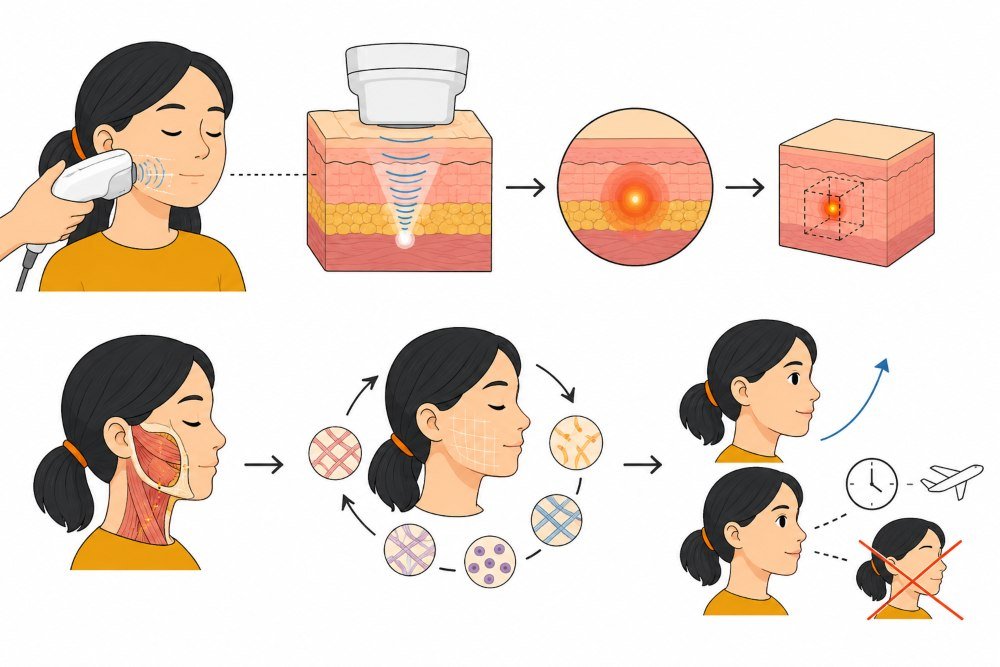
High-intensity focused ultrasound concentrates sound energy at a fixed depth beneath the skin, much as a magnifying glass concentrates sunlight to a point. The surface is bypassed entirely. At the focal point, tissue briefly reaches a temperature high enough to create a thermal coagulation zone roughly a cubic millimetre in size.
The deepest of those focal points is aimed at the Superficial Musculoaponeurotic System, the fibrous sheet of platysma, parotid fascia and fibromuscular tissue that a surgeon lifts and repositions during a facelift. Injuring it in a controlled, microscopic way triggers a healing response, and over the following eight to twelve weeks the body lays down fresh collagen and elastin around each zone.
Two things follow from that timeline, and both matter more when you are travelling. Nothing dramatic happens on the day, so anyone promising an instant lift before your flight is overselling. And the result you are paying for will appear long after you are back in the UK.
Expectations should be calibrated accordingly. A systematic review of microfocused ultrasound for facial skin tightening found measurable improvement across the published studies. Still, the effect sizes were modest and the evidence base thinner than the marketing implies. This is a reasonable option for mild to moderate laxity in someone who does not want surgery. It is not a facelift at any price.
What HIFU Costs In Singapore
Singapore clinics usually price by treatment area, by shot count, or by a combination of the two. Broad market ranges through 2026 look roughly like this:
- Small single areas such as brow, jawline or under-eye: about S$300 to S$1,200
- Lower face alone: about S$800 to S$1,800
- Full face: about S$1,000 to S$2,500
- Full face and neck together: about S$1,500 to S$3,500 and upwards
- Packages of two to three sessions: about S$3,500 to S$6,000
- Consultation: about S$50 to S$150, frequently waived if you proceed with treatment
At roughly 1.7 Singapore dollars to the pound, a full face and neck protocol lands somewhere around £880 to £2,050. Check the live rate before you convert anything, and watch your card issuer’s foreign transaction fee, which can quietly add three per cent.
One piece of local vocabulary is worth knowing. When a Singapore clinic advertises a price as “nett”, it means the figure is final and inclusive, with GST and any additional charges already absorbed. A price quoted without that word may not be. Ask directly, because GST in Singapore currently sits at nine per cent and it makes a real difference at the top of these ranges.
How That Compares With Home
For reference, UK clinics through 2026 were charging roughly £150 to £350 for small areas, £450 to £900 for a full face, and £600 to £1,200 or more for a full face and neck.
So the ranges overlap considerably. The genuine difference is at the bottom. Britain has a visible bargain tier, driven by deal sites and salon-based operators, which does not really have a Singaporean equivalent. The reason is regulatory rather than commercial, and it is worth understanding before you assume the cheapest local option is simply a keener price.
Consumable Nobody Mentions: Cartridges And Shots
Here is the part of HIFU economics that rarely reaches a price list.
Energy is delivered through transducer cartridges, each fixed to a specific depth. A face protocol typically uses three: 4.5mm for the SMAS, 3.0mm for the deep dermis and 1.5mm for the superficial dermis. Cartridges are consumables with a finite working life measured in lines or shots, and on premium platforms a replacement is a high four-figure cost to the clinic.
That single fact explains most of the price spread in any market. Every shot fired carries a real unit cost. A clinic advertising S$299 cannot deliver a comprehensive protocol at that price and remain solvent, so something gives. Usually it is the shot count, sometimes the number of depths used, occasionally the cartridge itself.
None of which makes an entry-level offer dishonest. A S$299 promotion for 200 shots on a defined small area is legitimate if that is what you actually need and the clinic says so plainly. The problem is only when a small treatment is presented as a full one.
Why Shot Counts Are The Most Misused Number
Shot counts have become a selling point in Singapore advertising, which has made them less useful rather than more.
A shot count means something only when you also know the cartridge depths used, the areas covered, and how the shots were distributed. Eight hundred shots fired entirely at 1.5mm across a whole face is superficial work dressed up as structural treatment. Three hundred shots placed accurately at 4.5mm along the jawline and under the chin will do considerably more for a sagging jaw.
As a rough benchmark, a thorough full face protocol generally lands around 600 shots, rising towards 800 when the neck is included. Targeted single areas may need only 200 to 400. If a clinic will not break the number down by depth and zone, that reluctance is itself an answer.
Device naming deserves the same scepticism. Platforms such as Ultraformer MPT, Ultracel Q+, Dublo and Ultherapy differ in delivery speed, comfort and whether they include real-time imaging that lets the operator confirm the focal point is landing in the SMAS rather than in bone or an implant. Those differences are real. Marketing labels like “3D” and “4D” are not regulated technical classifications and guarantee nothing in themselves.
Why Singapore Regulates This Differently From Britain
This is the part most cost guides omit, and for a UK visitor it is the most useful thing on the page.
Singapore treats aesthetic medicine as medicine. The Singapore Medical Council’s Guidelines on Aesthetic Practices for Doctors specify which procedures a doctor may perform and the competencies required to perform them, with an oversight committee advising on the lists. The Ministry of Health reviews compliance with those guidelines during audits of licensed healthcare institutions. Energy-based devices, HIFU platforms included, must be approved by the Health Sciences Authority and used under licensed medical supervision. Beauty salons and spas are not registered with MOH; medical aesthetic clinics are.
England is only now moving in that direction. Section 180 of the Health and Care Act 2022 created the power to license non-surgical cosmetic procedures, and the Department of Health and Social Care has set out a risk-based red, amber and green model, but the scheme is not yet in force. The House of Commons Library briefing on the regulation of non-surgical cosmetic procedures tracks where it has got to. In the meantime, there is very little in England stopping someone with a weekend certificate from buying a HIFU device and treating the public.
The practical implication for you is straightforward. In Singapore, the baseline is higher, so a much larger share of what you find will be doctor-led by default. That is not a reason to skip your own checks. It just means the checks are easier to make.
Checking A Clinic Before You Book
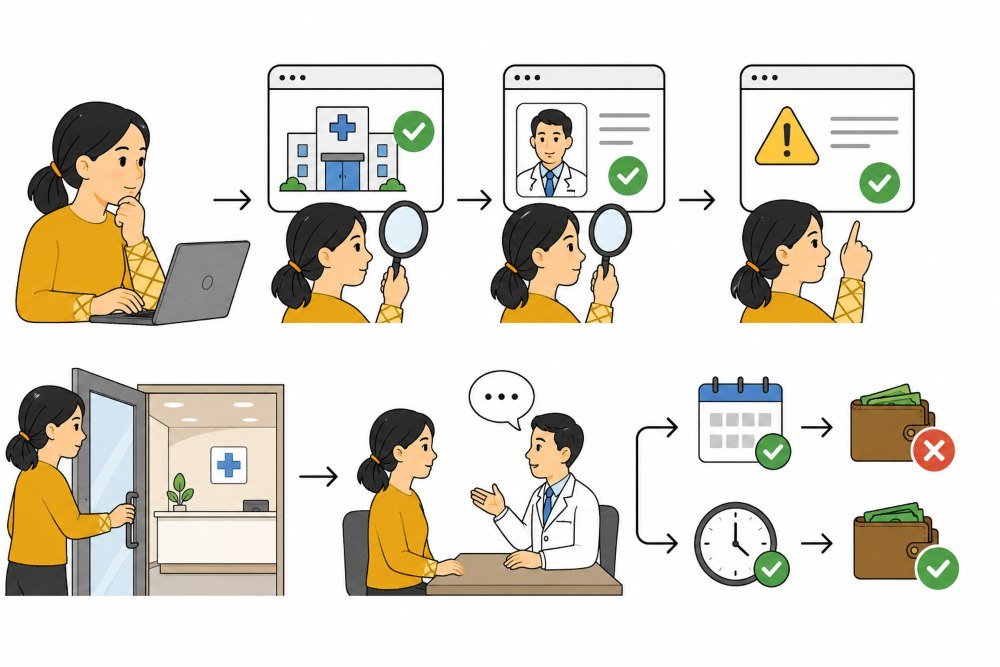
Three verifications, all free, all doable from a hotel room in about ten minutes.
First, confirm the clinic itself is licensed. MOH runs a public directory of licensed healthcare institutions where you can search by name. If a premises treating you with an energy device is not there, that tells you what kind of establishment you have walked into.
Second, check the doctor is registered with the Singapore Medical Council, and check the name on the register matches the person who will actually be holding the handpiece rather than a medical director whose name appears on the door.
Third, look at the MOH watchlist of enforcement actions against healthcare institutions and practitioners. It is not long, which is rather the point, but it costs nothing to scan.
The NHS makes a complementary point in its advice on what to consider before any cosmetic procedure, and it travels well: never book on the day you first walk in, and never pay before a proper consultation. A same-day discount that expires if you leave the building is a pressure tactic in any currency.
Fitting Treatment Around A Trip
HIFU is often sold as a lunchtime procedure, and for most people the downtime is genuinely minimal. Still, the sensible planning is not what most visitors assume.
Expect some redness and tenderness for a day or two, occasional mild swelling, and in a minority of cases patches of numbness or tingling that can persist for a few weeks. None of that stops you sightseeing, but it does argue against booking the afternoon before a wedding, a conference or a long-haul flight in a middle seat.
Singapore sits almost on the equator, so ultraviolet levels are high year-round and freshly treated skin should be kept covered and protected. The FCDO also notes that between June and October the city can experience haze from land clearance fires elsewhere in the region, which is worth factoring in if you are sensitive to air quality.
The bigger scheduling issue is the one nobody mentions. Your result appears at eight to twelve weeks, by which point you will be several thousand miles away. Ask before you book how the clinic handles remote review, whether they want photographs at a set interval, and what their process is if you are unhappy with the outcome. A clinic that has a clear answer has thought about international patients. A clinic that has never been asked will improvise, which is not the same thing.
Insurance, Complications And Getting Home
Two financial realities are worth stating plainly.
Travel insurance almost never covers elective cosmetic procedures, and it very rarely covers complications arising from them. Read your policy wording rather than assuming. The FCDO’s health guidance for Singapore is blunt that healthcare there is high quality and expensive, and there is no reciprocal NHS arrangement, so anything that goes wrong is billed to you.
Complications from HIFU are uncommon but not theoretical. Superficial burns, prolonged numbness, nerve irritation and localised fat loss are all documented. Branches of the facial nerve run deep to the SMAS, which is precisely the plane the deepest cartridge targets, so accurate placement is the entire job. It is also the strongest argument for choosing an MOH-licensed, doctor-led Aesthetic Clinic over whichever promotion happens to be running nearest your hotel.
Before you fly home, get the treatment record in writing: device used, cartridge depths, shot counts per area, energy settings, and a named contact. If you do need to see someone in the UK, that document is what makes it possible for them to help you.
Questions Worth Asking Before You Pay
- Which device is being used, and is it HSA-approved?
- Which cartridge depths will be used on my face, and why those?
- How many shots in total, and how are they distributed across the areas we have discussed?
- Is the doctor performing the treatment personally, and are they SMC-registered?
- Is the quoted price net, and what does it exclude?
- What is the plan for review once I have returned to the UK?
- What happens if I develop a burn, numbness or asymmetry after I have flown home?
Working Out Whether A Price Is Fair
A fair price is not the lowest number on Orchard Road. It is a number that corresponds to a defined quantity of energy, delivered at appropriate depths, by a registered doctor who can explain their reasoning and who has a plan for the eight weeks after you leave.
If a quote sits mid-range and the clinic can walk you through depths, shot counts, device capability and its follow-up process, you are probably paying for something real. If a quote sits well below the market and nobody will tell you how many shots you are getting, you are not buying a cheaper version of the same treatment. You are buying a smaller one, and you will discover that three months later at home, where doing anything about it is considerably harder.
Get the specifics in writing, sleep on it, and check the register before you hand over a card.
This article is for general information and does not constitute medical advice. Discuss any cosmetic procedure with a qualified doctor who has assessed you in person. Prices and exchange rates are indicative and change frequently.