There is a particular kind of silence that happens when someone unwraps a painting. It is not the polite noise people make over a candle set or a voucher. It is a pause, then a second look, then a slightly wobbly attempt at saying thank you. Anyone who has watched a grandparent recognise their own late spouse in oil paint knows exactly the moment being described here.
That silence explains a great deal about where gifting has drifted in 2026. We have arrived at a point where almost anything can be in your hallway by tomorrow morning, and where an image of your family rendered in the style of a Renaissance oil can be generated on a phone in eleven seconds. Abundance has done what abundance always does. It has made the abundant thing feel cheap, and quietly raised the value of everything that still takes time.
Trouble With Gifts That Arrive Tomorrow
Most households in Britain now contain a drawer that functions as a graveyard for well-intentioned presents. The fitness tracker whose app stopped being supported. The novelty gadget from a work Secret Santa. The speaker that needed an account, a firmware update and a password nobody remembers. None of these were bad gifts. They were simply gifts with an expiry date built into them, and everyone involved sensed it.
Commissioned portraiture sits at the opposite end of that spectrum, and its recent popularity is less a trend than a correction. When an image costs nothing to produce, the ones that cost something start to mean something. A painted portrait carries evidence of labour on its surface. You can see where the brush loaded up, where the artist changed their mind about a jawline, where a highlight was scraped back and put down again. Software does not leave fingerprints. People do.
What Actually Changes When A Photograph Becomes A Painting
A camera records. A painter decides. That distinction is the whole of it.
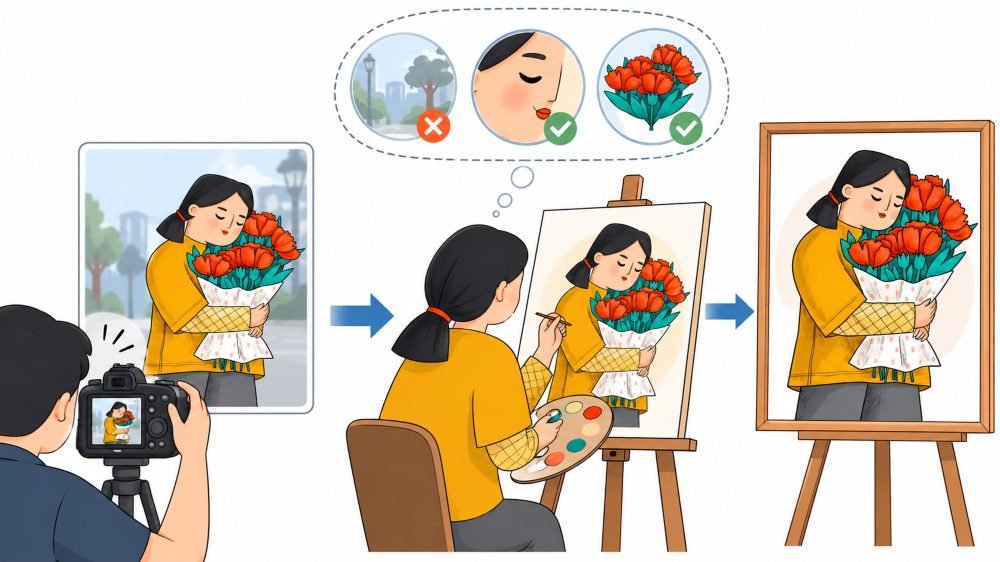
Given a snapshot, an artist has to work out which of the fifty things happening in the frame actually matter. They will usually flatten the fussy background, warm the skin where the phone has gone slightly grey and blue, and lengthen the moment the shutter cut short. What arrives is not a copy of your photograph. It is somebody’s considered account of the person in it, which is why portraits so often look more like the subject than the reference image did.
Britain has never really let go of this idea, whatever the technology of the day. The National Portrait Gallery still runs the most significant painted portrait competition in the world, and its 2026 exhibition drew nearly fifteen hundred entries from more than sixty countries. Free to visit, on until early October, and genuinely worth an afternoon if you want to calibrate your eye before commissioning anything. Standing in front of fifty painted faces teaches you more about what you like than an hour of scrolling ever will.
Your Photographs Are Less Permanent Than You Assume
Here is the uncomfortable part. The average person’s most precious images live in exactly one place: a phone, mirrored to a cloud account that is paid for monthly and tied to an email address that may or may not still be active in thirty years.
Physical prints from the 1970s survive in lofts across the country in shoeboxes nobody has opened since the funeral. Digital files are more fragile than that, not less. Formats fall out of support, accounts lapse, drives fail without warning, and the sheer volume works against you. The National Archives has published extensive guidance on preserving digital records precisely because the problem is real and institutional, not just a domestic nuisance. Their advice to organisations, kept, is the same advice that applies to you: know what you have, keep more than one copy, and periodically check that the copies still open.
A painting sidesteps that entire chain of dependencies. It needs no account, no charger and no compatible software. It needs a wall.
Choosing The Reference Photograph
This is where most commissions are won or lost, and it is the part clients rush.
Artists want detail in the face above all else. That means a sharp, well-lit original at the highest resolution available, sent as the untouched file rather than something forwarded through WhatsApp, which compresses images heavily. Soft, even daylight is ideal, and Britain provides a great deal of it. A bright but overcast day beside a north-facing window flatters almost everyone. Direct midday sun and on-camera flash do the opposite, carving out hard shadows and flattening the features an artist needs to read.
Two practical warnings. Portrait mode blurs edges artificially, and that blur becomes very obvious around hair and shoulders once someone tries to paint it. And beloved old photographs, the creased ones from the 1960s, can absolutely be worked from, but tell the studio upfront so the artist can plan for interpretation rather than transcription.
Once you have your file, most people work with a commission studio rather than approaching an individual painter cold, and that is a sensible route for a first commission. Services such as TryArtWork handle the matching, the proofing stage and the delivery logistics, which removes a lot of the anxiety from what is otherwise quite an exposed process.
Medium, And Why It Matters In A British House
Oil is the traditional choice and ages beautifully, but it is slow. As the Tate’s own glossary on oil paint explains, thin layers are touch dry within days while thicker passages keep hardening for decades. In practice, that means a heavily worked oil portrait should not be sealed behind glass or couriered in a hurry.
Watercolour and coloured pencil suit lighter, brighter interiors and works on paper generally want glazing. Charcoal reads beautifully in a monochrome or minimalist room. Acrylic dries fast, travels well and is often the pragmatic answer when the anniversary is six weeks away.
Where you hang it matters more here than in drier climates. British housing stock, particularly Victorian and Edwardian terraces, gives you cold external walls, chimney breasts above working fires and radiators sitting directly beneath the best windows. The British Association of Paintings Conservator-Restorers advises against all three positions in its guidance on caring for paintings, because it is fluctuation in humidity and temperature that cracks paint, not any single reading. For context, the National Gallery holds its own collection at around 55 per cent relative humidity with tightly controlled lighting, as set out in its notes on paintings and their environment. Nobody expects that at home. An internal wall, out of direct sun, away from the radiator, gets you most of the benefit.
If something does go wrong years down the line, resist the urge to clean anything yourself. Icon’s find a conservator directory lists accredited professionals across the UK, and an hour of proper advice costs far less than an amateur repair.
Timing It Properly
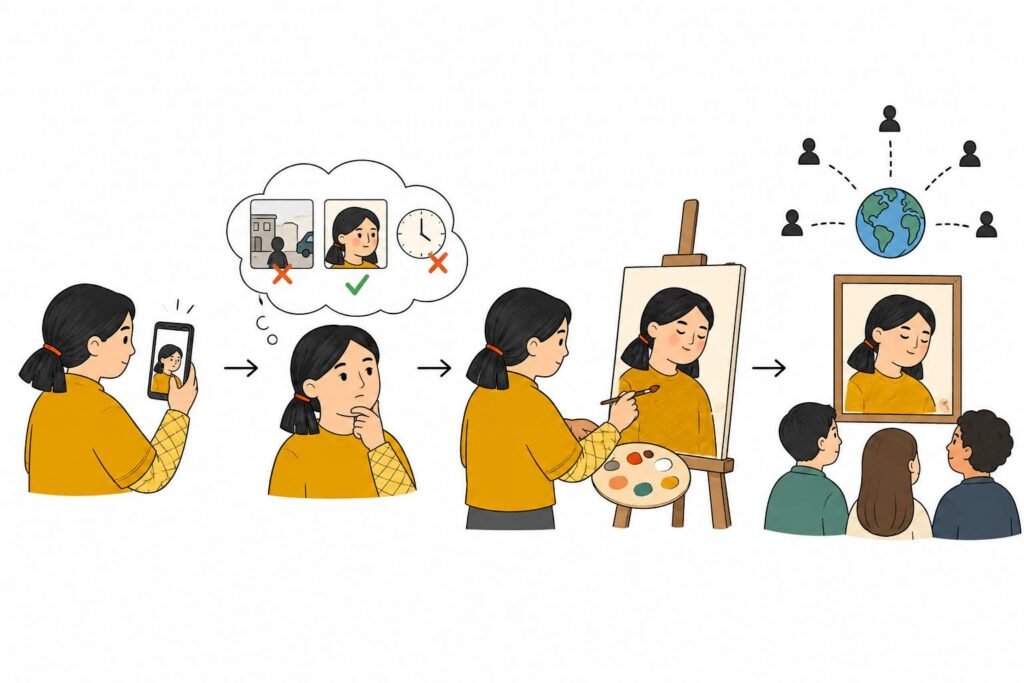
Commission lead times typically run four to ten weeks, and bespoke framing adds a fortnight on top. Work backwards from the occasion, not forwards from today.
The British calendar has its own traps. Mothering Sunday falls in March here rather than May, and it moves each year with Easter, which catches out anyone used to American gift guides. Father’s Day lands in June. For Christmas, a September commission is comfortable, and a late October one is a gamble, because every studio in the country is running the same backlog.
One more thing worth knowing before you pay a deposit. Personalised and made-to-order goods are exempt from the standard fourteen-day cancellation rights that apply to most online purchases in the UK, as Citizens Advice sets out in its guidance on returning goods bought online. This is not a reason to be nervous, but it is a reason to read the studio’s proofing policy, confirm what happens if you dislike the initial sketch, and keep everything in writing.
Point Of All This
A good portrait is not really about the paint. It is a statement, made in a fairly costly and irreversible way, that a particular person mattered enough to be looked at properly for weeks by someone who had never met them.
If you want to sharpen your instincts before committing, spend an afternoon at the Royal Academy of Arts or your nearest regional gallery and pay attention to which faces stop you. That preference, more than any style guide, is what you should hand the artist.
Everything else in the gift drawer will be forgotten by spring. This will still be on the wall when your grandchildren are arguing gently about who gets to keep it.