
Every clothing business, regardless of its size or the channel through which it sells, is only as reliable as the supply relationships behind it. A well-designed product range, a compelling brand identity, and a carefully built audience count for very little if stock is inconsistent, late, or poorly made. This is one of the more humbling realities of fashion retail: the sourcing decisions that customers never see shape almost everything they experience.
For UK-based brands and retailers, sourcing is not simply about price. It is about reliability, compliance, shipping timelines, customs processes, VAT handling, and quality consistency. Getting this right is not a back-office task. It is one of the most important strategic investments a growing fashion business can make.
Below is a more practical, UK-focused guide to choosing and managing suppliers to support sustainable growth.
Why Supplier Choice Matters More in the UK Market
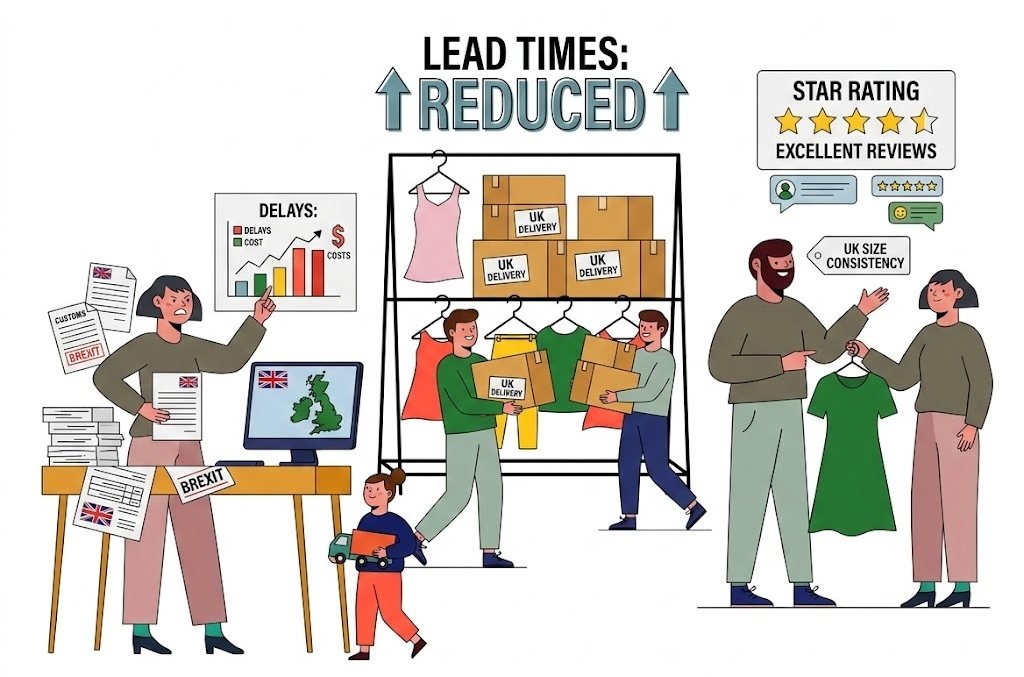
Operating in the UK brings specific considerations that directly affect sourcing decisions:
Import complexity
Post-Brexit customs procedures, import duties, and VAT treatment can add unexpected cost and delay when sourcing from overseas. A supplier that understands UK documentation requirements can prevent stock from being held at port.
Lead time sensitivity
UK retail is highly seasonal. Spring, Summer, and Autumn-Winter collections follow tight buying cycles, and missing a delivery window can mean missing peak demand entirely.
Consumer protection expectations
UK customers are accustomed to clear returns policies, consistent sizing, and reliable quality. Inconsistency is quickly reflected in online reviews.
Working with experienced wholesale clothing suppliers who understand these UK-specific pressures reduces operational friction and protects margin during growth.
Supplier Relationship as a Strategic Asset
In the early stages, many brands treat sourcing as transactional: request samples, compare prices, and place an order. This works temporarily but does not build resilience.
As your business grows, the advantages of a deeper supplier relationship become clear:
- Early visibility on new collections
- Priority production slots during peak periods
- Faster resolution of quality issues
- More flexible reordering terms
- Better communication during disruptions
This is not theoretical. A January 2026 analysis by FashionUnited on how fashion brands are future-proofing their supply chains showed that resilience, not speed alone, is now the defining performance metric. Brands with collaborative supplier partnerships were better positioned to maintain stock availability and protect margins during global instability.
For UK businesses navigating shipping volatility and seasonal demand swings, resilience is not optional.
What Quality Consistency Really Means
Quality consistency is often discussed vaguely. In practice, it involves measurable standards.
1. Fabric Consistency
- Same GSM weight across reorders
- Same fibre composition
- Same dye depth and wash response
Request fabric specification sheets and keep them on file. If a reorder differs, you have a documented reference.
2. Sizing Accuracy
- Consistent grading across production runs
- No pattern adjustments without approval
- Reliable measurement tolerances
Ask suppliers for size charts with tolerance ranges. Compare samples to those charts before bulk approval.
3. Construction Standards
- Stitch count per inch
- Reinforcement at stress points
- Consistent label placement and finishing
Quality control should be part of your buying process, not an afterthought handled by customer service.
In the UK online retail environment, inconsistent sizing is one of the fastest ways to increase return rates and damage review scores.
How to Assess a Supplier Before Committing
Beyond price, here are practical steps UK brands can take:
Request Real Production Samples
Sales samples can differ from bulk production. Ask for a sample from an actual production run.
Ask About Peak Season Performance
Instead of asking what the lead time is, ask:
- What was your average delivery time during your busiest quarter last year?
- What percentage of orders were delayed?
This reveals operational reality.
Check Reorder Flexibility
- Can you reorder in smaller quantities once a style proves successful?
- Can colourways be mixed within minimums?
- Are core styles permanently available?
For growing brands, the ability to restock bestsellers quickly is often more valuable than saving a small amount per unit.
Reading a Supplier’s Range for Commercial Fit
Not every supplier aligns with every brand.
If your bestsellers are:
- Simple, well-constructed staples
- Neutral colour palettes
- Core layering pieces
Then a supplier focused on long-term re-orderable essentials will serve you better than one built around short-lived trends.
Conversely, if your customers respond strongly to novelty drops and rapid style turnover, a trend-focused supplier may be more aligned.
Look at your sales data. Your bestsellers reveal what customers actually purchase, not just what they browse.
Minimum Order Quantities and Cash Flow
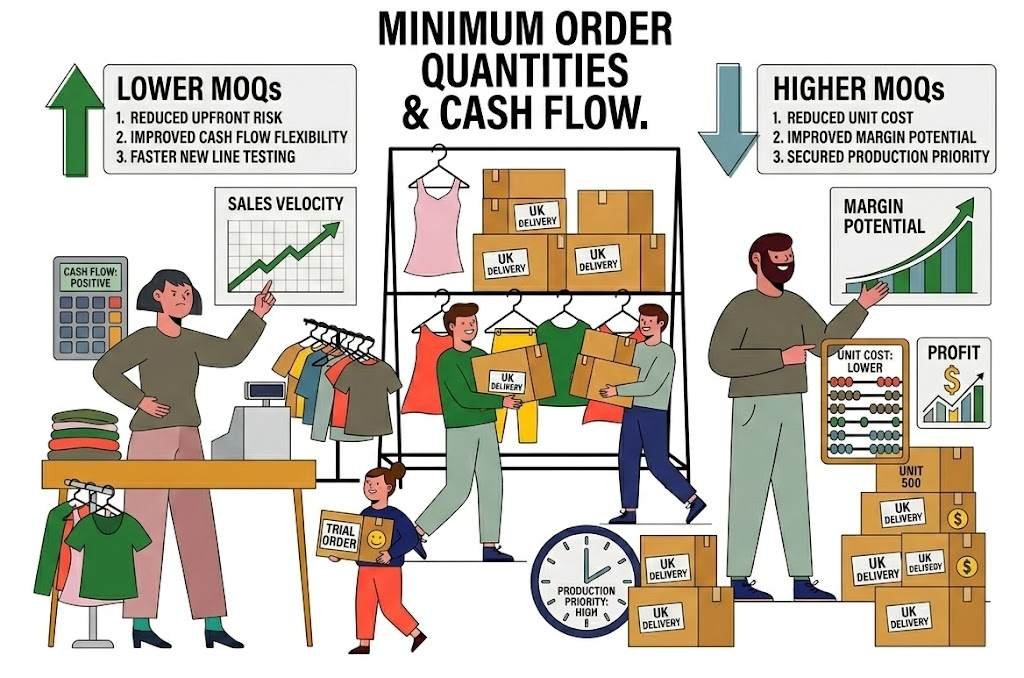
Minimum order quantities directly affect your working capital.
Lower MOQs:
- Reduce upfront risk
- Improve cash flow flexibility
- Allow faster testing of new lines
Higher MOQs:
- Reduce unit cost
- Improve margin potential
- Secure production priority
UK brands should calculate sales velocity before negotiating. If a style sells 100 units per month, a 500-unit order may be appropriate. If it sells 20 units per month, that same order puts cash flow under strain.
A strong supplier relationship often allows:
- Smaller trial orders
- Graduated reorders
- Mixed colourway minimums
- Partial restocks
This flexibility becomes a competitive advantage.
Communication as a Predictor of Performance
One of the most overlooked indicators of supplier quality is the speed and clarity of communication before an order is placed.
Pay attention to:
- Response time to emails
- Details provided in stock updates
- Transparency about delays
- Accuracy of documentation
If communication is slow and vague during the sales process, it is unlikely to improve once money has changed hands.
For UK retailers operating on strict launch schedules, proactive communication can be the difference between a smooth collection release and a costly delay.
Risk Management for UK Brands
To reduce exposure, consider these practical steps:
- Avoid relying on a single supplier for your entire range
- Keep core bestsellers with one consistent partner
- Use secondary suppliers for experimental lines
- Maintain a 4 to 6 week safety stock for proven items
- Document all quality standards in writing
Diversification does not mean constant switching. It means structured redundancy.
Sustainability and Compliance Expectations
UK consumers are increasingly attentive to sustainability claims and ethical sourcing.
Before committing to a supplier, clarify:
- Where garments are manufactured
- Labour standards followed
- Environmental certifications
- Fabric traceability
Even if sustainability is not your primary brand message, regulatory and consumer scrutiny in the UK market continues to increase. Transparency now prevents reputational issues later.
Final Thoughts
Building a fashion business is an exercise in making informed decisions under uncertainty. Product design and marketing receive the most creative attention, but supply relationships quietly determine whether those efforts succeed.
For UK brands in particular, sourcing decisions influence:
- Delivery reliability
- Return rates
- Customer reviews
- Cash flow stability
- Long-term scalability
A well-chosen supplier is not just a product source. It is a structural advantage. When supply is consistent, communication is strong, and reordering is flexible, everything else becomes easier to build.
The strongest fashion businesses are rarely those chasing the lowest unit cost each season. They are the ones that treat their supply relationships as long-term strategic assets and build from that stable foundation.