
Here is a statistic that should bother anyone who writes about lifestyle for a living. According to the Office for National Statistics, the amount of time UK adults spend on entertainment, socialising and other free time activities has been falling steadily, down to an average of three hours and thirty-nine minutes a day, compared with four hours and seventeen minutes three years earlier. Roughly two hours and seventeen minutes of what remains goes on television. Actual socialising with other people accounts for about thirty-two minutes.
We have less free time than we did, and the response from most of the wellness internet has been to tell us to manage it better. Schedule it. Batch it. Track it. Treat your downtime with the same rigour you apply to your skincare routine or your training plan.
This is a strange piece of advice when you look at it directly. The problem is that there is less rest available, and the solution on offer is to make rest more effortful.
Productivity Trap Has Come For Your Evenings
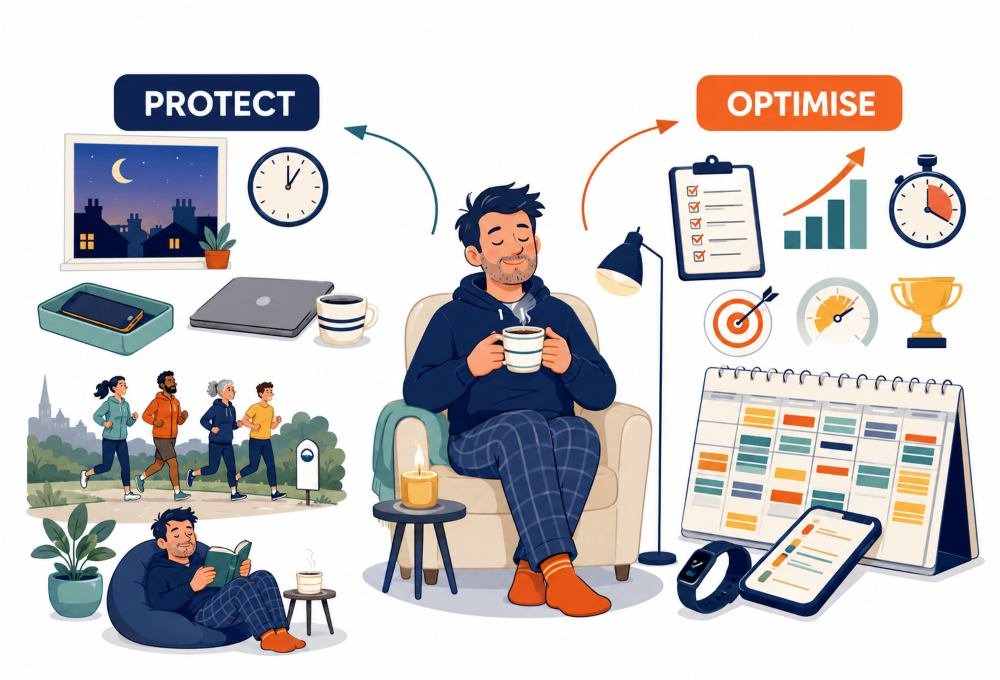
You can see the logic of it. If you only get ninety uninterrupted minutes on a Tuesday, you want them to count. Nobody wants to surface from a scroll hole at half eleven wondering where the evening went.
But there is a difference between protecting your leisure and optimising it, and the distinction matters more than it sounds. Protecting it means defending the boundary: phone in the other room, tea at seven, no email after eight. Optimising it means importing the machinery of work into the one part of the day that was supposed to be free of it. Targets. Metrics. A sense that you might be doing your relaxation wrong.
Parkrun is a useful test case here. It works, and it is enormously popular across Britain, and the reason is not that it gamified running. It is that it is free, it is at the same time every Saturday, and nobody is measuring whether you got value out of it. The structure removes decisions rather than adding them. That is the shape good leisure infrastructure takes.
Most “intentional leisure” advice does the opposite. It hands you another thing to be conscientious about, which is precisely the resource that was already exhausted.
What Oxford Actually Found About Play
Because gaming sits in this conversation constantly, it is worth being accurate about what the research says, since the research is regularly misdescribed.
The Oxford Internet Institute has produced the most rigorous work in this area, largely because it managed to get objective play data from games companies rather than relying on people’s estimates of their own screen time. Its 2022 study, published in Royal Society Open Science, concluded that there was little evidence for a causal connection between time spent playing and wellbeing in either direction. Playing more did not make people happier. Playing less did not either.
A later study tracking over 140,000 hours of gameplay across 150 games found that it is the quality of the experience rather than the quantity of hours that predicts how players feel. Feeling competent at something, and feeling connected to other people through it, did the work. The clock did not. A separate mood study from the same group described gaming, for most people, as a recovery activity that helps manage everyday stress without producing substantial long-term effects.
That is a genuinely useful finding, and it is more modest than the version that circulates. There is no reputable evidence that fifteen minutes of daily play improves cognitive flexibility in the middle-aged, and claims along those lines tend to trace back to nothing at all. What the evidence supports is narrower and more sensible: enjoyable, absorbing activity is decent for your mood in the short run, and how you feel while doing it matters more than how long you do it.
Where The Comparison Stops Working
Here is the part that lifestyle writing tends to blur, and it is worth being blunt about.
All of the research above concerns video games. It does not concern gambling, and the two are not interchangeable categories just because both happen on a phone and both involve a screen with buttons on it. A puzzle game has no stake. A slot does. That single difference changes the psychology, the regulation and the risk profile entirely, and no amount of shared interface design collapses it.
British advertising rules take this seriously enough to write it down. Section 16 of the CAP Code prohibits gambling advertising from suggesting that gambling can enhance personal qualities such as self-image, self-esteem or a sense of control. Separate guidance makes clear that ads must not present gambling as an escape from personal problems such as loneliness or low mood, nor as a route to emotional support or relief. Those rules exist because that framing has caused real harm, repeatedly, to real people.
So the “slots as self-care” framing you occasionally see in lifestyle content is not merely a bit of harmless positioning. In Britain it is the specific thing the code was written to prevent.
It is also not how people describe their own behaviour. The Gambling Commission’s national survey found that the most common reasons adults gave for gambling were the chance of winning big money, cited by 84 per cent, and because it is fun, cited by 69 per cent. Wellness does not appear. People know what they are doing. They are doing it for the money and the entertainment, which is a perfectly coherent answer and considerably more honest than calling it mindfulness.
Decisions That Happen Before You Play
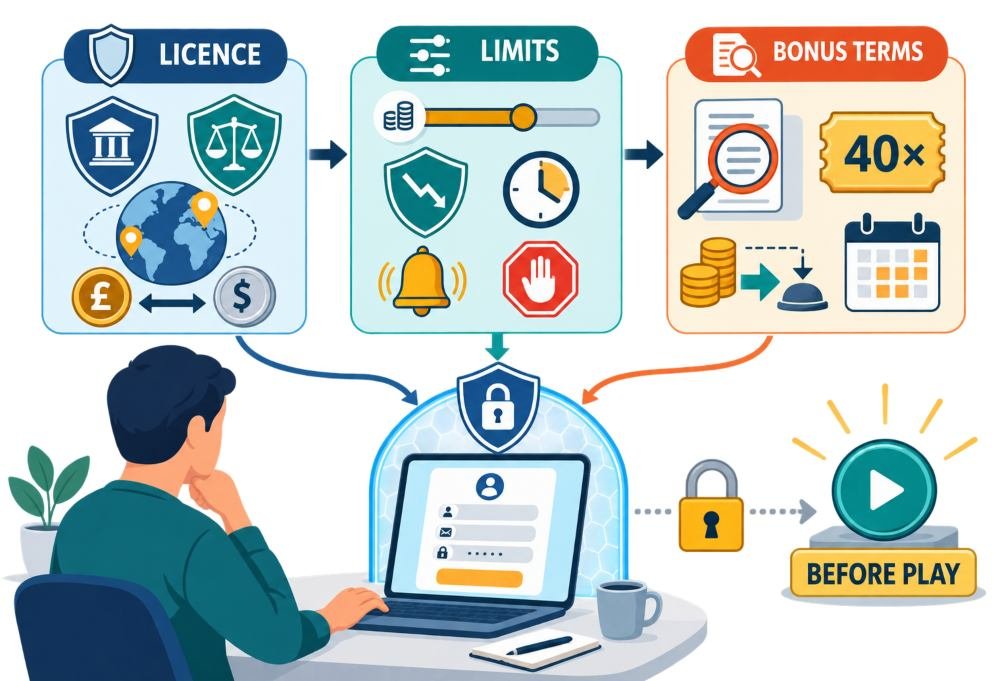
If you do gamble, the meaningful choices sit at account level, and they sit there before you open anything rather than during it.
Deposit limits, loss limits, session time-outs, reality checks and self-exclusion are the actual controls. On an operator holding a Great Britain licence, several of those are mandatory and connect to the national self-exclusion register, which means one registration blocks you everywhere licensed. On an operator licensed elsewhere, none of that is guaranteed, and whatever tools exist are the ones the operator chose to build.
This is worth checking at the point of registration rather than later, because the difference is invisible from the front page. A Curaçao-licensed platform aimed at the Canadian market, for instance, presents a broadly similar sign-up flow to a British one. Still, the Lucky Hills casino login sits behind a different regulator, a different currency and a different set of obligations to the person opening the account. Whether that suits you is your call. Not knowing which one you are on is the avoidable part.
The second thing to read is the bonus terms, specifically the wagering requirement. A promotion advertised as a match on your deposit will typically carry a multiplier attached to it, and a 40x requirement means the bonus is not money in any ordinary sense until a great deal of turnover has passed through the account. Withdrawal caps and monthly limits sit in the same paragraph. These are the least glamorous four hundred words on any gambling site and the only ones that materially affect what happens to your money.
A More Honest Version Of Rest
Strip out the optimisation talk and what remains is fairly ordinary, which is probably why it does not trend.
Rest that works tends to be absorbing rather than stimulating, and it tends to involve either other people or something you are moderately good at. That is the actual through-line in the Oxford findings: competence and connection. It describes a running club, a bad five-a-side team, a choir, a woodworking evening class, a proper conversation in a pub, a library card. It also describes gaming, when the gaming is the kind where you get better at something or play alongside someone.
What it does not describe is passive consumption with a metric attached. Half an hour of something you enjoy, chosen because you enjoy it, is not improved by tracking it.
Britain has less free time than it did five years ago. The honest response to that is to defend the hours rather than to audit them. Put the phone down, or do not, but stop grading yourself on the outcome. The whole point of leisure is that it is the part of the day where nothing is required of you, and any framework that turns it into another performance review has quietly taken the thing it claimed to protect.
Disclaimer: This article is for readers aged 18 and over and is provided for general information only. It is not medical, financial or legal advice. Nothing here is a recommendation to gamble or to use any particular platform, and gambling should never be approached as a wellbeing practice, a source of income or a response to stress or low mood. Regulatory protections described apply to operators licensed by the Great Britain Gambling Commission and differ in other jurisdictions. If gambling is causing difficulty for you or someone close to you, free and confidential help is available from the National Gambling Helpline on 0808 8020 133, 24 hours a day, and from the NHS and GamCare.