
Physical therapy continues to advance rapidly. UK patients who understand what certified physiotherapists offer, and what Orthopedic services to ask about, consistently achieve better outcomes. This guide cuts through the noise and tells you exactly what matters.
Which Physical Therapy Certifications Matter Most?
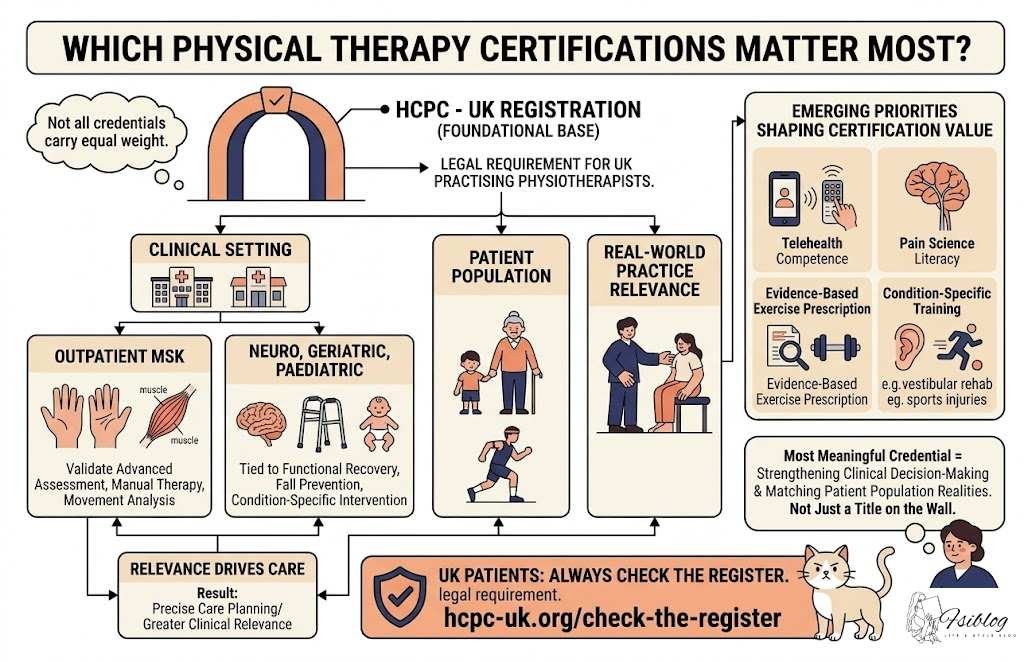
Not all physiotherapy credentials carry equal weight. In the UK, the baseline requirement is registration with the Health and Care Professions Council (HCPC). Beyond that, what matters depends almost entirely on the clinical setting, the patient population, and the relevance of additional physical therapy certifications to real-world practice.
In outpatient musculoskeletal rehabilitation, credentials that validate advanced assessment, manual therapy, or movement analysis support more precise care planning. In neurological, paediatric, or geriatric settings, certifications tied to functional recovery, fall prevention, and condition-specific intervention carry greater clinical relevance.
Several emerging priorities also shape how certifications are valued today:
- Telehealth competence for remote assessment and exercise delivery
- Pain science literacy to address chronic musculoskeletal pain accurately
- Evidence-based exercise prescription grounded in current research
- Condition-specific training, such as vestibular rehabilitation or sports injuries
The most meaningful credential is the one that strengthens clinical decision-making and matches the realities of the patient population being served, not simply the most impressive-sounding title on a clinic wall.
UK Patients: Always Check the Register. Before starting physiotherapy, verify your therapist is registered with the HCPC at hcpc-uk.org/check-the-register. This is a legal requirement for practising physiotherapists in the UK.
Top Certifications for Orthopedic Physiotherapists
For physiotherapists working in orthopedic or musculoskeletal settings, the most respected credentials are those that sharpen clinical reasoning, advance manual therapy skills, and demonstrate commitment to evidence-based practice. Here is what the key qualifications actually mean for patients:
| Certification | What It Means | Best For | UK Relevance |
|---|---|---|---|
| OCS (Orthopaedic Clinical Specialist) | Advanced competence in musculoskeletal evaluation, differential diagnosis, and complex movement disorders | Joint pain, post-surgical rehab, chronic MSK conditions | High, recognised internationally |
| FAAOMPT (Fellow, American Academy of Orthopaedic Manual Physical Therapy) | Elite-level training in joint mobilisation, manipulation, and spinal assessment | Neck and back pain, complex joint dysfunction | High, aligned with MACP standards in the UK |
| MACP Membership (Manipulative Association of Chartered Physiotherapists) | UK-specific advanced manual therapy qualification for chartered physiotherapists | Spinal and extremity manual therapy | Very high, UK gold standard |
| Dry Needling Certificate | Specialised technique for trigger point treatment and myofascial pain | Muscle pain, tension headaches, fibromyalgia | Moderate, regulated under HCPC scope |
| Vestibular Rehabilitation Certificate | Specialised training in balance disorders and dizziness rehabilitation | BPPV, vestibular neuritis, Meniere’s disease | High for specialist clinics |
| Blood Flow Restriction (BFR) Training | Advanced technique for building muscle strength with low loads, ideal post-surgery | Post-operative ACL, hip, and shoulder rehabilitation | Growing, used in NHS and private settings |
| Sports Physiotherapy Diploma (BASEM / BPS) | Focused credential for athlete assessment, injury management, and return to sport | Sports injuries, performance rehabilitation | Very high for sports and active patients |
For UK patients, membership of the Chartered Society of Physiotherapy (CSP) is a strong quality signal alongside HCPC registration. Chartered Physiotherapists (MCSP) have met rigorous professional standards and commit to ongoing continuing professional development.
How Orthopedic Services Help Patients Recover
Orthopedic services address the root causes of pain, restricted movement, and functional loss following injury, surgery, or chronic musculoskeletal conditions. Recovery is not a single event but a structured progression through distinct phases, each requiring different interventions.
Phase 1: Initial Assessment and Pain Management
A thorough evaluation of joint mechanics, tissue irritability, gait pattern, range of motion, and functional tolerance forms the foundation of any orthopedic rehabilitation plan. Early sessions focus on reducing pain and inflammation, protecting healing tissues, and beginning gentle mobility work.
Phase 2: Rehabilitation and Strength Rebuilding
As irritability settles, clinicians progressively introduce manual therapy, therapeutic exercise, neuromuscular reeducation, and controlled loading programmes. The aim is to restore movement quality, rebuild tissue capacity, and correct compensatory patterns before they become ingrained.
Phase 3: Functional Return and Injury Prevention
The final phase prepares the patient for full return to daily activities, work demands, or sport. Education covers posture correction, load management, body mechanics, and home exercise adherence to reduce the risk of reinjury and support long-term musculoskeletal health.
What to Expect at Each Appointment: A good orthopedic physiotherapy session includes a progress review against measurable goals, hands-on treatment or guided exercise, and a clear explanation of what is happening in your body and why. If your therapist cannot explain their reasoning, consider asking for clarification or seeking a second opinion.
Core Orthopedic Services Available in the UK
- Manual therapy, including joint mobilisation and soft tissue techniques
- Exercise-based rehabilitation with progressive loading programmes
- Post-operative physiotherapy following knee, hip, shoulder, or spinal surgery
- Gait retraining and biomechanical analysis for lower limb conditions
- Dry needling and acupuncture for pain modulation
- Hydrotherapy for patients who cannot tolerate land-based exercise
- Digital and telehealth physiotherapy for remote exercise supervision and advice
- Workplace and ergonomic assessment for occupational musculoskeletal conditions
Questions UK Patients Should Ask Their Provider
Asking the right questions before and during physiotherapy can significantly improve your experience and your outcome. Many patients accept the first service offered without understanding whether it matches their specific condition or goals.
Before starting any orthopedic care programme, consider asking the following:
What qualifications and specialist certifications does my physiotherapist hold?
- Beyond HCPC registration, look for CSP membership, relevant specialist credentials, and evidence of ongoing professional development.
Does current research support this treatment approach?
- Evidence-based practice is the standard in UK physiotherapy. Your therapist should be able to explain why a particular technique has been selected for your condition.
What are my measurable treatment goals, and how will we track progress?
- Vague goals lead to vague outcomes. Ask for specific milestones such as achieving a target range of motion, returning to a particular activity, or reaching a strength benchmark.
How many sessions will I need and at what frequency?
- A clear treatment plan with realistic timescales helps you plan around work, family, and finances.
What can I do between sessions to support my recovery?
- Home exercise programmes and activity modification are often more important than the time spent in the clinic.
Are there red flags in my condition that would require referral to an orthopaedic surgeon or GP?
- Good physiotherapists know their scope of practice and will refer promptly when imaging, injections, or surgical assessment may be needed.
Does the clinic offer telehealth appointments?
- Remote sessions can reduce travel burden, particularly useful for patients with mobility restrictions or those living in rural areas of the UK.
How PT Certifications Improve Treatment Outcomes
Advanced certification is not merely a professional achievement. When applied well, it translates directly into measurable benefits for patients at every stage of recovery.
| Area of Benefit | How Certification Helps | Patient Impact |
|---|---|---|
| Assessment accuracy | Advanced training sharpens the ability to identify impairments that generalised screening misses | Fewer delayed diagnoses, faster route to appropriate treatment |
| Treatment selection | Certified clinicians draw on a broader evidence base to select targeted interventions | More precise care matched to the individual condition |
| Dosage and progression | Greater understanding of tissue tolerance and healing timelines informs safer loading | Reduced risk of overloading and setbacks during recovery |
| Patient education | Clearer explanations of diagnosis, pain mechanisms, and expected recovery timelines | Improved adherence, reduced anxiety, better home exercise compliance |
| Specialist conditions | Focused credentials address areas such as vestibular rehabilitation, post-surgical care, or sports injuries where general training is insufficient | Faster recovery in complex or atypical presentations |
| Interdisciplinary coordination | Certified physiotherapists communicate more precisely with GPs, surgeons, and pain specialists | Fewer gaps and hand-off delays in the care pathway |
Research published by the National Institute for Health and Care Excellence (NICE) consistently supports exercise-based rehabilitation delivered by trained physiotherapists as the first-line treatment for most musculoskeletal conditions, reinforcing the value of evidence-grounded specialist care over passive treatment alone.
How to Choose the Right Physiotherapist and Orthopedic Care in the UK
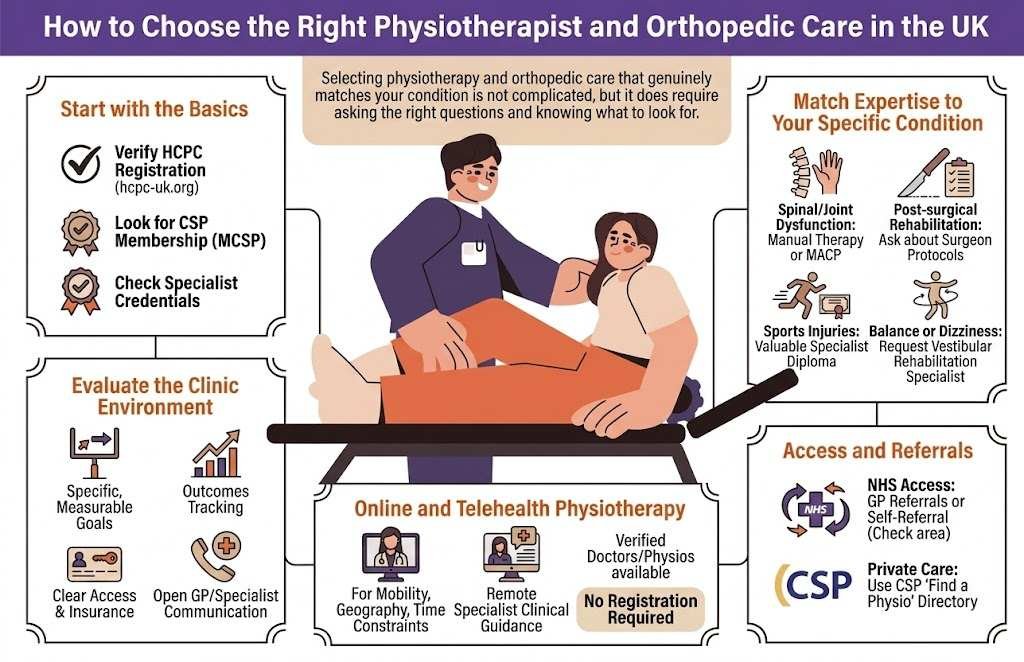
Selecting physiotherapy and orthopedic care that genuinely matches your condition is not complicated, but it does require asking the right questions and knowing what to look for.
Start with the basics.
- Confirm HCPC registration at hcpc-uk.org
- Look for CSP membership (the MCSP designation) as a quality indicator.
- Check whether the clinic or individual holds specialist credentials relevant to your condition.
Match expertise to your specific condition
- For spinal pain or joint dysfunction, seek a physiotherapist with manual therapy training or MACP membership.
- For post-surgical rehabilitation, look for experience with your specific procedure and knowledge of surgeon protocols.
- For sports injuries, a Sports Physiotherapy Diploma or equivalent specialist credential is valuable.
- For balance or dizziness problems, request a vestibular rehabilitation specialist.
Evaluate the clinic environment.
- The care plan should include specific, measurable goals and realistic timeframes.
- Outcomes tracking should be discussed from the first appointment.
- Access, insurance coverage, and referral pathways should be clear before care begins.
- The team should communicate openly with your GP or specialist when needed.
For patients accessing physiotherapy through the NHS, referrals can be made by a GP or, in many areas, you can self-refer directly. For private care, the CSP’s Find a Physio directory is a reliable starting point for locating qualified practitioners across the UK.
Online and Telehealth Physiotherapy. For patients who struggle to access in-person care due to mobility, geography, or time constraints, telehealth physiotherapy services offer certified clinical guidance remotely. Platforms connecting patients with verified doctors and physiotherapists make specialist access available regardless of location, with no registration required in many cases.
Trusted Resources for UK Patients
- HCPC Register Check – Verify any physiotherapist is legally registered to practise in the UK
- Chartered Society of Physiotherapy (CSP) – The professional body for physiotherapy in the UK, with patient resources and practitioner directory
- NICE Guideline NG193 – Evidence-based guidance on chronic primary pain and musculoskeletal rehabilitation
- NHS Physiotherapy Overview – How to access NHS physiotherapy, what to expect, and self-referral options
- Versus Arthritis: Physiotherapy Guide – Plain-English explanation of physiotherapy for arthritis and joint conditions
- British Orthopaedic Association (BOA) Patient Information – Guidance on orthopaedic surgery, rehabilitation, and what to expect from specialist care