
Tantric Massage for Women is a professional discipline that applies the principles and methods of the Tantric tradition to the work of healing, development, and the enrichment of sexual and relational life. It draws on one of the oldest and most sophisticated bodies of knowledge about human sexuality and embodied experience in the world, while adapting that knowledge into a secular, practical framework that is accessible to modern clients with no background in Eastern philosophy or spirituality.
Despite its growing presence in cities across Europe and North America, Tantric therapy remains widely misunderstood, partly because commercial interests have so thoroughly misappropriated the word Tantra with no genuine connection to the tradition, and partly because authentic Tantric practice occupies a space that does not map neatly onto existing professional categories. It is not psychotherapy, not conventional massage, not coaching in the usual sense, and not a spiritual practice requiring religious commitment. It is something distinct from all of these, with its own methods, its own understanding of the human being, and its own characteristic results.
This article provides a serious and comprehensive introduction to Tantric therapy: what it is, where it comes from, how it works, who it serves, and how to recognise practitioners who are genuinely qualified and trustworthy.
What Tantric Therapy Actually Is
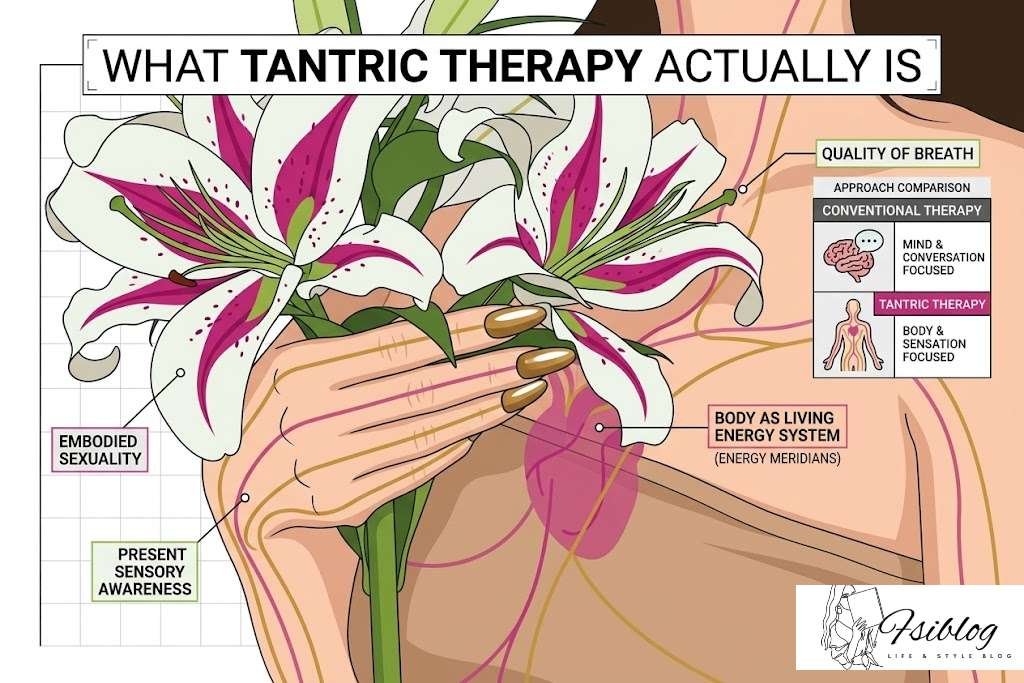
At its core, Tantric therapy is a body-centred approach to sexual healing and development. It holds that the body is not simply a physical object that carries the mind from place to place. Still, a living system of energy, sensation, and awareness, and that genuine transformation in the domains of sexuality and intimacy requires engaging this system directly, not only through language and reflection.
This is the central insight that distinguishes Tantric therapy from most other professional approaches to sexual difficulty and development. Conventional psychotherapy and sex therapy work primarily through conversation: they seek to identify and modify thought patterns, to explore emotional history, and to address relational dynamics through insight and behavioural change. These are genuinely valuable methods with a substantial evidence base. But they work at the level of the mind, and sexual experience is not only a mental phenomenon. It is a bodily one, rooted in the nervous system, in patterns of muscular tension and release, in the quality of breath and physical presence, and in the way sensory experience is received and processed throughout the body.
Tantric therapy addresses these bodily dimensions directly. Through conscious touch, breathwork, guided somatic awareness, and a carefully structured therapeutic relationship, it creates conditions in which deeply held patterns of tension, numbness, disconnection, or dysregulation in the body can shift and release. The results of this work are not primarily conceptual. They are felt, directly and unmistakably, in the body itself.
Tantric Tradition
The tradition from which Tantric therapy draws its principles is ancient, philosophically rich, and internally diverse. Tantra as a body of practice and understanding emerged in India over many centuries, with its earliest textual evidence dating to around the fifth century CE. However, its roots in oral and ritual traditions are certainly older. It has branches within both Hinduism and Buddhism. While these differ in important respects, they share a number of core orientations that are central to the therapeutic application of Tantric principles.
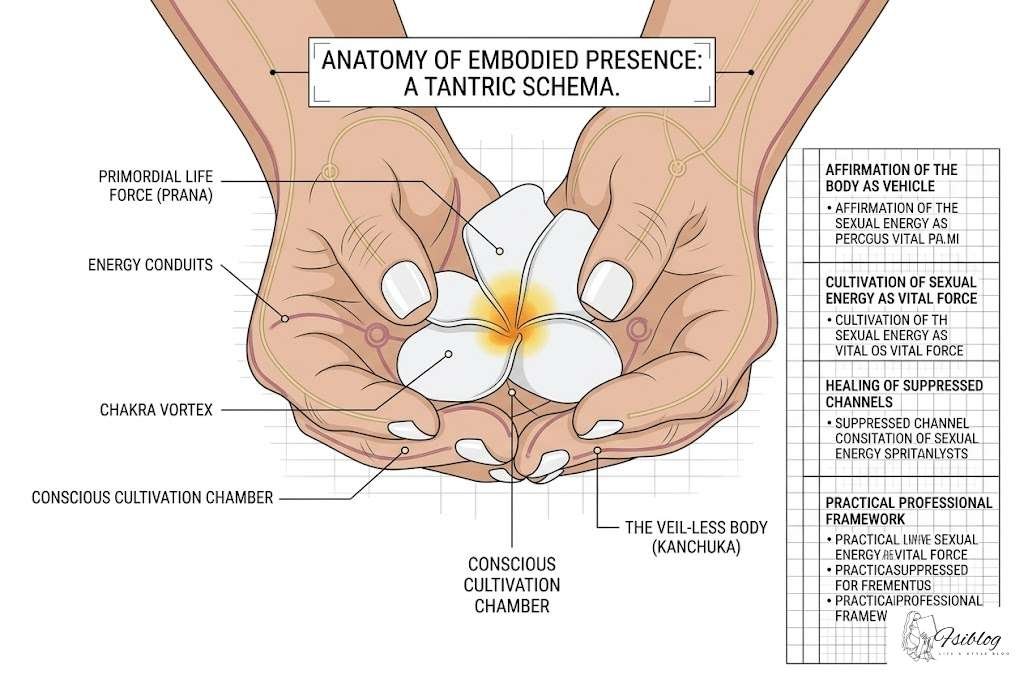
The most fundamental of these shared orientations is the affirmation of the body and sensory experience as legitimate and valuable dimensions of human life. Where many religious and philosophical traditions have treated the body with suspicion, seeking to transcend or control physical impulses in the service of spiritual development, Tantra has consistently insisted that embodied experience, including sexual and sensual experience, is not an obstacle to human flourishing but a vehicle for it.
In the Tantric view, sexual energy is a fundamental life force that permeates all living systems. When this energy is suppressed, misdirected, or held in patterns of chronic tension and unconsciousness, it becomes a source of difficulty: physical, psychological, and relational. When it is cultivated consciously, allowed to move freely through the body, and engaged with awareness and intention, it becomes a source of vitality, healing, and expanded capacity for pleasure, connection, and aliveness.
Tantric therapy translates these insights from their original ritual and metaphysical context into a practical professional framework. The practitioner does not need to be a devotee of any particular spiritual tradition, and the client does not need to hold any particular beliefs. What is required is an openness to the possibility that the body knows things the mind does not, and that engaging with the body directly, rather than only through the mediation of language and thought, can produce change that other approaches cannot.
Methods of Tantric Therapy
Tantric therapy draws on a range of methods, and the specific combination used in any given session or series of sessions will depend on the client’s needs, intentions, and circumstances. Several core elements are consistent across most professional practices, however, and understanding these helps to clarify what makes this approach distinctive.
Conscious touch is the most central method. Tantric touch is not technique-driven in the way that conventional massage is: it is not primarily about applying specific strokes to specific areas in a prescribed sequence. It is about the quality of attention and intention with which touch is offered. Touch that is genuinely present, genuinely caring, and genuinely responsive to the person being touched communicates something that purely mechanical touch cannot, and this quality of communication is itself a therapeutic force. For many clients, the experience of being touched with this quality of full presence is itself profoundly healing, quite apart from whatever else the work may involve.
Breathwork is the second central method. Breath is the most immediate point of interface between conscious awareness and the body’s autonomous processes. Changes in breathing patterns produce immediate changes in the state of the nervous system, the quality of bodily sensation, and the degree of somatic awareness. Tantric therapy uses breath as a primary tool throughout, guiding clients to breathe into areas of tension or numbness, to expand their capacity for sensation through fuller and more conscious breathing, and to maintain bodily presence rather than retreating into habitual mental activity during the session.
Somatic awareness practices form a third central element. These are methods that invite clients to turn their attention toward their own bodily experience with curiosity and without judgment: to notice what is actually happening in the body from moment to moment, to distinguish between different qualities of sensation, and to develop a more nuanced and accurate internal sense of their own physical state. For many people, this kind of embodied self-awareness is surprisingly unfamiliar, and cultivating it is both a skill and a form of healing in its own right.
The therapeutic relationship itself is a fourth and often underappreciated method. The quality of the relationship between practitioner and client shapes everything that happens within it. A relationship characterised by genuine care, clear boundaries, consistent transparency, and profound respect for the client’s autonomy creates conditions in which the deepest and most difficult work becomes possible. Practitioners who understand this invest heavily in the quality of this relationship, beginning with the very first contact and maintaining it with consistent attentiveness throughout.
What Tantric Therapy Addresses
The range of difficulties, challenges, and aspirations that bring people to Tantric therapy is broad, and the practice has demonstrated usefulness across a wide spectrum of human experience. Among the most common applications are:
- Sexual dysfunctions of various kinds, including difficulties with arousal, orgasm, desire, and comfort during sexual activity, in both women and men
- The physical and psychological residue of painful, difficult, or traumatic sexual experiences, including experiences that predate conscious memory
- Chronic disconnection from the body or from one’s own sensuality and sexuality, often experienced as numbness, flatness, or an inability to feel present during intimate encounters.
- Relational difficulties rooted in the sexual dimension of partnership, including mismatches in desire, difficulties with intimacy and vulnerability, and communication problems around sexual needs and preferences
- The gradual erosion of sexual vitality and connection that many long-term couples experience, and the desire to restore richness, variety, and genuine intimacy to an established relationship
- A more general desire for development and enrichment in one’s embodied and sexual life, without any specific problem or dysfunction as a presenting concern
- Curiosity about Tantric principles and practices, and a wish to understand and experience them directly rather than only conceptually
It is important to note that Tantric therapy is not appropriate as a response to all situations. Where significant psychological disturbance, active trauma, or complex mental health conditions are present, these should be addressed with appropriate clinical support before or alongside Tantric work. A responsible practitioner will always assess this carefully and will not accept clients whose needs exceed what Tantric therapy can safely and appropriately address.
Tantric Therapy and Conventional Sex Therapy
Many people who come to Tantric therapy have previously engaged with conventional sex therapy or psychosexual counselling. Understanding the relationship between these approaches helps to clarify what Tantric therapy offers that other methods do not.
Conventional sex therapy, in its various forms, works primarily through language. Sessions involve conversation: exploring personal and relational history, identifying unhelpful patterns of thought and behaviour, developing new cognitive frameworks, and practising communication skills. This work is valuable and, for many people, genuinely helpful. Its limitations appear most clearly in cases where the difficulties are substantially somatic in character, where they are held in the body rather than primarily in the mind.
For a person whose sexual difficulty involves physical numbness, chronic pelvic tension, an inability to feel pleasure in the body, or a profound disconnection between mental intention and physical response, years of skilled conversational work may produce insight without producing change in the bodily experience itself. The conversation reaches the mind but not the body, where the problem actually lives.
Tantric therapy addresses this gap precisely because its primary methods are somatic rather than verbal. It works where the difficulty is, in the tissue and nervous system and the patterns of energy held there, rather than approaching the body indirectly through the mediation of language. This is not a claim that Tantric therapy is superior to conventional sex therapy in all cases. It is a recognition that they address different dimensions of human experience, and that for many people, particularly those whose difficulties have a substantial somatic component, the direct somatic approach of Tantric therapy offers something that purely verbal methods cannot.
Tantric Therapy for Women
While Tantric therapy is practised with both women and men, its application to female sexuality is particularly rich and particularly important. Female sexual experience has its own distinct character, its own specific vulnerabilities and possibilities, and its own characteristic patterns of difficulty. A Tantric therapy practice that specialises in work with women brings a depth of specific knowledge and attention that transforms the quality and effectiveness of the work.
Women’s sexuality tends to be more contextual, more holistic, and more dependent on felt safety and relational quality than the dominant cultural models acknowledge. The female body carries particular areas of extraordinary sensitivity and potential, including the pelvic floor, the cervix, and the broader genital anatomy, that are rarely engaged with the conscious skill and patience they deserve. Many women carry significant tension, numbness, or difficulty in these areas as a result of physical experiences, cultural conditioning, or a lifetime of sexual encounters that have not genuinely met their actual needs.
Tantric therapy for women works with all of this with a specificity and intelligence that general bodywork cannot approach. It includes specialised methods such as Yoni massage, which addresses the genital anatomy directly with therapeutic intent. It builds sessions around an understanding of how female sexual energy actually works: its slower rhythm, its need for safety and trust as preconditions rather than accompaniments to arousal, and its capacity for depth and expansiveness when approached with genuine skill and care.
For many women, Tantric therapy represents the first time in their lives that their sexuality has been approached with this quality of serious, knowledgeable, and genuinely caring professional attention. The results of this experience, in terms of healing, development, and a profoundly richer relationship with their own bodies and intimate lives, are often described as transformative in a way that no other professional intervention has been.
Recognising Genuine Tantric Therapy
Because Tantric therapy is not formally regulated in most countries, the responsibility for identifying genuine, high-quality practice falls entirely on the person seeking it. Several criteria reliably distinguish serious professional practice from the many services that misuse the language of Tantra for commercial purposes.
The depth and specificity of professional knowledge are the most fundamental indicators. A genuine Tantric therapist can explain what they do and why with clarity, precision, and genuine intellectual substance. Their written and spoken descriptions of their work reflect a real understanding of the Tantric tradition, somatic approaches to sexuality, and the specific needs of their client population. Vague, evasive, or primarily suggestive language is a reliable indicator that substantive professional knowledge is absent.
Ethical clarity is equally important. A genuine practitioner is explicit and transparent about what their sessions do and do not involve, maintains clear professional boundaries, and structures their work around the client’s wellbeing and genuine development rather than around the provision of pleasure as an end in itself. They will insist on a thorough preliminary consultation before any bodywork begins, and they will not proceed with any element of a session without clear and informed consent.
Sustained professional practice over many years is among the strongest available indicators of genuine quality. Building a lasting practice in this field requires actually delivering what is promised, and practitioners who have been working professionally for a decade or more have already demonstrated, through their continued presence and reputation, a level of integrity and effectiveness that newcomers cannot match. Where verifiable client testimonials and reviews are available, these provide additional confirmation of consistent professional quality.
Finally, the quality of early contact matters. Before booking any session, make contact with the practitioner, ask questions, and pay attention to how those questions are received and answered. A practitioner who responds with genuine warmth, thoroughness, and patience, who welcomes your due diligence rather than discouraging it, and who communicates clearly and honestly throughout this preliminary exchange is demonstrating, in that very exchange, the quality of presence and care that characterises their work.
For those seeking a long-established, specialist Tantric therapy practice with over 20 years of professional experience, including Tantric massage for women, Yoni massage, and sex coaching for individuals and couples, further information is available at Tantric Therapy London.
Disclaimer
This article is for general informational and educational purposes only. It is not intended to replace medical advice, psychological support, sex therapy, counselling, or any other form of professional healthcare. Tantric therapy may involve sensitive emotional, physical, and relational topics, so anyone considering this type of work should carefully research the practitioner, check their experience, understand the boundaries of the service, and make sure informed consent is clearly respected at every stage.
Tantric therapy is not formally regulated in many countries, including the UK, so readers should use caution when choosing a practitioner. People dealing with trauma, mental health concerns, medical conditions, pain, sexual difficulties, or relationship issues should speak with a qualified healthcare professional, psychotherapist, counsellor, or registered sex therapist before beginning any body-based or intimacy-focused practice. The information in this article should not be treated as a guarantee of results, and individual experiences may vary.