
A sofa can look neat and modest in a showroom the size of an aircraft hangar, then fill half a Victorian front room the moment it comes through the door. Paint plays the same trick. A shade that glowed under the bright lights of a retail park can turn flat and grey beside a north-facing window on a wet Tuesday in November. Most of us only find this out after the money has gone and the cardboard is waiting for bin day.
There is a cheaper way to get it wrong, and that is to get it wrong on a screen first. Take one honest photo of the room you already have, then use an AI image editor to try furniture, colour and lighting ideas on top of it. The pictures will not be perfect, and they do not need to be. Their job is to help you rule ideas in or out before anything goes in a basket.
Picture a rented one-bedroom flat on the first floor of a converted terrace in Leeds. The living room is also the dining room. It has a narrow sash window with a radiator under the sill, grey laminate flooring, a navy two-seater sofa and a drop-leaf table pushed flat against one wall. The person who rents it wants somewhere to read and enough space for friends to come round, but the sofa is staying. It was not cheap, and it fits. This is a very ordinary situation. Around 4.7 million households in England, roughly one in five, rent privately according to the English Housing Survey, and most of them cannot knock through a wall or move a window to make a room work. Working with the room you have is not a compromise here. It is the whole point of the exercise.
Photograph The Room So Its Constraints Are Visible
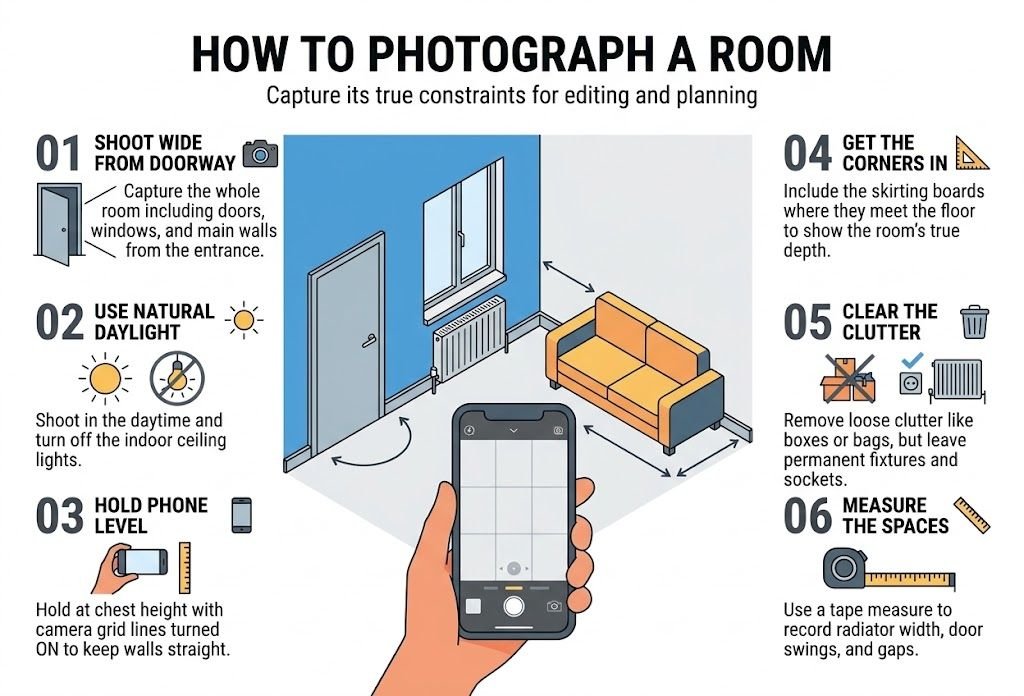
The photo you start with decides how useful everything after it will be. A styled close-up of the coffee table with a candle and a paperback might look lovely on Instagram, but it tells an image editor almost nothing about the room. What you need is a plain, slightly boring picture taken from the doorway that shows the window, the main wall, the sofa, the radiator and as much floor as possible.
In the Leeds flat, one shot from the door catches the sash window, the radiator below it, the long wall with the sofa and the alcove beside the chimney breast where the sideboard lives. That single view carries more useful information than a dozen arty angles.
A few habits make a big difference:
- Shoot in daylight and switch off the big light. Mixing a warm ceiling bulb with cool daylight gives the photo an odd colour cast, and the editor will happily copy it into every version.
- Hold the phone level at about chest height. Turning on the grid lines in your camera settings helps keep door frames and window edges straight.
- Get the corners in. The line where the skirting board meets the floor tells the editor, and you, how deep the room really is.
- Clear away temporary clutter such as the clothes airer, shopping bags and empty boxes, but leave anything permanent in shot, including plug sockets, the radiator and the furniture you plan to keep.
- Save the untouched original in its own album so you never edit over it by accident.
Next, find a tape measure and write the numbers somewhere you will not lose them, such as a note on your phone. Measure the gap between the end of the sofa and the window wall, the width of the radiator, how far the door swings into the room and the width of the table with its leaves up. AI editors are very good at making a scene look believable and much less dependable at keeping objects to scale. The picture helps you choose a direction. The tape measure tells you whether that direction will actually fit.
Decide What Has Permission To Change
Before you write a single prompt, sort the room into three groups. The first is the building itself, which you cannot change. The second is the stuff you own and want to keep. The third is a short list of things you are genuinely willing to test. Writing this down can feel fussy, but it stops the AI, and you, from drifting off into a room that does not exist.
Keep The Architecture In Place
Name the fixed features in every instruction: the window and where it sits, the radiator, the walls, the door and the camera angle. Older British homes often have extra details worth listing, such as a chimney breast with alcoves on each side, deep skirting boards or a plaster ceiling rose. Image editors sometimes tidy up awkward features without being asked. A chimney breast quietly shrinks, or the window slides along the wall to make room for a bookcase. When you review each result, check these features first. If the window has moved, the picture is solving a problem in somebody else’s flat.
Protect The Pieces You Already Own
The navy sofa stays. So does a low oak sideboard, picked up from a charity shop years ago, which holds books and a record player. Say so in the instruction, and describe where they sit when it matters: “Keep the navy two-seater sofa against the long wall and the oak sideboard in the left-hand alcove under the framed print.” This matters more than it seems. A new armchair only makes sense beside the sofa it will actually live next to, so the sofa in the picture needs to be your sofa, not a smarter cousin of it.
Give Each Experiment A Specific Job
For the first round, test a rug and an accent chair. For the second, try a warmer wall colour. For the third, see what happens when the drop-leaf table moves closer to the window. Each version should answer one practical question. If you change six things at once and the room suddenly looks better, you will have no idea which change did the work, and you may end up buying all six.
Run A Three-Version Makeover Experiment
Say the room has space for one more chair, as long as the route to the window stays clear for opening the sash and bleeding the radiator in autumn. Three drafts can test quite different priorities without touching the sofa or the sideboard.
| Concept | Main change | Question it answers |
| Reading corner | Compact armchair, slim floor lamp, flat-weave rug | Is there room for a comfortable place to read? |
| Flexible hosting | Nesting side tables and two lightweight stools | Can guests sit down without blocking the route to the window? |
| Calmer everyday room | Warm off-white walls, linen curtains, fewer things on show | Would a quieter palette help the furniture already here look settled? |
Start with the reading corner. Upload the original photo to an image-to-image editor such as flux 3, then write an instruction rooted in the real room: “Keep the same walls, narrow sash window, radiator, chimney breast, navy two-seater sofa, oak sideboard and camera angle. Add one compact olive-green armchair beside the sofa, a slim floor lamp and a flat-weave rug. Keep a clear path to the window. Natural daylight, realistic proportions for a small rented flat.”
Treat what comes back as a proposal, not a promise. Put it next to the original photo and check three things. Has the sofa grown or shrunk? Can you still reach the radiator valve? Would the chair stop the door from opening fully? Note what went wrong and fix it in the next prompt. “Make the armchair narrower, no wider than the sideboard” is far more useful than “make it look better”.
When you move on to the hosting version, go back to the original photo instead of editing the reading-corner image again. This is not just neatness. The Black Forest Labs researchers behind the FLUX.1 Kontext image editing model wrote that many current editing tools “exhibit degradation in character consistency and stability across multiple turns”. Their own model was designed to reduce that problem, but the safe habit with any tool is the same. Every edit stacked on top of another edit gives small errors a chance to pile up, and a room can slowly lose a few centimetres here and gain a window pane there. Starting each concept from the same photo keeps the comparison fair.
Save all three versions together with the exact prompt used for each one. A simple file name such as lounge-v1-reading.jpg, plus the prompt pasted into the same note, is plenty. A month from now, standing in a shop and wondering why you liked the green chair, you will be glad you did.
Turn The Favourite Picture Into A Shopping Shortlist
In this example, the reading corner wins. The chair gives the room a proper destination, somewhere to sit that is not the sofa, and the lamp makes the long dark evenings between October and March far more pleasant. Now comes the important part: separating the mood of the picture from the things you can actually buy.
Match The Chair To A Real Footprint
Measure the empty floor beside the sofa and compare it with real chair dimensions: width, depth and the extra few centimetres needed to pull the chair slightly away from the wall so it does not scuff the paint. Then mark the footprint on the floor with masking tape and live with it for a couple of days. If you keep stepping on the tape on your way to the window, you have your answer.
Getting the chair into the room is a separate problem from fitting it in the room. Converted terraces and flats often have narrow stairs with a tight turn at the landing, and a common internal door size in British homes is only about 76 cm wide. Here is how the numbers look for the example flat:
| What to measure | Example flat | Why it matters |
| Floor space beside the sofa | 85 cm wide, 90 cm deep | Sets the largest chair footprint you can use |
| Clear route to the window | 60 cm kept free | Room to open the sash and reach the radiator valve |
| Living room door, inside the frame | 76 cm | The chair has to pass through, often tipped on its side |
| Narrowest point on the stairs | 78 cm | A tight turn can stop a chair that clears the door |
| Ceiling height above the landing | 195 cm | Matters if the chair has to be stood upright to turn |
If the chair in your AI picture looks suspiciously slim, it probably is. Search for a real model with similar measurements, or go back and test a different shape in the image.
There is one more check worth doing in the UK. Under the Furniture and Furnishings (Fire) (Safety) Regulations 1988, new upholstered furniture sold here must carry a permanent label, often tucked under a seat cushion or on the base, headed “CARELESSNESS CAUSES FIRE”. The Trading Standards guide to fire safety rules for new upholstered furniture explains what that label should show. Since an update to the rules in October 2025, shops no longer have to attach a separate display label, so it is worth checking the chair itself or asking. This matters even more if you are hunting for a second-hand armchair on Facebook Marketplace or in a charity shop. Used upholstered furniture has to meet the same standards, and a chair with the label cut off is one to walk away from.
Check Colour With Physical Samples
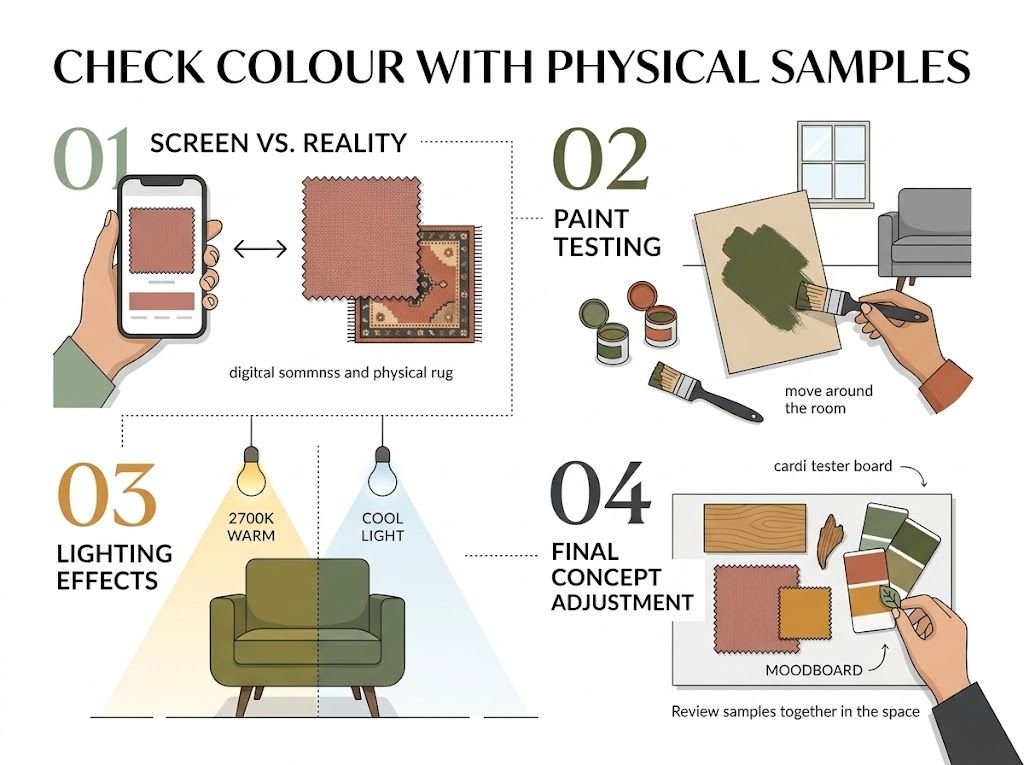
An olive chair and a warm rug can look spot on on a phone screen. Screens are bright, backlit and usually tuned to make colours pop. Your living room in February is none of those things, and the same fabric will look different at ten in the morning and at nine at night under a lamp.
Ask for fabric swatches, which many retailers will post out free or for a small charge, and ask about rug samples or offcuts too. Lay them on the sofa arm and leave them there for a few days, checking them in daylight and again in the evening. For paint, skip testing patches directly on the wall, which your tenancy may not allow, and brush the tester pot onto a sheet of lining paper or thick card instead. You can then move it around the room and see how it changes beside the window, in the alcove and next to the navy sofa.
Bulbs matter as much as fabric. Most living rooms feel cosier under warm white LEDs, around 2,700K on the box, while cooler bulbs can make the same olive chair look grey and tired. The Energy Saving Trust’s advice on choosing efficient lighting is a useful plain-English starting point, including the reminder that not every LED bulb works with a dimmer switch. Once you know the real colours on your shortlist, you can go back and adjust the concept image to match them.
Put A Ceiling On The Budget
The AI picture might hint at a full transformation. In reality, most of the improvement in the example room comes from one chair and better light. Write down the full cost before you buy anything, including the bits people forget.
| Item | Example budget |
| Compact armchair | £250 to £350 |
| Slim floor lamp with a warm white bulb | £40 to £70 |
| Flat-weave rug, around 120 x 170 cm | £60 to £100 |
| Courier or van charges | £0 to £40 |
| Money set aside in case something goes back | £40 |
| Ceiling for the whole project | £600 |
The line for returns is not pessimism. When you buy online in the UK, you usually have a 14-day cooling-off period that starts the day after the goods arrive, and Citizens Advice has a template letter for cancelling an online order that sets out how to use it. The right to cancel does not always mean a free return, though. Retailers can often ask you to pay to send items back, and returning a bulky armchair is rarely cheap. Made-to-measure items, such as curtains cut for your window, are usually excluded altogether. Check the returns policy before you click, especially for anything heavy.
Retailers have known about this problem for years. A case study of IKEA’s augmented reality app in the Journal of Information Technology Teaching Cases notes that letting shoppers try furniture virtually before buying is expected to reduce returns. Your phone photo and an AI editor do a rougher version of the same job.
What To Share With A Partner, Landlord, Or Designer
If you share the flat, put the three images side by side with one line under each explaining what it is trying to fix. Then talk through your actual week rather than which picture is prettiest. Where do you eat? Who needs to reach the window to open it on a muggy day? Where does the laptop go when one of you works from home? Pictures give you something concrete to point at, which is far easier than describing “a bit cosier but not cluttered” out loud.
For renters, the key line is between things you add and things you alter. A rug, a lamp and a freestanding chair can usually go in without asking anyone. Painting, drilling, putting up shelves, swapping light fittings or doing anything around the radiator is different. That normally needs your landlord’s written agreement, and some jobs need a qualified electrician or heating engineer whoever gives permission. In England, the Renters’ Rights Act came into force on 1 May 2026 and changed how private tenancies work, so the government’s overview of the Renters’ Rights Act for tenants is worth reading if you have not already. Even so, what you can do to the walls still comes down largely to your tenancy agreement and what your landlord agrees to. Get any yes in writing and keep it with your deposit paperwork. Scotland, Wales and Northern Ireland have their own rules. Either way, an AI picture of a sage-green wall tells you nothing about whether you are allowed to paint one.
If you bring in an interior designer, send the original photo, the key measurements and your favourite concept together. Be honest about what the image shows well, which is mood, colour and rough layout, and about what it cannot tell anyone: exact sizes, how the furniture is built, or whether a wall can take a heavy shelf. Accurate measurements and product specifications should guide any detailed layout or building work. The picture is the start of the conversation, not the plan.
Use The Image To Make The Next Decision
A good experiment ends with a clear next step, not a mood board. In the Leeds flat, that step looks like this: keep the sofa, buy an armchair that genuinely fits the 85 cm gap, try the lamp in two positions before committing, and compare two real rug samples in daylight and lamplight.
It helps to remember what kind of tool you are using. Augmented reality apps from furniture retailers place a scaled 3D model of a product into your room, and a 2024 study comparing augmented reality with web-based furniture shopping looked at how that changes the shopping experience and people’s intention to buy. An AI-edited photo works differently. It is closer to a quick sketch than a scale drawing, which is exactly why the tape measure stays part of the process from start to finish.
The finished room will not match the AI picture exactly. Fabric, light and proportions always shift a little in real life, and that is fine. The preview has already earned its keep by taking a lot of guesswork out before any money left your account.
Keep the original photo and the winning concept together. When the chair is in place and the lamp is plugged in, stand in the same doorway and take a new photo at the same height. Putting the before shot, the AI preview and the after shot side by side shows you which ideas worked in real life and which only worked on a screen. That comparison is the best guide you will have for the next small change, whether it is new curtains, a different bulb or finally deciding what to do about that drop-leaf table. The most useful makeover is not the most dramatic one. It is the one you are still happy to come home to on a grey Wednesday in January.
Disclaimer
This article is for general information only and is not legal, financial or professional design advice. AI-generated images are not drawn to scale and should never replace real measurements or product specifications. The rules on renting, consumer rights and furniture safety mentioned here mainly reflect England at the time of writing and can change, so check your own tenancy agreement, speak to your landlord or letting agent, and use a qualified electrician or heating engineer for any work involving wiring, wall fixings or heating. The example measurements and prices are for illustration only.
References
- Black Forest Labs, Batifol, S., Blattmann, A., Boesel, F., Consul, S., Diagne, C., Dockhorn, T., English, J., English, Z., Esser, P., Kulal, S., et al. (2025). FLUX.1 Kontext: Flow Matching for In-Context Image Generation and Editing in Latent Space. arXiv preprint arXiv:2506.15742 [cs.GR], submitted 17 June 2025, revised 24 June 2025. DOI: https://doi.org/10.48550/arXiv.2506.15742
- Ozturkcan, S. (2021). Service innovation: Using augmented reality in the IKEA Place app. Journal of Information Technology Teaching Cases, 11(1), 8-13. SAGE Publications. First published online 13 August 2020. DOI: https://doi.org/10.1177/2043886920947110
- Zare Ebrahimabad, F., Yazdani, H., Hakim, A. and Asarian, M. (2024). Augmented Reality Versus Web-Based Shopping: How Does AR Improve User Experience and Online Purchase Intention. Telematics and Informatics Reports, 15, 100152. DOI: https://doi.org/10.1016/j.teler.2024.100152
- Ministry of Housing, Communities and Local Government (2025). English Housing Survey 2024 to 2025: Headline Findings on Demographics and Household Resilience, Chapter 1: Profile of Households and Dwellings. GOV.UK, published 4 December 2025. https://www.gov.uk/government/statistics/chapters-for-english-housing-survey-2024-to-2025-headline-findings-on-demographics-and-household-resilience/chapter-1-profile-of-households-and-dwellings
- Ministry of Housing, Communities and Local Government (2026). Renters’ Rights Act Overview for Tenants. GOV.UK guidance. https://www.gov.uk/guidance/renters-rights-act-overview-for-tenants
- Chartered Trading Standards Institute. New Upholstered Furniture: Fire Safety. Business Companion. https://www.businesscompanion.info/en/quick-guides/product-safety/new-upholstered-furniture-fire-safety
- Citizens Advice. Letter to Cancel or Return Goods Bought Online, Over the Phone or by Mail Order. https://citizensadvice.org.uk/consumer/template-letters/letters/cancelling-goods-or-services/letter-to-cancel-or-return-goods-bought-online-over-the-phone-or-by-mail-order
- Energy Saving Trust. Lighting. https://energysavingtrust.org.uk/advice/lighting/
- The Furniture and Furnishings (Fire) (Safety) Regulations 1988, SI 1988/1324, as amended. https://www.legislation.gov.uk/uksi/1988/1324/contents
- The Consumer Contracts (Information, Cancellation and Additional Charges) Regulations 2013, SI 2013/3134. https://www.legislation.gov.uk/uksi/2013/3134/contents