
The news cycle doesn’t wait for you to catch up. Climate reports arrive alongside inflation figures, which arrive alongside headlines about fragile ceasefires and shifting alliances. For most people, this is background noise they can mute. For journalists, policy analysts, and anyone whose job is to sit inside that noise all day, muting it isn’t an option. The question isn’t whether to engage with hard news. It’s how to do so without letting it quietly wear you down.
Research into journalists’ wellbeing treats this as a professional hazard, not a personal weakness. People who work closely with distressing material report compassion fatigue, an emotional erosion that builds from repeated exposure rather than one traumatic event. Encouragingly, the same research identifies what protects people. It isn’t willpower. It’s structure.
Treat Your News Intake Like a Dose, Not a Flood
One image that keeps surfacing among journalists who cover conflict is borrowed from radiology: exposure to distressing content is dose-dependent. A single scan is fine. Constant, unmonitored exposure isn’t. The same logic applies to a newsfeed. You don’t need to disengage from world events to protect your mind, but you do need to decide when and how much you’ll take in, rather than letting notifications decide for you.
In practice, this can mean reading your major sources once or twice a day at set times, rather than checking continuously between other tasks. Turn off breaking news alerts and scan headlines during a dedicated block instead. The goal isn’t ignorance. It’s giving your nervous system predictable windows of exposure instead of a constant drip that never lets your body downshift out of alert mode.
Separate Being Informed From Being Hypervigilant

There’s a meaningful difference between knowing what’s happening in the world and feeling like you must know it the moment it happens. The second state keeps your body in a low-grade fight-or-flight posture, even while scrolling on the sofa. Over time, that constant readiness leaves people feeling flat or numb rather than simply well-informed.
A helpful check-in question is this: has reading this story changed anything I can act on today? If not, you’ve absorbed the emotional weight without gaining any corresponding ability to respond to it. That mismatch, repeated daily, is exhausting. Being selectively informed, rather than exhaustively informed, isn’t a lesser form of engagement. It’s a sustainable one.
Talk About What You’ve Read, Not Just Consume It
One of the most consistent findings in stress research is that social support acts as a genuine buffer against the psychological cost of demanding work. People who process difficult material out loud, with colleagues, friends, or family, tend to fare better than those who absorb it silently and move to the next task. Debriefing turns a private weight into a shared one, and shared weight is lighter.
This doesn’t require a formal support group. It can be a five-minute conversation with a colleague after a difficult story, or telling a friend honestly that today’s headlines left you rattled instead of performing composure. Isolation is consistently flagged as one of the factors that makes distressing work harder to carry.
Give Your Brain Something Low-Stakes To Hold Onto
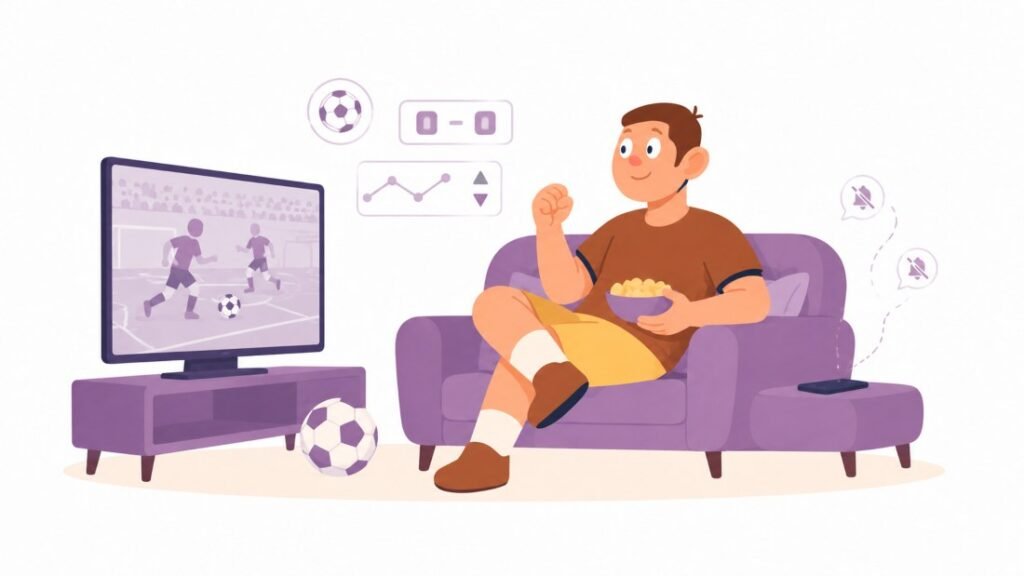
Full relaxation, the kind where your mind isn’t quietly still processing a crisis in the background, is one of the two major factors researchers point to for long-term resilience under chronic stress. That means the goal isn’t just rest in general. It’s finding something engaging enough actually to occupy your attention, so the news cycle isn’t running in a tab you never closed.
This is where a lot of people quietly lean on sport, and for good reason. A match has stakes, momentum, and a story arc, all the ingredients that make something genuinely gripping, but none of the real-world consequences that make hard news so heavy to carry. It gives your brain something to root for that costs nothing to lose. For anyone who wants that same sense of stakes without any emotional residue, following the odds around a match through a reliable platform for sport betting can turn passive viewing into something more actively absorbing, precisely because the outcome doesn’t follow you home the way a headline does.
Build Recovery Into the Rhythm, Not Just the Coping
Coping gets you through the day. What keeps the job sustainable over years is treating recovery as non-negotiable, even when the instinct is to stay plugged in out of duty. None of this requires stepping away from meaningful work or pretending the world’s problems aren’t real. It simply means treating your attention as a finite resource worth managing with the same care you’d apply to any other part of your health. The people who last longest in demanding, information-heavy roles aren’t the ones who feel the least. They’re the ones who’ve built a rhythm of exposure and recovery that lets them keep showing up, informed and intact.
Disclaimer
This article is intended for general information only and does not constitute medical, psychological, or professional mental health advice. Compassion fatigue, burnout, and chronic stress are recognised occupational health issues. Anyone experiencing persistent distress, low mood, numbness, or difficulty functioning should speak to a qualified healthcare professional rather than relying on self-management strategies alone.
References to sport and betting in this article describe optional leisure activity, not a treatment, a coping mechanism, or a recommended response to stress. Betting carries real financial risk, and outcomes can and do carry emotional and financial consequences. It should never be used to manage difficult emotions, escape distress, or recover losses. Anyone who chooses to bet should do so only if they are of legal age in their jurisdiction, only with money they can afford to lose, and only within limits set in advance.
If gambling is causing difficulty for you or someone you know, free and confidential support is available. In Great Britain, the National Gambling Helpline, operated by GamCare, is available 24 hours a day on 0808 8020 133. In the United States, the National Problem Gambling Helpline can be reached on 1-800-GAMBLER. Equivalent services operate in most other jurisdictions.
References
- Thompson, I., Shapiro, B., & Newman, E. (2021, updated 2025). GCJT Style Guide for Trauma-Informed Journalism. Global Center for Journalism and Trauma. https://gcjt.org/resources/gcjt-style-guide-trauma-informed-journalism
- Rees, G. (2023). Reporter’s Guide to Investigating War Crimes: Self-Care for Covering Traumatic Events. Global Investigative Journalism Network. https://gijn.org/resource/reporters-guide-to-investigating-war-crimes-self-care-for-covering-traumatic-events/
- McLaughlin, B., Gotlieb, M. R., & Mills, D. J. (2023). Caught in a Dangerous World: Problematic News Consumption and Its Relationship to Mental and Physical Ill-Being. Health Communication, 38(12), 2687–2697. https://doi.org/10.1080/10410236.2022.2106086
- Harvard Health Publishing. (2024). Understanding the stress response. Harvard Medical School. https://www.health.harvard.edu/mind-and-mood/understanding-the-stress-response
- Newman, N., Fletcher, R., Robertson, C. T., Arguedas, A. R., & Nielsen, R. K. (2025). Digital News Report 2025: Overview and Key Findings. Reuters Institute for the Study of Journalism, University of Oxford. https://reutersinstitute.politics.ox.ac.uk/digital-news-report/2025/dnr-executive-summary
- Cohen, S., & Wills, T. A. (1985). Stress, social support, and the buffering hypothesis. Psychological Bulletin, 98(2), 310–357. https://doi.org/10.1037/0033-2909.98.2.310
- Blake, H., Hassard, J., Thomson, L., Choo, W. H., Dulal-Arthur, T., Karanika-Murray, M., et al. (2025). Psychological detachment from work predicts mental wellbeing of working-age adults: Findings from the ‘Wellbeing of the Workforce’ (WoW) prospective longitudinal cohort study. PLOS ONE, 20(1), e0312673. https://doi.org/10.1371/journal.pone.0312673
- Sonnentag, S., Cheng, B. H., & Parker, S. L. (2022). Recovery from Work: Advancing the Field Toward the Future. Annual Review of Organizational Psychology and Organizational Behavior, 9, 33–60. https://doi.org/10.1146/annurev-orgpsych-012420-091355