
The laptop closes at six. By seven you are on the sofa, the telly is on, and you have read the same paragraph of a news article four times because you are still drafting a reply to something that arrived at half four. The working day finished an hour ago. Nobody appears to have told your brain.
This is an ordinary British evening, and it is more common than it should be. The Health and Safety Executive’s latest figures for Great Britain record 964,000 workers suffering from work-related stress, depression or anxiety in 2024/25, with 409,000 of those being new cases in a single year. Between them, those conditions accounted for around 22.1 million lost working days. It is the highest rate since annual collection began.
So the question of how you actually switch off is not a soft one. It has a fairly serious evidence base behind it, and quite a lot of what gets repeated about it is wrong.
What The Research Actually Says About Switching Off
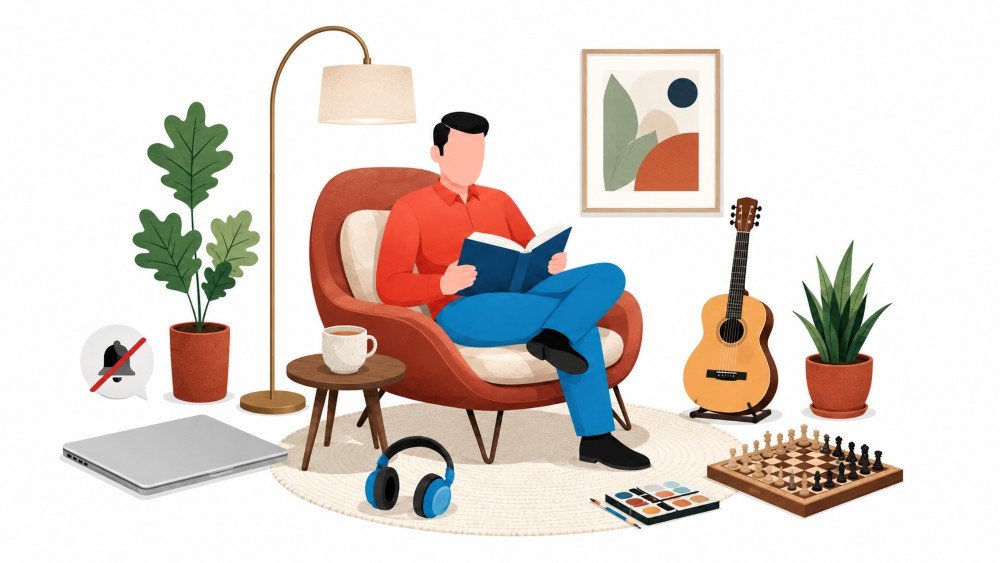
Occupational psychologists have been studying this since the mid-2000s, and the framework most of the field uses comes from Sabine Sonnentag and Charlotte Fritz, whose Recovery Experience Questionnaire identified four distinct things that help people recuperate from work during their own time.
The four are psychological detachment, relaxation, mastery, and control. They are not interchangeable, and the differences matter more than the labels suggest.
- Psychological detachment is the big one, and it is the most studied. It does not simply mean stopping work. It means being mentally away from it: not turning the meeting over, not rehearsing tomorrow’s difficult conversation. Research has consistently found that people who fail to detach in the evening report more fatigue and worse mood the following morning, because the physiological stress response keeps running in the background.
- Relaxation means low-effort, pleasant, low-activation activity: a bath, music, a walk, a book.
- Mastery is the interesting one, and the one most people get backwards. It refers to doing something that stretches you slightly: learning, practising, seeking a bit of challenge.
- Control means deciding for yourself what you do with the time.
A later expansion of this, the DRAMMA model, adds meaning and affiliation to the list. A study of 909 teachers testing all six found that detachment, relaxation, control and mastery were linked to higher vitality. In contrast, detachment, relaxation, meaning and affiliation were linked to higher life satisfaction. Detachment and relaxation showed up in both, which tells you something about where to start.
Why Scrolling Rarely Leaves You Feeling Rested
There is a popular claim that passive activities are useless for recovery and active ones are superior. That is not quite what the evidence shows, and it is worth correcting because it sends people in an unhelpful direction.
Relaxation is a genuine recovery experience in its own right. Lying on the sofa listening to something is not a failure of self-discipline. Low-demand, pleasant activity does real work.
The problem with the phone specifically is not that it is passive. It is that it is the same object your job lives inside. Detachment requires distance from work, and a device holding your inbox, Teams, Slack and www.rocketplay35.com keeps you permanently one notification away from being back at your desk.
Then there is what is actually on the screen. Feeds are engineered around comparison, outrage and novelty, none of which lower physiological arousal. Twenty minutes of it can leave you flatter than when you started, without ever having produced the sense of being genuinely elsewhere.
So the useful reframing is not “be more active”. It is to put some distance between yourself and the job. That might be a run. It might equally be a bath.
Building An Evening Routine That Holds Up
The transition is the part people skip. You cannot go from a tense call straight to sleep and expect the handover to be smooth. What helps is a buffer, and a fairly unglamorous one.
Pick a finish time and defend it. If work email is reachable from your phone, the finish time is theoretical until you remove the app or silence it. This single change does more for detachment than any amount of scented candles.
Mark the boundary with something physical. Getting changed, walking round the block, cooking. A repeated cue trains the association over a few weeks, which is the same principle behind a bedtime routine.
Deal with tomorrow before you sit down, not in bed. The Mental Health Foundation’s guide to sleeping better notes that worrying in bed, particularly before an important day, makes falling asleep considerably harder. Writing the list at eight o’clock takes five minutes and buys the rest of the evening back.
Protect the last hour. NHS Every Mind Matters advice on falling asleep faster and sleeping better is direct on this point: keep regular hours, and try not to use phones, tablets or computers for an hour before bed, because the light from screens makes it harder to drop off. Most adults need somewhere between seven and nine hours, and the hour before is where that is usually won or lost. If sleep is a persistent struggle, The Sleep Charity runs a national helpline staffed by trained sleep advisers.
One thing to place earlier rather than later: exercise. The UK Chief Medical Officers recommend adults aim for at least 150 minutes of moderate activity a week, and activity genuinely improves both mood and sleep. But a hard session close to bedtime works against winding down for a lot of people. Move it to lunchtime or straight after work if you can.
Case For Doing Something Slightly Difficult
This is where the mastery finding becomes practical, and it does run against intuition.
After a draining day, the obvious move is to do as little as possible. Yet the research keeps showing that activities requiring a bit of skill and effort are associated with higher vitality, not lower. Learning three bars on a guitar, getting a recipe right, an hour at the climbing wall, a language app, a difficult crossword, five-a-side on a Tuesday.
The mechanism is reasonably intuitive once you see it. Something mildly demanding occupies your attention properly, which crowds out rumination in a way that half-watching a programme does not. It also delivers a sense of competence, which is often exactly what a frustrating day at work has failed to provide.
Two honest caveats. Mastery is not the same as adding pressure. If the hobby acquires targets, streaks and a sense of falling behind, it has become a second job, and it will stop working. And it only counts if you chose it, which is where control comes in. An activity someone else has scheduled for you does not deliver the same benefit.
The realistic version is a mix. Something demanding some evenings, something entirely undemanding on others, depending on what the day took out of you.
Company, Not Just Quiet
Affiliation earns its place in the research for good reason: time spent with other people is associated with higher life satisfaction, and high-pressure jobs are quietly isolating in a way that is easy to miss until you are already in it.
This does not need to be elaborate. A club, a team, a class, a walk with a friend, a phone call to someone who has no idea what your job involves. That last quality is underrated. Talking to somebody outside your industry forces genuine detachment, because you cannot slip into shop talk.
Worth naming the British default here, honestly. The pub is a reasonable venue for affiliation and a poor one for sleep. Alcohol shortens the time it takes to fall asleep and then degrades the quality of what follows, which is why so many people wake at four in the morning after a heavy night. The company is doing you good. The pints are not doing your recovery any favours.
When Unwinding Is Not The Answer
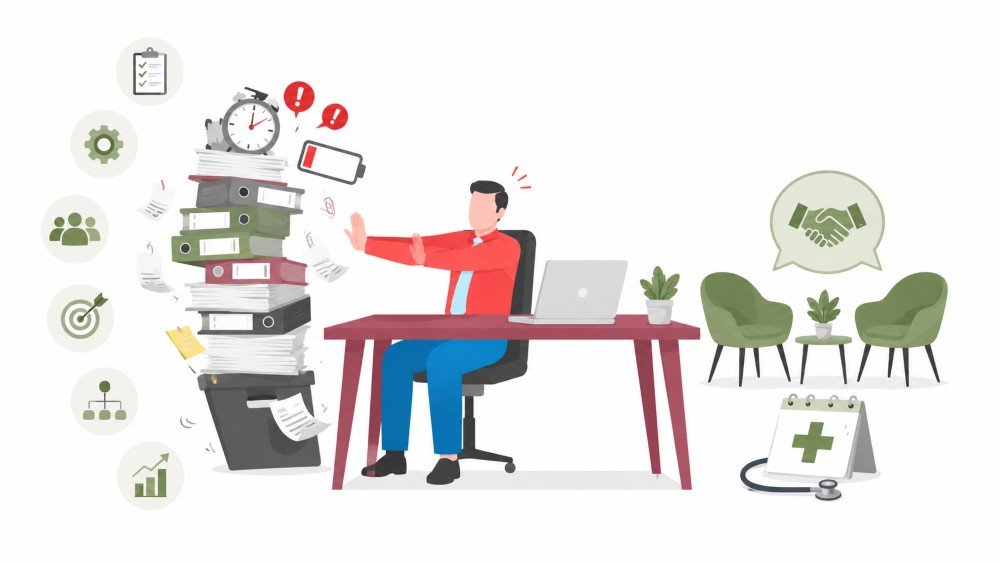
One thing the wellness genre almost never says, so it is worth saying plainly.
If you need an elaborate recovery routine every single night just to become a functional person again, the routine is managing a symptom. No amount of evening ritual offsets a structurally unsustainable job, and framing it as a personal failure of relaxation technique is both unfair and unhelpful.
In Britain this is not merely a matter of opinion. Employers have a legal duty to assess the risk of work-related stress, and the HSE’s Management Standards set out the six areas it expects them to manage: demands, control, support, relationships, role and change. The HSE publishes guidance for employees on raising stress at work, including how to start the conversation with a manager. If the pattern has lasted months, that is a more productive route than another wind-down technique. So is a GP appointment.
Getting Started
None of this requires an overhaul. The evidence points at a small number of things that reliably work: get genuinely away from work rather than merely away from your desk, protect the last hour before bed, do something moderately difficult that you actually chose, and see people who are not colleagues.
Pick one. Run it for a fortnight and see whether the evenings feel different. The measure that matters is not whether you followed a routine but how you feel on waking, because that is where the recovery research consistently finds the effect.
Your evenings belong to you. It is worth spending them on something that gives you the next day back.
Disclaimer: This article is for general information and is not medical advice. It is not a substitute for assessment by a qualified professional. If stress, low mood, anxiety or sleep problems are persistent or affecting your daily life, speak to your GP. Free NHS mental health information is available through Every Mind Matters, and Mind (mind.org.uk) offers an information line for people seeking support in England and Wales.
References
- Health and Safety Executive. Key figures for Great Britain 2024 to 2025. Health and safety statistics. https://www.hse.gov.uk/statistics/overview.htm
- Health and Safety Executive. HSE publishes annual workplace health and safety statistics. Press release, 20 November 2025. https://press.hse.gov.uk/2025/11/20/hse-publishes-annual-workplace-health-and-safety-statistics/
- Sonnentag, S. and Fritz, C. The Recovery Experience Questionnaire: Development and Validation of a Measure for Assessing Recuperation and Unwinding From Work. Journal of Occupational Health Psychology, 2007, 12(3), 204 to 221. https://pubmed.ncbi.nlm.nih.gov/17638488/
- Virtanen, A., De Bloom, J. and Kinnunen, U. Relationships between recovery experiences and well-being among younger and older teachers. International Archives of Occupational and Environmental Health, 2019. DOI: 10.1007/s00420-019-01475-8. https://link.springer.com/article/10.1007/s00420-019-01475-8
- Newman, D. B., Tay, L. and Diener, E. Leisure and Subjective Well-Being: A Model of Psychological Mechanisms as Mediating Factors. Journal of Happiness Studies, 2014, 15(3), 555 to 578. DOI: 10.1007/s10902-013-9435-x
- NHS. Fall asleep faster and sleep better. Every Mind Matters. https://www.nhs.uk/every-mind-matters/mental-wellbeing-tips/how-to-fall-asleep-faster-and-sleep-better/
- Mental Health Foundation. How to sleep better. https://www.mentalhealth.org.uk/explore-mental-health/publications/how-sleep-better
- The Sleep Charity. National Sleep Helpline and adult sleep support. https://thesleepcharity.org.uk/
- Health and Safety Executive. Help for employees on stress at work. https://www.hse.gov.uk/stress/help-employee.htm
- Public Health England. Health matters: getting every adult active every day. GOV.UK, updated guidance on the UK Chief Medical Officers’ physical activity guidelines. https://www.gov.uk/government/publications/health-matters-getting-every-adult-active-every-day/health-matters-getting-every-adult-active-every-day