Aging is one of those things everyone talks about, but not always honestly. We hear so much advice about confidence, beauty, self-acceptance, skincare, treatments, and “letting yourself age naturally” that it can become difficult to know what we actually feel anymore. This piece is not about telling anyone what they should or should not do with their face, body, or routine. It is simply an honest look at the quiet pressure many women feel when they are expected to age, but somehow not look like they are aging too much.
Aging Gracefully, But Make It Real
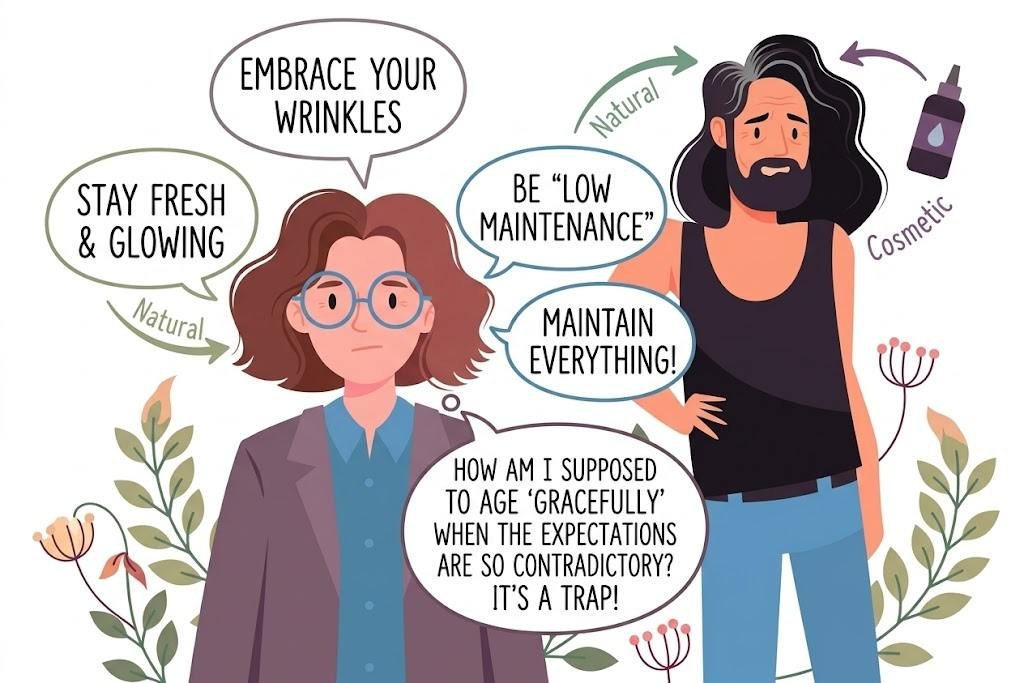
There is a particular kind of pressure that creeps up on you somewhere in your thirties, and nobody really warns you about it beforehand. It is the pressure to “age gracefully,” which on the surface sounds lovely and freeing, but in practice turns out to be one of the most contradictory expectations placed on women.
Because here is the thing. We are told to embrace our wrinkles and let our hair go grey if it wants to. But we are also expected to look fresh, glowing, and somehow ageless. We are praised for being “low maintenance” while being quietly judged if we actually look like we have not maintained anything. The whole concept of aging gracefully has become a trap, and I have spent a fair amount of time recently trying to untangle my own feelings about it.
Mixed Messages Are Exhausting
If you have ever scrolled through your feed and felt vaguely bad about yourself without quite knowing why, you are not alone, and the contradiction I just described is a big part of it.
On one hand, there is the body-positivity, adopt-your-natural-self movement, which I genuinely love and believe in. On the other hand, the same platforms are absolutely flooded with anti-aging serums, tweakments, and “anti-aging from your twenties” content that suggests every line is a problem to be solved. You are meant to love yourself exactly as you are, while also fixing everything about yourself immediately.
It is no wonder so many of us feel a bit lost. We have been handed two opposite scripts and told to perform both at once. Love your face. Also, here are fourteen products to change it. Be confident in your skin. Also, why do you look so tired?
What “Graceful” Actually Seems to Mean
When you really break it down, “aging gracefully” rarely means aging naturally. If it did, we would celebrate deep wrinkles, jowls, age spots, and grey roots as the beautiful, normal things they are.
What it actually seems to mean is aging in a way that is invisible. Looking young without anyone being able to tell you tried. Doing the work quietly, behind closed doors, and then pretending you woke up like this thanks to water and good genes. The “grace” is really just discretion. We are allowed to fight aging. We are just not allowed to be seen fighting it.
That double standard bothers me more the longer I sit with it. Why is honesty about wanting to look and feel good treated as some moral failing? Why is a woman who openly looks after her appearance judged more harshly than one who pretends she does nothing?
My Own Messy Relationship With It
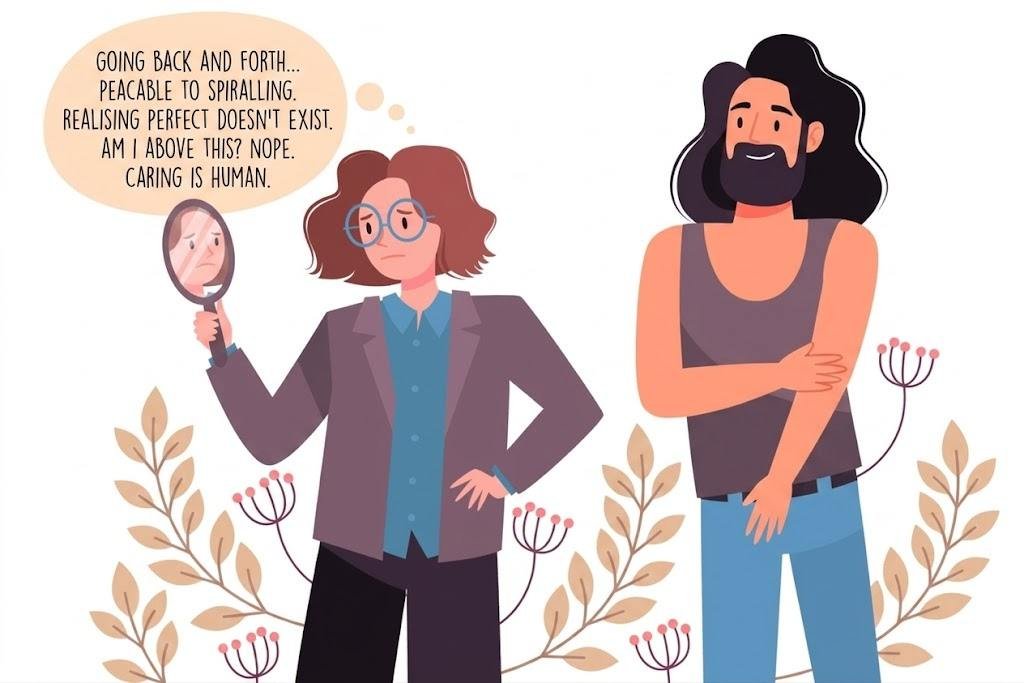
I will be honest with you, because that is the whole point of this blog. I go back and forth constantly.
Some days, I feel completely at peace with the way I am aging. I look in the mirror and see a face that has lived, laughed, and been through things, and I genuinely like it. Other days, I catch myself in an unflattering light and spiral a little, and then immediately feel guilty for spiralling, because I am supposed to be above all that by now.
What I have slowly come to realise is that there is no version of this where I get it perfectly right. There is no enlightened state where I stop caring entirely, and honestly, I am not sure I would want to reach it even if it existed. Caring about how I look is not shallow. It is human. The goal, for me at least, is not to stop caring. It is to care in a way that feels kind to myself rather than punishing.
Information Is the Antidote to Shame
The thing that has helped me most is not a product or a treatment. I am being informed about all my options without judgment attached to any of them.
For a long time, I felt like there were only two acceptable choices. Do absolutely nothing and call it self-love, or do something and feel vaguely ashamed about it. But that framing is rubbish. The real freedom comes from understanding the full range of what is out there, from a good skincare routine and better sleep all the way through to professional treatments, and then choosing what feels right for you with full information and zero guilt.
That includes knowing what the more involved options actually entail, even if you never pursue them. I have spent time reading about everything from non-invasive treatments to what board-certified specialists actually do, and practices like Dr. Cat, which built its reputation on natural-looking results, are part of that wider conversation about feeling at home in your own skin. Understanding the options did not make me feel pressured. It made me feel calmer, because the mystery and the shame around the whole topic finally lifted. Knowledge, it turns out, is far less stressful than wilful ignorance.
Aging On Your Own Terms
Where I have landed, at least for now, is this. The most graceful thing is not pretending you do not care. It is making peace with the fact that you do, and then making your own choices from a place of self-respect rather than fear.
For me, that looks like a skincare routine I actually enjoy, prioritising sleep like it is my job, moving my body because it feels good rather than to punish it, and staying informed about everything else so that if I ever want to explore it, I can do so without panic. For you, it might look completely different, and that is entirely the point.
Permission Granted
So consider this your permission slip, if you have been waiting for one. You are allowed to age however you like. You are allowed to embrace every line, or to do something about the ones that bother you, or to land somewhere in the messy middle as most of us do.
You do not owe anyone a performance of effortlessness. You do not have to pretend you woke up flawless. And you definitely do not have to feel guilty for wanting to feel good in your own skin, whatever that takes.
Aging gracefully, as far as I am concerned now, means aging honestly. On your own terms, with kindness towards yourself, and without apologising to anyone for the choices you make about your own face. That is the only version of grace worth having.
Closing Thoughts
The older I get, the more I believe that aging gracefully should not mean following another impossible rule. It should not mean proving how natural you are, hiding the effort you make, or pretending you never care about your appearance. It should mean having the freedom to choose what makes you feel calm, confident, and comfortable in your own skin.
There is no perfect way to age. Some people will choose skincare only. Some will choose professional treatments. Some will do very little. Some will change their minds many times. All of that is allowed. What matters most is that the choice comes from self-respect, not shame.
So maybe the real goal is not to age flawlessly. Maybe it is to age truthfully, with softness towards yourself and less concern about what other people think. That feels far more graceful than trying to meet another standard that was never fair in the first place.
Disclaimer
This article is for general information and personal reflection only. It should not be taken as medical, cosmetic, mental health, or professional treatment advice. Any skincare, aesthetic treatment, or cosmetic procedure should be discussed with a qualified healthcare professional or board-certified specialist who can explain the possible benefits, risks, costs, recovery time, and whether it is suitable for your personal situation. The mention of any clinic, doctor, product, or treatment is for context only and should not be understood as a personal recommendation or guarantee of results.
References
- Sontag, S. (1972). The double standard of aging. The Saturday Review, September 23, 1972, pp. 29–38.
- Hurd Clarke, L., & Griffin, M. (2008). Visible and invisible ageing: Beauty work as a response to ageism. Ageing & Society, 28(5), 653–674. DOI: 10.1017/S0144686X07007003.
- Slevec, J., & Tiggemann, M. (2010). Attitudes toward cosmetic surgery in middle-aged women: Body image, aging anxiety, and the media. Psychology of Women Quarterly, 34(1), 65–74. DOI: 10.1111/j.1471-6402.2009.01542.x.
- Tiggemann, M., & Lynch, J. E. (2001). Body image across the life span in adult women: The role of self-objectification. Developmental Psychology, 37(2), 243–253. DOI: 10.1037/0012-1649.37.2.243.
- Slevec, J., & Tiggemann, M. (2011). Media exposure, body dissatisfaction, and disordered eating in middle-aged women: A test of the sociocultural model of disordered eating. Psychology of Women Quarterly, 35(4), 617–627. DOI: 10.1177/0361684311420249.