
The warning appeared about forty minutes into a shoot I had already been paid half for. A little thermometer icon, a dimming screen, and a line telling me the phone needed to cool down before the camera would work again. I was standing on a harbour wall on the North Yorkshire coast in the middle of a bright July afternoon, filming a family-run guesthouse for a summer social campaign, and my brand new phone had quietly decided it was done for the day.
I remember the specific, sinking feeling of it. The owner was still smiling, the light was perfect, and I had a shot list I had promised to clear before the tide came in. Instead, I was cupping the phone in the shade of my body like an injured bird, waiting for it to be willing to record again. That afternoon cost me a reshoot, a slightly awkward email, and a fair chunk of my own confidence. It also changed how I buy hardware for a living, so I want to walk through what actually went wrong, because almost none of it was on the spec sheet I had trusted.
Shoot That Fell Apart In Slow Motion
I had bought the phone for one reason. The headline camera number was enormous, far bigger than anything I had owned, and I let that single figure do all my thinking for me. In my head, a bigger number meant sharper client work, which meant I could charge more, which justified the upgrade. I did not read a single review about heat. I did not think about how long the battery would hold under sustained recording. I did not do the storage maths. I saw the number, I saw the price, and I convinced myself I had found a bargain.
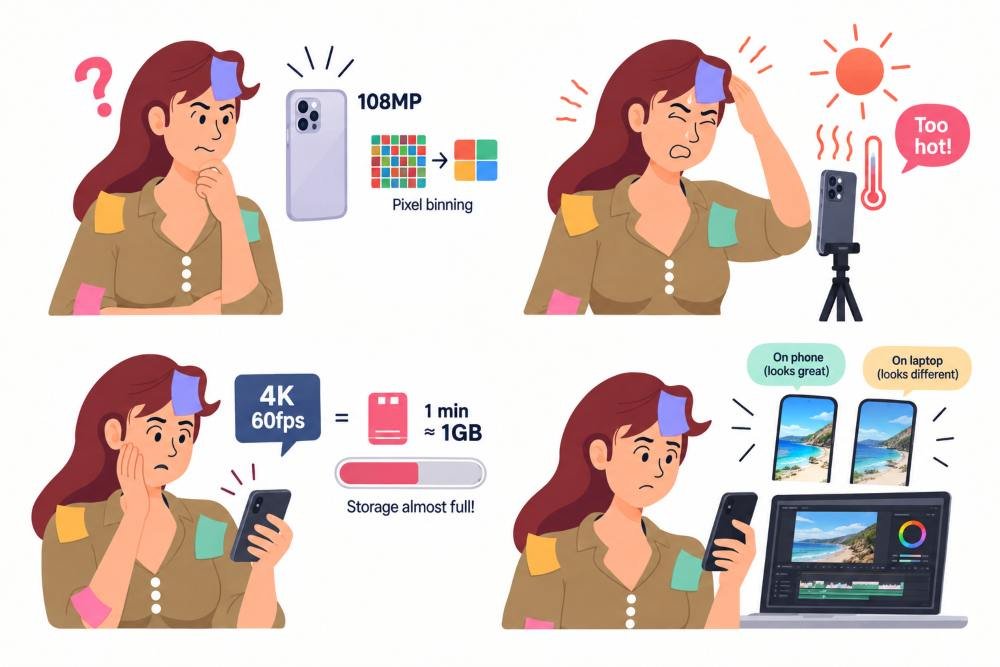
The shoot exposed every gap at once. The heat warning stopped my 4K recording twice. When it did record, a storage-full error interrupted a take I could not repeat because the owner’s dog had wandered off. Back home that evening, the handheld clips looked like they had been filmed during an earthquake, and the colours I had carefully graded on the phone screen looked completely different on my laptop. Four separate problems, none of which the marketing had prepared me for, all landing inside a single paid job.
What Actually Went Wrong
Megapixel Number I Trusted Too Much
The first mistake was believing the camera number meant what I assumed it meant. Modern high-resolution phone sensors rarely output at their full advertised figure. They combine groups of tiny pixels into larger ones to improve light gathering, a process worth understanding if you buy phones for photography, because it explains how pixel binning actually works and why a headline figure and a final image are two very different things.
A device like the HONOR 400 Smart smartphone leads with a 108MP main camera, and that is genuinely useful for detail and cropping, but the number on the box was never the thing that was going to make my footage usable. Lens quality, sensor size, processing, and stabilisation mattered far more, and I had checked none of them. If you want a grounding in what actually separates a good phone camera from a big number, independent testing such as this round-up of the best camera phones is a far better guide than a manufacturer’s front page.
Heat I Never Planned For
The second mistake was treating heat as someone else’s problem. Sustained video recording is one of the most demanding things you can ask a phone to do, because the sensor, the processor, and the storage are all working hard at the same time, and a warm day in direct sun stacks the odds against you further. Phone makers are surprisingly open about this. Apple, for instance, documents a recommended operating range of roughly 0 to 35 degrees Celsius and warns that the device will throttle or pause features outside it. The principle applies across almost every modern smartphone, not just one brand.
I had assumed a premium camera phone would film for as long as I wanted. It will not, and knowing that changes how you plan a shoot. Shorter takes, a shaded staging spot, a lighter case, and lower frame rates when you do not need the extra smoothness are all small habits that keep a phone recording. I learned every one of them the hard way, on the clock, in front of a client.
Storage Maths I Skipped
The third mistake was arithmetic I could have done in two minutes. High-resolution video is enormous. Depending on the settings, a single minute of 4K can run from a few hundred megabytes to well over a gigabyte, and you can prove this to yourself in seconds with a video file-size calculator before you ever leave the house. I had turned up to a paid job with a phone that was already half full of my own life, and I paid for that with a lost take. Now I clear space the night before, shoot to a codec that keeps files smaller where quality allows, and offload footage the same evening rather than trusting a nearly full device to see me through.
Screen That Lied To Me While I Edited
The fourth mistake was the quietest and, in some ways, the most damaging. I graded the clips on the phone’s own screen, which was vivid and punchy and made everything look wonderful. On a calibrated laptop, the same footage looked oversaturated and slightly cold. Phone displays are tuned to look attractive in a shop, and many cover wide colour ranges such as the DCI-P3 colour space that make images pop rather than read accurately. Judging final colour on that screen is like checking your reflection in a funfair mirror. These days I make my colour decisions on a display I trust, and I treat the phone screen as a rough preview only.
How The Mistake Changed The Way I Buy
The lasting shift was philosophical rather than technical. I stopped buying phones by their loudest specification and started buying them by my actual workflow. Before I spend anything now, I write down what the device genuinely has to survive on a bad day. Sustained recording in warm weather. Enough real storage headroom for a full shoot with reshoots. Steady handheld footage, which usually comes down to proper optical stabilisation rather than any camera number, and it is worth understanding what optical image stabilisation does and does not fix. Battery that lasts a working session away from a plug. Only then do I let myself look at the camera figure, and only as one factor among several.
That reframing has saved me money as often as it has made me spend it. Twice now I have talked myself out of an expensive upgrade because the phone I already owned handled my real workflow perfectly well once I stopped chasing a bigger number.
What I Would Tell Anyone Buying A Phone For Client Work
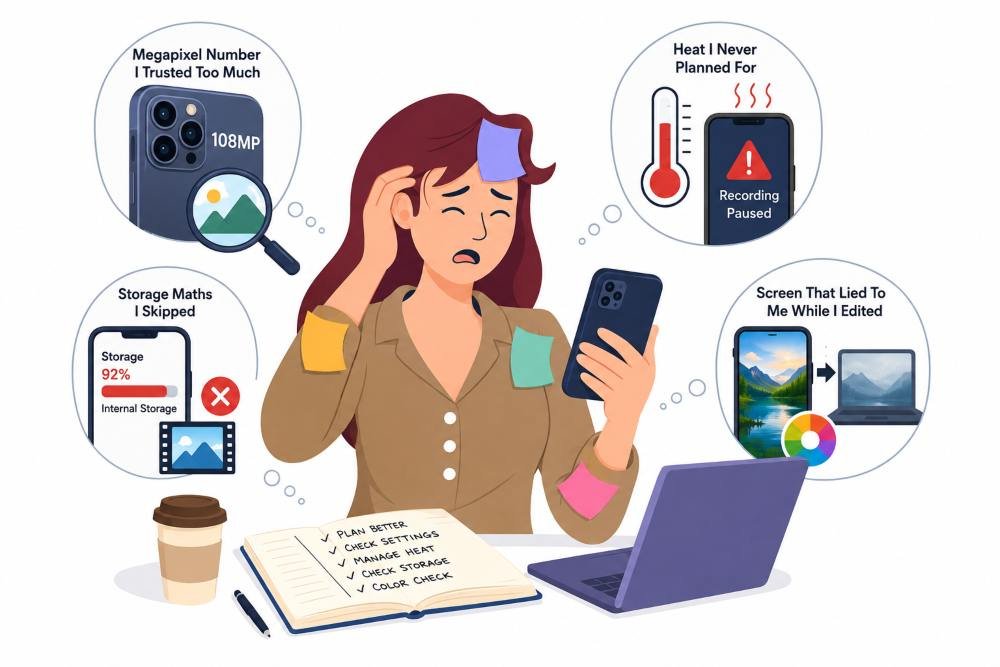
Match the phone to the job, not to the advertisement. Read reviews that stress-test heat, battery, and video, not just still photos in good light. Do the storage maths before you buy, and plan your shoots around a device that will throttle when it gets hot, because it will. Grade on a screen you trust. And if a device you bought genuinely cannot do the ordinary work it was sold to do, remember that in the UK you have real protection. Which? explains your rights under the Consumer Rights Act when a product is not fit for purpose, and Citizens Advice sets out the practical steps for returning something that falls short.
Conclusion
None of this makes me anti-phone or anti-any particular brand. Phones remain the most practical creative tool most of us carry, and mine has since produced work I am proud of. The lesson was never that the hardware failed me. The lesson was that I outsourced my judgement to a single number and let it stand in for the dozen quieter things that decide whether a shoot survives contact with a warm afternoon and a paying client. Buy for the work you actually do, plan for the day when everything runs a little too hot, and the phone in your pocket will very rarely be the thing that lets you down.