
There is a specific kind of tiredness that only long-haul produces. You leave a damp car park at Gatwick some time after tea, sleep badly at 38,000 feet, and step out twelve hours later into air with the texture of a warm flannel. What happens over the following two hours- the transfer, the check-in, the first proper shower- sets the tone for the whole fortnight in a way it never does on a city break to Porto.
That is the honest case for thinking carefully about where you sleep in Phuket. Not because a hotel is the holiday, but because you have spent a serious amount of money and most of a day getting to an island roughly the size of the Isle of Wight, and you will spend your first forty-eight hours operating at half speed. This is a guide to the quieter south-eastern corner of that island, written for people flying from Britain.
Rule That Changed This Week
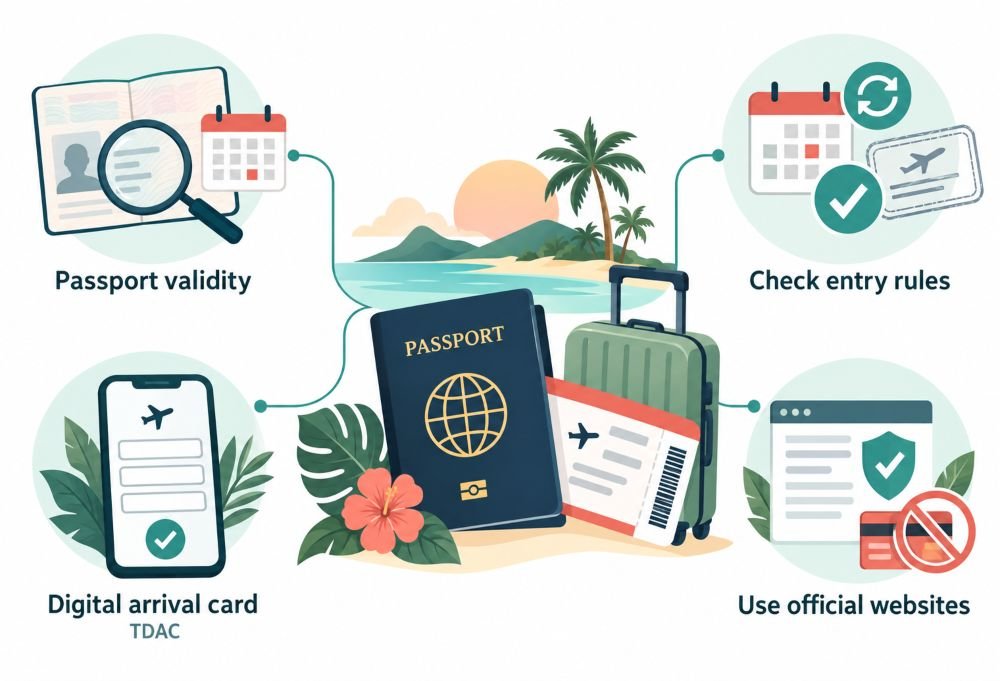
Start with paperwork, because it has just moved. British passport holders have enjoyed an unusually generous run in Thailand since 2024, entering visa-free for up to sixty days. That scheme has now ended. From 15 September 2026, the United Kingdom sits in a group of around sixty countries whose nationals receive a thirty-day stamp on arrival instead. Anyone stamped in on or before 14 September keeps the longer permission printed in their passport.
For a two-week beach holiday this changes precisely nothing. For a six-week winter escape, a sabbatical or a stint of remote working, it changes a great deal, and the extension route through a Thai immigration office adds another thirty days rather than sixty. Because these rules have shifted twice in as many years, the sensible habit is to read the Foreign, Commonwealth and Development Office advice for Thailand at the point of booking and again in the week before you fly, rather than trusting a forum post from last winter.
One more piece of admin catches people out. Since May 2025, every foreign visitor must submit a Thailand Digital Arrival Card online, no earlier than seventy-two hours before landing. It replaces the old paper form; it is free, and it takes about five minutes with your passport and hotel address to hand. A small industry of copycat websites now charges twenty pounds for the privilege of filling it in for you, so use the immigration bureau’s own address and no other. Your passport also needs six months of validity remaining on the day you enter.
Twelve Hours, And A Six-Hour Clock
There is no year-round non-stop between Britain and Phuket. What exists is a seasonal winter service: Virgin Atlantic from Heathrow and Norse Atlantic from Gatwick, broadly running from autumn to spring, alongside charter capacity. Flying time is around twelve hours. Outside those months, you connect, usually through Doha, Dubai, Abu Dhabi or Bangkok, and the door-to-door figure climbs to fifteen or sixteen hours once the layover is counted.
Thailand runs seven hours ahead of GMT, which means six hours ahead while Britain is on summer time. Travelling east is the harder direction for most bodies. The unglamorous advice still works best: get outside into daylight on arrival day, eat at local mealtimes, and hold out until nine in the evening before surrendering.
Geography matters for the transfer too. Phuket International sits at the northern end of the island, while Cape Panwa is at the far south-eastern tip, a drive of roughly forty-five minutes to an hour depending on traffic through Phuket Town. It is not a distance you want to negotiate with a taxi tout at two in the morning, so book the transfer in advance.
Why Cape Panwa Reads Differently From Patong
Most British visitors picture the west coast when they picture Phuket: Patong, Karon, Kata, the long Andaman-facing beaches with their sunsets and their sound systems. Cape Panwa is on the other side of the island entirely, a green headland pointing south into Makham Bay, and it behaves differently as a result.
The water is sheltered, which usually means calm enough to swim or paddle in before breakfast rather than merely to look at. The outlook is east, so you get sunrises over the water and no sunsets at all, a genuine trade-off that nobody mentions in the brochures. And there is very little on the cape beyond the resorts themselves: a handful of local restaurants, the aquarium at the tip, a fishing pier, and not much else. Phuket Town is about twenty minutes away by road and Patong closer to forty.
That combination suits one sort of traveller and frustrates another. If your idea of a holiday is wandering out at seven and choosing between thirty restaurants, the west coast will serve you better. If you would rather the island came to you, arriving as a boat trip or a booked car, the east coast is the calmer proposition. Properties here are built around the assumption that guests will spend real time on site. The Pullman Phuket Panwa Beach Resort is a reasonable illustration of the type, with 211 rooms and villas, three pools, its own stretch of beach on the bay and Green Globe certification for its environmental management. Families tend to like the sheltered water and the kids’ club; couples tend to like the fact that the nearest nightclub is a taxi ride away.
Timing A Trip Around The British Calendar
The Andaman coast has a clear rhythm. The south-west monsoon runs roughly from May into October, and the dry high season from November through April. This is worth internalising, because Thailand’s other famous islands, Koh Samui and its neighbours in the Gulf, run on an almost opposite cycle. A friend’s glorious July photographs from Samui tell you nothing useful about Phuket in July.
For British families, the awkwardness is obvious. February half-term and the fortnight around Christmas land squarely in peak season, with peak pricing and peak flight demand to match. April is reliably the hottest month of the year, which makes the Easter holidays a sweaty prospect with young children. The value sits in late October and early November, when the rain has largely burned off, the crowds have not yet arrived, and hotel rates have not reached their December ceiling.
October also brings the island’s most extraordinary event. The nine-day festival held in the ninth lunar month, known locally as Tesagan Gin Je and to visitors as the Phuket Vegetarian Festival, fills Phuket Town with white-clad processions, firecracker smoke and street food from before dawn. The dates move each year with the Chinese calendar, so confirm them with the tourism authority before you build a trip around it. It is loud, genuinely startling in places, and unlike anything on a British calendar.
Eating In A UNESCO City Of Gastronomy
Phuket Town is not a bolt-on to a beach holiday. In 2015 it became the first city in Thailand and in ASEAN to join UNESCO’s Creative Cities Network as a City of Gastronomy, a recognition of Peranakan food culture built over generations by Hokkien Chinese tin-mining families and their Thai and Malay neighbours.
What that means at the table is a set of dishes you will not find in a Thai restaurant in Manchester. Moo hong is pork belly slow-braised with black pepper and garlic until it collapses. Mee Hokkien is a tangle of yellow noodles fried with seafood and stock rather than swimming in coconut. O-tao is an oyster and taro pancake cooked hard on a flat plate. Breakfast, if you get there early, is roti and sweet tea in a shophouse doorway on Thalang Road, under Sino-Portuguese facades painted in the pastel shades of a Georgian terrace that has been left in the sun.
Two practical notes. Southern Thai cooking is properly hot, hotter than the standard British restaurant calibration, and “mai phet” is a phrase worth learning. And a resort breakfast is a fine thing, but a fortnight of it is a wasted opportunity twenty minutes from one of Asia’s more interesting food towns.
Sea Is Not The Cornish Coast
British beachgoers are used to a level of lifeguard cover that does not exist across most of Thailand. Drownings among foreign visitors are a persistent problem on Phuket’s west coast, particularly during the monsoon months when rip currents form fast, and red flags go up along Patong, Karon and Kata. The flags are not decorative and swimming past them is not a display of Yorkshire hardiness. Sheltered eastern bays such as Panwa are considerably gentler, which is part of their appeal for families, but no beach here should be treated like a supervised English resort beach in August.
Two related risks. Jellyfish appear seasonally, and hotel reception will know the current picture. And motorbike hire, which looks cheap and liberating, is the single most common way British travellers come unstuck: most UK travel policies exclude it unless you hold the correct category A entitlement and wear a helmet, and hire firms are not always insured in the way you would assume.
What Catches British Visitors Out
Three legal points deserve blunt treatment. Vapes and e-cigarettes are illegal in Thailand, and that covers possession as well as use. Enforcement has intensified sharply; devices are confiscated at the airport, and fines running into hundreds of pounds are routine. Leave the whole kit at home. Cannabis occupies a strange middle ground inside the country but carrying any of it out is a serious criminal matter, and British nationals have been arrested in transit at third-country airports. Finally, carry your passport, because Thai law requires it.
On health, book a pharmacy or GP travel appointment four to six weeks before departure and use the National Travel Health Network and Centre’s country guidance for Thailand as your reference. Dengue is present year-round and mosquito bite avoidance matters more than any tablet. Antimalarials are generally not required for Phuket’s tourist areas, though your clinician will confirm against your itinerary.
Insurance is the item people economise on and regret. A GHIC is worthless in Thailand, private hospital bills in Phuket are substantial, and a medical repatriation can run well into six figures. The government’s foreign travel insurance guidance sets out what a policy should cover and, crucially, why pre-existing conditions must be declared. Check that scuba diving, jet skis and scooters are included rather than assumed.
Finally, if elephants are on your list, read World Animal Protection’s elephant-friendly tourist guide first. The word “sanctuary” is unregulated, and riding, bathing and hugging all indicate a venue where the animals have been broken to accept human contact.
Booking It So You Are Actually Protected
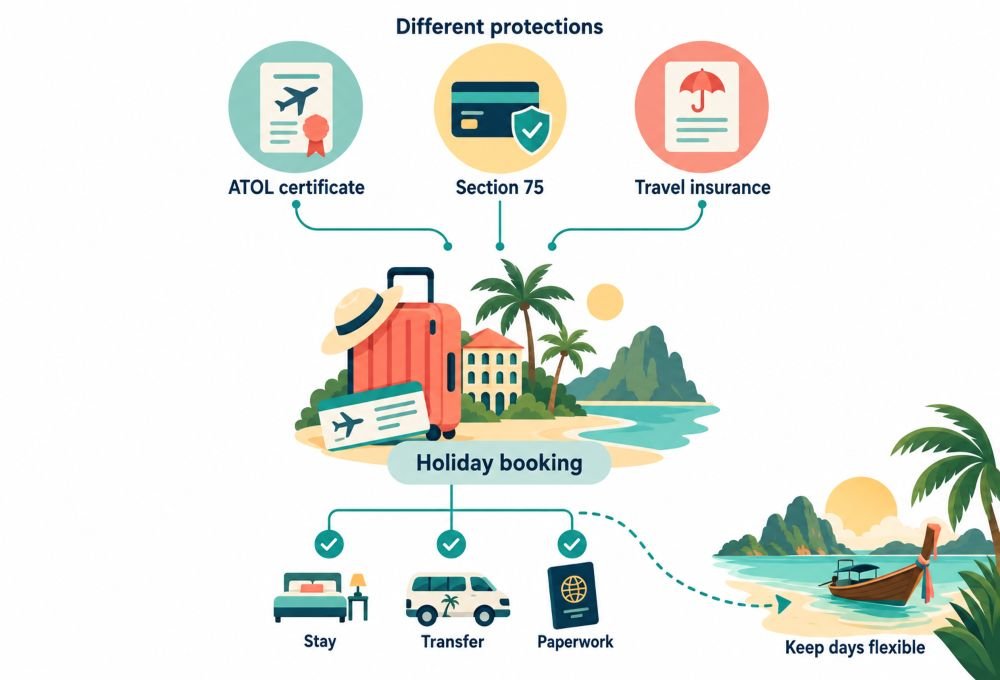
A flight-inclusive package bought from a UK company should come with an ATOL certificate, which means the Civil Aviation Authority will get you home or refund you if the operator fails. Accommodation booked separately, and especially accommodation booked through an overseas platform, carries no such protection. Paying by credit card gives you Section 75 rights on purchases between £100 and £30,000, which is a meaningful backstop on a deposit. None of this replaces travel insurance; the three schemes cover different failures.
Phuket rewards a bit of planning and punishes none of the spontaneity. Book the base, book the transfer, sort the paperwork, then leave the days themselves loose. The island is small enough that a morning decision to go to Phuket Town or out to the islands is still a morning decision, and the best hours of most trips are the ones nobody scheduled.
This article is for general information only and reflects entry, health and consumer protection rules as understood in September 2026. Visa arrangements, arrival card requirements and travel advice change frequently. Verify current requirements with the FCDO and official Thai government sources before booking and again before departure. This is not legal, medical or financial advice.