
Nala had just passed her annual check-up with no concerns raised. She was eating well, maintaining weight, and her bloodwork was clean. My vet, a good one, with 20 years of experience, signed her off as a healthy nine-year-old cat with no action required until the following year.
Six weeks later, a wearable sensor on her collar told a different story.
Her overnight movement had dropped 34% over the previous three weeks. Not in a single dramatic dip, the kind that would have caught my attention, but gradually, across 21 nights, in a pattern so slow it was completely invisible to me in daily life. She was still jumping onto the sofa, still eating, and still coming to find me in the evenings. Nothing about her behaviour signalled that anything was wrong. Tools like Kitty Sense exist precisely for this, catching the slow, invisible shifts that daily life makes it almost impossible to notice on your own.
The data did.
When I brought that three-week movement report to my vet, she examined Nala’s lower spine and hips more closely than a standard wellness check would typically prompt. She found early-stage spondylosis, a degenerative joint condition, in two vertebrae. Nala wasn’t showing pain behaviours because cats almost never do at that stage. She was moving less at night, in the quiet hours when no one was watching, because it had started to hurt.
That appointment changed how I think about what it means, actually, to monitor a cat’s health.
What a Standard Annual Check-Up Can and Cannot Tell You
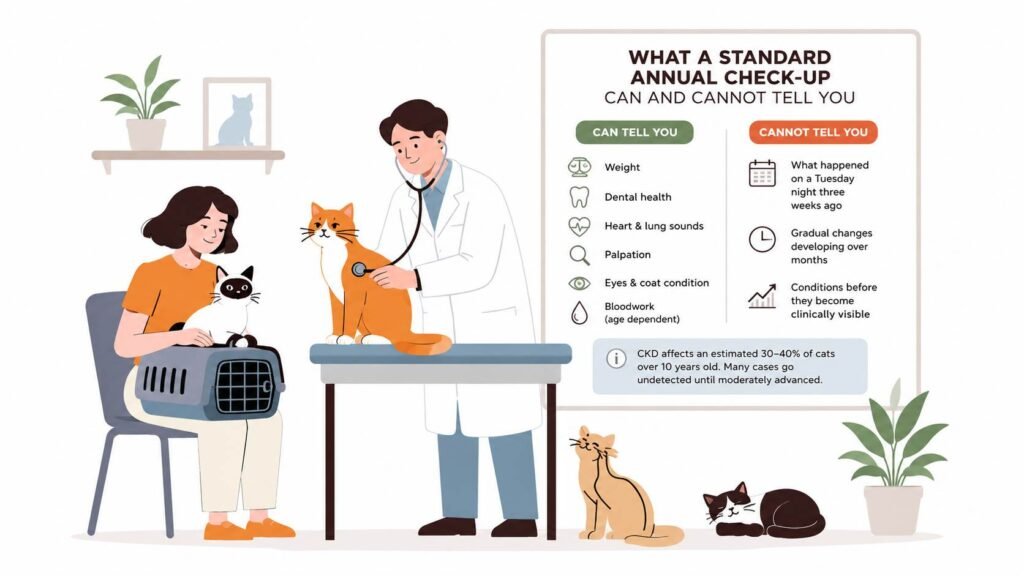
This isn’t a criticism of veterinary care. A thorough annual examination covers a lot of ground, including weight, dental condition, heart and lung sounds, palpation, coat and eye health, and, depending on age, bloodwork. A good vet working carefully can pick up a significant amount in a ten-to-fifteen-minute appointment.
What it cannot do is tell you what happened on a Tuesday night three weeks ago.
Feline health conditions that matter most, chronic kidney disease, early cardiac changes, hyperthyroidism, and joint degeneration, share a common feature: they develop gradually and quietly over months, not days. By the time they’re visible during a clinical exam, they’ve often been progressing for longer than anyone realises. The British Small Animal Veterinary Association notes that chronic kidney disease affects an estimated 30 to 40% of cats over ten years old, and a significant proportion of those cases go undetected until the condition is moderately advanced.
The annual check-up is not the problem. The eleven months in between are where the information gap lives.
What the Wearable Actually Measured and What It Didn’t
There’s a version of this conversation that turns into a sales pitch for technology. That’s not what this is. Wearables have real limitations, and it’s worth being clear about both sides.
What the sensor tracked on Nala
The device measured three things with reasonable reliability:
- Resting respiratory rate. Normal for a healthy adult cat is between 15 and 30 breaths per minute during sleep. Sustained elevations above 30, particularly if consistent across multiple nights, can indicate early fluid accumulation or cardiac stress. Nala’s was consistently within range, which was useful information in its own right.
- Heart rate variability. Not the heart rate itself, but the variation between beats, which is sensitive to stress and early cardiovascular irregularity. This requires a baseline to be meaningful; a single reading tells you almost nothing, but several weeks of data establishes a personal normal range that genuinely flags deviations.
- Activity and movement. This is where Nala’s pattern showed up. The algorithm doesn’t just track total steps or distance; it segments activity by time of day and compares it against a rolling baseline. A cat that was previously moving between rooms twice an hour overnight, and is now doing so once every two hours, registers as a significant change even if her daytime behaviour appears identical.
What it cannot do
A wearable cannot diagnose anything. It cannot replace bloodwork, imaging, or physical examination. What it can do is give a vet a reason to look more closely at something specific, and in Nala’s case, that’s exactly what it did. I didn’t arrive at that second appointment saying, “My cat has arthritis.” I arrived, saying, “Her overnight movement has dropped consistently over three weeks, and I don’t know why.” That’s a very different and more useful starting point.
Three Conditions Where Early Detection Changes the Outcome Most
Not every health condition benefits equally from early detection. For some, the treatment is the same regardless of when it’s caught. For three of the most common conditions affecting UK cats, however, the timing window genuinely matters.
Chronic Kidney Disease
CKD is staged from one to four. At stage one and early stage two, cats show no clinical signs, and bloodwork may still appear normal on standard panels. Phosphorus-restricted diet, hydration management, and specific supplements introduced at this stage can slow progression significantly in some cats, holding them at stage two for years rather than months. By stage three or four, those interventions are still helpful, but the management options narrow considerably.
A consistent downward shift in water intake trackable via a smart fountain or feeding station is one of the earliest behavioural indicators. Combined with wearable movement data and periodic at-home biomarker panels, some owners are now catching CKD at a stage where their vet has real room to work.
Hypertrophic Cardiomyopathy
HCM is the most common cardiac condition in cats, and certain UK-popular breeds, such as Maine Coons, British Shorthairs, and Ragdolls, carry a significantly elevated genetic risk. It can progress from an undetectable early thickening of the heart wall to a life-threatening emergency without any obvious outward signs in between.
Resting respiratory rate monitoring is the single most useful at-home indicator for HCM risk. Most cardiologists now recommend that owners of high-risk breeds track this manually or via a wearable, and treat any sustained reading above 30 breaths per minute during sleep as a reason to call their vet that day.
Hyperthyroidism
The earliest signs of hyperthyroidism, such as slight weight loss, marginally increased appetite, and subtle increase in vocalising at night, are individually easy to dismiss. Together, tracked against a baseline over weeks, they form a recognisable pattern. Smart feeding stations that log intake by weight rather than just bowl-empty or bowl-full give owners and vets a much more precise picture of whether a cat is genuinely eating more, or whether the bowl is being finished for another reason.
How the Data Actually Gets Used in a Veterinary Consultation
One concern owners raise is whether vets will actually engage with this data or treat it as noise. Based on experience, the answer depends significantly on how it’s presented.
Arriving with a printout of three weeks of movement graphs and asking your vet to “look at this” without context puts the interpretation burden on them in a short appointment. That’s not ideal for anyone.
What works better is arriving with a specific observation: “Her overnight movement has dropped by roughly a third over three weeks, and this is what the trend looks like.” That’s a clinical prompt, not a data dump. Most vets, particularly those working with older cats, will engage with that immediately because it’s the kind of slow change that’s genuinely hard to catch any other way.
At-Home Biomarker Testing: What It Can Realistically Offer
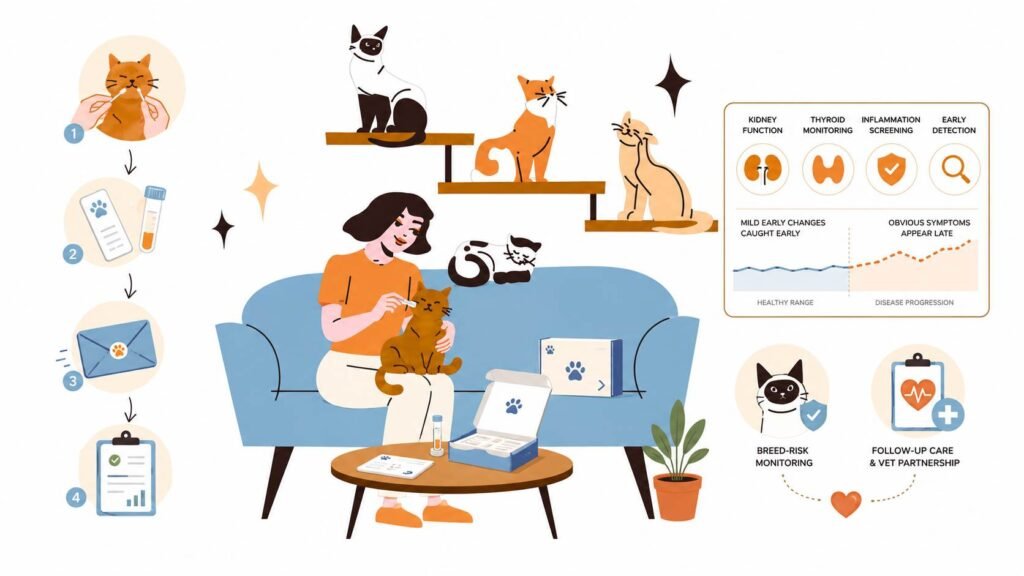
Mail-in blood biomarker panels for cats have become considerably more accessible over the past two years, with several UK-available options now reviewed by RCVS-registered professionals. They typically screen for kidney function markers, thyroid hormone levels, and basic inflammatory indicators.
The realistic use case is not to replace clinic bloodwork. It’s to provide a screening layer between annual appointments, particularly for cats over seven, or breeds with known predispositions, so that changes which warrant a full clinical panel get caught before they’re clinically obvious.
A panel that comes back with a mildly elevated SDMA, a kidney function marker sensitive to early CKD, gives your vet a specific reason to run a full panel and potentially start a staging workup. That’s a much better starting point than waiting for the cat to present with weight loss and poor coat condition twelve months later.
One practical note: cheek swab genetic testing is worth doing once, early, for pedigree cats with documented breed risks. Knowing that your Maine Coon carries HCM-associated genetic variants doesn’t mean the cat will develop the condition. Still, it does mean that resting respiratory rate monitoring and an annual cardiac scan become genuinely justified rather than optional extras.
What Nala’s Story Actually Means for Your Cat
Nala is now eleven months old from that second appointment. She’s on a joint supplement, her sleeping area has been raised slightly to reduce the step-up she was avoiding, and her overnight movement has recovered to within about 15% of her pre-symptoms baseline, which, given the underlying condition, her vet considers a genuinely good outcome.
She would not have been diagnosed at that stage through a standard annual check-up alone. The spondylosis was there to be found once someone knew to look. Still, without the data prompting a more targeted examination, it would have continued developing quietly until the behavioural signs became obvious. By that point, more of the joint surface would have been affected.
None of this required a large investment or a complicated setup. A collar-mounted sensor. A feeding station with a built-in scale. One at-home biomarker panel. And a vet who was willing to take a specific, data-backed observation seriously.
For cats over seven, for any pedigree breed with a documented heritable condition, or simply for owners who want the kind of early warning that a once-yearly appointment structurally cannot provide, that combination is now genuinely accessible. The window it opens is, for some cats, the difference between a manageable condition caught early and a crisis that didn’t have to happen.