
The early thrill of generative video was all about the output: type a sentence, watch a cinematic clip appear, feel briefly like a wizard. That fascination fades fast the moment a team stops making five clips a week and starts needing five hundred. At that point, the interesting question is no longer “can it look amazing,” it is “can we afford the time and the spend to make this many, this often, without the whole thing quietly bankrupting the department?” The magic gives way to logistics, and logistics is where teams either build a real production engine or a very expensive hobby.
Scaling a generative pipeline is rarely about crowning one all-powerful model. It is about working out where, for each job, the cost and time of making an asset actually line up with what that asset is worth. A fifteen-second social ad built for a forty-eight-hour flight does not need the same heavy compute as a hero brand film that will run for a year. Learning to route those two jobs differently is the whole discipline, and it is the difference between a sustainable operation and a budget that leaks from every render.
Hidden Tax of Always Reaching for the Best Model
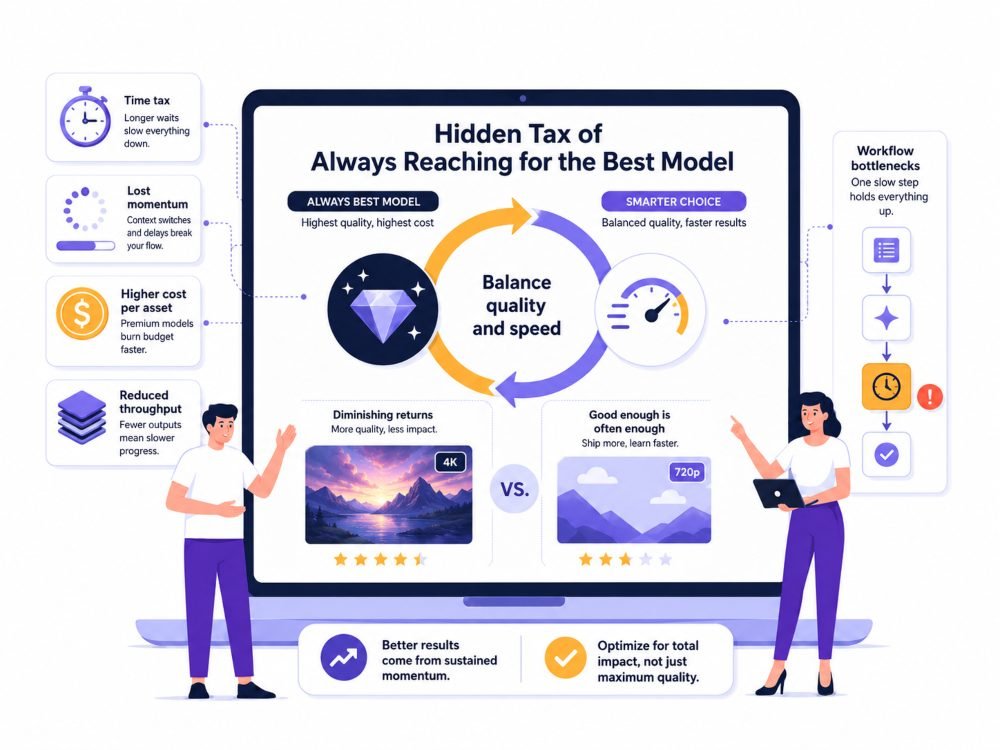
In the early days of adopting an AI video tool, a lot of teams fall into what you might call fidelity maxing. They reach for the highest-parameter model every single time, on the assumption that more visual complexity always equals better results. That instinct quietly ignores two taxes: time and momentum.
The most capable models are often the slowest. Waiting ten or fifteen minutes for a single render is fine for a one-off showpiece. In a high-volume shop, those minutes stack up in a hurry. If an editor needs three attempts to nail one bit of camera movement, that is the best part of an hour lost to watching a progress bar. That is the real cost of waiting, and it is a drain on your most expensive resource, which is skilled human attention, not credits. It routinely dwarfs the API or subscription cost of the generation itself.
There is also a hard ceiling of diminishing returns. For throwaway content, a story, a TikTok cut, an internal mockup, the gap between “good enough” and “cinematic masterpiece” makes almost no difference to whether anyone clicks, watches or buys. Demanding peak fidelity for every asset throttles your own throughput and inflates your cost per asset for no measurable gain. Even the researchers behind these systems frame the field’s central struggle as a trade-off between motion consistency and computational efficiency, not a straight march toward “more.” Treating fidelity as a free good is the first mistake to unlearn.
Build a Tiered Stack, Not One Super-Tool
The fix that experienced operators land on is a tiered architecture. Rather than leaning on a single engine, they keep a small stack of models sorted by compute weight, and they match the engine to the stakes of the job.
In the discovery and storyboarding phase, speed is the only metric that matters. Lightweight, high-speed engines let a team blast through dozens of visual concepts in the time a heavyweight model spends on one frame. This is deliberately low-stakes generation: you are locking in composition, pacing and direction, not final polish. There is no sense burning premium credits, or the compute behind a cinematic-grade model, before anyone has even agreed the shot. Much of the recent research effort goes precisely into cutting the number of denoising steps a model runs so it can generate faster, whether through consistency models or distilling a slow model into a fast one. Those are the techniques quietly powering the “draft” tier.
The point of a platform like MakeShot is to make that shift painless. By centralising a range of engines, from fast-iteration tools through to heavy-duty cinematic models, an AI Video Generator lets a team pivot between draft quality and final quality without ever switching interfaces or breaking flow. That matters more than it sounds. It keeps the cognitive load down and, crucially, it reserves the most expensive compute for the final ten per cent of the job, where fidelity actually earns its keep. The heavy latent video models built for that final tier are a genuinely different class of engine from the ones you use to sketch, and they are designed to be scaled that way.
Why Failing Fast Beats Rendering Slow
A metric almost nobody tracks, but everyone should, is the generation-to-rejection ratio. Generative models are stochastic by nature; you rarely get exactly what you pictured on the first try. So the ability to fail cheaply and quickly is worth more than the ability to produce a single, expensive, high-quality miss.
Faster, cheaper models frequently produce better final work, precisely because they permit more experimentation. A creator who can spin up twenty variations of a scene in five minutes is far more likely to stumble on a lucky composition or an unexpected bit of movement than one who has waited half an hour for two immaculate renders that both happen to be wrong. Volume of attempts, not perfection per attempt, is what surfaces the good stuff.
Consistency Ceiling: Where Speed Stops Paying Off

There is a real technical limit to all this, and pretending otherwise wastes money. High-speed models still tend to struggle with temporal consistency: textures that shimmer or “boil,” characters that morph across a few seconds, physics that quietly falls apart. Generating genuinely coherent, high-fidelity video over time is a hard, unsolved problem, and it is exactly the milestone the foundational work in this area set out to chase.
So reset expectations honestly. Speed usually costs you physics-heavy consistency. Fast engines are superb for rapid ideation, but a human editor still has to recognise when the quality floor has been missed, because the model will not tell you. If a shot needs a character to perform a complex, anatomically correct dance, a high-speed engine will very likely fail no matter how many times you reroll it. Knowing which jobs sit above that ceiling, and routing them straight to a heavier model, is part of the craft.
Unit Economics: Cost Per Winning Asset, Not Cost Per Clip
When you work out the return on an AI video pipeline, drop the naive “cost per clip” figure. The honest measure is cost per winning asset.
In performance marketing, you might generate a hundred clips to find the three that actually move revenue. If all hundred were rendered on a top-tier, high-latency model, your cost per winner is frankly grotesque. Generate the bulk on lighter engines, identify the handful that perform, and only then spend real compute upscaling the winners, and your burn rate collapses towards something a finance director will sign off.
Managed platforms add a layer of financial predictability through credit-based pricing, which for small and medium teams is usually saner than trying to run their own GPU fleet. The overhead of maintaining A100 or H100 instances, wrangling cold-start latency and keeping local model weights current is a high and easily overlooked cost. A managed ecosystem absorbs that infrastructure risk so the team can concentrate on creative throughput rather than server uptime. Part of why these platforms can be economical at all is architectural: modern systems generate in a compressed latent space rather than raw pixels, which cuts the compute bill substantially.
Compliance Layer UK Teams Cannot Skip.
For a British team, there is one more axis that has nothing to do with compute and everything to do with staying out of trouble, and it belongs in the pipeline design from day one.
An AI-generated ad is still an ad. The Committee of Advertising Practice has been clear that the existing UK advertising rules apply the same whether or not AI was involved, and that slapping on an “AI was used” disclosure will not rescue a fundamentally misleading message. If a generated clip implies a product does something it does not, that is a problem regardless of how it was made, and the advertiser, not the model, carries the liability. Build a human review step that catches fabricated claims and dodgy synthetic likenesses before anything goes live.
Data protection is the other one. The moment your clips involve real faces, voices or any personal data, UK GDPR is in play, and the ICO’s guidance on AI and data protection sets out what lawful, fair and transparent processing looks like across the lifecycle. Add intellectual property to the pile, since a convincing likeness or a scraped style can raise IP and passing-off questions entirely separate from the advertising code. None of this needs to slow a good pipeline down. It just needs to be a named stage in it rather than an afterthought discovered by a regulator.
What You Still Cannot Predict
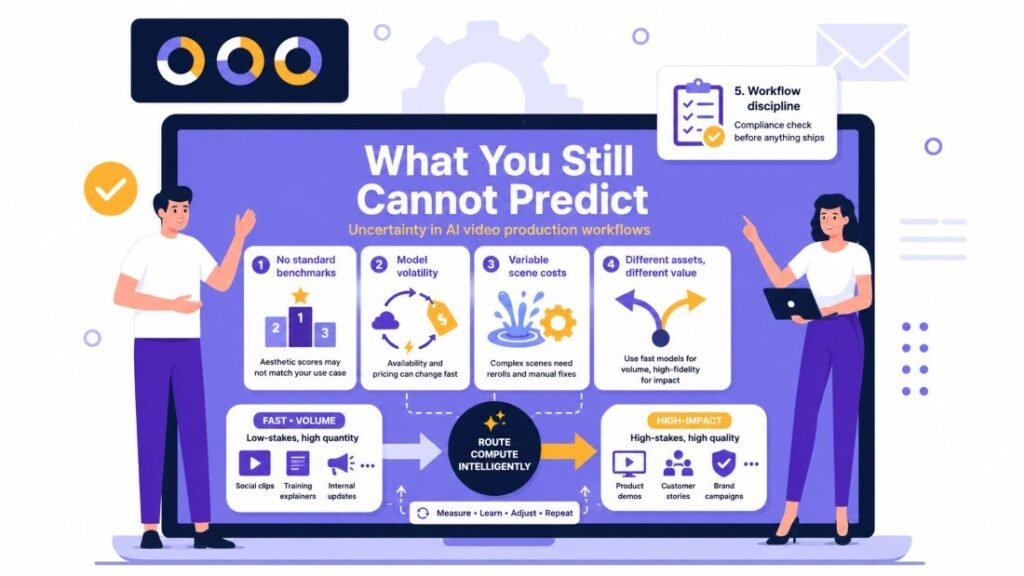
For all the progress, a production lead has to plan around real uncertainty. The biggest is the lack of standardised benchmarking. Current leaderboards lean on subjective aesthetic scores or narrow prompt sets that may have nothing to do with your actual use case. A model that shines at slow-motion nature cinematography can be useless urban fashion.
The landscape itself is volatile. Model availability and pricing can shift overnight on the back of a provider pivot or a regulatory change. It is also currently impossible to promise a fixed cost per minute for genuinely complex scenes, because physics-heavy prompts, water splashing, and intricate mechanical interactions tend to demand more rerolls and more manual intervention, which makes a flat budget per project type a fiction.
The goal, then, is not the fastest tool or the cheapest one. It is a workflow that recognises different assets carry different value, and routes compute accordingly: high-speed models for volume, high-fidelity models for impact, and a compliance check before anything ships. Crossing from experimental AI use to industrial-scale production is not really a technology problem. It is a matter of pipeline discipline.
Important Disclaimer
This article is general information for content and marketing teams and is not legal, financial, or professional advice. The generative AI landscape moves quickly: specific model names, capabilities, availability, and pricing referenced here can change without notice, and benchmark results are highly dependent on your own use case. Any figures are illustrative. Responsibility for meeting UK advertising, data protection, and intellectual property obligations rests with the advertiser and its agency, not with any tool or platform. Before running AI-generated content in live campaigns, consider seeking advice from a qualified legal or compliance professional and consult the current guidance from the relevant UK regulators.
References
- Ho J, Salimans T, Gritsenko A, Chan W, Norouzi M, Fleet DJ. Video diffusion models. arXiv:2204.03458 [Preprint]. 2022. doi:10.48550/arXiv.2204.03458
- Blattmann A, Dockhorn T, Kulal S, Mendelevitch D, Kilian M, Lorenz D, et al. Stable Video Diffusion: scaling latent video diffusion models to large datasets. arXiv:2311.15127 [Preprint]. 2023. doi:10.48550/arXiv.2311.15127
- Song Y, Dhariwal P, Chen M, Sutskever I. Consistency models. arXiv:2303.01469 [Preprint]. 2023. doi:10.48550/arXiv.2303.01469
- Salimans T, Ho J. Progressive distillation for fast sampling of diffusion models. arXiv:2202.00512 [Preprint]. 2022. doi:10.48550/arXiv.2202.00512
- Rombach R, Blattmann A, Lorenz D, Esser P, Ommer B. High-resolution image synthesis with latent diffusion models. arXiv:2112.10752 [Preprint]. 2022. doi:10.48550/arXiv.2112.10752
- Wang Y, et al. Survey of video diffusion models: foundations, implementations, and applications. arXiv:2504.16081 [Preprint]. 2025. doi:10.48550/arXiv.2504.16081
- Committee of Advertising Practice. Disclosure of AI in advertising: striking the balance between creativity and responsibility. Advertising Standards Authority. Available from: https://www.asa.org.uk/news/disclosure-of-ai-in-advertising-striking-the-balance-between-creativity-and-responsibility.html
- Information Commissioner’s Office. Guidance on AI and data protection. Available from: https://ico.org.uk/for-organisations/uk-gdpr-guidance-and-resources/artificial-intelligence/guidance-on-ai-and-data-protection/