
Ask a Leeds salon owner or a Bristol coffee roaster what stops them putting an app in front of customers, and the answer is almost never ambition. It is the quote. Bespoke development has historically meant five figures and a six-month wait, which rules it out for most independent businesses before the conversation starts. That maths has shifted. A generation of no-code platforms, YourModule among them, now lets a non-technical owner build an app with AI in an afternoon, describing what they want in plain English and ending up with something installable rather than a slide deck. What has not shifted is everything that happens after the build, and that is where most first-time app projects come unstuck.
Mobile is where UK customers already are. The build is the easy part now; distribution and compliance are not.
Why The Mobile Question Keeps Coming Up
The behavioural case is not really arguable any more. Ofcom’s most recent research found that UK adults spend the bulk of their online time on a smartphone and use an average of 41 apps a month. Your customers are not deciding whether to use apps. They are deciding which ones earn a place on the home screen.
For the 5.7 million private sector businesses in the UK, the overwhelming majority of which have fewer than fifty staff, that creates an awkward gap. The behaviour is mobile. The budget is not. No-code builders exist precisely in that gap, and the AI layer that has been bolted on over the past two years has made them considerably less painful to use than the drag-and-drop era that preceded them.
What These Tools Are Actually Good At
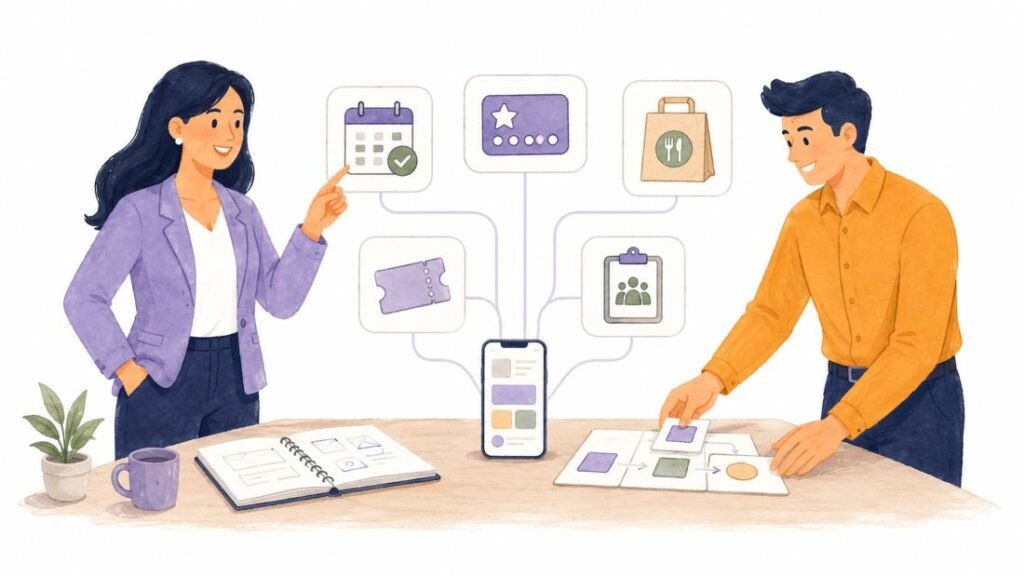
Be honest about the job you are hiring an app to do. The projects that succeed on no-code platforms tend to share a shape: a repeat interaction, a small number of screens, and a customer who already knows your business.
Booking and appointments are the clearest example. A barber, a physio, a driving instructor or a dog groomer running a diary through phone calls and text messages has a genuine operational problem, and an app that handles slots, reminders and cancellations solves it. Loyalty schemes work for similar reasons. So do ordering apps for takeaways, catalogue apps for trade suppliers whose customers reorder the same twelve items, event apps for a festival or a conference, and internal tools such as a shift rota or a site checklist for a team of engineers.
What these have in common is that nobody needs persuading to install them. The app is a convenience for an existing relationship, not a marketing channel hoping to acquire strangers.
Where The Limits Sit
The honest constraints are worth knowing before you start rather than three weeks in.
Anything that depends on unusual hardware access, heavy real-time processing, complex offline behaviour, or deep integration with a legacy till or booking system will strain a no-code platform. Integrations are the usual sticking point: if your stock lives in a system with no public API, no builder can conjure one. Highly regulated categories bring their own problems, and anything touching payments, credit or health data needs proper advice rather than a template.
There is also a maintenance question that rarely features in sales material. Apple and Google update their operating systems annually, and apps that are not kept current eventually get removed. A platform that handles those updates on your behalf is worth more than one that does not, and it is a fair question to ask before you commit.
Part Nobody Warns You About: Getting Into The Stores
Building the app is now the straightforward half. Publishing it is where first-timers lose weeks.
Apple’s rules are specific about app builders. Under the App Store Review Guidelines, an app produced from a commercial template or generation service is rejected unless the business whose content it is submits it directly. In practice, that means you need your own Apple Developer account in your own company name, paid annually, and the builder cannot file on your behalf. It also means the app has to do something. Apple has little patience for what amounts to a website in a wrapper, and “minimum functionality” rejections are common for exactly that.
Google’s hurdle is different but equally real. Setting up a Play Console account as an organisation now requires verified identity details including a D-U-N-S number, the nine-digit business identifier issued by Dun and Bradstreet. Plenty of UK companies already have one without knowing it. If yours does not, applying is free but can take a few weeks, so start that before you start designing screens.
Both platforms are under closer scrutiny here than in most markets. The Competition and Markets Authority designated Apple and Google as having strategic market status in mobile in October 2025, and has since secured commitments on app review transparency and store processes aimed squarely at the frustrations developers report. Useful context if a rejection ever feels arbitrary: there is now a regulator taking an interest in how those decisions are made.
Data Protection Is Not Optional Because You Are Small
The moment your app collects a name, an email address, a booking history or a device identifier, you are processing personal data and UK GDPR applies. There is no small business exemption, and the Information Commissioner’s Office has been increasingly vocal about apps specifically.
The practical requirements are not exotic. Collect only what you actually need. Write a privacy notice a human can read and make it reachable from inside the app, not just from a website footer. Be clear about what is gathered and why. Delete what you no longer use. The ICO frames this as data protection by design and by default, and the point of the phrase is timing: these decisions are cheap at the wireframe stage and expensive once you have ten thousand records.
Worth knowing too that a no-code platform is typically your processor while you remain the controller. The legal responsibility for your customers’ data sits with you, not with the tool. Ask where data is stored and what happens to it if you stop paying.
Two Things Worth Getting Right Early
- Accessibility. Under the Equality Act 2010, service providers owe a duty to make reasonable adjustments, and an app is part of your service. The practical standard almost everyone works to is the Web Content Accessibility Guidelines, which cover contrast, text sizing, touch target size and screen reader labelling. Retrofitting these is tedious. Choosing a template that handles them is free.
- Security. An app that holds customer contact details and booking histories is a target, and small firms are targeted precisely because they are assumed to be soft. The National Cyber Security Centre’s Small Business Guide is short, free and written for people who are not security specialists. Read it before you launch rather than after an incident.
Ask Whether You Need An App At All
This is the question a good adviser asks and a bad one skips.
If customers interact with you once or twice a year, an app is the wrong tool. Nobody installs software for an annual boiler service. A fast mobile website, a decent Google Business Profile and a working online booking link will serve you better and cost less. The app case strengthens with frequency: weekly coffee, monthly grooming, a gym you attend four times a week, a wholesaler you order from every Tuesday.
Sketch the numbers honestly. If you have 400 regular customers and 30% install the app, that is 120 people. Is 120 people using a home screen icon worth the annual platform subscription, the developer account fees, and the hours of your own time? Sometimes clearly yes. Sometimes clearly no. Doing that sum first is worth more than any feature comparison.
A Sensible Order Of Operations
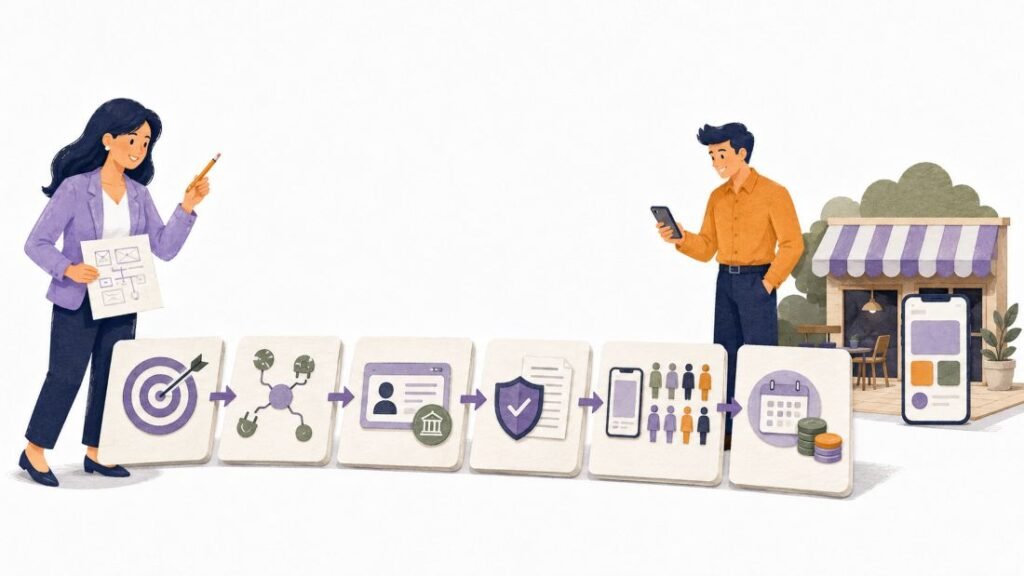
If you decide to proceed, sequencing saves considerable grief:
- Write down the single job the app does, in one sentence, before looking at any platform.
- Check your existing systems for an API. That answer shapes everything else.
- Register your Apple Developer account and check your D-U-N-S status now, while you build.
- Draft the privacy notice at the design stage, not the week you submit.
- Build the smallest version that does the one job, and test it with ten real customers.
- Budget for year two. Apps are a subscription, not a purchase.
The technology has genuinely democratised. A café in Falmouth can now ship something that would have cost £30,000 in 2015. The compliance, the store rules and the question of whether anyone will actually install it have not been democratised at all, and those remain the parts that decide whether the project was worth doing.
Disclaimer
This article is general information for UK businesses and is not legal, financial or technical advice. Data protection duties, accessibility obligations and app store requirements vary with your circumstances and change over time. Take advice from a qualified solicitor or data protection specialist before launching an app that processes customer data, and check current requirements directly with Apple, Google and the ICO.
References
- Ofcom. Online Nation 2025: From Apps to AI Search, How the UK Goes Online. London: Office of Communications; 10 December 2025. Available at: https://www.ofcom.org.uk/media-use-and-attitudes/online-habits/from-apps-to-ai-search-how-the-uk-goes-online-in-2025
- Federation of Small Businesses. UK Small Business Statistics. London: FSB. Available at: https://www.fsb.org.uk/media-centre/uk-small-business-statistics
- Apple Inc. App Store Review Guidelines. Cupertino, CA: Apple Developer. Available at: https://developer.apple.com/app-store/review/guidelines/
- Google LLC. Required Information to Create a Play Console Developer Account. Play Console Help. Available at: https://support.google.com/googleplay/android-developer/answer/13628312?hl=en
- Competition and Markets Authority. Improving the Way Apple and Google Deliver App Store Services and Enhancing iOS Interoperability in the UK. Digital Markets Unit blog; 10 February 2026. Available at: https://competitionandmarkets.blog.gov.uk/2026/02/10/improving-the-way-apple-and-google-deliver-app-store-services-and-enhancing-ios-interoperability-in-the-uk/
- Information Commissioner’s Office. Data Protection by Design and by Default. Wilmslow: ICO. Available at: https://ico.org.uk/for-organisations/uk-gdpr-guidance-and-resources/accountability-and-governance/guide-to-accountability-and-governance/data-protection-by-design-and-by-default/
- W3C Web Accessibility Initiative. WCAG 2 Overview. World Wide Web Consortium. Available at: https://www.w3.org/WAI/standards-guidelines/wcag/
- National Cyber Security Centre. Cyber Security: Small Business Guide. London: NCSC. Available at: https://www.ncsc.gov.uk/files/NCSC_A5_Small_Business_Guide_v3_OCT20.pdf