
You’ve worn size 10 shoes since your twenties. You know which brands you like, which styles work with your clothes, and roughly how much room to expect around the toes. Buying another pair shouldn’t require much thought. Then a new pair arrives, and something feels wrong. There’s plenty of space beyond your longest toe, but the sides are painfully tight. You exchange them for a 10.5. The squeezing improves, although your heels now move every time you walk downstairs. The problem may have nothing to do with length. Men tend to think of shoe size as a single number. In reality, the width and shape of the foot have just as much influence on comfort. Ignoring those measurements can leave you wearing shoes that never quite fit, regardless of how carefully you choose the length.
Why Knowing Your Shoe Size Isn’t Enough
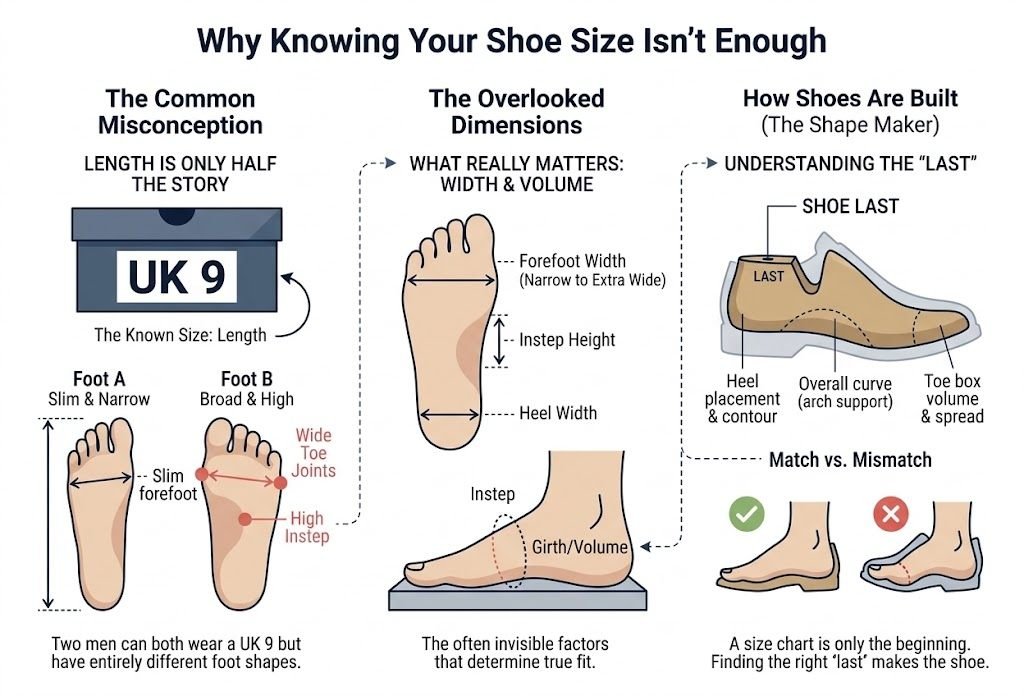
Ask someone what shoe size they wear, and they’ll usually answer immediately. Ask about width, and the conversation becomes less certain. That’s understandable. Most shoe boxes make the length impossible to miss, while width options are often tucked away in product details or unavailable in certain shops. Yet two men who both wear a UK size 9 can have very different feet. One might have a narrow heel and slim forefoot. The other could have broad toe joints and a high instep. Give them identical shoes, and there’s a good chance only one will be comfortable. Shoe manufacturers build footwear around forms called lasts. These determine the overall shape, including how the shoe curves, how much space surrounds the forefoot, and where the heel sits. A last that suits one person beautifully may be a poor match for someone else. That’s why finding the right number on a size chart is only the beginning.
What Happens When Shoes Are Too Narrow?
Think about the last time you wore shoes that pressed against your little toes. Perhaps they were tolerable while you were sitting. After half an hour of walking, however, you started noticing the pressure with every step. The forefoot naturally spreads when it carries body weight. If the shoe doesn’t have enough room for that movement, the upper can press against the toe joints. Sometimes the skin becomes red or irritated. With repeated rubbing, blisters, corns, or calluses may develop. The American Academy of Orthopaedic Surgeons advises choosing footwear with a broad enough toe box to avoid squeezing the toes together. There’s also the question of numbness. A tight forefoot may irritate nerves, leaving some people with tingling or unusual sensations around the toes. That doesn’t mean every episode of numbness comes from narrow shoes. Persistent symptoms deserve medical investigation rather than endless experiments with different footwear.
Why Buying Longer Shoes Can Create Another Problem
Suppose your size 9 shoes feel cramped across the ball of the foot. You try a size 10, hoping the extra space will solve the problem. It might feel better initially. But when you start walking, your heel rises slightly out of the back. You tighten the laces, and the shoe begins pressing across your instep instead. You’ve traded one annoyance for another. In traditional British shoe sizing, a full-size step represents approximately one-third of an inch, or 8.47 millimetres, in nominal length. Finished shoe dimensions depend on the manufacturer’s last and construction. Width usually changes somewhat between lengths, but that increase may not match what your feet need. There’s another detail people rarely consider. A shoe bends at a particular position near the ball of the foot. When the shoe is unnecessarily long, that flex point may sit too far forward. The Brannock Device Company, known for its foot-measuring equipment, emphasises measuring heel-to-ball length alongside overall foot length to avoid this mismatch. Buying a longer shoe isn’t always the solution to a wider foot.
How Shoe Width Sizes Actually Work
Width labels can be surprisingly confusing, particularly when shopping across British, American, and European brands. In common US men’s sizing, D represents a standard width, while 2E is wide and 4E is extra wide. Some British footwear manufacturers use letters such as F, G, and H instead. The meaning depends on the manufacturer’s own fitting system. There’s no guarantee that one company’s wide shoe will feel identical to another’s. The Brannock Device Company’s fitting guidance acknowledges that terms such as wide and extra wide aren’t applied consistently across the footwear industry. This is worth remembering when shopping online. A wide label gives you a useful starting point, but the actual shape of the shoe determines whether it suits your foot. For someone who regularly feels pressure along the forefoot, wide shoes for men may be worth comparing with standard-width pairs before moving up another length.
Toe Box Can Matter More Than The Width Label
Look at your bare feet while standing. Your toes probably don’t form a perfect point. The forefoot widens around the joints before tapering towards the ends of the toes. Now compare that outline with a sleek pair of formal shoes. Some styles narrow quite sharply towards the front, particularly those designed around an elongated silhouette. A shoe can technically offer a wide fitting and still leave your little toe uncomfortably crowded if the toe box tapers too soon. Other models have a rounded front that gives the toes more natural space. The American Academy of Orthopaedic Surgeons recommends rounded or square toe boxes when conventional narrow styles cause discomfort. For men with bunions, hammertoes, or prominent toe joints, the shape becomes especially important. A bunion may need extra space beside the big-toe joint, while a hammertoe might require additional depth above the toe. Simply choosing the widest option won’t necessarily resolve both problems.
Why Men’s Feet May Get Wider With Age
A man can wear the same shoe size for twenty years before noticing that his usual footwear has become restrictive. His feet haven’t necessarily grown longer. Over time, the tissues supporting the arches may change. The arch can settle lower, allowing more of the foot to spread against the ground. Body weight, old injuries, arthritis, and changes in toe position may also influence how much room the forefoot occupies. A 2014 study published in Maturitas examined foot and ankle measurements among 1,105 adults across three age groups. Researchers found differences in several measurements, including foot circumference. The study doesn’t suggest every older man will need bigger shoes. It does offer a useful reminder that foot dimensions aren’t necessarily fixed throughout adulthood. If the shoes you bought comfortably at 30 feel narrow at 55, having your feet measured again is more sensible than assuming the manufacturer has changed its sizing.
Why Foot Width Matters During Walking
Walking places repeated demands on the forefoot. Your heel contacts the ground first, weight moves forward, and eventually the ball of the foot helps you push into the next step. During that movement, the foot needs enough space to function comfortably. A tightly fitted upper may create friction around prominent joints. An unnecessarily loose shoe, meanwhile, can allow the foot to slide forward. Neither situation is particularly pleasant during a long commute. The problem may become more obvious after several hours. Feet can swell slightly during the day, especially after prolonged walking or standing. A shoe that’s already narrow in the morning may become uncomfortable by late afternoon. This is one reason NHS footwear advice often recommends trying shoes later in the day rather than first thing in the morning.
How To Measure Foot Width Properly
Many men haven’t had their feet professionally measured since childhood. It’s worth correcting that habit, especially if your shoes keep feeling tight despite having enough room around the toes. The Brannock Device, developed by Charles Brannock during the 1920s, measures overall foot length, heel-to-ball length, and width. Measurements should be taken while standing. Your feet spread under body weight, so a seated measurement may not reflect the shape they take during ordinary walking. Check both feet separately. It’s common for one to be slightly longer or broader than the other. The American Academy of Orthopaedic Surgeons recommends leaving approximately 3/8 to 1/2 inch, or around 10 to 13 millimetres, beyond the longest toe. Once the length is right, examine the width. The ball of your foot should sit comfortably within the broadest part of the shoe. You shouldn’t feel the upper pressing hard against either side. Try walking for a few minutes before deciding. A shoe that feels comfortable while sitting may behave quite differently once you’re moving.
Why Heel Fit Still Matters In Wide Shoes
It’s entirely possible to have a broad forefoot and a relatively narrow heel. This combination can make shoe shopping frustrating. A standard-width model squeezes the toes, while a poorly shaped wide version leaves the heel slipping. The answer isn’t to ignore one problem in favour of the other. Look for footwear that provides forefoot room alongside a suitably shaped heel counter. Adjustable laces can help hold the midfoot securely without forcing the toes together. The heel should move very little during normal walking. If you’re constantly tightening your shoes to stop them slipping, the overall shape may be unsuitable. Different brands use different lasts, so trying another model can sometimes be more productive than repeatedly changing size within the same design.
What About Insoles And Arch Support?
A new insole is often the first thing people try when their shoes feel uncomfortable. Sometimes that’s useful, particularly when additional cushioning or prescribed support is needed. But inserts occupy space. Place a thick insole inside shoes that already feel tight, and you may end up with even less room around the toes or instep. The American Academy of Orthopaedic Surgeons advises that footwear should accommodate the foot without excessive squeezing, including when inserts are used. If you wear orthoses, bring them when buying shoes. Models with removable factory footbeds can be easier to fit because the original insert can be taken out rather than stacking one on top of another. And remember that arch support and width solve different fitting problems. A supportive insole won’t make a narrow toe box wider.
Choosing Wide Shoes Without Compromising Everyday Style
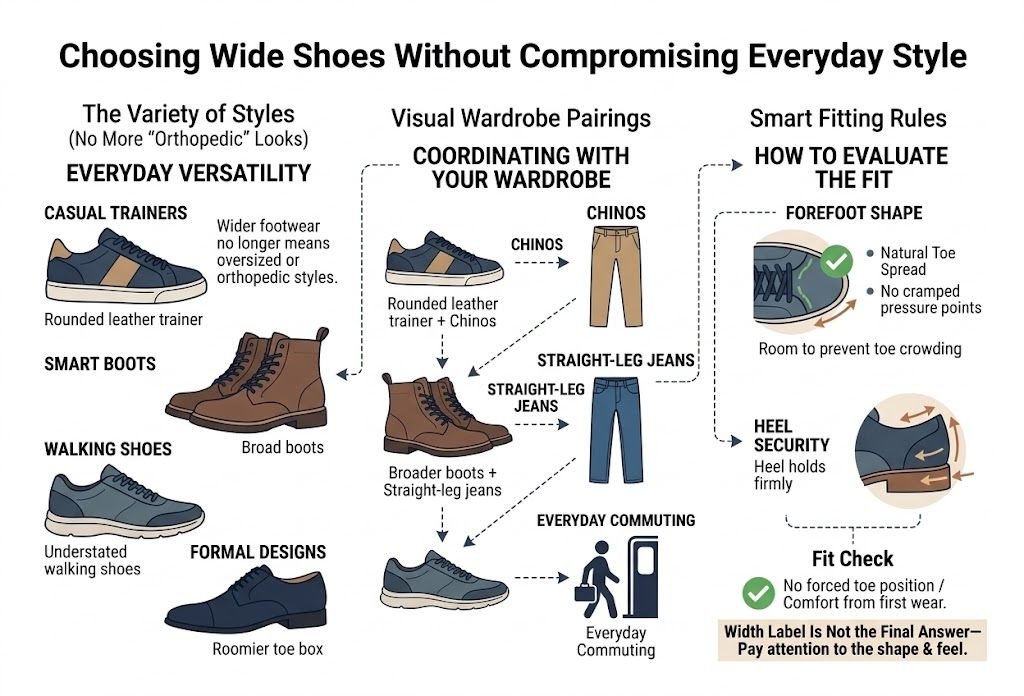
Men’s footwear has become considerably more varied. You can find broad-fitting casual trainers, leather walking shoes, smart boots, and even formal designs with roomier toe boxes. There’s no reason to assume wider footwear must look oversized or orthopedic. The trick is finding a shape that works with both your foot and your wardrobe. A rounded leather trainer may sit comfortably beneath chinos. Broader boots can work particularly well with straight-leg jeans, while understated walking shoes suit everyday commuting. When comparing wide shoes for men, pay attention to the forefoot shape and heel security rather than treating the width label as the final answer. A properly fitted shoe should feel comfortable without requiring your toes to change position to accommodate it.
When Shoe Tightness Needs Medical Attention
Most width problems can be addressed by choosing better-fitting footwear. But not every uncomfortable foot simply needs a broader shoe. Recurring numbness, persistent pain, unexplained swelling, or increasing toe deformity may indicate an underlying condition. A newly collapsing arch, particularly when accompanied by pain around the inner ankle, also deserves assessment. For men with diabetes-related nerve damage, tight shoes can be especially troublesome because rubbing may occur without the usual warning pain. A podiatrist can examine foot structure, sensation, circulation, and walking mechanics to identify what needs attention. Don’t keep buying larger shoes when the same symptoms continue.
A Better Fit Starts With Looking Beyond The Number
Most men remember their shoe size because they’ve been buying it for years. Width rarely receives the same attention, despite having a considerable effect on everyday comfort. A shoe that’s too narrow can crowd the toes and create pressure. One that’s too long may allow the heel to slip and bend in the wrong place. Neither problem is solved by choosing the most expensive brand or the softest sole. The next time your familiar size feels uncomfortable, don’t automatically reach for a longer pair. Have your feet measured, try different widths, and pay attention to the shape of the shoe. A good fit should accommodate the foot you actually have, not the number you’ve always bought.
FAQs About Men’s Shoe Width
Why Do My Shoes Feel Tight Even When They’re The Right Length?
Your forefoot may need more width or depth. If there’s already space beyond the toes, check whether the sides or upper are pressing against your foot.
Is Shoe Width As Important As Length?
Think about walking in shoes that leave your toes plenty of forward space but squeeze them together. The correct length won’t make that pressure disappear.
Do Wider Shoes Have Extra Length?
Not simply because they’re wide. A wider fitting is intended to provide more room across the foot while keeping the nominal length the same.
What’s The Difference Between D, 2E, And 4E?
In common US men’s sizing, D is standard, 2E is wide, and 4E is extra wide. British brands may use different lettering, so check their individual fitting guides.
Can Men’s Feet Become Wider As They Age?
They can. Some men notice their arches sitting lower or the forefoot spreading more than it used to. Others wear the same width for decades.
Should I Size Up If My Shoes Squeeze My Toes?
First check the length. If that’s already correct, try a wider or differently shaped toe box before buying a longer shoe.
Are Wide Shoes Better For Bunions?
A little more space at the front can help keep the shoe from rubbing or pressing against the swollen joint. Look for a shape that clears the bunion without allowing the heel to move excessively.
Can Tight Shoes Cause Numb Toes?
Pressure from narrow footwear can sometimes irritate nerves. Tingling that keeps returning, particularly when you’re barefoot as well, should be assessed.
Should I Measure Both Feet When Buying Shoes?
Yes. One foot may be broader or longer than the other. Start by fitting the larger one, then check that the smaller foot remains secure.
Will Wearing Wide Shoes Help With Foot Pain?
If cramped footwear is responsible, a better width may bring considerable relief. If the pain is coming from arthritis, a tendon issue, or another health problem, changing shoes may not be enough on its own.