
Tendon and ligament injuries are very hard to fix in bone and joint care. The main reason is that they don’t have much blood coming to them. Their cells don’t change fast. It takes a long time for people to feel better after getting hurt. New studies show soft tissues can heal better when helped by man-made bio-things. One main thing is Body Protection Compound-157 (BPC-157). This comes from a part found in stomach juice. BPC-157 works in many ways to help people get better quicker. It makes fibroblast cells move more quickly. It makes growth factor cell parts go up. It helps the body make more small blood vessels.
UK Peptide Lab provides good materials for researchers to do tests in safe ways for fixing muscles and joints. If you read bpc 157 uk science papers, you will see proof that shows how BPC-157 changes thick body tissues.
Understanding BPC-157 And Soft Tissue Regeneration
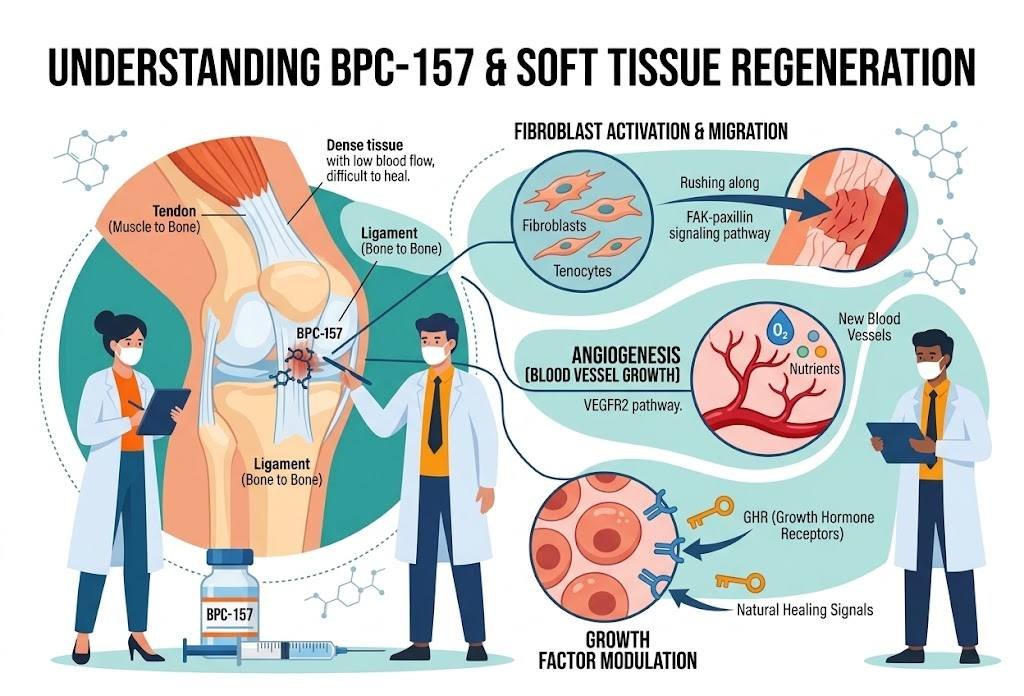
Connective tissues, like tendons, link muscle to bone. Ligaments join bone to bone. These tissues are dense and have a lot of Type I collagen. They help joints stay strong. There is not much blood flow in these tissues, so they do not heal well after tears or long-term injury. This makes it hard for them to get better by themselves.
- Fibroblast Activation & Migration: This makes tenocytes and fibroblasts quickly move to the injury area by using the FAK-paxillin signaling pathway.
- Angiogenesis: It turns on the VEGFR2 pathway. This helps small blood vessels grow. These new blood vessels bring oxygen and important nutrients to areas with not enough blood.
- Growth Factor Modulation: It raises the number of growth hormone receptors (GHR). With more GHR, tendon cells can better take in the body’s healing signals.
UK Peptide Lab provides UK researchers with good BPC-157. The team makes these products under strict quality rules. UK Peptide Lab has clean compounds. These help UK scientists find out how cells work.
Top 6 BPC-157 Research Studies On Tendon & Ligament Healing
1. Achilles Tendon Transection & Structural Reconstruction
Primary Focus: The main goal was to make the healing of fully cut Achilles tendons in rodent models much faster.
Key Findings: Researchers looked at what happens when BPC-157 is given in a steady way after a full cut. They found the healing was quicker, and the tissue got rebuilt faster. When they looked closer at the tissue, they saw that BPC-157 helped collagen fibers grow back in a strong and straight way. It also made the healing better by stopping thick scar tissue from forming.
How It Works: The peptide helped tenocytes go across the cut area. It also stopped cells from dying in that spot.
2. In Vitro Tendon Fibroblast Outgrowth & Migration
Primary Focus: The study looked at what BPC-157 does to tendon cells taken from the body and kept in the lab.
Key Findings: The study watched tendon cells to see if they live longer, multiply faster, and move better. BPC-157 helped these cells last longer when there was high stress. It helped them move fast toward areas where the tissue was damaged.
Mechanism: The study found that BPC-157 turns on the FAK and paxillin pathways. These let cells move and stick to the area around them.
3. Growth Hormone Receptor Upregulation In Tendocyte Repair (Chang et al., 2014)
Primary Focus: The main thing here is how BPC-157 and growth factor receptors talk to each other in tendon cells.
Key Findings: Researchers found that BPC-157 makes tendon cells have more growth hormone receptors. It does this at both the gene and protein level. With more receptors, these cells react much more to growth hormones that move around in the body. This leads to more collagen being made and better repairs to the tissue’s structure.
Mechanistic Explanation: This shows that BPC-157 is the main force. It helps connective tissue cells feel what the hormones are doing in the body. These hormones help the body grow and heal. BPC-157 does not work on its own, but helps these cells respond better.
4. Medial Collateral Ligament (MCL) Healing & Functional Strength (Cerovecki et al.)
Primary Focus: The main point is to help the knee heal after being hurt.
Key Findings: Fixing these bands in the knee often makes it harder for them to hold up against force. In the study with cut knee bands, using BPC-157, both in the body and right at the spot, helped them work better sooner. Tests showed bands treated with BPC-157 got strong faster than ones not treated. The bands could handle more load and bend more.
Mechanistic Insight: The study showed that BPC-157 helps the bands in the knee heal, so they keep their strength and can hold up well. This helps the knee stay steady over time.
5. Reversal Of Corticosteroid-Induced Tendon Impairment
Primary Focus: The main goal is to fix tendon problems that do not heal. These happen because of local corticosteroid use.
Key Findings: Doctors use corticosteroid shots to help with pain and swelling. But these shots can make tendons weak and less healthy. They do this by stopping cell growth and collagen development. Studies show BPC-157 can help stop these bad results. Giving BPC-157 with the steroid, or after, helps keep fibroblast cells alive. It also helps cells move again and lets the tendon connect with bone in a good way.
Mechanistic Details: BPC-157 helps tissue cells by stopping the signals from steroids that cause cell death. This helps bring back normal cell function in places hurt by the treatment.
6. Angiogenic Response Via VEGFR2 & Nitric Oxide Pathways (Seiwerth et al.)
Primary Focus: The main goal is to help small blood vessels grow again in hurt soft tissue and where tendons meet bones.
Key Findings: When blood flow is low, tendons and ligaments heal more slowly. This first study looked at how BPC-157 affects VEGFR2 levels and turns on eNOS pathways. The results show new small blood vessels grow fast and stay near the injured tendon. This happens without harming blood vessels elsewhere and does not make veins or arteries grow in a strange or bad way.
How It Works: BPC-157 helps new small blood vessels grow in a neat and local way. This helps the body send important things right to thick tissue that does not have much blood.
Summary Of Core Research Studies
| Research Focus | Experimental Subject | Primary Mechanism Identified | Observed Outcome |
| Achilles Transection | Rodent Model | Tenocyte migration & collagen alignment | Re-established complete tendon continuity |
| Cell Migration | In Vitro Tenocytes | Activation of FAK-paxillin signaling pathway | Increased cellular mobility & survival under stress |
| Growth Factors | Tendon Fibroblasts | Upregulation of Growth Hormone Receptors (GHR) | Enhanced intrinsic collagen synthesis |
| MCL Ligament Repair | Rodent Model | Accelerated ligamentous tissue matrix deposition | Faster recovery of tensile load-bearing capacity |
| Steroid Reversal | Corticosteroid Model | Rescue of suppressed tenocyte proliferation | Restored tendon-to-bone interface integration |
| Angiogenesis | Vascular Endothelium | VEGFR2 activation & NO pathway modulation | Rapid creation of functional microvessel networks |
Role Of UK Peptide Lab In Life Science Research
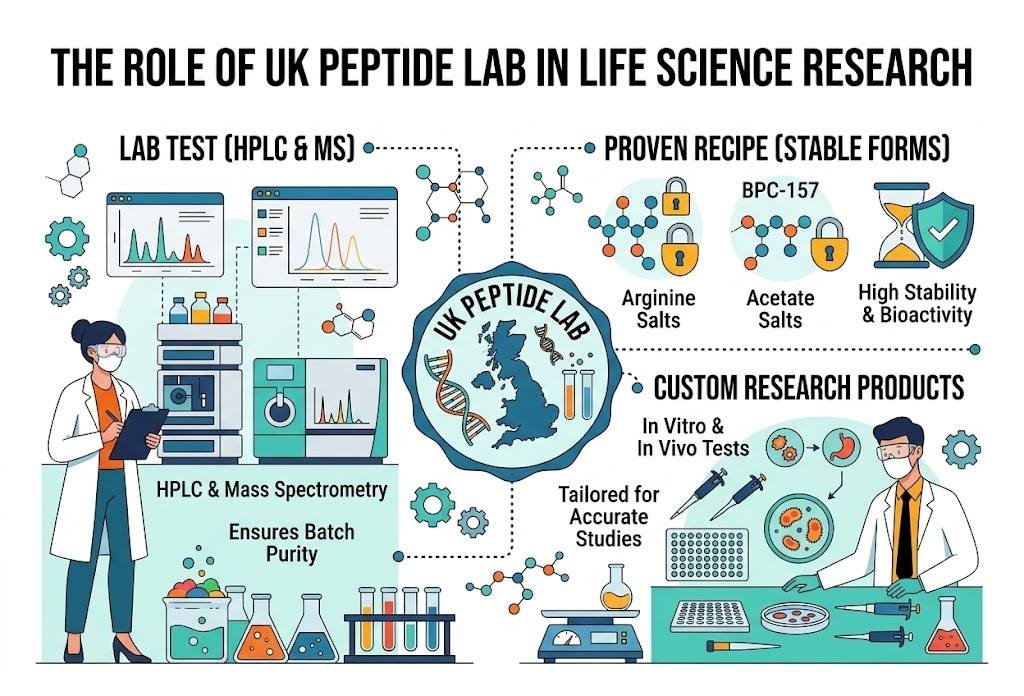
For people to trust scientific results, researchers need to use peptides that are tested for chemical purity. The parts must be in the right order, and they must not change over time. UK Peptide Lab is well known in the UK. The company gives help to people in research and lab studies in the region.
- Lab Test: We use High-Performance Liquid Chromatography (HPLC) and Mass Spectrometry (MS). This is how we make sure each batch is pure.
- Proven Recipe: We give you stable forms of BPC-157, such as acetate salts or arginine salts. These forms keep working well when you use them in the lab.
- Custom Research Products: We provide products made just for in vitro and in vivo tests. We always keep high lab standards for all.
Conclusion
Current science shows that Body Protection Compound-157 helps with bone and joint studies. It moves cells faster in the body and sets up small blood vessels by changing VEGFR2. BPC-157 acts on body barriers that stop soft tissue from healing. UK Peptide Lab offers samples with high purity. This helps people learn more about these body actions. More people want to get bpc 157 uk research materials in schools and hospitals. Good BPC-157 is important for fixing soft tissue and for making new treatments for hard-to-heal tendon and limb damage.
Disclaimer
This article is provided for informational and educational purposes only and summarises published preclinical research. It is not medical advice and must not be used to diagnose, treat, cure, or prevent any condition.