
Every growth hormone study starts in the same small place: a cluster of neurons in the hypothalamus that releases growth hormone-releasing hormone (GHRH) in bursts. That signal travels a short distance to the anterior pituitary, which responds by releasing growth hormone (GH). GH then prompts the liver and other tissues to produce insulin-like growth factor 1 (IGF-1), which feeds back to quieten the whole system. The Society for Endocrinology’s plain-English guide to growth hormone-releasing hormone walks through that loop well, including the braking role of somatostatin.
CJC-1295 is a synthetic GHRH analogue designed to pull the first lever in that chain. Yet anyone comparing forms of cjc 1295 soon discovers that one name covers two quite different research tools. One version carries a Drug Affinity Complex (DAC) and lingers in circulation for days. The other does not, and is largely cleared within hours. Neither is “better” in the abstract. The useful question is which exposure profile matches what a study is actually trying to measure.
A Naming Quirk Worth Clearing Up First
Strictly speaking, the name CJC-1295 was coined by the Canadian biotech ConjuChem for the DAC-bearing molecule. Its original preclinical characterisation in rats described a modified GRF(1-29) chain with an extra lysine and a reactive maleimidopropionyl group at the tail, engineered to bond covalently to albumin once in the bloodstream [1].
What suppliers now sell as “CJC-1295 No DAC” is the same backbone without that tail. In the scientific literature it is usually called modified GRF(1-29), or tetrasubstituted GRF(1-29), because four positions in the native 29-amino-acid sequence (2, 8, 15 and 27) are swapped for residues that better resist enzymatic attack. The most important swap is D-alanine at position 2. Native GHRH is rapidly inactivated in plasma when the enzyme dipeptidyl peptidase-4 clips off its first two amino acids [4], and the D-alanine substitution was shown decades ago to slow that clearance in healthy men [5].
This is more than pedantry. Papers, product listings and forums use the names inconsistently, so any serious comparison has to say which molecule it means. The two forms also differ in mass by roughly 279 daltons: about 3,368 Da for No DAC against about 3,647 Da for DAC. As we will see, that makes mass spectrometry the quickest way to tell them apart.
CJC-1295 No DAC: A Shorter-Duration Approach
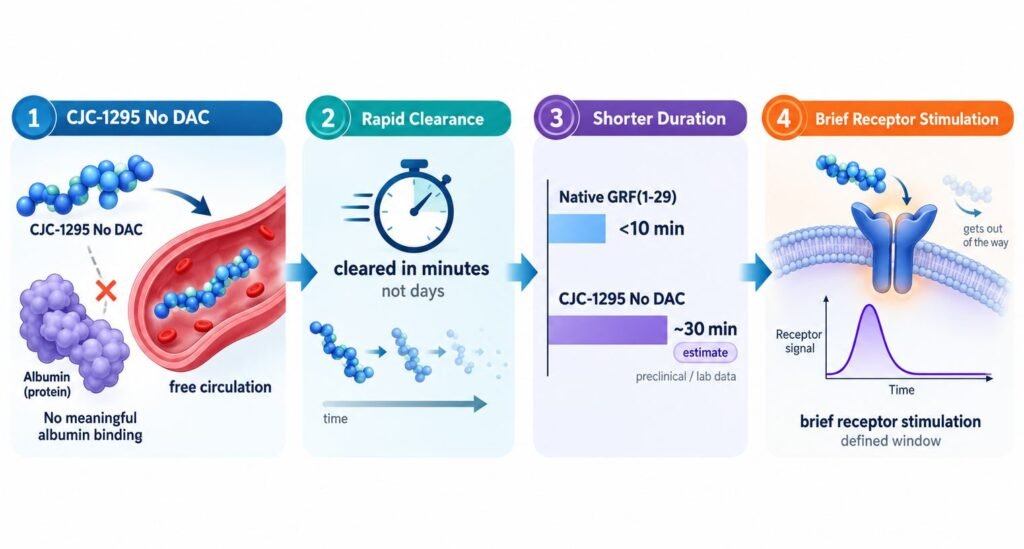
Without the DAC there is no meaningful albumin binding, so the peptide circulates freely and is cleared on a timescale of minutes rather than days. Native GRF(1-29) survives for less than ten minutes in plasma. The tetrasubstituted version is widely credited with a half-life of around 30 minutes, a figure that rests largely on preclinical and laboratory work rather than a dedicated human pharmacokinetic trial. It is best treated as an informed estimate, not a settled constant.
That short life is the whole point. No DAC delivers a brief, well-defined window of receptor stimulation and then gets out of the way, which suits any design where prolonged circulation would blur the result.
What Makes No DAC Different?
The difference is pharmacokinetic rather than pharmacological. Both forms share the same receptor-binding backbone, so at the pituitary they are asking the same question of the same receptor. What changes is how long they keep asking. Removing the DAC does not leave an incomplete formulation. It changes how the peptide behaves once it is inside a biological system: the same affinity for its target, but no covalent binding to circulating proteins and a far more condensed exposure curve.
CJC-1295 No DAC Versus DAC: Key Differences
| Characteristic | CJC-1295 No DAC (Mod GRF 1-29) | CJC-1295 DAC |
| Structure | Tetrasubstituted GRF(1-29) | Tetrasubstituted GRF(1-29) plus lysine and maleimidopropionyl group |
| Approximate molecular mass | 3,368 Da | 3,647 Da |
| Albumin interaction | No DAC-mediated binding | Covalent binding after administration |
| Approximate half-life | Around 30 minutes (largely preclinical estimate) | 5.8 to 8.1 days (human data) |
| Exposure profile | Brief and pulse-like | Sustained and depot-like |
| Effect on baseline GH | Falls back towards baseline between exposures | Raised trough levels for days |
| Human pharmacokinetic evidence | Limited | Small published studies in healthy adults |
| WADA status | Prohibited at all times (S2) | Prohibited at all times (S2) |
Why A Shorter-Duration Profile Can Matter
Longer is not automatically better in peptide research. The strongest human evidence for the DAC form comes from two randomised, placebo-controlled trials in healthy adults published in 2006, which put its half-life at 5.8 to 8.1 days. A single dose raised mean GH two- to tenfold for six days or more and IGF-1 roughly 1.5- to threefold for 9 to 11 days. After repeated doses, IGF-1 stayed above baseline for up to 28 days [2].
Then comes the nuance that product pages rarely mention. A follow-up study using overnight blood sampling every 20 minutes found that the DAC form did not flatten the natural GH pulses at all. Pulse frequency and size were unchanged. What rose sharply was the floor between pulses: trough GH climbed about 7.5-fold, lifting mean GH by 46% and IGF-1 by 45% [3].
So the real trade-off is not “pulsatile versus flat”. It is whether a study can tolerate a raised baseline running quietly underneath everything else for a week or more. If DAC is an all-day ticket, No DAC is pay-and-display by the hour: you pay only for the time you need, and the meter runs out when you expect it to. That reframing sharpens the case for No DAC in three ways.
- Targeted windows. A short-lived analogue lets researchers study transient GHRH-receptor signalling, the kind of acute response measured over minutes or hours, without a background of persistent stimulation.
- Baseline control. Because exposure falls away quickly, each sampling interval begins closer to a true baseline, which reduces carry-over between experimental conditions.
- Design freedom. Pharmacologists commonly allow about five half-lives for a compound to clear. For the DAC form that implies a washout of roughly four to six weeks. For No DAC, if the 30-minute estimate holds, it is a matter of hours. That gap alone can decide whether a crossover or repeated-measures design is practical.
No DAC Versus DAC: Which Research Profile Is More Flexible?
DAC was engineered for one job: extending activity so that a single administration keeps the GH axis switched on. For studies asking what sustained IGF-1 elevation does over several weeks, that is exactly right, and the published human data are stronger for it.
Flexibility, though, favours No DAC. Its exposure can be timed, repeated or stopped with precision, and its effects can be separated cleanly from whatever comes next. The DAC form cannot be switched off once given, so everything that happens in the following week happens against its backdrop.
It is also worth remembering that ConjuChem’s clinical programme never produced an approved medicine. Development stopped at phase II in 2006 after a trial participant died. The attending physician judged the death unrelated to CJC-1295, but the work was halted as a precaution [6]. Neither form is a licensed medicine in the UK today.
UK Picture: Research Use, Regulation And Sport
For a UK readership, three frameworks matter.
The first is medicines law. Under the Human Medicines Regulations 2012, the MHRA decides case by case whether a product counts as a medicine, and its guidance on borderline products explains how a product’s presentation and function feed into that decision. The agency’s borderlines team has said publicly that it will disregard “research purposes” labelling where it is being used to sidestep medicines regulation [7]. That is not an idle warning: in April 2026, the Guardian reported that the MHRA would investigate UK peptide clinics over their health claims. Genuine research-only presentation, with no dosing advice, no health claims and no suggestion of human use, is the basis on which these compounds can be supplied at all.
The second is sport. GHRH and its analogues sit under section S2 of the World Anti-Doping Agency’s Prohibited List, which names CJC-1295 explicitly and bans the class at all times, in and out of competition [8]. UK Anti-Doping enforces that list here, and British rugby league has already seen two-year bans involving other substances from the same growth hormone releasing factor group. Scientists at King’s College London have also helped develop liquid chromatography-mass spectrometry methods for detecting CJC-1295, both with and without DAC, alongside their metabolites in urine [9].
The third is laboratory practice. Any in vivo work falls under the Animals (Scientific Procedures) Act 1986 and Home Office licensing, while routine storage and handling belong within a lab’s COSHH assessment.
Choosing A CJC-1295 No DAC Research Product
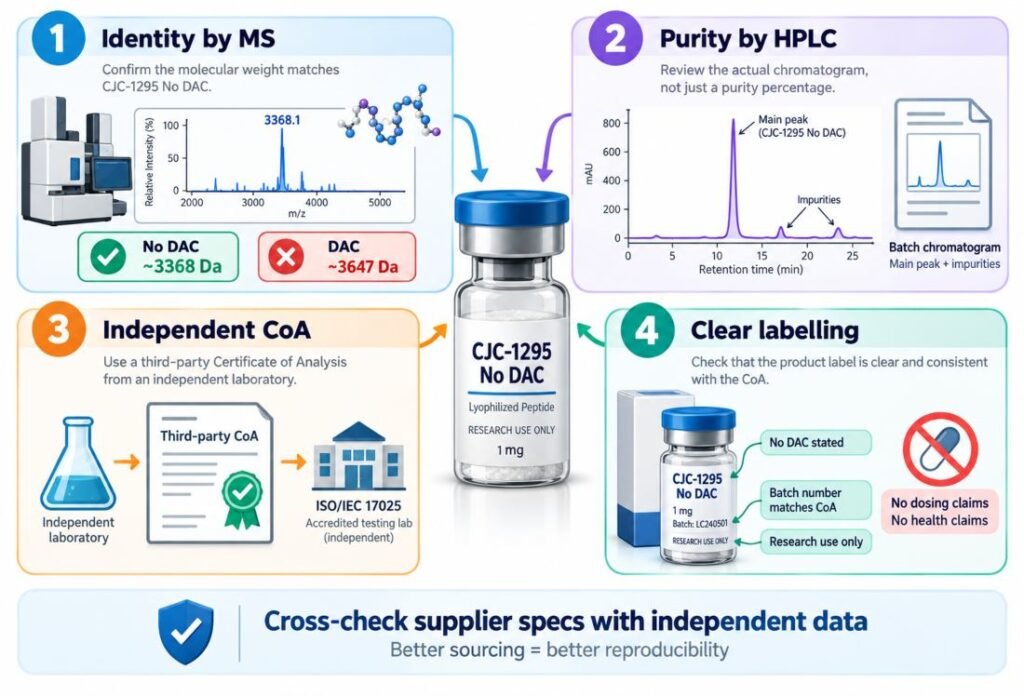
When assessing a cjc 1295 No DAC research product, the paperwork deserves as much scrutiny as the price. Mislabelling is not a hypothetical risk in this market; Norwegian anti-doping scientists once had to identify CJC-1295 inside a pharmaceutical preparation of unknown origin [10]. Four checks do most of the work.
- Identity by mass spectrometry. Look for an MS result consistent with the No DAC form, at around 3,368 Da. A reading near 3,647 Da points to the DAC version, whatever the label says.
- Purity by HPLC. Ask for the batch chromatogram itself, not just a headline percentage, so you can see the main peak and any impurities.
- An independent certificate of analysis. Testing should come from a third party rather than the supplier’s own bench. In the UK, the United Kingdom Accreditation Service (UKAS) is the government-recognised body that accredits testing laboratories to ISO/IEC 17025, and its register lets you confirm that a lab’s accreditation genuinely covers the method it used.
- Clear labelling. Expect an explicit statement that the product lacks the DAC moiety, a batch number that matches the certificate, and unambiguous research-only wording with no dosing guidance or health claims.
Supplier specifications should always be cross-checked against independent data before a protocol begins. Reliable sourcing is the cheapest insurance a study can buy for reproducibility.
Why No DAC May Be The Better Fit
The choice comes down to exposure. If a study needs the GH axis held open for days, with raised baseline levels built into the design, the DAC form was made for that job and has the stronger human data behind it. If the aim is to observe a clean, time-limited response at the receptor and then return to baseline, No DAC is the more natural fit: shorter, more controllable and far easier to design around. For most questions about acute signalling, that makes it the more flexible starting point.
Disclaimer: This article is for general information and educational purposes only. CJC-1295, with or without DAC, is not a licensed medicine in the UK and is not approved for human or veterinary use. The products discussed are intended solely for lawful laboratory research by suitably qualified professionals. Nothing here constitutes medical advice, dosing guidance or an endorsement of personal use. Both forms are prohibited in sport under the WADA Prohibited List.
References
- Jetté L, Léger R, Thibaudeau K, Benquet C, Robitaille M, Pellerin I, et al. Human growth hormone-releasing factor (hGRF)1-29-albumin bioconjugates activate the GRF receptor on the anterior pituitary in rats: identification of CJC-1295 as a long-lasting GRF analog. Endocrinology. 2005;146(7):3052-3058. doi:10.1210/en.2004-1286
- Teichman SL, Neale A, Lawrence B, Gagnon C, Castaigne JP, Frohman LA. Prolonged stimulation of growth hormone (GH) and insulin-like growth factor I secretion by CJC-1295, a long-acting analog of GH-releasing hormone, in healthy adults. Journal of Clinical Endocrinology and Metabolism. 2006;91(3):799-805. doi:10.1210/jc.2005-1536
- Ionescu M, Frohman LA. Pulsatile secretion of growth hormone (GH) persists during continuous stimulation by CJC-1295, a long-acting GH-releasing hormone analog. Journal of Clinical Endocrinology and Metabolism. 2006;91(12):4792-4797. doi:10.1210/jc.2006-1702
- Frohman LA, et al. Rapid enzymatic degradation of growth hormone-releasing hormone by plasma in vitro and in vivo to a biologically inactive product cleaved at the NH2 terminus. Journal of Clinical Investigation. 1986;78(4):906-913. doi:10.1172/JCI112679
- Soule S, King JA, Millar RP. Incorporation of D-Ala2 in growth hormone-releasing hormone-(1-29)-NH2 increases the half-life and decreases metabolic clearance in normal men. Journal of Clinical Endocrinology and Metabolism. 1994;79(4):1208-1211. doi:10.1210/jcem.79.4.7962295
- ConjuChem Biotechnologies. Patient died in lipodystrophy drug study. Company announcement, August 2006 (archived by NATAP).
- McQuillan C. Grey-market peptides: what nurses need to know. Nursing in Practice. 23 April 2026.
- World Anti-Doping Agency. The 2026 Prohibited List, International Standard. In force from 1 January 2026. Section S2.2.4, Growth hormone releasing factors.
- Memdouh S, Gavrilović I, Ng K, Cowan D, Abbate V. Advances in the detection of growth hormone releasing hormone synthetic analogs. Drug Testing and Analysis. 2021;13(11-12):1871-1887. doi:10.1002/dta.3183
- Henninge J, Pepaj M, Hullstein I, Hemmersbach P. Identification of CJC-1295, a growth-hormone-releasing peptide, in an unknown pharmaceutical preparation. Drug Testing and Analysis. 2010;2(11-12):647-650. doi:10.1002/dta.233