
AI leadership has stopped being about choosing a model or waving through a pilot. The decisions now landing on UK executive desks are harder and less reversible: where generative AI actually improves performance, which workflows suit agents, what data and infrastructure the ambition requires, and how much autonomy an AI system should be given before somebody needs to sign for it.
The scale of the gap is documented. The ONS analysis of artificial intelligence in UK businesses found that self-reported use among firms with ten or more employees climbed from around 12 per cent in late 2023 to roughly 35 per cent, while the average adopting business went from using about 1.4 AI technologies to about 1.6. Adoption has widened enormously and barely deepened at all. Researchers at Cambridge examining firm-level data reach a similar conclusion: uptake is concentrated among firms that were already well resourced rather than spreading through the economy.
That creates a specific learning requirement for business and technology leaders. They need enough technical understanding to assess GenAI and agentic AI on the merits, alongside sharper judgement on investment, governance, risk, organisational change and measurable business value.
The five programmes below approach those responsibilities differently. Some concentrate on practical AI adoption and agentic workflows. Others place AI inside a broader technology, governance, data or enterprise leadership agenda.
Overview: 5 AI for Leaders Programs
| # | Program | Provider | Duration | Best Aligned With |
|---|---|---|---|---|
| 1 | Post Graduate Program in Artificial Intelligence for Leaders | The McCombs School of Business at The University of Texas at Austin | 4 months | GenAI, agentic AI and AI ROI |
| 2 | Leading Enterprise Agentic AI Development | Carnegie Mellon University Heinz College | About 4 weeks | Agentic systems and governance |
| 3 | Technology Leadership Program | MIT Professional Education | 8 months | AI and technology leadership |
| 4 | Chief Data and AI Officer Program | Michigan Ross and Michigan Engineering | 5 months | Enterprise data and AI strategy |
| 5 | AI Governance & Compliance Certificate | Georgetown University | 6 weeks | Responsible AI and governance |
1. Post Graduate Program in Artificial Intelligence for Leaders, The McCombs School of Business at The University of Texas at Austin
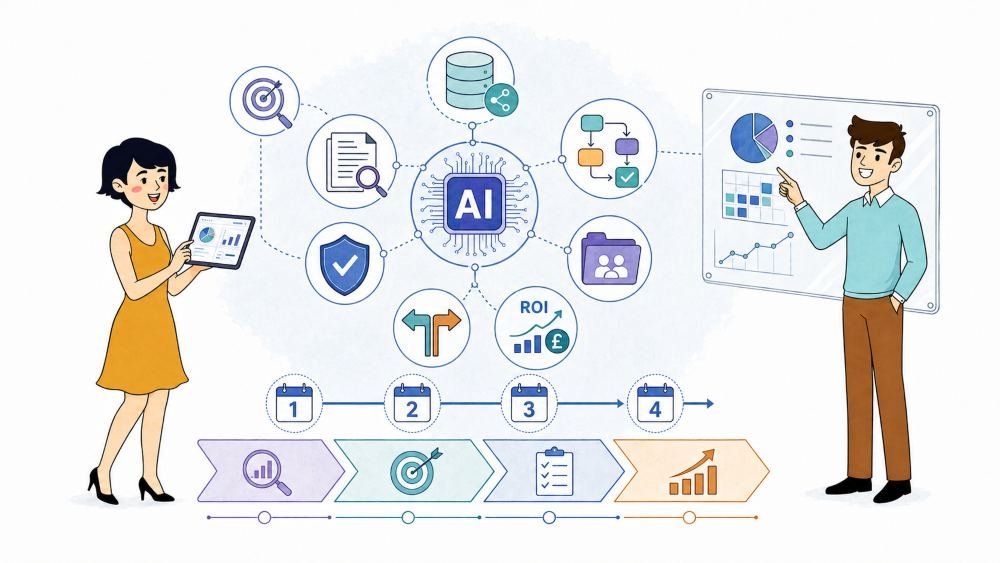
The AI for Business Leaders Course starts with AI fundamentals and then moves steadily into the decisions executives actually face once AI enters an organisation. The curriculum progresses through GenAI, agentic AI, implementation economics, AI team design, governance and business-case development.
- Delivery and Duration: Online over four months, combining recorded faculty lectures, weekly live mentor sessions, hands-on projects and case studies, with roughly eight to ten hours of study a week.
- Credentials: Certificate of completion from the McCombs School of Business at The University of Texas at Austin, with Continuing Education Units.
- Program Highlights: GenAI, LLMs, AI agents, agent memory, the Model Context Protocol, n8n, RAG, AI ROI, build-versus-buy decisions, LLMOps, AI ethics, governance, four projects and a team capstone.
- Outcomes: Participants learn to identify high-value AI opportunities, evaluate investments and risks, build implementation roadmaps, and develop an AI product proposal covering market potential, requirements, financial projections and business impact.
Why Should You Choose This Course?
It teaches agentic AI from a leadership vantage point rather than an engineering one. Learners work through architectures, memory and orchestration alongside the organisational use cases, which matters because the question a board asks is never “how does the agent work” but “what happens when it gets something wrong at three in the morning”.
AI economics runs through the whole thing. Return on investment, total cost of ownership, prioritisation and implementation planning tie the technology choices back to business value, which is precisely the link the ONS data suggests most British adopters have not yet made.
The no-code approach also lowers the barrier for UK functional leaders who came up through finance, operations or marketing rather than engineering. One practical note for participants here: live sessions run on US timings, and the fee is set in dollars, so budget holders should factor in currency movement over a four-month commitment.
2. Leading Enterprise Agentic AI Development Certificate, Carnegie Mellon University
Carnegie Mellon’s LEAAID programme is aimed at senior leaders carrying responsibility for enterprise AI adoption. It concentrates on designing, governing and securing autonomous and multi-agent systems, and on tying them to business priorities rather than to technical novelty.
- Delivery and Duration: Fully virtual over roughly four weeks, with five live modules plus an applied lab.
- Credentials: Leading Enterprise Agentic AI Development executive education certificate from Carnegie Mellon University’s Heinz College.
- Program Highlights: Agent architectures, multi-agent systems, planning, orchestration, tool use, vector databases, APIs, human oversight, red teaming, monitoring, AI assurance, governance and agent prototyping.
- Outcomes: Participants learn to prioritise agentic AI use cases, design AI-enabled workflows, establish governance structures and prototype an agent-based solution.
Why Should You Choose This Course?
The curriculum stays on enterprise agentic AI throughout. It goes well beyond GenAI awareness into multi-agent design, architecture and workflow orchestration, which is the layer where most current enterprise ambition sits and where most current enterprise capability does not.
Governance is handled at system level rather than as an ethics postscript. Security, hallucinations, model drift, auditability, human oversight and accountability all get proper attention. For UK leaders, that section reads alongside the NCSC guidance on AI and cyber security written for board members and senior executives, which is free, British and worth reading before any fee is committed.
The four-week format also suits executives who cannot disappear for a term. It is a sprint, not a sabbatical.
3. Technology Leadership Program, MIT Professional Education
For executives weighing a chief technology officer program against a broader leadership experience, MIT’s programme covers AI alongside the wider technology portfolio a senior leader may be accountable for. GenAI and agentic AI sit next to cybersecurity, robotics, cloud, quantum computing, innovation and organisational leadership.
- Delivery and Duration: Blended over eight months, including three residential weeks at MIT and more than fourteen live online sessions with over twenty cross-disciplinary faculty.
- Credentials: Certificate of completion from MIT Professional Education, with eligibility for 42 CEUs and MIT Professional Education alum status.
- Program Highlights: GenAI, agentic AI, machine learning, AI ethics, technology strategy, strategic decision-making, people analytics, innovation, negotiation and Action Learning Projects.
- Outcomes: Participants build the technical fluency and strategic judgement to assess emerging technologies, lead innovation initiatives, manage change and translate technology choices into business solutions.
Why Should You Choose This Course?
AI is treated as one holding in a larger technology portfolio. That framing is genuinely useful for leaders answerable for several emerging technologies at once rather than a single AI initiative, and it is closer to how most UK CTO and CIO roles are actually scoped.
Technology and people leadership develop together. Coaching, conflict management, negotiation, team building and strategic change sit alongside the technical curriculum, which reflects the uncomfortable truth that most failed transformation programmes fail on the human side.
UK participants should plan properly for the residential weeks. Three trips to Cambridge, Massachusetts across eight months means transatlantic travel, accommodation and time out of the business, none of which appears in the headline fee. Entry requires a minimum of six years of professional experience.
4. Chief Data and AI Officer Program, Michigan Ross

The Michigan programme focuses on aligning data and AI strategy with organisational priorities. It brings together governance, analytics, GenAI, data security, strategic decision-making and digital transformation for senior executives.
- Delivery and Duration: Blended over five months, with live online learning and a five-day campus experience in Ann Arbor.
- Credentials: Digital badge on successful completion, plus eight units towards the Michigan Ross Distinguished Leader Certificate.
- Program Highlights: Data strategy, AI strategy, GenAI, data governance, security, analytics, strategic decision-making, business simulations, innovation labs and a capstone.
- Outcomes: Participants learn to align data and AI investments with business goals, strengthen governance and build an actionable response to a real organisational challenge.
Why Should You Choose This Course?
Data governance and AI strategy are taught as one subject rather than two. That reflects the practical dependency between reliable enterprise data and anything resembling scalable AI. It lands squarely on a British problem: the government’s UK Business Data Survey found 82 per cent of large firms handling digitised data reported using AI, against 40 per cent of sole traders, with the gap tracking data maturity as much as budget.
The capstone works on a live business challenge, which converts leadership and AI strategy concepts into something implementation-shaped rather than theoretical—anyone whose organisation is still arguing about where the customer record lives will recognise the value.
5. Online Certificate in AI Governance & Compliance, Georgetown University
Georgetown concentrates on the controls that become necessary once AI and GenAI start informing organisational decisions. The course moves from AI fundamentals into trustworthy systems, governance frameworks, legal requirements, ethics and compliance.
- Delivery and Duration: Online over six weeks, with weekly Zoom sessions and 32 contact hours.
- Credentials: Certificate in AI Governance & Compliance from Georgetown University, with 3.2 CEUs.
- Program Highlights: AI and GenAI fundamentals, fairness, privacy, reliability, governance frameworks, risk, compliance, legal considerations, monitoring and a capstone project.
- Outcomes: Learners develop an AI governance plan, evaluate appropriate governance frameworks, address ethical risks and apply legal and compliance considerations to AI projects.
Why Should You Choose This Course?
Governance is the whole subject here, not a supporting module tacked on at the end. Leaders spend the full six weeks on trust, risk, law, ethics and organisational controls.
The timing is useful for UK organisations with European exposure. Article 4 of the EU AI Act imposes an AI literacy duty on providers and deployers, and it has applied since February 2025. The Act reaches extraterritorially, so a British company whose AI system or its output is used in the EU is in scope regardless of where it is registered. In June 2026, the Council of the EU signed off on a simplification package that deferred the heavier high-risk obligations to December 2027 and softened the literacy duty to an obligation of effort. Reading that as a reprieve would be a mistake, because the inventory and classification work it postponed is exactly the work that takes eighteen months.
The final assessment is practical rather than academic. The capstone asks learners to develop and govern an AI project using ethical and compliance principles, which is closer to the actual job than a written exam would be.
Conclusion
AI leadership now sits at the intersection of technology, strategy, governance and organisational responsibility. Leaders need to understand what GenAI and agentic systems can do, but they also need to decide where those capabilities create value and where tighter controls are the honest answer.
Choosing an AI for leaders programme therefore depends on the responsibility ahead. Some executives need practical exposure to agents and AI economics. Others need deeper preparation in technology portfolios, data strategy, governance or enterprise-wide AI oversight.
For UK leaders, there is one additional consideration that none of these curricula can supply. Britain has no AI Act and no dedicated AI regulator. Oversight runs through existing bodies applying existing law inside their own remits: the ICO, the FCA, the CMA, Ofcom, the MHRA. The government’s one-year progress report on the AI Opportunities Action Plan sets out where that agenda has reached, and a Lords debate in June 2026 shows how contested the approach remains. Whichever programme you choose, working out which regulator owns your risk is a judgement you will have to make yourself.
Disclaimer
This article is provided for general information and discussion only. It does not constitute legal, financial, regulatory or professional advice, and it is not an endorsement of any particular programme, institution or provider. Programme durations, fees, credentials, curricula and entry requirements change frequently and were accurate at the time of writing; readers should verify current details directly with the provider before applying. Regulatory positions described here, including those under the EU AI Act and UK sectoral frameworks, are summarised at a high level and evolve rapidly. Organisations should take qualified professional advice on their own obligations rather than relying on this summary. Fees quoted by providers in foreign currencies are subject to exchange rate movement.
References
- Alekseeva, L., Azar, J., Giné, M., and Samila, S. (2026). Artificial Intelligence Adoption and the Demand for Managerial Expertise. Strategic Management Journal, online first, 1 to 27. https://doi.org/10.1002/smj.70099
- Brynjolfsson, E., Rock, D., and Syverson, C. (2019). Artificial Intelligence and the Modern Productivity Paradox: A Clash of Expectations and Statistics. In A. Agrawal, J. Gans and A. Goldfarb (eds), The Economics of Artificial Intelligence: An Agenda, pp. 23 to 60. University of Chicago Press. https://doi.org/10.7208/chicago/9780226613475.003.0001
- Department for Science, Innovation and Technology. (2026). AI Opportunities Action Plan: One Year On. GOV.UK, published 29 January 2026. https://www.gov.uk/government/publications/ai-opportunities-action-plan-one-year-on/ai-opportunities-action-plan-one-year-on
- Department for Science, Innovation and Technology. (2026). UK Business Data Survey 2026. Official statistics, GOV.UK. https://www.gov.uk/government/statistics/uk-business-data-survey-2026/uk-business-data-survey-2026
- European Commission. (2026). AI Talent, Skills and Literacy. Directorate-General for Communications Networks, Content and Technology, Brussels. https://digital-strategy.ec.europa.eu/en/policies/ai-talent-skills-and-literacy
- Hossain, S., Fernando, M., and Akter, S. (2025). Digital Leadership: Towards a Dynamic Managerial Capability Perspective of Artificial Intelligence-Driven Leader Capabilities. Journal of Leadership and Organizational Studies. https://doi.org/10.1177/15480518251319624
- National Cyber Security Centre. (2024). AI and Cyber Security: What You Need to Know. NCSC, London. https://www.ncsc.gov.uk/guidance/ai-and-cyber-security-what-you-need-to-know
- Office for National Statistics. (2026). Artificial Intelligence in UK Businesses: 2023 to 2026. ONS, Newport, published 20 July 2026. https://www.ons.gov.uk/businessindustryandtrade/business/businessservices/articles/artificialintelligenceinukbusinesses/2023to2026
- Regulation (EU) 2024/1689 of the European Parliament and of the Council of 13 June 2024 laying down harmonised rules on artificial intelligence (Artificial Intelligence Act). Official Journal of the European Union, L series, 12 July 2024.
- Regulation (EU) 2026/1744 of the European Parliament and of the Council (Digital Omnibus on AI). Official Journal of the European Union, published 24 July 2026, in force 27 July 2026.