
Ask someone in Britain what they did on Tuesday night, and you will usually get a shrug. Not because the evening was bad, but because it no longer has a shape. There was a bit of a series, a scroll through something, a group chat that went off about nothing much, twenty minutes of a game on the sofa, and then bed later than planned. A decade ago that same evening would have been describable in one sentence. Now it is a mosaic.
The shift arrived without a launch event. It crept in through the phone in your pocket, and the numbers now confirm what most households already sense.
What The Data Actually Says About Britain’s Screen Time
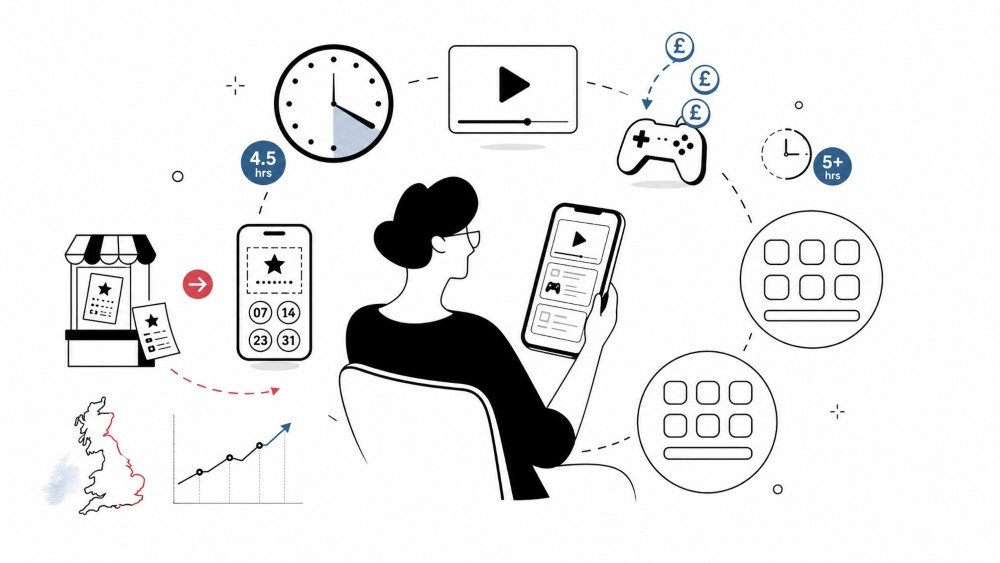
Ofcom’s Online Nation 2025 report found that UK adults spend an average of four hours and thirty minutes online each day outside of work, ten minutes more than the year before. Among 18 to 24 year olds the figure climbs to six hours and twenty minutes. Most of that time happens on a smartphone, and just over half of it sits inside services owned by two companies, Alphabet and Meta. YouTube alone accounts for roughly fifty-one minutes of the average adult’s day, and that is before anyone switches on the television.
Money follows attention. Ukie’s annual valuation of the UK games market put British consumer spending at £8.76 billion in 2025, up 7.4 per cent, with mobile responsible for around £2 billion of that. It happened in a year of visibly squeezed household budgets, which tells you something about where discretionary money goes when it is forced to choose.
Gambling has travelled the same rails, though less dramatically than the headlines imply. The Gambling Commission’s rolling survey of participation in Great Britain consistently shows the National Lottery draw as the most common thing British adults do online with money at stake, ahead of charity lotteries and instant win games. Online participation has crept upwards while in-person participation has stayed broadly flat. It is a migration between formats rather than a surge of new players.
Why The Sofa Beat The High Street
The honest explanation is not that digital entertainment is better. It is that it is nearer.
Going out in Britain has become an expensive logistical exercise. A cinema ticket, a round in the pub, a return fare and a taxi home mount up before anyone has actually enjoyed themselves. Pubs keep closing. Bookmakers have thinned out on high streets from Dundee to Plymouth. The friction of leaving the house has risen at precisely the moment the friction of staying in collapsed to almost nothing.
Compare the effort curves. A night out needs a decision, a plan, three other people’s diaries and about four hours. Opening an app needs a thumb. When two options deliver a broadly similar quantity of enjoyment, and one costs forty pounds plus a fortnight of coordination, the outcome is not genuinely in question.
Which is why the design of these platforms now matters more than their catalogue. Loading time, login flow and how easily a session can be abandoned have become the real competitive ground.
Design Language Of Frictionlessness
There is serious research on what happens when entertainment fits into the gaps of a day rather than occupying a slot in it. A study of gambling behaviour on smartphones in a naturalistic setting, conducted by researchers at the University of Nottingham, found that people engage with their phones intermittently and in short bursts, and that this pattern makes mobile play unusually persistent. Participants kept going through losses in proportion to how much they had already engaged with the app.
That finding is worth sitting with, because it reaches well beyond gambling. The same mechanism explains why a five-minute puzzle game becomes forty minutes, why one episode becomes three, and why a scroll that was only meant to cover the wait for the kettle outlasts the tea.
The better platforms are not passive about this. They show elapsed time, offer session summaries and make stopping as easy as starting. The worse ones bury the exit. For a reader trying to judge whether a service respects them, exit design is probably the most revealing thing on the screen.
Regulation Is Now Part Of The Product
Britain runs one of the more interventionist regimes in the world, and it shapes what a UK player actually experiences rather than merely what a company promises.
Under the Gambling Act 2005, as amended in 2014 to work on a point of consumption basis, any operator taking bets from customers in Great Britain needs a licence from the Gambling Commission, wherever the company itself is registered. That licence brings consequences a player can feel: identity and age verification, deposit limits, self-exclusion through GAMSTOP, restrictions on how bonuses are advertised, and caps on online slot stakes.
Other markets are built differently, and the contrast is instructive. Australia’s interactive gambling framework treats online casino games quite differently from sports betting, and a significant share of demand there is met by offshore operators such as Winspirit Australia, licensed in jurisdictions with their own disclosure and player protection standards rather than under a domestic regime. Whether that arrangement suits a player depends entirely on which protections they value, but the lesson for a British reader is simpler. The safeguards you assume are standard are in fact jurisdictional.
The practical step is unglamorous and takes thirty seconds. The Commission maintains a public register of licensed operators, and its guidance on tackling unlicensed gambling explains why the distinction is not academic. If a site is not on the register, a British customer has no realistic route to dispute resolution when something goes wrong.
Solitary Play, Social Lives
Digital leisure carries a reputation for isolation that the evidence does not really support. What has happened is subtler. The social layer has moved off the screen and into the messaging apps running alongside it.
You can see it in Britain most clearly in the small rituals. The Wordle score pasted into the family group at half past seven. The fantasy football league that keeps a group of school friends in contact fifteen years after they stopped living in the same city. The Discord call that runs for two hours while nobody says much. These are not substitutes for company. They are a form of company with the pressure taken out, which is a different thing and, for a lot of people, a genuinely useful one.
The caveat is that the same architecture works for solitude and for avoidance, and it does not distinguish between them. A platform cannot tell whether you are unwinding after a long shift or using it to sidestep something you should be dealing with. Only you can, and that judgement is easier to make when you are not in the middle of a session.
Where The Line Sits
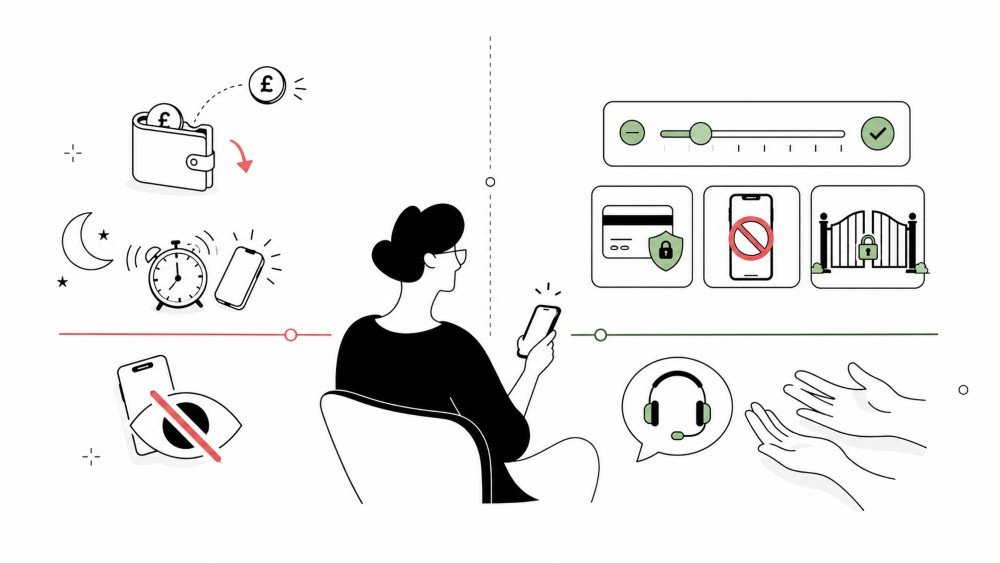
Most people who use these platforms are fine. A minority are not, and the difference is usually not about hours logged but about what the hours are doing to the rest of life. Money that was needed elsewhere. Sleep that was not optional. Secrecy about how long or how much.
If any of that sounds familiar, the NHS guidance on gambling harm is a sensible first stop, and it is written without lecturing. The National Gambling Helpline, run by GamCare, is free, confidential and open around the clock on 0808 8020 133. Support extends to family members, which is worth knowing, because they are frequently the ones who notice first.
Practical guardrails work better than good intentions. Deposit limits set on a calm Sunday afternoon hold up far better than willpower on a bad Friday night. Blocking software, bank-level gambling blocks and self-exclusion schemes exist precisely because in-the-moment decisions are unreliable, and using them is a sign of sense rather than weakness.
What Comes Next
Personalisation is the direction of travel, and it is a double-edged development. Recommendation systems already shape what you see across streaming, shopping and gaming, and they will get better at anticipating what keeps you engaged. The distinction that matters is between systems tuned to what you enjoy, and systems tuned to what holds you. Those are not the same objective, and from the outside they can look identical.
Ofcom’s own research contains a quietly striking finding: only around a third of UK adults now think the internet is good for society, even as the hours spent on it climb. That gap between behaviour and belief is where the next decade of regulation, product design and household negotiation is going to happen. Age verification arriving in July 2025 was an early signal of that, and it will not be the last.
Conclusion
The British evening was not stolen. It was traded, in dozens of small unremarked decisions, for something more convenient, more fragmented and considerably cheaper. There is a real gain in that. There is also something worth defending in the older shape of an evening, the one with a beginning and an end and other people physically in the room.
The workable position is not abstinence or surrender. It is knowing which platforms you have chosen deliberately, understanding what protections sit behind them, and keeping enough of the week for things that do not glow.
Disclaimer
This article is provided for general information and discussion only. It does not constitute legal, financial, medical or professional advice, and nothing in it should be read as an endorsement or recommendation of any gambling operator or service. Gambling regulation differs substantially between jurisdictions, and readers in Great Britain should verify that any operator they use holds a current licence from the Gambling Commission. Gambling carries a risk of financial loss and, for some people, of significant harm. It is restricted to adults aged 18 and over. Anyone concerned about their own gambling, or someone else’s, should contact the National Gambling Helpline on 0808 8020 133 or speak to a GP. External links are included for reference, and the author has no control over third-party content.
References
- Erdem, et al. (2026). Exploring the Profile of Online Gamblers: Key Factors and the Role of Smartphone Addiction in Long-Term Gambling Engagement. Journal of Consumer Behaviour, 25(2), 502 to 516. https://doi.org/10.1002/cb.70079
- GambleAware. (2026). The National Gambling Support Network. GambleAware. https://www.gambleaware.org/tools-and-support/national-gambling-support-network/
- Gambling Act 2005, c. 19, as amended by the Gambling (Licensing and Advertising) Act 2014, c. 17. The Stationery Office. https://www.legislation.gov.uk/ukpga/2005/19/contents
- Gambling Commission. (2026). Statistics on Gambling Participation, Wave 4, September 2025 to January 2026: Official Statistics. Gambling Commission, Birmingham, in partnership with the National Centre for Social Research. https://www.gamblingcommission.gov.uk/statistics-and-research/publication/statistics-on-gambling-participation-wave-4-september-2025-to-january-2026-official-statistics
- James, R. J. E., O’Malley, C., and Tunney, R. J. (2019). Gambling on Smartphones: A Study of a Potentially Addictive Behaviour in a Naturalistic Setting. European Addiction Research, 25(1), 30 to 40. https://doi.org/10.1159/000495663
- Mantere, E. S., Savolainen, I., Vuorinen, I., Hagfors, H., Palomäki, J., and Oksanen, A. (2026). The Internet of Problem Gambling: A Mixed Methods Study of the Role of Internet Enabled Risk Factors Among Finnish Adults. New Media and Society. https://doi.org/10.1177/14614448251333739
- National Health Service. (2026). Help for Problems With Gambling. NHS. https://www.nhs.uk/live-well/addiction-support/gambling-addiction/
- Ofcom. (2025). Online Nation 2025 Report. Office of Communications, London, published 10 December 2025. https://www.ofcom.org.uk/media-use-and-attitudes/online-habits/from-apps-to-ai-search-how-the-uk-goes-online-in-2025
- Ukie. (2026). UK Games Market Consumer Valuation 2025. Association for UK Interactive Entertainment, London, published April 2026. https://ukie.org.uk/news/uk-video-games-market-reaches-8-76-billion-growing-7-4-in-2025/