
There is a moment familiar to anyone who has tried to film at home in this country. You have the shot lined up, the plants look respectable, the cushions have been persuaded into position, and then the light goes. It is half past three in January, the sky above the rooftops has turned the colour of dishwater, and the ceiling light is casting everything in a tone best described as budget hotel corridor.
Most home content advice skips over this entirely. It is written for large rooms with tall windows in places where the sun behaves itself. British housing is a different proposition: narrow Victorian terraces, 1930s semis with box rooms, new-build flats where the living room and kitchen share one strip of daylight, and a private rented sector where painting a wall can require a conversation with a letting agent first.
None of that stops a room filming well. It just means the usual advice needs translating. And there is a reason worth translating it for. According to Ofcom’s Online Nation research, UK adults now spend around four and a half hours a day online, most of it on a phone, and short video sits near the centre of that habit. Rooms are being judged on small screens far more often than they are seen in person.
It is also why most advice on how to grow your TikTok followers eventually circles back to the room itself. Hooks, captions and posting times all get discussed at length, but the space you film in is the one variable settled before you press record, and in a British house it is the one that fights back hardest.
Why Some Rooms Film Well, and Others Do Not
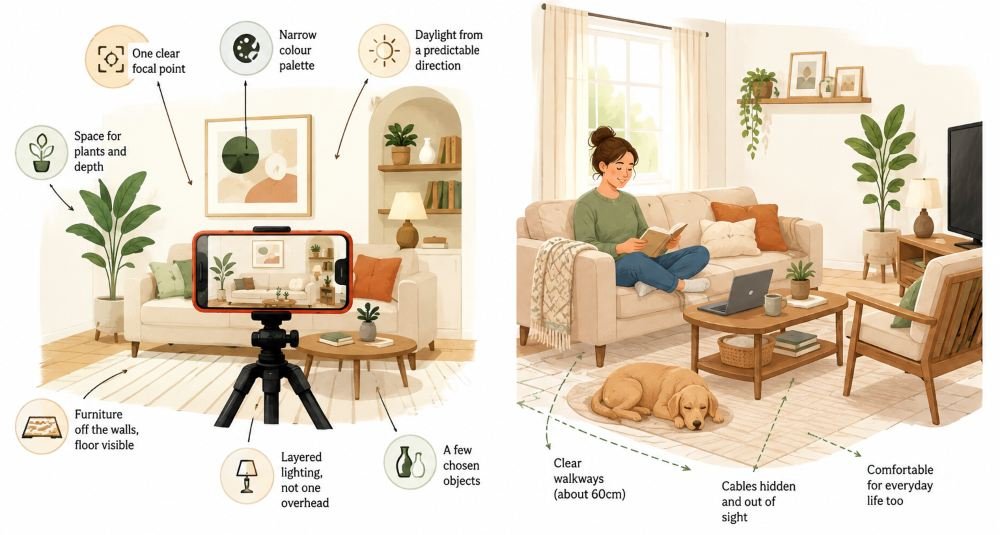
Two rooms can contain almost identical furniture and photograph completely differently. The gap is rarely about money. It is usually about editing.
Rooms that read well on a phone screen tend to share a handful of qualities: one clear focal point rather than four competing ones, a colour palette that stays within a narrow range, daylight arriving from a predictable direction, furniture that leaves the floor visible, and a small number of decorative objects chosen deliberately instead of accumulated by accident.
That last point does most of the work. A phone screen is roughly the size of a postcard, and detail collapses at that scale. Where a cluttered mantelpiece reads as charming in person, on video it becomes visual noise. This is the quiet principle behind good interiors in almost every style: rather than filling every surface, give each object enough space around it to be understood.
The Living Room Does Most of the Work
Sitting rooms carry the bulk of home content, and British ones come with a specific set of features worth using rather than fighting.
The chimney breast is the obvious one. The alcoves either side are the best free framing device in the house, and shelving them costs a fraction of what a feature wall costs. Bay windows give you a bright pocket for a chair and a plant. Radiators sit under windows in most British homes, which is inconvenient for plants and useful for hiding cables behind a console table.
Change What It Does On Camera Worth Knowing
Alcove shelving beside the chimney breast Creates a natural frame and gives shots depth Alcoves are rarely symmetrical in older houses, so measure both sides separately.
Pale, low-sheen wall paint Bounces weak daylight rather than flaring Matt emulsion photographs more evenly than silk, which throws hot spots under lamps.
A rug large enough for the front sofa legs to sit on Anchors the composition and stops the floor reading as empty Undersized rugs are the single most common mistake in British sitting rooms
Two or three lamps instead of one ceiling fitting Keeps the room usable and warm-looking after about three o’clock in winter Older flats are short on sockets, so plan a discreet extension lead in advance.
Plants at three different heights Adds depth, movement and colour Keep them off radiator shelves and away from draughty sash windows.
A clear walkway of roughly 60cm Lets you move a camera through the room without knocking into things Also the difference between a room that works and one that quietly irritates you.
Lighting: The Case for Turning Off the Big Light
The British instinct to switch off the ceiling light and reach for a lamp is not just a personality trait; it is sound practice. A single overhead source flattens faces, kills texture and gives everything a slightly institutional cast. Three smaller sources at different heights, say a floor lamp behind the sofa, a table lamp on a side unit and something low near the fireplace, will do more for a room than repainting it.
Bulb choice matters more than fitting choice. Warm white bulbs in the region of 2700K flatter skin tones and wood; cool white belongs in a garage. Buy by lumens rather than watts, since watts stopped describing brightness the moment LEDs took over. The Energy Saving Trust’s guide to choosing light bulbs sets out the equivalents clearly, and since lighting accounts for a meaningful slice of a household’s electricity use, getting it right is not purely cosmetic.
One practical note for filming: mixing colour temperatures across a room produces a colour cast that no amount of editing fully removes. Pick a temperature and stick to it throughout the space.
Plants That Survive a British Winter and Still Look Good
Plants are the cheapest way to make a room feel alive, and they photograph beautifully because they break up straight lines and catch the light. The trick is choosing species that tolerate a cold north-facing room in February rather than the tropical hothouse specimens that fill American feeds.
Aspidistra earned the nickname cast iron plant in exactly these conditions and has been surviving British parlours since the Victorians. Snake plants and ZZ plants shrug off low light and irregular watering. Devil’s ivy trails happily from a shelf. Spider plants are almost impossible to kill and produce free offspring. A Boston fern is at home in a steamy bathroom. Herbs on a kitchen windowsill earn their place twice over, once visually and once at dinner.
Arrange them in layers rather than dotting them about: something tall on the floor to draw the eye upward, something mid-height beside seating, something small on a coffee table, something trailing from height. The RHS guidance on houseplants is the most reliable starting point for matching a plant to the light your particular room actually gets, which is usually less than you think.
There is a practical dividend too. Field research led from Cardiff University found that adding plants to bare, stripped-back offices lifted productivity by around 15% and improved how people rated their concentration and air quality, a result summarised in the university’s write-up of the green versus lean workspace experiments. Healthy plants also signal something on camera that no amount of styling can fake, which is that somebody looks after this room.
Damp, Radiators and Other Very British Constraints
This is the section the international guides never write, and it matters more than any of them.
Do not place plants directly above a radiator. The rising heat dries the compost far faster than you expect and scorches the leaves nearest the wall. Pebble trays help in centrally heated rooms, but the plant still needs to be somewhere the heat is not blasting past it.
Be careful about turning a cold, north-facing room into a plant corner without thinking about moisture. Damp compost, drying laundry on an airer and a room that rarely gets warm is a combination that ends in condensation on the window frames and mould in the corner. Ventilation is the answer rather than fewer plants: open windows properly for short bursts, keep trickle vents clear, and shut internal doors when cooking or showering. Asthma + Lung UK has sensible, non-alarmist advice on air quality and allergies at home if anyone in the household has a lung condition.
Renters have one more constraint. Whether you can paint at all depends on your tenancy and your landlord, and the position differs for private tenants and for council or housing association tenants. Shelter’s guidance on making improvements to a rented home is worth reading before the paint arrives, not after. Where painting is off the table, large-format art, freestanding shelving, textiles and a decent lamp will shift the character of a magnolia box more than most people expect.
Colour That Behaves in Grey Light
Palettes that look crisp under Mediterranean sun can turn cold and slightly grim under an overcast British sky. Warm-leaning neutrals hold up far better.
Combinations that survive our light include warm white with oak, sage green with cream, soft clay and sand, mushroom with black ironmongery, and charcoal with brass and unpainted wood. What these share is a warm undertone and low contrast, which is what keeps a room looking calm rather than flat when the only light available is a grey rectangle of window.
Test paint on a board rather than the wall, and move the board around the room at different times of day. A colour that looks perfect at eleven in the morning by the window can look like something else entirely at four o’clock beside the door.
Keep the Room Working for the People in It
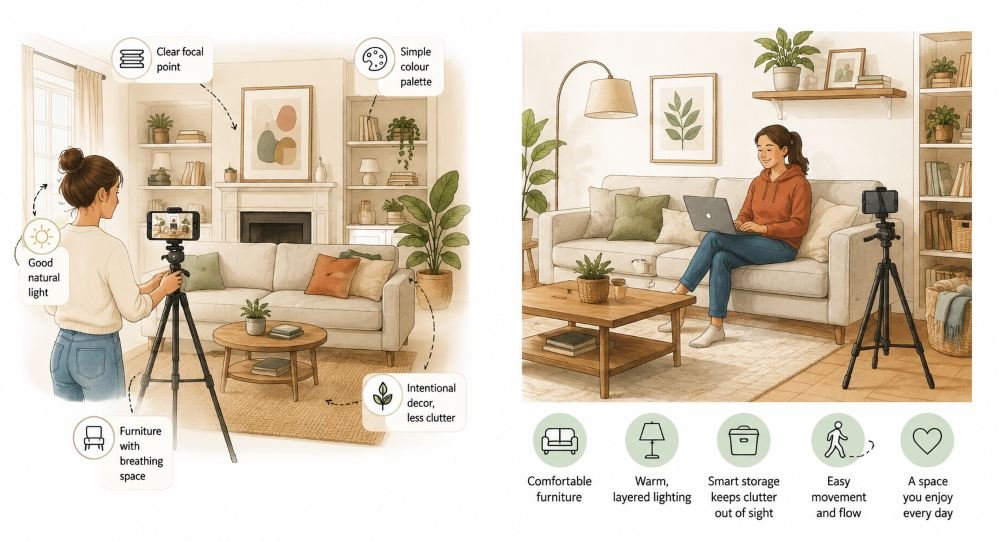
The most common failure in home content is setting up rooms for the camera first and for daily life second. It shows. Rooms staged purely to be filmed have a stiffness to them that viewers register even when they cannot name it.
Four questions catch most of it:
- Is there enough storage that the room can be tidy without a twenty-minute effort?
- Can two people cross the room at the same time without a negotiation?
- Are the things you use daily within reach of where you actually sit?
- Does anything decorative also do a job?
A room that passes those tests films well on an ordinary Tuesday, which is the only sustainable way to make home content. A room that fails them can be styled into a good video roughly twice before the effort becomes unbearable.
Buying Second-Hand Without Buying a Problem
Charity shops, Facebook Marketplace, Gumtree, car boots and local giveaway groups are where a lot of the most distinctive British interiors come from, and second-hand pieces carry a patina that new furniture cannot imitate. Solid wood, old mirrors, cane, brass and mid-century sideboards all photograph considerably better than flat-pack.
One caution that applies specifically here. Upholstered furniture sold in the UK is covered by fire safety regulations dating from 1988, and used items are held to the same standard as new ones. Check for the permanent fire safety label, usually tucked behind a loose cover at the back or under a seat cushion, before handing over cash for a sofa or armchair. Furniture made before 1950 sits outside the rules, which is why genuine antiques are treated differently. Business Companion, the Trading Standards guidance service, explains what to look for in plain terms.
Real Rooms Hold Attention for Longer
Audiences have become good at spotting a set. The rooms that hold attention are usually the ones carrying evidence of a life: your own artwork, framed family photographs, a ceramic somebody made badly and gave you anyway, books that have visibly been read, a plant that is slightly too big for its pot.
This is also where the maths of the platform works in favour of ordinary homes. TikTok’s own explanation of how the For You feed works confirms that follower count is not a direct factor in what gets recommended. A first video from a flat in Leeds can travel further than a fifteenth video from a studio in London if people watch it to the end. What matters is whether the thing is worth watching, which is why making good content consistently beats owning an expensive room.
Where Home Content Is Heading
A few shifts are worth watching, partly because they change what rooms look like and partly because they change what people want to watch.
Broken-plan is quietly replacing open-plan, with half-walls, Crittall-style screens and shelving used to define zones instead of knocking everything through. Second-hand-first is becoming a default rather than a budget compromise. Warm minimalism, meaning fewer objects but softer materials, is displacing the cold grey phase of the last decade. Smart lighting is now cheap enough that scene presets for filming are realistic in a rented flat. Wool, linen, cane and unlacquered brass are winning against high-gloss finishes, largely because matt surfaces photograph without glare.
Underneath all of it is a preference for rooms that look inhabited rather than installed.
Bringing It Together
Aim for a room that is warm, workable and photogenic in that order. Keep surfaces edited. Get plants that suit the light you actually have and keep them alive. Layer your lighting and match your bulb temperatures. Choose colours with warm undertones that hold up under grey skies. Put things in the room that say something about who lives there.
For anyone hoping to build an audience on the strength of their home, the room is the easy part. Posting consistently, filming in the same daylight window each day, and having something to say about the space will always matter more than the space itself. A well-arranged room removes the friction and makes it likelier that someone stays to the end of the video.
The homes people return to are not built for an algorithm. They are built for the person who lives there, and they happen to look good on a phone because a room that works tends to.