
The checkpoint sits at around 1,200 metres on the road up Jebel Akhdar, and the officer did not need to say much. He looked at the hire car, a white saloon with Muscat plates, then pointed back down the mountain. Two hours of driving, undone in about forty seconds.
I had a booking at a mountain lodge that night. I did not have a four-wheel drive, and on that road you cannot have one without the other.
Why My First Attempt at Muscat Went Wrong
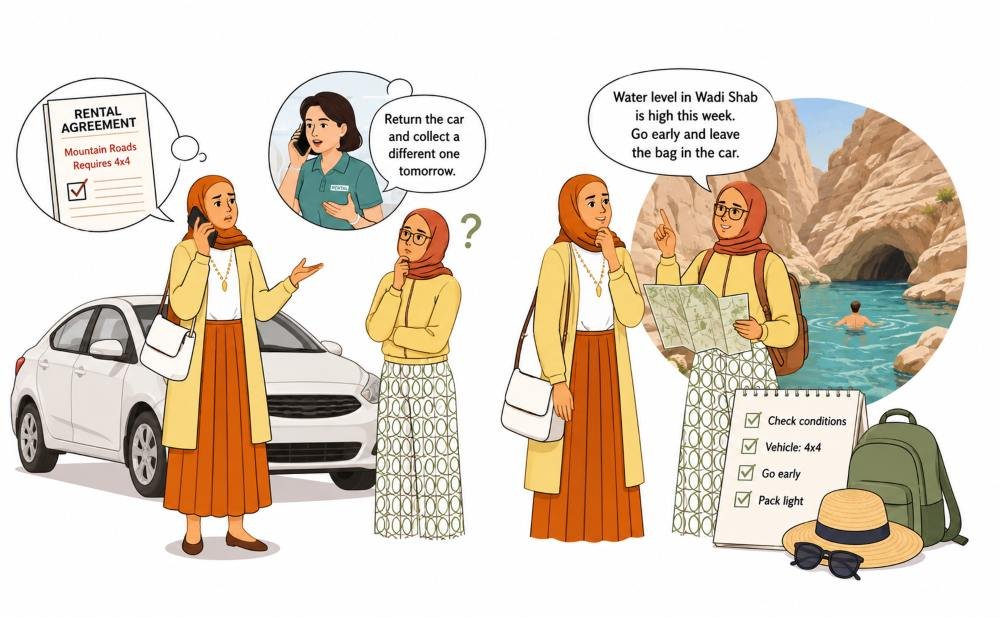
I rang the hire company from a lay-by, fairly annoyed, and read them the situation. The woman on the phone was polite and completely unmoved. The rental agreement, she explained, listed the mountain roads as requiring a 4×4, and their vehicles were insured accordingly. Would I like to return the car and collect a different one tomorrow?
She was right. I had skimmed the terms in the airport queue at one in the morning, ticked the box, and driven away.
That is the distinction Muscat teaches you, and it is worth understanding before you go rather than at a checkpoint. A list of things to do tells you what exists. It does not tell you what is reachable, on what day, in what vehicle, at what hour, in what clothing. Muscat is not a city you can improvise the way you might improvise Lisbon or Seville. Almost everything on the standard list has a condition attached, and the conditions are the actual information.
The second trip worked because a guide told me one sentence I would never have found on my own: the water level in Wadi Shab was high that week, and the final swim through the cave mouth would be tight. Go early, he said, and leave the bag in the car. That was it. That was the whole difference between a good day and a wasted one.
Before You Book: What UK Travellers Need to Know Right Now
This section matters more than usual this year, so it goes first rather than buried at the bottom.
Check the FCDO travel advice for Oman before you book and again in the week you fly. At the time of writing, it leads with a regional tensions warning. Since 8 July there have been strikes and retaliatory attacks by Iran in a number of locations across the region, Oman included, and there is a stated risk of further escalation. The Foreign Office has not advised against travel to Oman. What it does advise is that British nationals in the region should expect possible flight cancellations and periodic airspace closures, monitor local media for airport news, and keep departure plans under review.
The practical translation for a UK traveller is not “cancel.” It is: book flexible where you can, make sure your insurance actually covers disruption and curtailment rather than just medical, and sign up for the FCDO email alerts so you are not relying on a news app. It is also worth reading the government’s guidance on dealing with a crisis abroad once, before you go, rather than looking it up in a hurry.
On entry, the good news is that Oman is unusually easy for British passport holders. Per the FCDO entry requirements for Oman, you can visit for up to 14 days with no visa at all. Your passport needs at least six months’ validity from your arrival date. For anything longer than 14 days, you will need to apply through the Royal Oman Police e-visa portal, selecting the unsponsored visit visa if you are travelling as a tourist.
Three things get checked at the border and catch people out: a return or onward ticket, proof of accommodation, and proof of travel health insurance. That last one is not a formality. British nationals must use the private healthcare system in Oman, and visitors who cannot settle a medical bill can be prevented from leaving the country until it is paid. Read the FCDO’s foreign travel insurance guidance and buy accordingly.
Two more that regularly go wrong. Check TravelHealthPro’s Oman guide for current vaccination recommendations well before you fly. And check your medication, because some UK prescription and over-the-counter medicines are illegal in Oman. Oman’s Ministry of Health publishes the position, and you should carry a copy of your prescription for anything you do bring.
15 Best Things to Do in Muscat and Beyond
1. Sultan Qaboos Grand Mosque
Every list opens here, and it earns the spot. The main prayer hall holds one of the world’s largest hand-woven Persian carpets at roughly 4,000 square metres, under a Swarovski-encrusted chandelier. Photographs undersell both.
The condition: non-Muslim visitors are welcome Saturday to Thursday, 8 am to 11 am only. Turn up at two in the afternoon, and you will be looking at the car park. Women need a headscarf and full cover; men need long trousers. Go before 9:30 am for the light and before the coaches. Budget ninety minutes.
2. Mutrah Souq and Corniche
One of the few Gulf souqs still functioning as a market rather than a performance of one. Locals shop here. Frankincense, silver khanjar daggers, dishdasha fabric and sacks of dried limes sit beside the inevitable fridge magnets.
The smell arrives before anything else, oud and frankincense pressed into narrow covered alleys. Afterwards, walk the Corniche along the bay, past the old port and the wooden dhows. Evenings are the time: cooler, lit, full of Omani families out walking. Find one of the small coffee and halwa shops in the back alleys and order Omani coffee with a piece of halwa.
3. Al Alam Palace and the Old Muscat Forts
Old Muscat is compact and walkable in two hours. Al Alam Palace, the Sultan’s ceremonial residence, sits between two rocky headlands with Forts Mirani and Jalali on either side. Teal and gold against white rock, and genuinely theatrical.
You cannot go inside the palace. The forecourt and surrounding streets are open. The forts date from the 16th-century Portuguese occupation and now hold exhibits on Omani military and maritime history.
4. Royal Opera House Muscat
This one surprises British visitors who arrive expecting a regional theatre. It opened in 2011, hosts international orchestras and ballet companies alongside Omani performances, and the season runs October to May. The acoustics are excellent, and tickets are cheap by West End standards.
Guided tours of the building run most mornings if you are not attending a performance. Check the programme before you fly rather than after.
5. Bait Al Zubair Museum
The most underrated museum in the city. A private collection in a traditional Omani house in Old Muscat, covering weapons, jewellery, textiles, household objects and historical photographs.
The curation is the point. It is a coherent argument about how Omanis lived, traded and dressed across regions and periods, not a pile of old things in cases. Ninety minutes, and read the labels.
6. Qurum Beach
The city beach where you will find Omani families rather than hotel guests. Clean, warm water, rocky hills behind it. Morning swims between October and April are excellent. By midday in any season, the heat becomes the deciding factor.
7. Daymaniyat Islands
Nine uninhabited islands about 18 kilometres offshore, protected as a nature reserve. The snorkelling and diving rank among the best in the Arabian Sea, with hawksbill turtles, reef sharks and high coral coverage.
Day trips run from several marinas and take five to six hours including boat time. Choose an operator that caps group size. The reserve is worth protecting, and a crowded boat ruins the thing you came for.
8. Wadi Shab
Two hours south on the coastal road toward Sur, and the day most visitors name as the best of their trip. A short boat crossing at the wadi mouth, then a forty-minute walk up a limestone canyon involving some scrambling and wading through knee-deep water. At the end, a chain of green pools leads to a low cave entrance. Push through, and there is a waterfall in a chamber entirely enclosed by rock.
The condition here is water level, and it changes. This is the trip where working with a things to do in Muscat specialist genuinely pays for itself, because a local operator knows this week’s levels, which sections are passable, and what time to start so the exposed stretches are not done at midday.
9. Jebel Akhdar
The Green Mountain, over 2,000 metres, and the one that sent me back down. You need a four-wheel drive. There is a checkpoint on the ascent and saloon cars are turned around. Confirm the vehicle class with your hire company in writing, because their insurance depends on it.
Two hours from Muscat, and the drive gets better as the temperature drops. At the top: terraced villages cut into cliffs, rose gardens, pomegranate orchards, and a canyon falling away in every direction. Diana’s Point, named for the 1986 visit, is the photograph everyone takes.
Stay the night if you can. The lodges are good, the stars at altitude are worth the trip on their own, and dawn on the canyon is the thing you will remember.
10. Wahiba Sands
Three hours out, 12,500 square kilometres of classic erg desert with the high photogenic dunes that shift from pale gold to deep copper as the day ends.
The standard version is one night: arrive late afternoon, dune drive, sunset from a ridge, dinner at camp, leave after sunrise. It works. The Bedouin families running the camps have been in this desert for generations, and the less polished operations tend to be the better ones.
11. Nizwa Fort
Ninety minutes away in Oman’s historical heartland. The fort is the most impressive in the country, a huge circular 17th-century tower with exhibits across several floors.
Go on a Friday morning. The livestock souq beside it runs until around noon, with goats, cattle and frankincense changing hands in a scene that has plausibly looked similar for centuries. Loud, chaotic, entirely real.
12. Bimmah Sinkhole
Ninety minutes along the same coastal road as Wadi Shab. A turquoise swimming hole formed where limestone collapsed into an underground aquifer. Smaller than the photographs suggest and lovely anyway. Pairs naturally with Wadi Shab into a two-day coastal run south.
13. Amouage Perfume Factory
Amouage is one of the world’s most prestigious perfume houses, and it is Omani. The factory outside Muscat runs guided tours from raw frankincense and oud through blending and bottling.
Worth doing even if you have no intention of buying. The tour is properly informative about fragrance chemistry, and the showroom lets you sample the full range. Prices are high by any measure.
14. Mutrah Fish Market
Most visitors walk straight past, which is their loss. It runs from about 5 am and winds down by eight or nine. Fishermen unloading, traders arguing, and species that never appear on a British menu laid out on ice in quantities that tell you how productive this sea still is.
Go before breakfast and follow it with coffee on the corniche while the city wakes up.
15. National Museum of Oman
Opened in 2016, and the best single overview of Omani history available. Fourteen galleries running from pre-Islamic civilisations through the maritime trading empire to the present. The building is a modern reading of Omani fort architecture and sits well in Old Muscat. Allow two hours; the archaeology and maritime trade galleries are the strongest.
How to Plan Muscat So It Actually Works
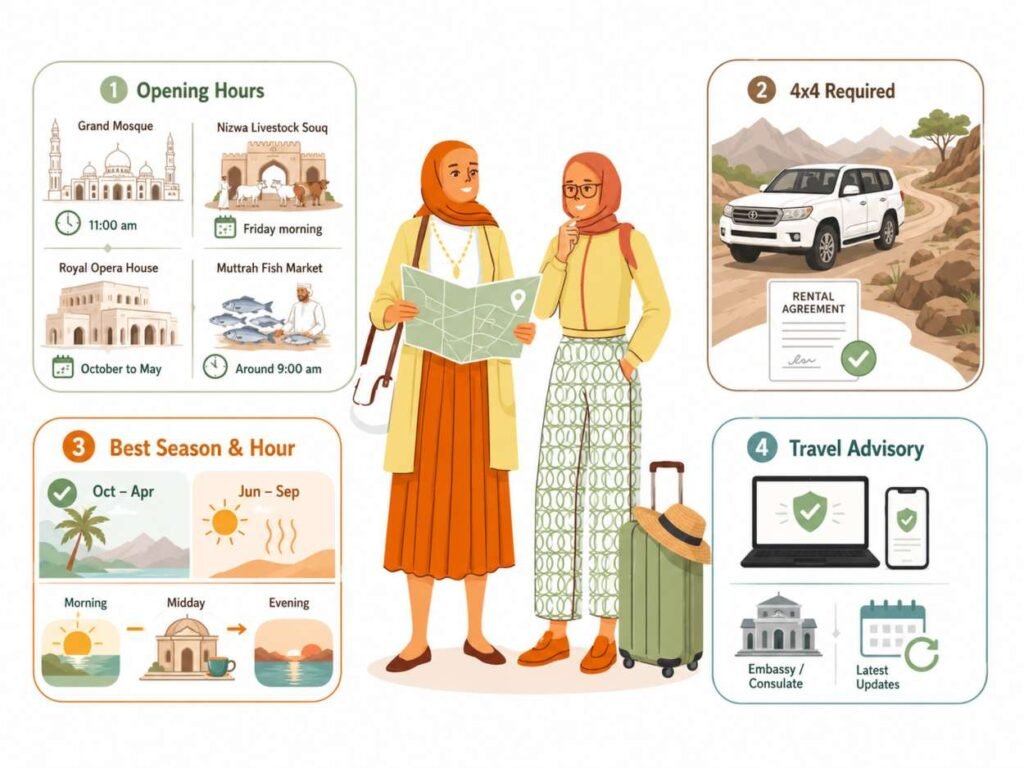
Four questions, applied before you book anything, would have saved my first trip.
| Question to Ask | What You Should Check |
|---|---|
| Does this attraction have opening conditions I have actually checked? | Confirm opening hours and visitor restrictions before you go. For example, the Grand Mosque closes to non-Muslim visitors at 11:00 am, the Nizwa livestock souq takes place on Friday mornings, the Royal Opera House season generally runs from October to May, and the Muttrah fish market is largely finished by 9:00 am. Many attractions operate within narrow time windows. |
| What vehicle does this require, and is it confirmed in writing? | Some destinations require a 4×4 vehicle, with checkpoints enforcing the rule. Jebel Akhdar is the best-known example, and some wadi routes also require suitable vehicles. Ask your rental company to confirm permitted roads in writing, as insurance coverage depends on the rental agreement rather than verbal assurances. |
| Am I booking for the right season and the right hour? | October to April offers the most comfortable weather for sightseeing. From June to September, Muscat remains more manageable than inland areas, but interior trips can become extremely hot, and some wadis may be unsafe. Plan outdoor activities for early morning or late afternoon, reserving the hottest part of the day for museums, shopping, or lunch. |
| Have I checked the latest travel advisory this week, not last month? | Review the latest official travel advice shortly before departure, as conditions can change. Sign up for travel alerts, keep emergency contact information for your embassy or consulate, and know how to reach it if needed during your stay. |
Getting Around, and Getting In From the Airport
Muscat sprawls. Distances between the places on this list are considerably longer than a map suggests, and walking between major sites is not realistic outside Old Muscat and Mutrah.
The first friction point is arrival. After a seven-hour flight, landing into an unfamiliar airport with a three-hour time difference, sorting ground transport at the terminal is the worst version of the job. Booking a Muscat airport transfer in advance removes the one bit of the trip most likely to start it badly.
Once you are settled, ride-hailing handles city movement well and Careem operates properly here. For the day trips, Wadi Shab, Jebel Akhdar, Nizwa, private hire with a driver is the standard approach and usually the sensible one, particularly for the mountain.
Final Note
The honest version of the checkpoint story is that nobody misled me. The terms said 4×4. The road has had that checkpoint for years. Every guide to Jebel Akhdar mentions it. I had read a list of fifteen things to do and treated it as a list of fifteen things I could do, which are not the same document.
Muscat rewards preparation more than most places, and not because it is difficult. It is one of the easiest, most welcoming countries in the region to travel in. It is because the interesting parts sit behind small, specific, entirely knowable conditions: a vehicle class, a three-hour window, a water level, a season. None of those are obstacles once you know about them. All of them are obstacles at four in the afternoon on a mountain road with a lodge booking you are not going to reach.
Read the conditions before you go. Then go, because it is worth it.
This article reflects FCDO travel advice and Omani entry requirements as published at the end of July 2026. Both change. Check gov.uk/foreign-travel-advice/oman for the current position before booking and again before you travel. General information only, not travel or insurance advice.