
Spend ten minutes on any British gambling forum and you will find the same story told a hundred ways. Someone lands a decent win on a Saturday night, heads to the cashier and gets stopped by an email asking for a photo of their driving licence, a recent utility or council tax bill, and sometimes a selfie holding the licence. The thread usually ends with the same verdict: the casino is stalling, hoping the player gets bored, cancels the withdrawal and spins the money back into the slots.
It is easy to see why people think that. It is also mostly wrong. Identity checks, known across the industry as Know Your Customer or KYC, are what separate a regulated gambling site from an open door for fraudsters and money launderers. The routine is not a British invention either. Operators in other markets run their own versions, and Canadian-facing brands such as Cherry Spins also ask players for ID or a utility bill to confirm who they are. For anyone gambling in the UK, though, the standard that counts is set by the Gambling Commission in Birmingham. Once you know what it demands, a document request stops looking like red tape and starts looking like a sign you are on an accountable site.
Legal Anchor: The Gambling Commission And Britain’s Money Laundering Rules
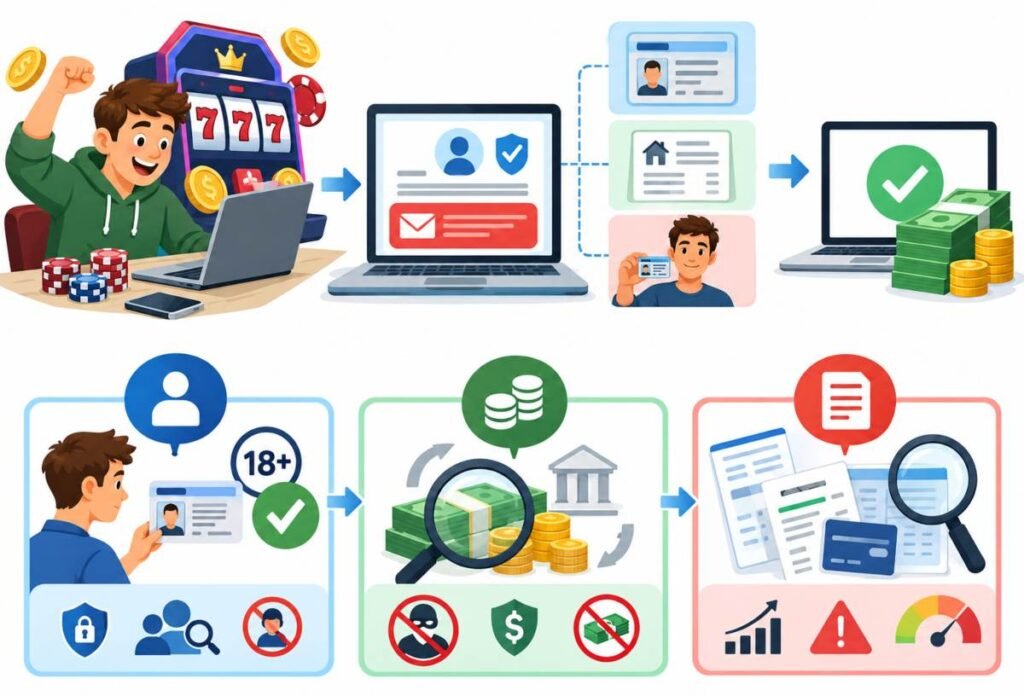
Gambling in Great Britain runs on the Gambling Act 2005, which set up the Gambling Commission. Since 2014, any operator offering online gambling to British customers has needed one of its licences, wherever the company is based. Northern Ireland has its own separate law, which is why regulators tend to say “Great Britain” rather than “the UK”.
Checks used to be looser. Before 2019, online operators had 72 hours to confirm a customer’s age, and players could not withdraw until that was done. Many sites saved their document requests for the cashier, and around 15 per cent of complaints to the Commission’s contact centre were about players being blocked from withdrawing until they sent ID. The age and identity rules the Gambling Commission brought in on 7 May 2019 closed that gap. Licensed operators must now:
- confirm your age before you can deposit, gamble with your own money or a bonus, or even play free demo versions of their games
- verify at least your name, address and date of birth before you place a bet
- tell you, before your first deposit, what documents they might ask for, when, and how to send them
- ask for any extra information promptly and keep your details accurate
The second layer is financial crime law. Casinos, online ones included, fall under the Money Laundering Regulations 2017, with the Commission as their supervisor. Under regulation 27 of the Money Laundering Regulations 2017, a casino must carry out customer due diligence on any stake or withdrawal of £2,000 or more, whether made in one go or across linked transactions. The threshold was set in euros until changes took effect on 30 June 2026 and switched it to sterling. Suspicious activity also has to be reported to the National Crime Agency under the Proceeds of Crime Act 2002.
The Commission backs this up with heavy fines. In 2022, Entain agreed to pay £17 million for anti-money laundering and social responsibility failures, the regulator’s biggest enforcement outcome at the time. That same year, Smarkets paid £630,000 after one customer was allowed to deposit £395,000 in four months without proper source of funds checks. When a casino asks for your documents, it knows exactly what happens to operators that do not.
Three Pillars Of KYC: What They Are Checking And Why
KYC is really three checks, each aimed at a different risk. Most players only ever meet the first, but seeing them side by side explains a lot.
| Check | What You Might Be Asked For | What It Is There To Stop | When It Usually Happens |
| Age and identity | Name, address and date of birth, sometimes a passport or driving licence photo | Underage play, fake accounts and self-excluded players slipping back in | At sign-up, before your first deposit |
| Anti-money laundering | Further ID, proof of address, questions about large or odd transactions | Criminal money being passed through gaming accounts | When stakes or withdrawals pass set levels or look unusual |
| Source of funds and financial risk | Payslips, bank statements, or a background check with a credit reference agency | Gambling with stolen money, or losses someone cannot afford | At high spending levels |
Age And Identity Verification (The Baseline)
The legal gambling age is 18 across the UK, and a licensed site must be sure you are over it before any money moves. Most of the time you never see the check. When you sign up, the operator compares your name, address and date of birth with credit reference and electoral roll data, and a match comes back in seconds.
Document requests usually appear when that electronic match fails, and the reasons are often dull. People who have just moved house, changed surname after marriage, or have a thin credit history (common among students and younger adults) are the most likely to be asked for a passport or licence photo. It is not an accusation. It is the fallback when the databases cannot confirm who you are.
Your date of birth matters beyond sign-up too. Since 2025, online slot stakes in Britain have been capped at £5 per spin for adults aged 25 and over and £2 per spin for 18 to 24-year-olds. An operator cannot apply the right cap without knowing your real age.
Anti-Money Laundering (The Financial Shield)
Online casinos move a lot of money quickly, which makes them useful to criminals. The basic trick is simple: load an account with stolen or criminal money, play a few low-risk rounds, then withdraw the balance as “winnings” that look clean on a bank statement. Often the money runs through mule accounts, meaning bank accounts opened or lent by people paid to move funds for someone else, and fraud prevention body Cifas reports that most money mule cases involve people under 30.
KYC makes that trick far harder. A licensed operator will typically check:
- that the name on your debit card or e-wallet matches your account (credit cards have been banned for gambling in Britain since April 2020)
- that withdrawals go back to the method you deposited with, known as closed-loop payments
- that you are not on a financial sanctions list
- whether your play makes sense, such as large deposits followed by withdrawals with very little gambling in between
One legal detail explains plenty of forum anger. If a casino has reported a suspicion to the National Crime Agency, the “tipping off” rules can stop staff telling the customer anything about it. That is why some support replies sound vague to the point of being maddening: the agent may simply not be allowed to say more. Your bank works under the same rule.
Source Of Funds (The Affordability Check)
This check causes the most anger, partly because it mixes two questions. Source of funds asks where the money came from, which is about crime. Financial risk asks whether losing it would push you into real trouble, which is about protecting you. For years both were answered the same clumsy way: send three months of bank statements.
That is changing. In July 2026 the Commission confirmed a staged rollout of Financial Risk Assessments, which use credit reference data instead of paperwork. In the first stage, the largest operators will assess customers aged 25 and over who deposit more than £5,000 net in a rolling 24 hours, or more than £2,500 for under-25s, a spending pattern fewer than 0.5 per cent of customers ever reach. Once fully in place, the triggers fall to £1,000 in 24 hours or £3,000 over 90 days (£750 and £2,000 for under-25s). In the pilot, 97 per cent of accounts above the thresholds could be checked without friction, and the assessments do not affect credit scores. Acting chief executive Sarah Gardner said the approach would remove “the need for unnecessary and unpopular document checks”. At the time of writing, a start date for stage one had not been fixed.
Why check at all? The Commission’s figures show high-spending gamblers are two to four times more likely than the wider population to be on a debt management plan. Independent research points the same way. A study of anonymised UK bank data covering up to 6.5 million people linked spending a bigger share of income on gambling with financial distress, worse health and wellbeing, and, at the heaviest levels, a much higher risk of death. A check that catches someone gambling money they do not have is not a privacy grab. For some players it is the only brake in the system.
The Asymmetry: How A Strict KYC Check Actually Protects The UK Player
The paperwork falls on the casino. Most of the benefit falls on you. That imbalance is easy to miss while you wait for a withdrawal, so it is worth spelling out.
Ultimate Protection Against Identity Theft
Stolen personal details are now the most common raw material for fraud in Britain. Cifas figures for the first half of 2026 show identity fraud made up 59 per cent of fraud-risk cases on the UK’s National Fraud Database, with nearly 130,000 cases, up 9 per cent. Unauthorised SIM swaps, where a criminal hijacks your phone number to intercept security codes, rose by 402 per cent compared with the same period in 2025.
Picture your name, address and card details sitting in a leaked database. At an unlicensed site that checks nothing, a fraudster can open an account in your name and gamble your money away in an afternoon. At a GB-licensed site, they have to pass an electronic identity match, and often a document check and a live selfie compared with your passport photo. That SIM swap figure matters here: a text code alone is no longer strong protection, but a face that has to match a document is much harder to fake. Strict KYC turns a regulated casino into a dead end for most identity thieves.
Guarantee Of Financial Solvency And Payout Security
No licence can promise that a business will never fail, and nobody honest should claim otherwise. What a licence does give you is a set of rights you do not get anywhere else. Any site taking bets from British players without a Commission licence is breaking the law, and the regulator said it issued 741 cease-and-desist orders and disrupted 1,134 websites through takedowns or geo-blocking in its last financial year. If a site like that keeps your money, there is no British regulator to complain to and no independent adjudicator to hear your case.
| What You Get | GB-Licensed Casino | Unlicensed “No ID” Site |
| Age and identity checks | Required before you gamble | Often none, or only when it suits the operator |
| Self-exclusion | Must be linked to GAMSTOP | No GAMSTOP link |
| Disputes | Complaints process, then an approved dispute service such as IBAS | Nothing beyond the operator itself |
| Your balance | Operator must tell you how well customer funds are protected if it goes bust | No disclosure required |
| Your documents | UK GDPR, overseen by the ICO | Depends on where the company is based, if anywhere |
A casino that takes verification seriously is protecting its licence, and that licence is worth far more to it than any single withdrawal. That is not a promise of fast payouts, but it is a good reason to expect you will be paid.
Automated Self-Exclusion Enforcement
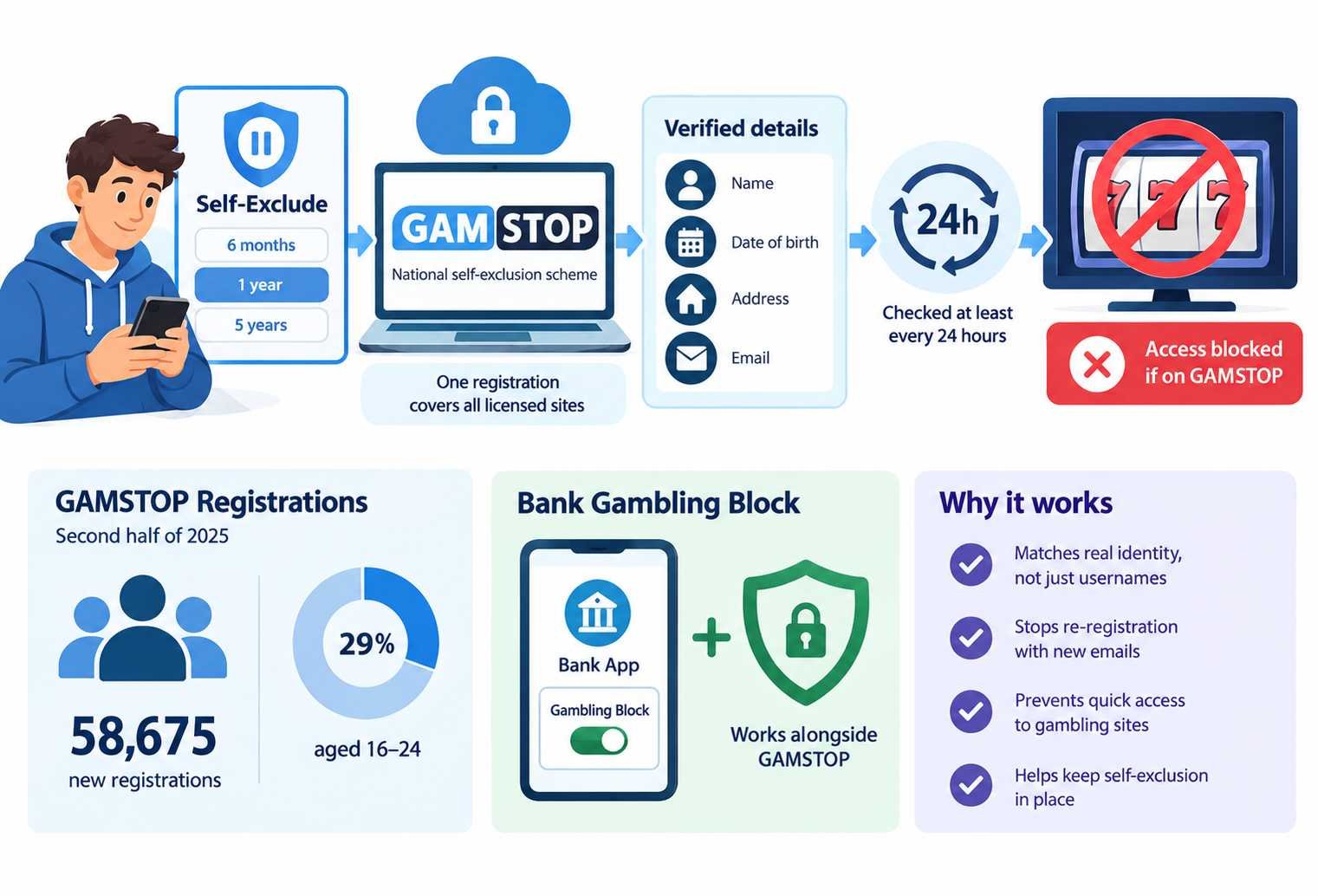
For someone trying to stop, KYC can decide whether a ban holds or leaks. Since 31 March 2020, every online operator licensed by the Commission has had to connect to GAMSTOP, the national online self-exclusion scheme, and operators must check their whole customer base against it at least once every 24 hours. One registration covers every licensed site for six months, a year or five years.
The system only works because details are verified. GAMSTOP matches people on information such as name, date of birth, address and email. If a casino accepted any made-up username and a new email address, a self-excluded player could be back within minutes. Verified identity shuts that door.
Demand keeps rising. GAMSTOP recorded 58,675 new registrations in the second half of 2025, and people aged 16 to 24 made up 29 per cent of them. Many UK banks also let customers switch on a gambling block in their app, which adds a second lock that works alongside the first.
Frequently Asked Questions
Why Did The Casino Let Me Deposit Without ID But Blocked My Withdrawal?
At a GB-licensed site, you almost certainly were checked before your deposit. It just happened electronically, so you never saw it. What you meet at withdrawal is usually a second layer, set off by things like a transaction passing the £2,000 anti-money laundering threshold, a payment method in someone else’s name, unusual play, or the operator’s own source of funds review at high spending levels.
The operator should still have been upfront, telling you before your first deposit what it might need and when. If a request feels unreasonable or is dragging on, use the casino’s formal complaints process first. If it is not settled within eight weeks, you can take it to the operator’s approved dispute resolution provider. The Gambling Commission does not rule on individual disputes, but it does want to hear about operators breaking its rules.
Is It Safe To Upload My Driving Licence And Bank Statements To A UK Casino?
At a licensed operator, your documents are protected by UK GDPR and the Data Protection Act 2018, and the Information Commissioner’s Office can act if they are mishandled. Operators must keep the data secure and not hold it longer than needed. You also have the right to ask for a copy of everything they hold on you, and they normally have one month to respond.
A few habits make it safer still:
- check the site’s licence on the Gambling Commission’s public register before sending anything
- upload only through the verification area of your account or the official app, never in reply to an unexpected email or text
- ask whether you can blank out bank statement lines that have nothing to do with gambling
- keep a note of what you sent and when
Fake “verification” messages are a common phishing trick, so log in directly and confirm any document request is real before you act on it.
How Long Does A Standard KYC Check Take To Complete?
The electronic check at sign-up normally takes seconds. When documents are needed, a clear passport or licence photo is often approved within a few hours, though it can take longer at busy times. Source of funds reviews are slower because a person has to read the paperwork, and a few working days is not unusual. Financial Risk Assessments are designed to run in the background without documents for nearly everyone who reaches the thresholds.
You can speed things up. Verify your account before you need to withdraw, not after a big win. Photograph documents in good light with all four corners showing, make sure your proof of address matches your account exactly, and deposit from an account in your own name.
Bottom Line
KYC is not there to spoil a winning streak. It keeps children out, keeps criminal money out and keeps self-excluded players protected, while giving you rights you can use when something goes wrong. The next time a UK casino asks for your ID, feeling a bit impatient is fair. But the request also tells you something useful: the site answers to a regulator, and so does the money in your account.
Disclaimer
This article is for general information only and is not legal or financial advice. Gambling law differs between Great Britain and Northern Ireland, and rules on verification, anti-money laundering and financial risk checks change often, so some details may have moved on since publication. Always check an operator’s licence on the Gambling Commission’s public register before registering or depositing. Gambling is for adults aged 18 and over and carries a real risk of losing money. If gambling is causing problems for you or someone close to you, free and confidential help is available 24 hours a day from GamCare’s National Gambling Helpline on 0808 8020 133.
References
- Cifas (2026) Fraudscape 2026: 6 Month Update. Press release, 5 August 2026. London: Cifas. Available at: https://www.cifas.org.uk/newsroom/fraudscape-2026-6-month-update
- European Gaming (2026) ‘Gambling Commission: FRAs are not affordability checks’, 21 May 2026. Available at: https://europeangaming.eu/portal/latest-news/2026/05/21/204953/gambling-commission-finance-risk-assessments-are-not-affordability-checks/
- Gambling Commission (2019) New rules to make online gambling in Britain fairer and safer. Birmingham: Gambling Commission. Available at: https://www.gamblingcommission.gov.uk/news/article/new-rules-to-make-online-gambling-in-britain-fairer-and-safer
- Gambling Commission (2022) Enforcement statements on Entain plc (£17 million regulatory settlement) and Smarkets (Malta) Limited (£630,000 penalty), August 2022. Birmingham: Gambling Commission.
- Gambling Commission (2026) Commission to introduce Financial Risk Assessments in staged approach, 7 July 2026. Birmingham: Gambling Commission. Available at: https://www.gamblingcommission.gov.uk/news/article/commission-to-introduce-financial-risk-assessments-in-staged-approach
- Gambling Commission (2026) Upcoming changes to the Money Laundering Regulations 2017. Licensee notice. Available at: https://www.gamblingcommission.gov.uk/licensees-and-businesses/notice/upcoming-changes-to-the-money-laundering-regulations-2017
- GAMSTOP (2021) Annual Report and Accounts, 31 December 2020. The National Online Self Exclusion Scheme Limited. Available at: https://www.about.gamstop.co.uk/_files/ugd/e95905_15ed9e8e33244f2a8de2d44fda8b079f.pdf
- iGaming Business (2026) ‘Gamstop reports surge in self-exclusion among younger bettors’. Available at: https://igamingbusiness.com/sustainable-gambling/responsible-gambling/gamstop-surge-self-exclusion-younger-people/
- Information Commissioner’s Office (n.d.) A guide to subject access. Wilmslow: ICO. Available at: https://ico.org.uk/for-organisations/uk-gdpr-guidance-and-resources/subject-access-requests/a-guide-to-subject-access/
- Muggleton, N., Parpart, P., Newall, P., Leake, D., Gathergood, J. and Stewart, N. (2021) ‘The association between gambling and financial, social and health outcomes in big financial data’, Nature Human Behaviour, 5(3), pp. 319-326. doi: 10.1038/s41562-020-01045-w
- The Money Laundering, Terrorist Financing and Transfer of Funds (Information on the Payer) Regulations 2017, SI 2017/692, reg. 27. Available at: https://www.legislation.gov.uk/uksi/2017/692/regulation/27