
There is no right age. That is probably the most reassuring thing to know before you go any further. Some children are ready to move up at four, others are perfectly happy on a smaller bike at six, and both are completely fine. Readiness is not about hitting a birthday; it is about what you are actually seeing when your child rides.
Spring tends to be the moment it all becomes obvious. More time outside, more riding, more chances to notice that something has changed. Whether your little one is showing signs of outgrowing their current bike or itching to race ahead with older siblings, this guide will help you spot the signals and know exactly what to do next.
Here are seven signs your child might be ready for their first big kid bike, plus a practical size guide and our top tips for making the switch with confidence.
1. They Have Outgrown Their Current Bike
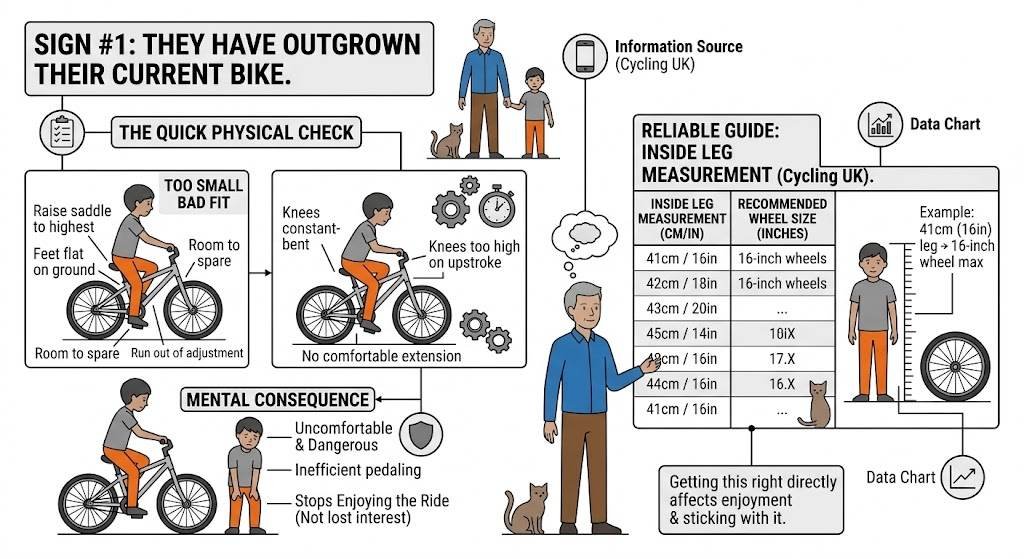
The clearest sign is usually physical. Watch your child pedal and look at their knees. If they are constantly bent, coming up too high on the upstroke, or there is no comfortable extension at the bottom, the bike is too small. It sounds obvious, but it is easy to let it slide for a few months longer than you should.
Riding a bike that is too small is not just uncomfortable; it’s dangerous. It changes how a child moves, makes pedaling inefficient, and can genuinely slow down their progress. Many children who seem to “go off” their bikes around this age have not lost interest. They have stopped enjoying the ride.
Quick physical check: Raise the saddle to its highest position and ask your child to sit on the bike. If both feet go flat on the ground with room to spare, the bike has run out of adjustment. There is nowhere left for them to grow into it.
According to Cycling UK, the inside leg measurement is the most reliable guide: if your four-year-old has a 41cm (16in) inside leg, 16-inch wheels are the maximum. Getting this right matters more than most parents realize, because a poorly fitting bike directly affects how much a child enjoys cycling and whether they stick with it.
2. They Can Ride Confidently Without Stabilizers
A child who can balance, steer, and stop on their own has already done the hard work. Those are the skills that carry over directly to a bigger bike, and if they have got them, there is no real reason to keep them on a frame they have outgrown.
What you are looking for is not speed or distance. It is control. Ask yourself:
- Can they hold a steady line?
- Can they brake without wobbling?
- Do they look where they are going rather than at the ground?
If the answer is yes to all three, they are ready. Halfords’ kids bike guide confirms that a proper fit is just as important as confidence. A bike that is too large may be uncomfortable to control or difficult to brake safely, while a well-fitted one builds confidence naturally.
3. They Are Asking to Keep Up with Older Children
This one tends to sneak up on you. One day, they are happy pottering along at their own pace, and then suddenly, they are frustrated because they cannot keep up with their older sibling, or because the kids from school are leaving them behind on the way to the park.
Social motivation is huge at this age. When a child wants to keep up but cannot, it stops being about the ride and becomes about the bike. A smaller wheel cannot cover the same ground as a bigger one, no matter how hard they pedal.
This is often the moment parents start looking at bikes for 4-year-olds, specifically models designed for the transition from toddler bikes to proper junior bikes. Matching the bike to your child’s ambition, rather than waiting until they have clearly and definitively outgrown it, makes a real difference to how much they enjoy riding.
Getting outside and staying active is something we talk a lot about on fsiblog’s health and fitness section, and for children, cycling is one of the most joyful and sustainable ways to build that habit early.
4. They Show Growing Physical Coordination
Cycling readiness does not just show up on the bike. Look at how your child moves in general. Can they kick a moving ball? Dodge around things when they are running? Change direction quickly without losing their footing?
These are signs that the brain-body connection is developing well and that they can handle the slightly more responsive steering and the heavier frame that come with moving up a size. A bigger bike asks a bit more of a child physically. The ones who are ready for it tend to show it in other ways too, not just on the bike, but in how they move and play generally.
The NHS Healthier Families guidance recommends that children cycle, walk, or scoot whenever possible as a natural way to build coordination alongside fitness. Cycling, in particular, helps children develop balance and motor skills that benefit them across other physical activities.
5. The Saddle Has No Room Left to Grow
This is a simple check every UK parent can do in the garden or on the pavement. Raise the saddle to its highest position. Now ask your child to sit on the bike with both feet flat on the ground. If there is still room to spare under their knees, you have some life left in the bike. If their legs are almost fully extended at the bottom of the pedal stroke, the fit is already borderline. If both feet go flat and there is space between the knees and the handlebars, the bike has run out of room entirely.
This is usually the point at which 16-inch bikes come into play. According to Tredz Bikes’ sizing guide, 16-inch wheel bikes are best suited to children between 112cm and 125cm tall, which covers many five and six-year-olds in the UK. They give children proper saddle height and reach again, so they are back in a comfortable position that lets them ride well.
UK Kids Bike Size Chart at a Glance
Use this table as a starting point. Always measure inside leg length for the most accurate fit, and when in doubt, let your child sit on the bike before you buy.
| Wheel Size | Age Range (Guide) | Height Range | Typical Features |
|---|---|---|---|
| 12 inch | 2 to 4 years | Under 100 cm | Balance bike or stabilisers, single brake |
| 14 inch | 3 to 5 years | 95 to 110 cm | Stabilisers, simple hand brake |
| 16 inch | 4 to 6 years | 105 to 120 cm | Stabilisers optional, hand brakes |
| 18 inch | 5 to 8 years | 112 to 128 cm | Often stabiliser-free, may have gears |
| 20 inch | 6 to 10 years | 120 to 140 cm | Gears, V-brakes, junior mountain bike styles |
| 24 inch | 9 to 12 years | 135 cm plus | Full gearing, disc or V-brakes, near-adult features |
Key tip from Cycling UK:Children’s bikes are sized by wheel diameter, not frame size. Always measure your child’s inside leg rather than relying on age alone, as children of the same age can vary significantly in height and reach.
6. They Are Interested in Longer Rides
Some children are happy to loop around the block and come home. Others start pushing for more, a different route, a further destination, a ride that actually goes somewhere. If yours is in the second camp and they are still on a smaller bike, they will quickly run into its limits.
Smaller bikes are not built for sustained effort or varied terrain, and children who push against those limits often get frustrated without quite knowing why. If you have a four- or five-year-old who is already showing that kind of enthusiasm, it is worth looking at bikes for 4-year-olds built to keep up with where they want to go, rather than holding them back.
Spring in the UK opens up brilliant options for family rides, from traffic-free canal towpaths and converted railway lines to seaside promenades and local park circuits. Many UK families use resources like Sustrans’ National Cycle Network to find safe, scenic routes near them, and having a properly sized bike makes a real difference to whether children enjoy those longer outings or quietly give up halfway around.
This connects nicely to something we explore in our road trip advice for young families, the idea that children engage far more with outdoor adventures when they feel capable and comfortable, not held back by kit that no longer fits.
7. Spring Has Them Itching to Be Outdoors
It is not a scientific sign, but it is real. Spring brings a particular kind of restlessness in children. They want to be outside after school, notice what other kids are riding, and ask to go further and stay out longer.
Longer evenings, warmer weekends, and the Easter school holidays all make this the right time to take a proper look at whether their bike is actually up to everything they want to do with it. And there is a good reason to act on that energy. The Office for National Statistics has highlighted that fewer than a quarter of UK children meet minimum daily physical activity recommendations, making every opportunity to get them moving on a bike genuinely valuable.
Cycling is one of the best ways to build that habit sustainably. It never feels like exercise to a child who loves it. It is just freedom.
What to Look for When Buying a Bigger Bike: A Practical Checklist
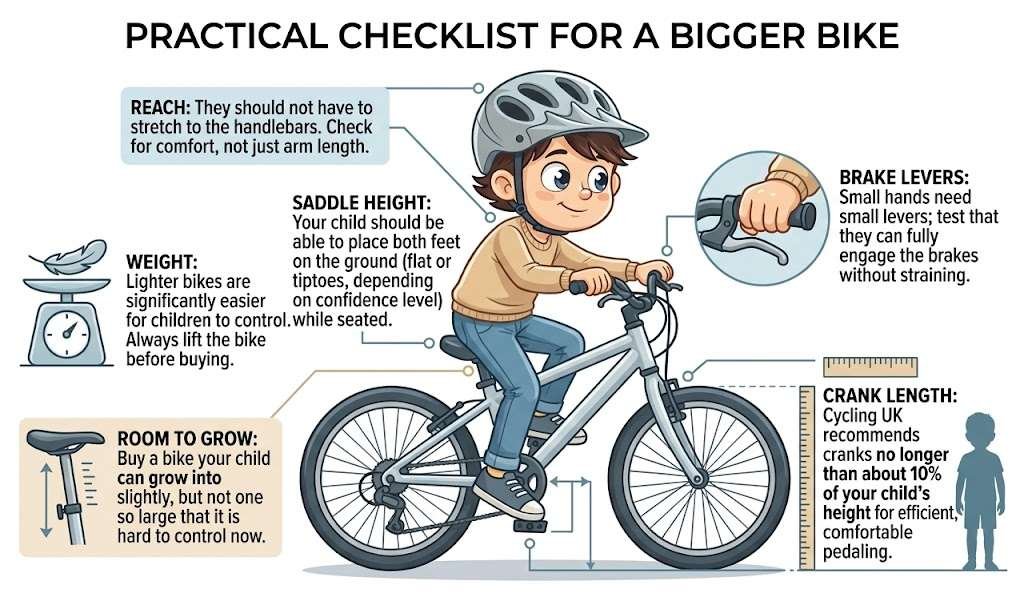
Before you commit to any purchase, run through this checklist at the shop or before a delivery arrives:
- Saddle height: Your child should be able to place both feet on the ground (flat or tiptoes, depending on confidence level) while seated
- Reach: They should not have to stretch to the handlebars. Check for comfort, not just arm length.
- Brake levers: Small hands need small levers; test that they can fully engage the brakes without straining
- Weight: Lighter bikes are significantly easier for children to control. Always lift the bike before buying.
- Crank length: Cycling UK recommends cranks no longer than about 10% of your child’s height for efficient, comfortable pedaling
- Room to grow: Buy a bike your child can grow into slightly, but not one so large that it is hard to control now
For the 4-6 age range specifically, browsing bikes for 4-year-olds from dedicated children’s cycling brands tends to yield lighter, better-proportioned options than budget department store bikes, which often hit a price point at the expense of fit and weight.
Safety Essentials for UK Parents
Moving to a bigger bike is exciting, but it is also a good moment to refresh your child’s safety setup. Here is what every UK parent should have in place:
- Helmet: The two-finger rule. The helmet sits low on the forehead with two fingers’ width above the eyebrows. Replace after any significant impact.
- High-vis or bright clothing: Especially important during early spring when visibility can be poor in the mornings and evenings
- Bike fit check: A local independent bike shop will often check saddle and brake setup for free
- Regular servicing: Chains, brakes, and tires should be checked every six months. Most local bike shops offer a basic service check.
Staying active as a family is something we talk about regularly on fsiblog’s lifestyle section, and cycling together is one of the few activities that is genuinely fun for both adults and children at the same time.
Final Thoughts
The upgrade from a starter bike to a proper big-kid bike is one of those milestones that tends to happen quietly, then all at once. The signs above, outgrown saddle, growing confidence, social motivation, and longer ambitions rarely all appear at the same time. But if two or three of them are ticking boxes, it is worth acting sooner rather than later.
The right bike does not just fit your child today; it fits your child for life. It gives them the confidence and capability to love riding, and that habit, started early, has a way of sticking for life.
If you are at the beginning of the journey, start with bikes for 4-year-olds4-year-olds and use the size table above to narrow down your choices before you visit a shop. And if you want to read more about building active habits that last, for children and adults alike, explore our wellness tips on fsiblog.