
Some brands just get it right consistently, and that is rarer than it sounds in lingerie. Finding a bra that actually fits, not in the vague “technically does up” sense but genuinely, comfortably, still fine at four in the afternoon, is something a lot of women spend years trying to sort out. Fantasie keeps coming up in that conversation, and there are decent reasons why.
The brand has been going since 1951, which in fashion terms is practically geological. Most labels of that vintage either disappeared or went so mass-market they lost whatever made them worth buying. Fantasie went the other way and built its reputation around fuller cup sizing, which was an unglamorous corner of the market to commit to in the 1950s and turned out to be the right one. It is still designed and produced in Britain by Wacoal Europe, which absorbed the old Eveden group in 2012, and the company has operated out of a Victorian corsetry factory since 1989. Its first moulded bra came out of that building in 2000.
That is a long time spent on one problem. It shows.
What Actually Sets It Apart
A lot of lingerie marketing is noise. Every brand on the high street claims exceptional fit and luxurious feel, and the words have been used so often they have stopped meaning anything. Fantasie’s reputation did not come from advertising. It came from women telling each other, after years of bras that dug in, gapped at the top of the cup, or rode up the back by lunchtime.
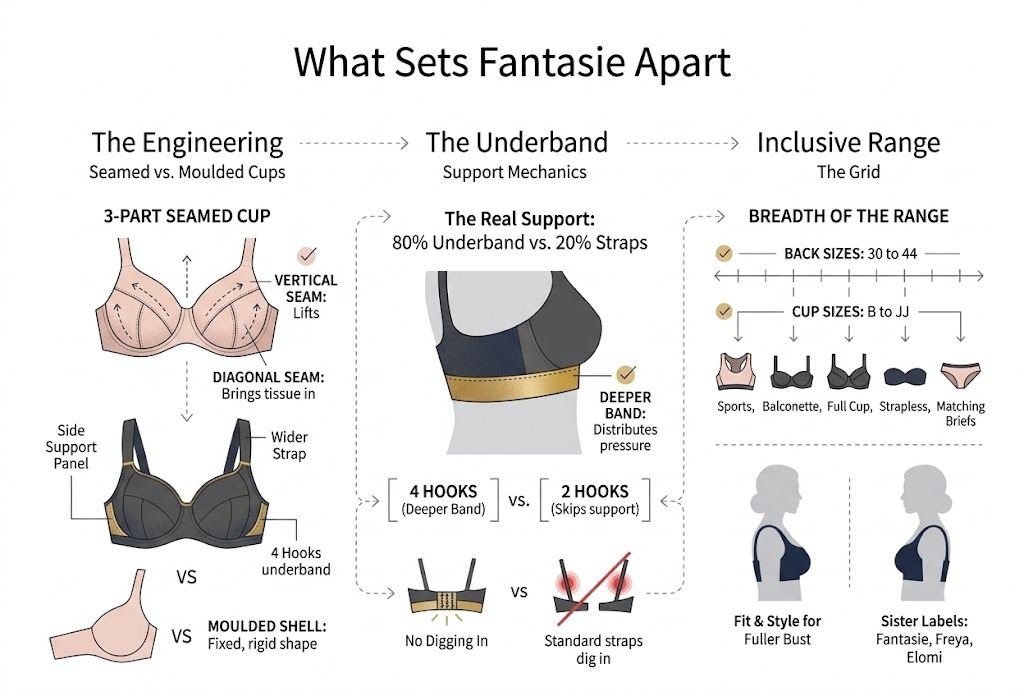
The engineering is the part worth understanding, because it is where the money goes. Seamed cups shape the breast rather than just containing it. Side support panels stop everything migrating towards your armpit. Wider straps spread the load across the shoulder instead of concentrating it in one groove, which is why cheap bras leave marks and good ones do not. A properly built three-part cup behaves completely differently from a moulded foam shell scaled up from a B cup pattern, and if you have never worn one, the difference is not subtle.
There is a physical reason the seams matter. A moulded cup has one fixed shape, and it either matches your shape or it does not. A seamed cup is assembled from separate panels, and the direction each seam runs decides where the breast tissue is pushed. A vertical seam lifts. A diagonal one brings tissue in from the side. Three panels working together can produce a shape that a single moulded piece simply cannot, which is why seamed cups dominate the upper end of the size range and foam dominates the lower one.
The underband does a similar job invisibly. Most of a bra’s support comes from the band, not the straps, and the wider and firmer that band is, the more weight it can carry without digging in. This is also why the better fuller-bust bras have four hooks rather than two: more hooks means a deeper band, and a deeper band distributes pressure across more of your ribcage. None of this is glamorous and none of it photographs well, which is precisely why budget ranges skip it.
Then there is the breadth of the range. Plenty of brands do one or two styles in extended sizing and consider the job done. Fantasie’s size grid runs from a 30 back up to a 44, and from a B cup all the way to a JJ, with the swimwear reaching further still. Within that you get sports bras, balconettes, full cups, strapless styles that are not a write-off above a D cup, and the matching briefs that mysteriously stop existing in a lot of larger ranges.
That breadth matters more than it sounds. Women with a fuller bust should not have to pick between something that fits and something that looks like it was designed by a person who found the whole subject faintly embarrassing. For a long time, that was genuinely the choice. Fantasie was one of the brands that made it stop being the choice, alongside its sister labels Freya and Elomi, which cover the same territory with different styling.
The Fit Question, And Why Britain Changed Its Mind About It
UK bra fitting has had a proper cultural reckoning over the last fifteen years, and it is worth knowing what actually caused it, because it was not a marketing campaign. It was research.
The University of Portsmouth runs a Research Group in Breast Health, which is the leading academic group on this subject anywhere, and its position is blunt: over 80% of women are wearing the wrong size bra. Its researchers argue that women should be taught to assess fit themselves rather than having a size dictated by a tape measure.
That last point is the one that upended the high street. A Portsmouth study compared the traditional tape-measure method against a best-fit approach across 45 women, and found the tape measure overestimated band size in 76% of cases and underestimated cup size in 84%. The discrepancy got worse the larger the bust. Which means the old method was not slightly imprecise, it was systematically wrong, and wrong in the specific direction that most inconvenienced the women it failed hardest.
It is worth knowing where that method came from, because it was not arbitrary. The old approach of measuring under the bust and adding four or five inches dates from an era when bra fabrics had almost no stretch in them. You needed that slack simply to get the thing on and off. Elastane changed the engineering completely and the fitting formula never caught up, so for decades British women were being handed a band several inches too big and a cup correspondingly too small, which is the exact combination that produces straps digging in, a band riding up at the back and the sensation that bras are simply uncomfortable by nature.
They are not. Most women who move down a band size and up a cup or two, which is the usual correction, describe it as a revelation rather than an improvement.
The consequences are not just aesthetic. Writing about the group’s work, Professor Joanna Wakefield-Scurr has pointed out that breast pain is reported by around half of women, and that in one study assessing women who wanted breast reduction surgery, every single one was in an ill-fitting bra. The NHS likewise notes that strains in the neck, shoulder or back can be felt as breast pain, which is exactly the load path a badly fitted bra interferes with.
The sports side makes the point even more starkly. When Portsmouth researchers worked with the England women’s football squad, their pre-intervention assessment found breast pain affecting 61% of the players, with a quarter reporting it at clinically significant levels, alongside poor fit and poor knowledge across the group. These are elite athletes with full-time medical support. If it was going unaddressed there, it is going unaddressed everywhere.
The numbers behind that are more dramatic than most people expect. Portsmouth’s biomechanics work has measured breast movement ranging from around four centimetres during a walk to roughly fifteen during a run, in multiple directions at once, and breast tissue has no muscle in it to resist any of that. The group found breasts to be the fourth most common barrier to exercise reported by women, behind only motivation, time and general health. It also suggests replacing a sports bra on the same schedule as your running shoes, which almost nobody does.
For fuller busts this is where bra type matters. Compression bras flatten the breasts against the chest, which works reasonably below a D cup and poorly above one. Encapsulation bras support each breast separately in its own moulded or seamed cup, which is what larger sizes actually need. Fantasie’s sports range sits in the encapsulation and combination camp rather than the sports-crop-top camp, which is the whole reason it exists as a separate proposition.
So here is the five-point check the Portsmouth approach is built on, which you can do in front of a mirror without a tape measure anywhere near you:
| What To Check | What Good Looks Like |
| Underband | Firm and level all the way round, no riding up at the back. It does most of the support work |
| Cup | Breast tissue fully contained, no spilling over the top or gaping at the edge |
| Underwire | Sitting flat against the ribcage, following the natural crease, not resting on breast tissue |
| Straps | Adjusted so two fingers slide underneath. They are for shaping, not for holding everything up |
| Front band | Lying flat against the breastbone rather than standing away from it |
If the straps are doing the lifting, the band is too loose. That single realisation fixes more bras than anything else on the list.
This is where brands built around a wide size grid have an advantage, and it is a technical one rather than a philosophical one. A 32G and a 38G hold roughly similar breast volume on completely different frames, and they need different patterns, different wire shapes and different panel geometry to work. Grading one pattern up and down a size chart does not produce that. It produces a bra that fits one size properly and approximates the rest. Fantasie’s patterns are developed with that in mind, which is why women who have given up on off-the-shelf options often find it works where other brands have not.
What To Expect On Price
It is not a budget brand and there is no sense pretending otherwise. You are typically looking at somewhere around £40 to £55 for a bra, more for certain styles, with swimwear and matching briefs sitting at a comparable premium. For some people that is unremarkable. For others it is a purchase you think about for a week first.
The counter-argument is about lifespan rather than luxury. Bras in this construction class last considerably longer than cheap ones, provided you treat them properly, and the care routine is not demanding:
- Hand wash, or use a mesh bag on a cool, gentle cycle
- Never tumble dry, which destroys elastane faster than anything else you can do to a bra
- Fasten the hooks before washing so they do not catch on other garments
- Dry flat rather than hanging by the straps, which stretches them
- Rotate between a few bras rather than wearing the same one daily, so the elastic recovers
- Store moulded cups unfolded, because a crease in foam is permanent
Looked after like that, a Fantasie bra worn regularly can reasonably last two to three years while holding its shape, which changes the arithmetic. Three cheap bras replaced annually against one good one lasting three years is not a close contest on cost, and it is not close at all on how the intervening three years feel.
One practical note on buying at this price point. Bodies change with weight, hormones, pregnancy and age, and so does the right size. Buying three of the same bra because it fits today is a reasonable instinct and a slightly risky one. Buy one, wear it for a month, then stock up if it is still right.
Who It Actually Suits
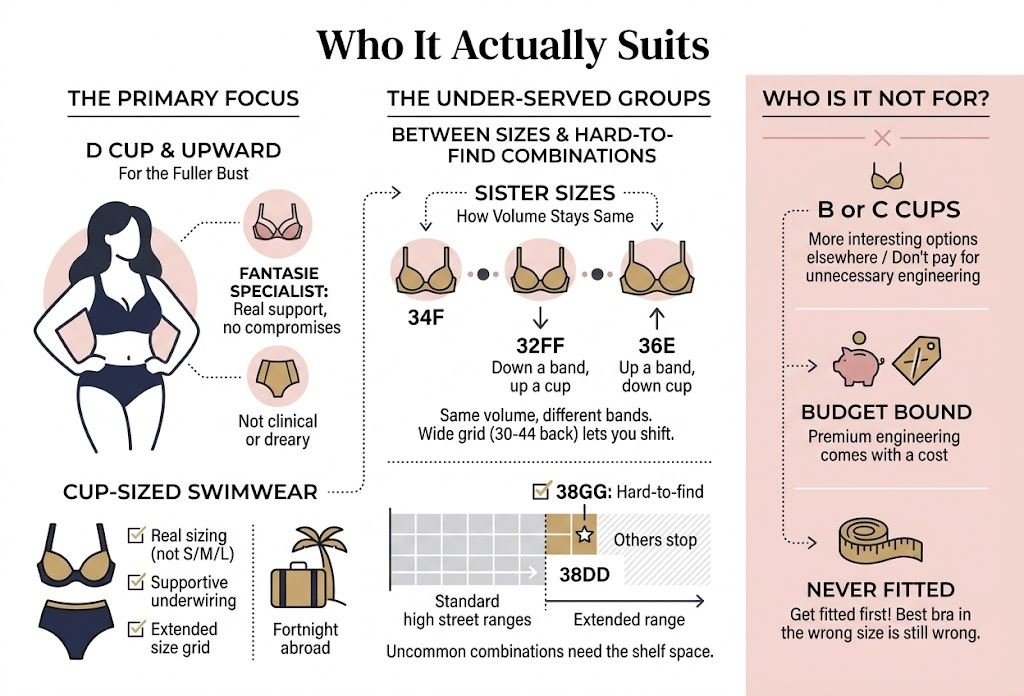
Mostly this is aimed at women around a D cup and upwards who want something that does the job without being either clinical or dreary about it. That is the core of it, and the brand is honest about being a fuller bust specialist rather than trying to be everything.
The swimwear range has a particular following, and for good reason. Cup-sized swimwear is genuinely difficult to find, and most of what exists treats support and appearance as mutually exclusive. A bikini top with proper underwiring and a real size grid rather than S, M and L is a small thing that makes a fortnight abroad considerably less annoying.
It also tends to work well for two groups that standard ranges serve badly. The first is women who are between sizes, where a 34 is slightly tight and a 36 slightly loose.
This is where sister sizing becomes useful, and it is worth understanding properly because almost nobody explains it in a shop. Cup volume is relative to the band, not absolute, so the same letter means a different amount of space depending on what it sits on. Going down a band size and up a cup letter keeps the volume roughly the same: a 34F holds broadly what a 32FF does and what a 36E does. If a bra fits in the cup but the band is loose, you want the next band down and the next cup up, not simply a smaller bra. A range that runs from a 30 to a 44 back gives you room to make that move. A range that stops at a 38 DD does not.
The second group is women whose back measurement and cup requirement do not line up with the combinations most high street ranges bother to stock, which is a surprisingly large number of people once you get past a DD. A 38GG is not an exotic request. It is just one that a lot of retailers decided was not worth the shelf space.
Who is it not for? If you are a B or C cup, there are brands doing more interesting work at your end of the market, and you would be paying for engineering you do not especially need. If budget is the binding constraint, it is not the answer, and nobody should pretend otherwise. And if you have never been properly fitted, start there rather than with a brand decision, because the best bra in the world in the wrong size is still the wrong bra.
Where That Leaves You
No brand is right for everyone and anybody telling you otherwise is selling something. But for the specific problem Fantasie set out to solve in 1951, which was making well-built, decent-looking underwear for women the rest of the industry was ignoring, it has been solving it for seventy-odd years without drifting.
The more useful takeaway is probably not about the brand at all. It is that the discomfort an enormous number of women have quietly accepted as the normal cost of having breasts is, in a large share of cases, a fitting problem rather than an inevitability. The research says over 80% of women are in the wrong size. The odds are not in your favour.
While you are thinking about your chest, it is worth knowing what normal feels like for you. Breast Cancer Now has clear guidance on checking, and getting familiar with your own breasts is the sort of five-minute habit that genuinely matters. Getting a bra that fits is the pleasant version of paying attention. Do both.
Disclaimer
This article is provided for general information only and does not constitute medical advice. It describes a clothing brand and is not endorsed by, or affiliated with, that brand or its manufacturer. Prices, size ranges and product availability change and vary by retailer; figures given are indicative and should be checked at the point of purchase. Anyone experiencing persistent breast pain, or who notices a lump, skin change, nipple discharge or any other change in their breasts, should contact their GP rather than assuming the cause is a poorly fitting bra. Research findings cited reflect the samples and conditions described in the original publications. Figures cited were accurate at the date of the sources listed below.
References
- Wakefield-Scurr, J., Jones, M., Jones, B., Whatling, E. and Mehta, R. Hidden Support For The Lionesses: A Breast/Bra Intervention. Research in Sports Medicine, published online 21 May 2024. DOI: 10.1080/15438627.2024.2357761. Available at: https://doi.org/10.1080/15438627.2024.2357761
- University of Portsmouth. Research Group In Breast Health. School of Sport, Health and Exercise Science. Available at: https://www.port.ac.uk/research/research-groups-and-centres/research-group-in-breast-health
- Wakefield-Scurr, J. Wearing An Ill-Fitting Bra Isn’t Just Uncomfortable, It’s Bad For Your Health. University of Portsmouth, originally published in The Conversation. Available at: https://www.port.ac.uk/news-events-and-blogs/blogs/health-and-wellbeing/wearing-an-illfitting-bra-isnt-just-uncomfortable-its-bad-for-your-health
- NHS. Breast Pain. Page last reviewed 3 May 2023. Available at: https://www.nhs.uk/conditions/breast-pain/
- Breast Cancer Now. Breast Awareness And Checking Guidance. Registered charity numbers 1160558 (England and Wales) and SC045584 (Scotland). Available at: https://breastcancernow.org/