
There is a particular kind of present that only makes sense once you have watched a teenager, a grandparent or your flatmate disappear into TikTok for an evening. It is not a jumper and it is not a book token. It is a little bit of spending power inside the app they already love, so they can back the baker in Bristol who livestreams sourdough at 5am, or the Glaswegian comedian who does crowd work over a webcam.
That is the quiet appeal of a TikTok gift card. It turns a vague “I don’t know what to get you” into something specific to how someone spends their free time. But the product is also widely misunderstood. People assume it works like a high street voucher, that it can be refunded like a pair of trainers, or that it is a safe way to pay someone you have never met. None of those are quite true.
What A TikTok Gift Card Really Is
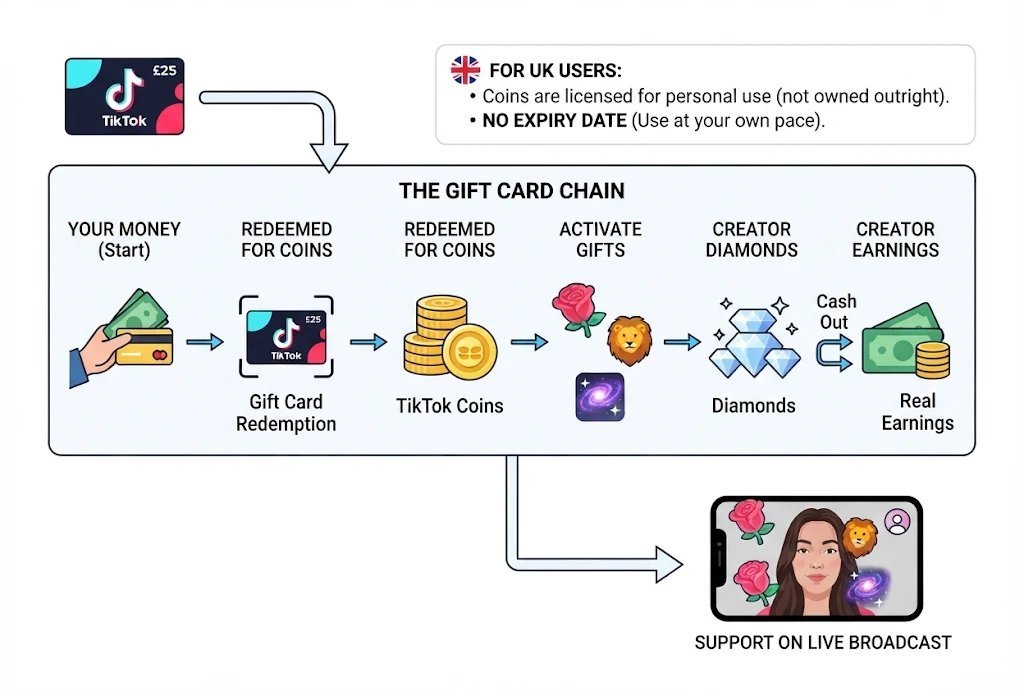
At its simplest, a gift card carries a prepaid value that is redeemed for TikTok Coins. Coins are the platform’s virtual currency. You cannot spend them in Boots or transfer them to a bank account. Their main job is to activate Gifts, the animated roses, lions and galaxies you see floating across the screen during a LIVE broadcast.
When a viewer sends a Gift, the creator receives Diamonds, which eligible creators can later convert into real earnings. So the chain looks like this: your money becomes Coins, Coins become a Gift, and a Gift becomes Diamonds for the person on the other end. A gift card simply sits at the start of that chain and lets someone else decide where the support goes.
For UK and European users, the rules are set out in TikTok’s Coins Policy for the UK and EEA, which is worth a five minute read before you buy. Two points stand out. Coins are licensed to you for personal use on the platform rather than owned outright, and they do not have an expiry date. The second point is genuinely useful for a present, because the recipient is not racing a deadline.
Why It Works Better As A Gift Than You Might Expect
Most digital vouchers are generic. A TikTok card is oddly personal, because it shows you have noticed what someone actually enjoys.
A few situations where it makes real sense:
- The supporter, not the scroller. Some people have a short list of creators they genuinely want to back, perhaps a local musician, a language tutor or a small business owner selling candles from a unit in Leeds. A card gives them the means to do it without dipping into their own budget.
- The long-distance relative. If your cousin in Belfast spends Sunday evenings in a LIVE book club, a card lands as a small, thoughtful nod to something she cares about.
- The secret Santa at work. It fits a modest office limit, it posts instantly by email, and it avoids the shared-fridge fate of yet another box of biscuits.
Where it makes less sense is for someone who only watches and never interacts. If they have never sent a Gift, a card may sit untouched. A quick, casual question (“Do you ever send stuff on LIVEs?”) saves you guessing.
Age Rules Matter More Than The Price Tag
This is the part UK families most often miss. TikTok’s minimum age to hold an account is 13, but buying Coins and sending Gifts is restricted to adults. That means a TikTok card is not a suitable present for most secondary school pupils, however much they ask for one.
The wider climate in Britain has shifted too. Since July 2025, platforms covered by the Online Safety Act have been expected to apply Ofcom’s children’s safety codes, and the regulator has named TikTok among the services it is monitoring most closely for its impact on young users. For parents, the practical takeaway is simple: if a younger teen is using the app, the better gift is time spent together setting up the TikTok parental controls explained step by step by Internet Matters, including Family Pairing, screen time limits and content filters.
Buying A Card Without Getting Caught Out
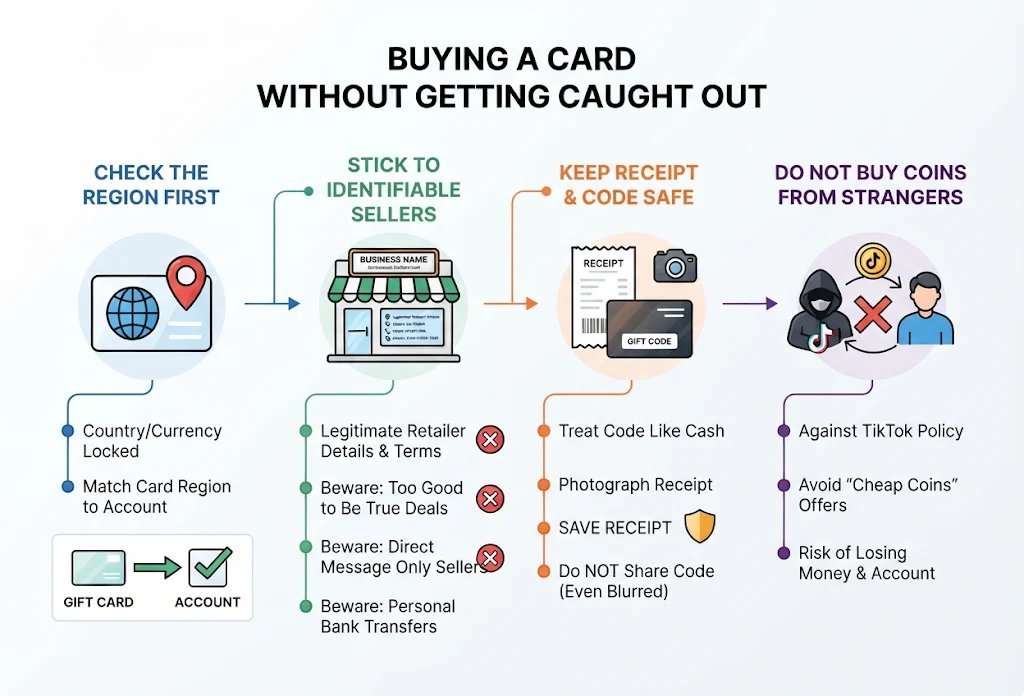
Cards are sold through a mix of high street tills, supermarket gift card stands and online digital retailers. Wherever you buy, the same few rules apply.
- Check the region first. Gift cards are frequently locked to a specific country or currency. A card intended for one region may not redeem on an account registered elsewhere. If you are buying online from a digital storefront, for example a TikTok gift card from a third-party marketplace, read the product page carefully and confirm that the region on the card matches the region of the account it is meant for. This single check prevents most redemption headaches.
- Stick to sellers you can identify. A legitimate retailer will show a business name, contact details and clear terms. Prices that look far too good, sellers who only want to deal through direct messages, and listings asking you to pay by bank transfer to a personal account are all reasons to walk away.
- Keep the receipt and the code safe. Treat the code like cash. Photograph or save the receipt, and do not share the code on social media, even partly blurred.
- Do not buy Coins from strangers. TikTok’s own terms say Coins and virtual items should not be bought, sold or traded outside the platform except as the policy allows. Offers of “cheap Coins” from random accounts usually end with the buyer losing money and, in some cases, their account.
Redeeming It: A Simple Walkthrough
The exact menu labels can change between app updates, but the general flow is consistent:
- Open TikTok and go to your profile.
- Open the menu and find the balance or wallet area.
- Look for the option to redeem a code or recharge.
- Enter the gift card code exactly as printed, then confirm.
- Check that your Coin balance has updated before closing the app.
If the code is rejected, slow down before assuming you have been scammed. Most failures come down to a typo, a region mismatch or a card that was never activated at the till. The official TikTok support center is the right place to raise a problem, and it helps to have the receipt, the code and a screenshot of the error to hand.
Your Consumer Rights In Plain English
Digital purchases in the UK are covered by the Consumer Rights Act 2015, which says digital content must be of satisfactory quality, fit for purpose and as described. That gives you real protection if a card is faulty or misdescribed, for instance if it was sold as working in the UK and simply does not.
What the law does not do is give you an easy refund for a change of heart once a code has been delivered and used. Gifts already sent to a creator are also very unlikely to be reversed. If something goes wrong, Citizens Advice has a clear guide to problems with apps, downloads and digital content, including template wording for asking a seller to put things right.
The Scam Every UK Buyer Should Recognise
Gift cards are a favourite tool of fraudsters precisely because codes are quick to redeem and hard to trace. The pattern is depressingly familiar: a message claiming to be from HMRC, a “parcel fee” text, a new online friend with an emergency, or an email that looks like it is from your manager asking you to pick up a few cards “for a client”.
No genuine organisation in Britain asks to be paid in gift card codes. Not the taxman, not your bank, not your energy supplier. If anyone asks you to read out or photograph a code to settle a bill, it is a scam.
Get Safe Online’s advice on voucher and gift card scams covers the common scripts in more detail. Suspicious emails can be forwarded using the National Cyber Security Centre’s scam reporting service, and scam texts can be forwarded free to 7726.
If you have already handed over a code, act quickly. Contact the retailer that sold the card, because funds can sometimes be frozen if they have not yet been spent. Then report it. Action Fraud has now been replaced by Report Fraud, the national service for England, Wales and Northern Ireland, reachable online or on 0300 123 2040. In Scotland, call Police Scotland on 101.
A Few Habits That Make The Gift Land Well
- Pick a sensible amount. A modest card is easier to enjoy guilt-free than a large one, and it keeps spending in proportion.
- Add a note. A line like “for your Thursday night LIVE gang” turns a code into a proper present.
- Send it at the right moment. Many creators run special streams around Bonfire Night, Christmas and the end of the football season, which gives the recipient something to look forward to.
- Encourage limits. It is easy to tap through Coins quickly in a busy LIVE. Suggesting the recipient sets their own personal spending cap is a kind gesture, not a lecture.
Final Thoughts
A TikTok gift card is a small thing, but done well it says something specific: I know what you enjoy, and I want you to enjoy it a bit more. Check the age rules, match the region, buy from a seller you can identify and treat every code like cash. Do that, and you have a present that is both modern and genuinely considerate, without any of the risks that give gift cards a bad name.
Disclaimer: This article is for general information only. Features, prices and policies can change, so always check TikTok’s current terms before buying. It is not financial or legal advice.