
When you step away from the rush of a busy high street and enter a quiet green space, the change can feel immediate. Noise fades. Your breathing slows. Your mind softens its grip on the endless list of daily concerns. In these moments, nature quietly does what crowded spaces cannot. It permits you to pause.
Memorial gardens take this natural calming effect and give it a deeper purpose. They are not simply parks or decorative landscapes. They are carefully crafted places where memory, grief, love, and reflection can coexist. For many people across the United Kingdom, memorial gardens offer something increasingly rare in modern life: a dedicated place to remember, process loss, and reconnect with both personal memories and community history.
Unlike traditional monuments made solely of stone, memorial gardens are living spaces. Trees grow, flowers return each spring, and wildlife continues its rhythms. This quality of life helps people understand loss more gently. Instead of representing an ending, the garden reflects continuity, renewal, and the quiet persistence of life.
Today, memorial gardens play an important role not only in mourning but also in wellbeing, community identity, and emotional recovery. Understanding how and why they help can make one’s visit far more meaningful.
Why Memorial Gardens Matter in Modern Britain
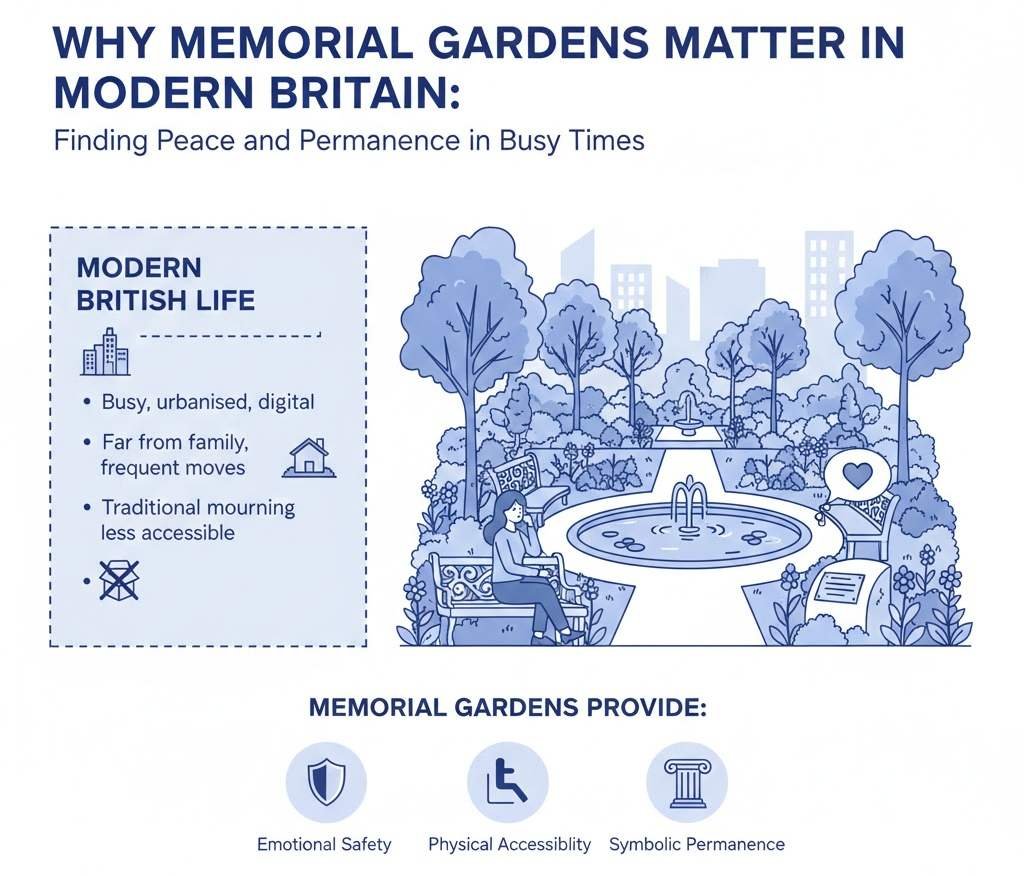
Modern British life is busy, urbanised, and often digitally saturated. Many people live far from extended family, frequently change homes, and work long hours. Traditional mourning practices that once centred on churchyards or close-knit neighbourhoods are not always as accessible as they once were.
Memorial gardens help fill this emotional and social gap.
They provide a physical destination where Remembrance becomes intentional. Instead of holding memories privately or only during formal anniversaries, people can return repeatedly to a peaceful, accessible setting designed for reflection.
Across the UK, councils, charities, and local trusts increasingly invest in green memorial spaces because communities continue to need them. Projects like the Queen Elizabeth II memorial initiatives lasting tributes and reflect a desire for green spaces to visit. These spaces honour national history while also providing individuals with a quiet place to sit, think, and remember.
Such projects demonstrate that Remembrance is not only about ceremonial events. It is also about everyday access to calm environments where people can process emotions at their own pace.
Memorial gardens matter because they combine three essential elements:
- emotional safety
- physical accessibility
- symbolic permanence
This combination allows people to return again and again, finding slightly different meaning each time.
Psychology Behind Green Spaces and Emotional Healing
Scientific research increasingly confirms what many people intuitively feel: nature supports mental recovery.
Exposure to greenery reduces stress hormones, improves mood regulation, and lowers physical tension. Even brief visits to a natural setting can produce measurable physiological changes, including a slower heart rate and improved breathing patterns.
In fact, back in 2020, a research project by the RHS and the universities of Sheffield, Westminster and Virginia revealed that greenery has a positive impact on stress levels.
This work, involving the Royal Horticultural Society, the University of Sheffield, the University of Westminster, and the University of Virginia, reinforced the idea that access to gardens improves emotional well-being across age groups and social backgrounds.
For people experiencing grief, this effect becomes even more valuable.
Grief is not only emotional. It is physical. It can cause fatigue, disrupted sleep, muscle tension, and difficulty concentrating. Quiet outdoor environments help regulate the nervous system in ways that indoor settings often cannot.
Memorial gardens intentionally combine natural therapy with symbolic meaning, making them especially effective healing environments.
Memorial Gardens as Places of Reflection and Personal Processing
A memorial garden is rarely designed randomly. Landscape planners and horticultural designers carefully shape how visitors move through the space.
Paths may curve gently rather than run straight. This slows walking speed and encourages contemplation. Seating is often positioned facing water features, trees, or open lawns rather than busy pathways. Plant selection often prioritises seasonal continuity so that the garden never feels abandoned or lifeless.
These subtle design choices influence how visitors feel without them consciously noticing.
When you walk through a memorial garden, the environment encourages:
- slower movement
- quieter speech
- longer pauses
- deeper breathing
- reflective thought
For someone dealing with loss, this structure can help when emotions feel chaotic or overwhelming.
Instead of forcing reflection, the garden allows it to emerge naturally.
Many people find that sitting quietly for twenty to thirty minutes brings a noticeable shift in emotional intensity. The mind gradually moves from acute distress into calmer Remembrance. Memories may still be emotional, but they become easier to hold on to.
Supporting Families During Funeral and Remembrance Periods
Memorial gardens increasingly complement modern funeral practices in the UK.
While traditional church services remain important for many, families often seek additional outdoor spaces to gather informally before or after ceremonies. Outdoor settings can feel less confined and allow for more personal interaction.
In many areas, gardens serve as a bridge between this modern look at wellness and mourning. For instance, families often seek out memorial gardens to complement formal ceremonies. From funerals in West Suffolk to services in the north, an open-air setting offers a less stifling environment for goodbye.
These spaces help accommodate diverse cultural and personal preferences.
Some families want a quiet, private reflection area. Others want a gentle communal setting where children can be present without the strict formality of indoor venues. Gardens allow both.
Because outdoor memorial spaces feel less intimidating, they can also make it easier for people who struggle with traditional mourning environments to participate fully in Remembrance.
Role of Sensory Experience in Emotional Recovery
One of the most powerful aspects of memorial gardens is their sensory richness.
Unlike indoor memorial halls, gardens engage every sense:
| Sense | Experience | Impact |
|---|---|---|
| Sight | Seasonal flowers, changing leaves, moving clouds, sunlight through branches | Creates a calm yet gently changing visual environment |
| Sound | Birdsong, wind in grass, distant water, soft footsteps | Reduces mental overstimulation |
| Touch | Wooden benches, stone paths, textured plants | Helps physically anchor you in the present moment |
| Smell | Lavender, roses, fresh grass, damp earth | Triggers comforting memories and emotional grounding |
This is why many therapists and bereavement counsellors recommend outdoor reflective spaces as part of long-term emotional recovery.
Community and Collective Memory
While healing often feels private, Remembrance also has a collective dimension.
Memorial gardens allow communities to honour shared history and loss together. They provide a physical focus for remembrance events, anniversaries, and public ceremonies.
Gardens often serve as gathering points during national commemorations such as Remembrance Sunday, where individuals come together not only to honour national service but also to remember personal loved ones.
This shared presence reinforces an important psychological truth: grief becomes easier to carry when it is acknowledged collectively.
Community memorial spaces help prevent loss from becoming socially invisible.
They also help younger generations understand local history, military sacrifice, public tragedies, and civic identity in a tangible way rather than through abstract stories.
Memorial Gardens and National Identity
In Britain, memorial landscapes often connect personal Remembrance with national heritage.
Gardens dedicated to figures such as Elizabeth II illustrate how Remembrance can unite private emotion with public history. National memorial landscapes encourage reflection not only on the individual honoured but also on the social era they represent.
This dual role strengthens the cultural importance of memorial gardens. They are not only for mourning individuals but also for preserving shared historical memory.
How to Use a Memorial Garden for Personal Healing
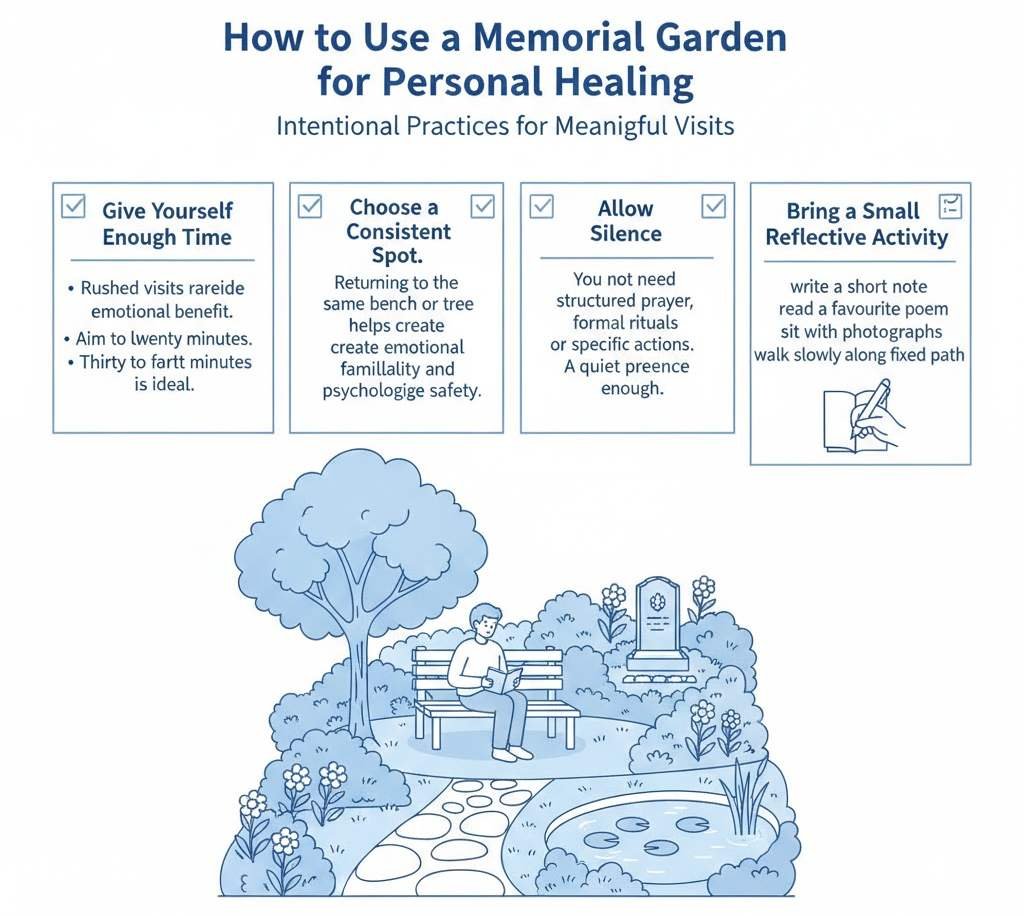
Many people visit memorial gardens without knowing how to use the space intentionally. A few simple approaches can make visits far more meaningful.
Give yourself enough time.
Rushed visits rarely provide emotional benefit. Aim for at least twenty minutes. Thirty to forty minutes is ideal.
Choose a consistent spot.
Returning to the same bench or tree helps create emotional familiarity and psychological safety.
Allow silence
You do not need structured prayer, formal rituals, or specific actions. A quiet presence is enough.
Bring a small reflective activity.
Some people find it helpful to:
- write a short note
- read a favourite poem
- sit with photographs
- walk slowly along a fixed path
These gentle activities help focus the mind while allowing emotions to surface safely.
Visit across seasons
Returning in winter, spring, summer, and autumn reinforces the powerful symbolic reminder that change and continuation coexist.
Growing Importance of Accessible Secular Memorial Spaces
One notable trend in the UK is the growing demand for memorial environments that are inclusive of all beliefs and backgrounds.
Not everyone feels connected to traditional religious burial grounds. Memorial gardens offer a neutral space that welcomes:
- religious families
- secular visitors
- multicultural communities
- mixed-belief households
This accessibility ensures Remembrance remains socially inclusive.
Modern British memorial planning increasingly prioritises:
- wheelchair accessibility
- quiet sensory-friendly zones
- clear signage
- public transport proximity
- safe evening lighting
These practical features make Remembrance both physically accessible and emotionally supportive.
Memorial Gardens as Living Symbols of Continuity
The most profound aspect of memorial gardens is their living nature.
Stone monuments remain unchanged. Gardens evolve.
A planted tree grows taller each year. A rose bush blooms, fades, and returns. Leaves fall and regrow. Wildlife nests, migrates, and returns.
This cycle subtly communicates a message that many grieving people need to experience rather than hear:
Life continues, and memory continues with it.
For many visitors, this realisation does not arrive suddenly. It develops slowly over repeated visits. One day, the garden feels heavy with loss. Months later, the same garden may feel comforting rather than painful.
The space itself has not changed dramatically. The visitor’s emotional relationship with it has.
That transformation is one of the quiet but powerful roles memorial gardens play in long-term healing.
Final Thoughts
Memorial gardens are far more than decorative public spaces. They are emotional infrastructure.
They support private grief, collective memory, national identity, and personal well-being simultaneously. In a society where time feels increasingly rushed and emotional processing often gets postponed, these calm green environments offer something deeply necessary: permission to pause and remember.
Whether created for national figures, local communities, or individual families, memorial gardens remind us that Remembrance need not be confined to a single ceremony or anniversary.
It can live quietly in a bench, a tree, a winding path, or a patch of sunlight moving slowly across the grass.
And sometimes, that quiet continuity is exactly what healing needs.