
If you have tried to book a GP appointment recently, you already know the feeling. You ring at eight in the morning, sit in a queue for twenty minutes, and are offered something a fortnight away for a problem you wanted sorting today. It is not that anyone is doing a bad job. General practice is under real strain, and that gap between needing something now and being seen later is exactly where online pharmacies and digital health services have quietly moved in.
For a lot of people this genuinely makes more sense than a morning in a waiting room. You can sort a repeat prescription, get a consultation, or ask for advice from your sofa, on your lunch break, or at eleven at night when the surgery is shut. The catch is that the online world contains both careful, properly regulated services and a long tail of sites that will sell you almost anything with no questions asked. Learning to tell those two apart is the single most useful skill you can bring to buying medicines online, so this guide focuses on exactly that.
What Actually Makes an Online Pharmacy Legitimate in 2026
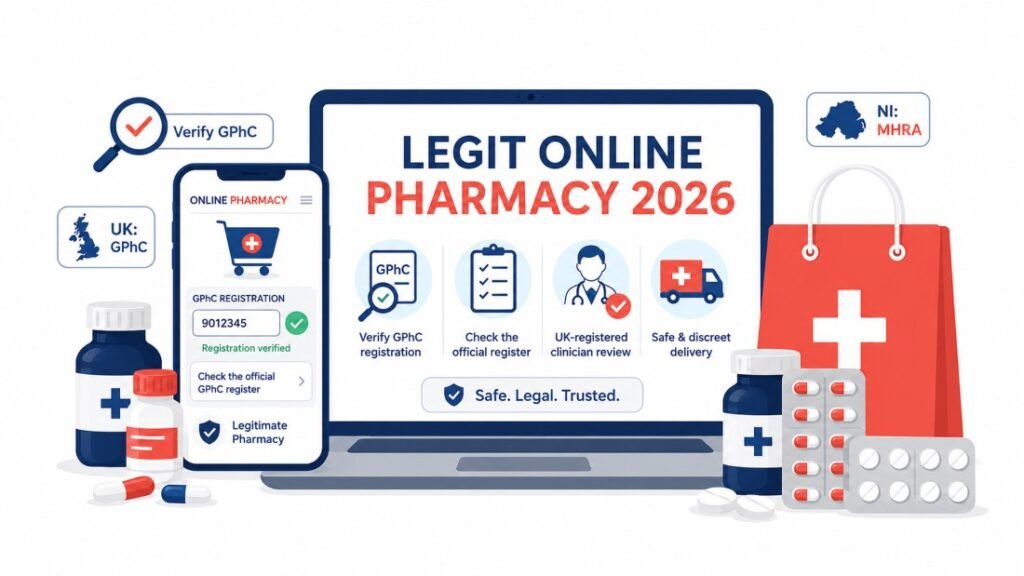
The foundation is registration with the General Pharmaceutical Council (GPhC), the regulator every legitimate pharmacy operating in Great Britain has to be on. Here is where a lot of older advice is now out of date. For years, people were told to look for the green GPhC internet pharmacy logo and click it. That voluntary logo scheme has closed, and the GPhC disabled it from its register at the end of December 2025. So the logo is no longer the thing to rely on.
What you should look for instead is the pharmacy’s GPhC registration number, usually in the website footer or the About Us section, and then verify it yourself. Take that number or the pharmacy name, search the GPhC register directly, and confirm the details match the site you are actually on. It takes about two minutes, and it is the closest thing there is to a guarantee. If a site has no registration number, or the details do not line up with the register, treat that as your cue to close the tab.
One quirk worth knowing if you are in Northern Ireland: the rules there differ slightly, and websites selling medicines to the Northern Irish public still use the MHRA Distance Selling Logo, with a separate MHRA register you can check. For England, Wales and Scotland, the GPhC register is the one that matters, and official government guidance now points GB shoppers to the GPhC rather than the old MHRA list.
Registration is the floor, not the ceiling. The better services also employ UK-registered clinicians who review your information before anything is dispensed. That is not box-ticking. It is the difference between a healthcare service and a shop that happens to sell prescription medicines. The IQ Doctor online pharmacy is one example of a GPhC-registered service run with a UK-based clinical team, covering a fairly broad range of areas from sexual health and weight management to hair loss and travel health, with clinician sign-off rather than a purely automated form. Whether it suits you depends entirely on what you need, and you can confirm its registration for yourself on the GPhC register in the same two minutes described above. That habit of checking, rather than trusting a brand name, is the point.
Why the Consultation Is Doing More Work Than You Think
It is tempting to see the online consultation as a formality: tick some boxes, get your medicine, done. For genuinely minor things it can feel that way. But for anything with a real clinical dimension, that questionnaire and the clinician reading it are doing the safety work that a rushed counter conversation sometimes cannot.
The regulator has taken this seriously. Since early 2025, GPhC guidance for pharmacies providing services at a distance has tightened the rules around higher-risk medicines, including stronger identity checks and a clear expectation that certain treatments should not be handed out on the back of an online questionnaire alone. A good service builds that in. A dodgy one skips it, which is precisely why the two can look similar on the surface and behave very differently once something goes wrong.
The Treatments Where Oversight Matters Most
Three common online categories show why the clinical layer earns its keep.
Weight loss is the obvious one right now. The injectable treatments that have been all over the news carry real contraindications rather than theoretical ones. Published safety reviews of semaglutide set out where caution is needed, including a personal or family history of medullary thyroid cancer, and the gastrointestinal and other effects that need monitoring. A proper consultation screens for that. A site flogging unlicensed imports does not, and that is a genuinely risky combination.
Erectile dysfunction is another. The standard tablets can interact dangerously with nitrate heart medicines. The pharmacology is not subtle: combining a PDE5 inhibitor with a nitrate can cause a severe, synergistic drop in blood pressure, which is why nitrate use is an absolute contraindication. This is exactly the kind of thing a clinician asks about and a careless form never will.
Then there are antibiotics, say for a urinary tract infection. Getting the wrong drug, or the wrong length of course, is not just ineffective for you. NICE guidance on treating lower UTIs exists partly to optimise antibiotic use and slow resistance, because the World Health Organization is clear that misuse and overuse of antibiotics are the main drivers of antimicrobial resistance. Casual online antibiotic sales work against all of that. The convenience is real, but only worth having when the clinical oversight is real too.
Who This Kind of Service Actually Suits
If you have a GP you see regularly and a good local pharmacy you trust, that setup already works, and you do not need to change it. Online pharmacies earn their place for specific situations.
They suit people dealing with something they find genuinely awkward to raise face to face, where the distance is a feature rather than a barrier. They suit people who work irregular or antisocial hours and cannot reach a surgery during opening times. They suit people in rural areas where getting to a chemist is a half-day expedition. And they suit the sizeable group who think more clearly when they can read information at their own pace and answer properly, rather than feeling the clock tick in a ten-minute appointment. That is a completely valid reason to prefer typing over talking.
It is also worth remembering that your local pharmacy has quietly expanded what it can do. Through Pharmacy First in England, community pharmacists can now assess and, where appropriate, treat several common conditions without a GP referral at all, which for some problems is faster than either a surgery or a website.
Where an Online Pharmacy Is the Wrong Tool
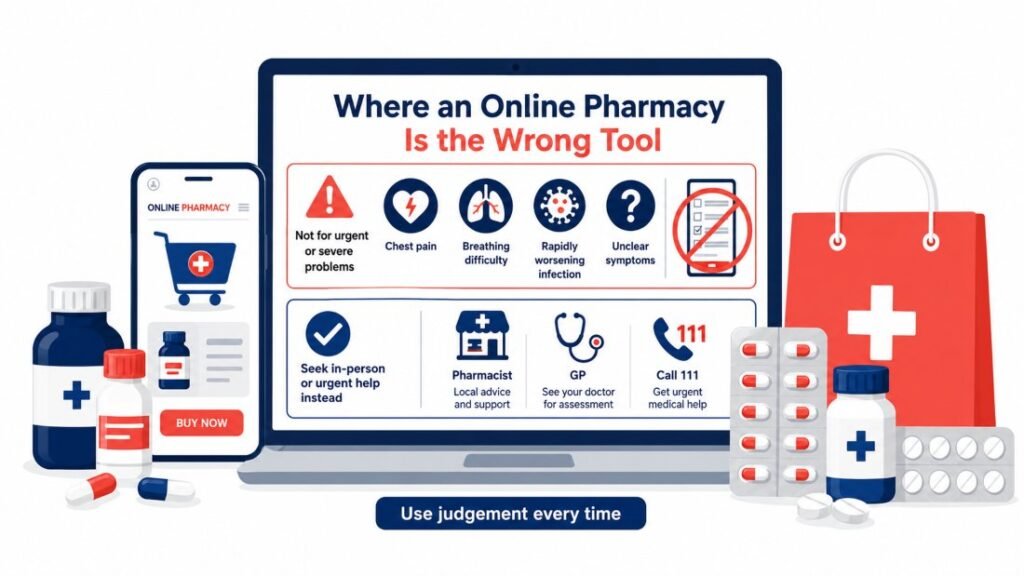
Some things do not belong online. Anything that genuinely needs a physical examination, and anything acute or severe that needs urgent assessment, should not be routed through a questionnaire. Sudden chest pain, breathing difficulty, a rapidly worsening infection, or symptoms you cannot make sense of are not tasks for a delivery service. If you are not sure which category your situation falls into, that uncertainty is itself the answer: speak to someone in person, whether that is your pharmacist, your GP, or NHS 111.
The honest, unglamorous conclusion is that access to healthcare has changed, and digital services are part of the landscape now, whether anyone likes it or not. The sensible response is neither to write the whole category off nor to adopt it uncritically, but to learn the few checks that separate the careful services from the careless ones, and to use that judgement every time.
Important Disclaimer
This article is general information for a UK audience and is not medical advice. It does not replace a consultation with a qualified healthcare professional, and no specific online pharmacy or treatment mentioned here is endorsed or recommended for your individual circumstances. Always verify a pharmacy’s registration on the GPhC register before using it, and speak to your GP or pharmacist before starting, stopping, or changing any medicine, especially if you take other prescription medication or have an existing heart, kidney, liver, or thyroid condition, or if you are pregnant or breastfeeding. If you have severe, sudden, or worsening symptoms, contact NHS 111, or call 999 in an emergency.
References
- General Pharmaceutical Council. Check registration for online health services. Available from: https://www.pharmacyregulation.org/patients-and-public/standards-you-can-expect-using-pharmacy-services/check-registration-online-health-services
- General Pharmaceutical Council. Registers. Available from: https://www.pharmacyregulation.org/registers
- General Pharmaceutical Council. Guidance for registered pharmacies providing pharmacy services at a distance, including on the internet (February 2025). Available from: https://assets.pharmacyregulation.org/files/2025-02/gphc-guidance-registered-pharmacies-providing-pharmacy-services-distance-february-2025.pdf
- GOV.UK. Check if a website can legally sell medicines online. Available from: https://www.gov.uk/check-medicines-online
- Medicines and Healthcare products Regulatory Agency. Medicine seller register. Available from: https://medicine-seller-register.mhra.gov.uk/
- Smits MM, Van Raalte DH. Safety of semaglutide. Front Endocrinol (Lausanne). 2021;12:645563. doi:10.3389/fendo.2021.645563
- Kloner RA, Goggin P, Goldstein I, Hackett G, Kirby MG, Osterloh I, et al. A new perspective on the nitrate-phosphodiesterase type 5 inhibitor interaction. J Cardiovasc Pharmacol Ther. 2018;23(5):375-386. doi:10.1177/1074248418771896
- National Institute for Health and Care Excellence. Urinary tract infection (lower): antimicrobial prescribing. NICE guideline NG109. Available from: https://www.nice.org.uk/guidance/ng109
- World Health Organization. Antimicrobial resistance (fact sheet). Available from: https://www.who.int/news-room/fact-sheets/detail/antimicrobial-resistance