
A tidy home is not about perfection. Most people do not live in magazine rooms, especially in the UK, where everyday homes often include narrow hallways, box rooms, shared cupboards, small kitchens, limited loft space, and the usual pile of coats, school bags, shoes, post, chargers, tools, paperwork, toys, and seasonal items.
The real aim is simpler: to make your home easier to live in.
Good organisation helps you find what you need, keep cleaning manageable, reduce waste, and make better use of the space you already have. This matters even more now that many UK households use the same rooms for work, rest, family life, storage, exercise, and hobbies. A kitchen table might also be a desk. A spare room might be part office, part laundry area, part guest space. A hallway might have to cope with muddy shoes, parcels, pushchairs, dog leads, and recycling bags.
When a home has no clear system, clutter builds quickly. Being surrounded by clutter can be a disaster for our mental well-being, but the solution is not always a huge clear-out or expensive fitted furniture. More often, it starts with better decisions, better zones, and habits that are realistic enough to survive normal life.
Start With Purpose, Not Panic
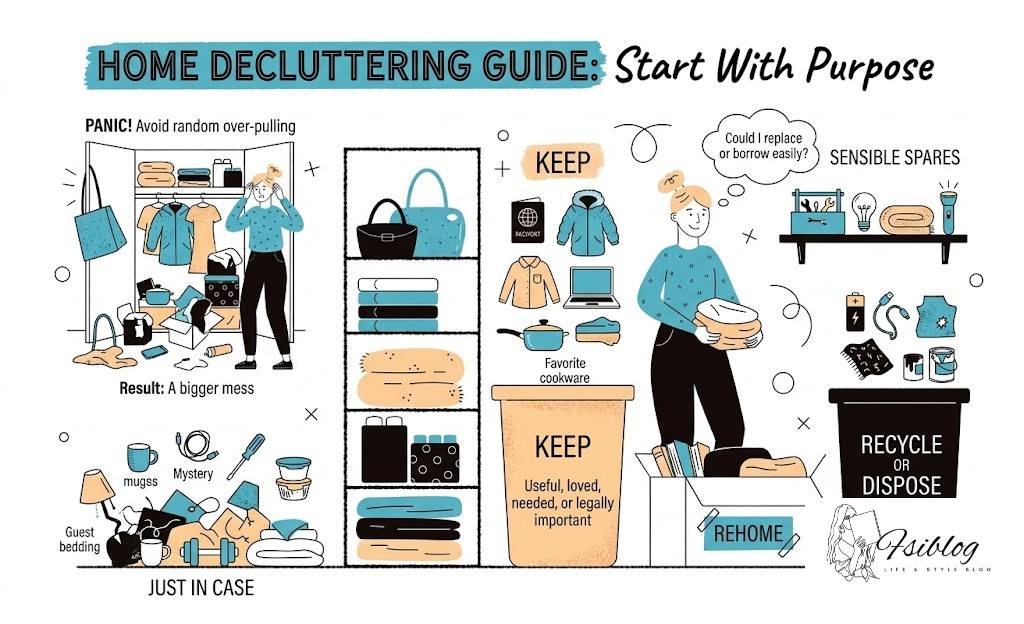
The worst way to declutter is to start randomly. Pulling everything out of cupboards can feel productive for the first hour, then overwhelming by lunchtime. The result is often a bigger mess than before, with bags half-filled, piles abandoned, and decisions delayed.
A better approach is to begin with one area that causes daily friction. That might be the hallway, kitchen worktop, bedroom floor, under-stairs space, airing cupboard, utility area, or the chair that has quietly become a second wardrobe.
Use The Three-Decision Method
Instead of asking, “Should I keep this?” ask, “What role does this item play in my life now?”
Most household items fall into three useful groups:
| Decision | What It Means | UK Example |
|---|---|---|
| Keep | Useful, loved, needed, or legally important | Passport, winter coat, work laptop, favourite cookware |
| Rehome | Still usable, but not needed by you | Clothes for a charity shop, books for a school fair, furniture for a local reuse group |
| Recycle or dispose | Broken, expired, unsafe, or no longer usable | Old batteries, damaged cables, worn-out textiles, empty paint tins |
This stops decluttering from becoming emotional guesswork. It also reduces the chance of simply moving clutter from one cupboard to another.
Be Honest About “Just In Case” Items
UK homes are full of “just in case” items: spare mugs, mystery cables, old paint, duplicate screwdrivers, carrier bags, takeaway tubs, broken lamps, unused fitness equipment, and bedding for guests who never stay.
Some spares are sensible. A basic tool kit, spare light bulbs, a winter blanket, and emergency supplies have value. But keeping too much for imaginary future situations can make your present home harder to use.
A useful question is: “Could I replace or borrow this easily if I genuinely needed it?” If the answer is yes, and you have not used it for years, it may not deserve prime storage space.
Declutter Responsibly In The UK
A good clear-out should not simply push the problem elsewhere. Disposal has a cost, both financially and environmentally. Many councils charge for bulky waste collections, recycling rules vary by local authority, and illegal dumping remains a serious issue across the country.
Know Where Different Items Should Go
Before filling bin bags, check your council’s website for local rules. The details differ across England, Scotland, Wales, and Northern Ireland, and even between neighbouring councils.
Common options include:
| Item Type | Better Route Than General Waste |
|---|---|
| Good-quality clothes | Charity shop, clothes bank, local community group |
| Usable furniture | Furniture reuse charity, online collection listing, council reuse scheme |
| Electrical items | WEEE recycling point, retailer take-back scheme, council recycling centre |
| Batteries | Supermarket battery recycling bins |
| Paint and chemicals | Household waste recycling centre guidance |
| Books and toys | Charity shop, school fair, library sale, local parent group |
Do not leave items outside charity shops when they are closed. It may seem helpful, but it can create extra work, weather damage, and sometimes waste collection costs for the charity.
Sell, Donate, Or Reuse With Care
For larger items, local reuse networks can be very effective. A table, cot, wardrobe, desk, or shelving unit that is awkward for you might be perfect for another household. British Heart Foundation, Emmaus, local hospice shops, community Facebook groups, Freecycle-style platforms, and council reuse schemes can all help extend the life of usable items.
Before donating, check the condition. If something is broken, unsafe, missing key parts, damp, or heavily stained, it may not be suitable. Passing poor-quality items to charities can create disposal costs for them.
Create Zones That Match Real Life
A home becomes easier to organise when every item has a logical home. This does not mean every drawer needs labels. It means your storage should match how you actually live.
In many UK homes, clutter gathers where life changes pace: the front door, the kitchen, the sofa area, the bedroom, and the stairs. These are the places where people put things down because they are tired, busy, carrying shopping, rushing to school, or switching from work mode to home mode.
Build Zones Around Daily Routines
Think about what happens in each space.
The hallway may need a shoe zone, coat hooks, a small tray for keys, and a place for letters. The kitchen may need a breakfast zone, lunchbox zone, cleaning zone, and recycling zone. A living room may need a charging spot, a remote-control basket, toy storage, or a paperwork folder. A bedroom may need a laundry system that is easier than “the floor.”
This sounds simple, but it works because it follows behaviour rather than fighting it.
Make Open-Plan Living Less Chaotic
Open-plan homes can look spacious, but they can also blur boundaries. When the kitchen, dining area, work space, and sitting area all share one room, clutter spreads quickly.
Use furniture to create quiet boundaries. A sideboard can mark the dining area. A rug can define the sitting area. A small desk tidy can keep work items from taking over the table. A closed cabinet can hide paperwork at the end of the day, which is especially useful when work and home life happen in the same room.
The aim is not to make each zone rigid. It is to make each activity easier to start and easier to tidy away.
Use Awkward Spaces Properly
Most UK homes have at least one awkward area: under the stairs, alcoves beside a chimney breast, a sloped loft corner, a narrow landing, a box room, or dead space above wardrobes. These spaces often become dumping grounds because they have no clear purpose.
Handled well, they can become some of the most useful storage in the house.
Under-Stairs Storage Can Change The Whole Hallway
The space beneath the stairs is often wasted, especially in terraced and semi-detached homes. It might hold coats, shoes, cleaning products, tools, bags, seasonal decorations, or a mix of everything.
A cupboard for the awkward space beneath the stairs might be extremely beneficial because it gives the mess a defined boundary. Even simple shelving, hooks, labelled boxes, or pull-out storage can turn a chaotic corner into a practical household hub.
For safety, avoid storing flammable materials, overloaded extension leads, or loose items that could fall into walkways. If the space includes meters, fuse boxes, or pipes, make sure access remains clear.
Make Alcoves Work Harder
Alcoves are common in older British homes. They can look charming, but without planning, they often collect random baskets, books, cables, and ornaments.
Fitted shelves, a low cabinet, or a desk built into an alcove can make the space useful without taking up much floor area. If you rent, freestanding shelving can be a safer choice than permanent fixtures. Always check tenancy rules before drilling into walls.
Do Not Forget Vertical Space
Small homes need vertical thinking. Wall-mounted shelving, tall bookcases fixed safely to the wall, over-door hooks, peg rails, and high cupboards can all free up floor space.
The key is to store lighter, less-used items higher up and keep daily items within easy reach. Heavy boxes above head height are a safety risk and make tidying harder, not easier.
Choose Storage That Reduces Future Clutter
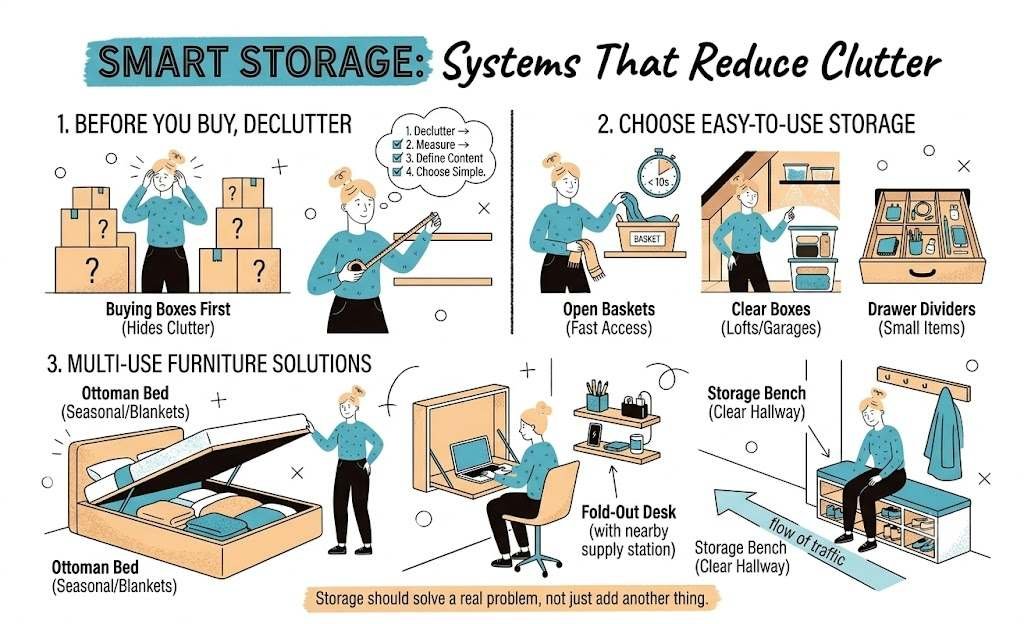
Storage is useful only when it supports better habits. Buying more boxes without reducing belongings can hide clutter rather than solve it.
Before buying storage, declutter first. Measure the space. Decide what the storage needs to hold. Then choose the simplest item that does the job.
Good Storage Is Easy To Use
If a storage system is too complicated, people stop using it. This is especially true in busy family homes.
Open baskets work well for children’s toys, scarves, hats, and everyday shoes. Clear boxes can help in lofts and garages because you can see what is inside. Drawer dividers help with small items. Stackable crates can work in utility areas, but only if they are not so deep that things disappear at the bottom.
A good test is whether you can put something away in less than ten seconds. If you cannot, the system may be too fussy for daily life.
Multi-Use Furniture Helps Small Homes
Ottoman beds, storage benches, fold-out desks, nesting tables, and sofa beds can all be useful in flats, maisonettes, and compact houses. But they should be chosen carefully.
A storage bed is helpful for spare bedding or seasonal clothing, but not for items you need every morning. A bench with hidden storage can work well in a hallway, but only if it does not block movement. A fold-out desk can be excellent for hybrid workers, but it still needs a nearby place for stationery, chargers, and paperwork.
Furniture should solve a real problem, not simply add another thing to the room.
Keep Paperwork Under Control
Paper clutter is one of the easiest problems to ignore. Bank letters, school forms, NHS letters, receipts, insurance documents, pension paperwork, warranties, manuals, and council tax notices can quickly take over drawers and kitchen sides.
Set Up A Simple Paper System
Create three places:
| Paper Type | Where It Should Go |
|---|---|
| Needs action | A visible tray or folder |
| Important to keep | A labelled file box or folder |
| Not needed | Recycling or shredding |
Deal with the post near the door or kitchen, not weeks later when it has become a pile. Keep documents such as passports, birth certificates, tenancy agreements, mortgage paperwork, insurance details, and medical letters in a secure, consistent place.
For privacy, shred anything with sensitive personal or financial details before disposal.
Build Habits That Keep Order Long Term
Organisation fails when it depends on one big annual clear-out. Real homes need small routines that fit into normal life.
Use The “Reset Point” Method
Pick one or two reset points in the day. For example, spend five minutes clearing the kitchen after breakfast, or ten minutes resetting the living room before bed. This stops the mess from becoming a weekend job.
The reset point works because it is small. You are not reorganising the whole house. You are simply returning key items to their zones.
Try A One-In, One-Out Rule
For categories that easily grow, such as clothes, mugs, toys, books, toiletries, and kitchen gadgets, use a one-in, one-out rule. When something new comes in, something old leaves.
This is especially useful after birthdays, Christmas, sales shopping, school changes, home moves, or starting a new hobby.
Review Seasonal Items Twice A Year
UK homes often need seasonal storage: winter coats, school uniforms, Christmas decorations, garden cushions, fans, heaters, sports kit, and holiday items.
Review these in spring and autumn. If something was not used all season, ask whether it is worth keeping. Store what remains in labelled containers, and keep damp-sensitive items away from cold or poorly ventilated areas.
Final Thoughts
An organised home is not a home with no personality. It is a home where everyday life feels less difficult. The goal is to reduce friction: fewer lost keys, fewer stressful mornings, fewer overfilled cupboards, fewer duplicate purchases, and fewer weekends lost to sorting out mess that could have been prevented.
Start small. Choose one problem area. Make clear decisions. Give items a proper place. Use awkward spaces wisely. Build habits that match the way your household actually lives.
You do not need a perfect home to feel more in control of it. But getting it right means getting started!