
The thing that catches most British visitors off guard in Iceland is not the waterfalls. It is the emptiness. You can drive for half an hour on good tarmac without passing a hedge, a pylon, a farm shop or another car, and the land just keeps unrolling. After a lifetime of British geography, where every lay-by looks across at somewhere else and the next village is eleven minutes away, that scale takes a day or two to settle into.
Then something loosens. You stop checking the clock against the itinerary, stop treating the drive as the dull bit between attractions, and start pulling over because the light has turned the moss a colour you have no word for. That shift is the whole argument for seeing Iceland by road rather than by coach seat. For travellers who want the days shaped by weather and curiosity instead of a booking confirmation, a self-drive trip with a company like Cozy Campers puts the decisions back in your hands.
Why Iceland Rewards Drivers Who Slow Down
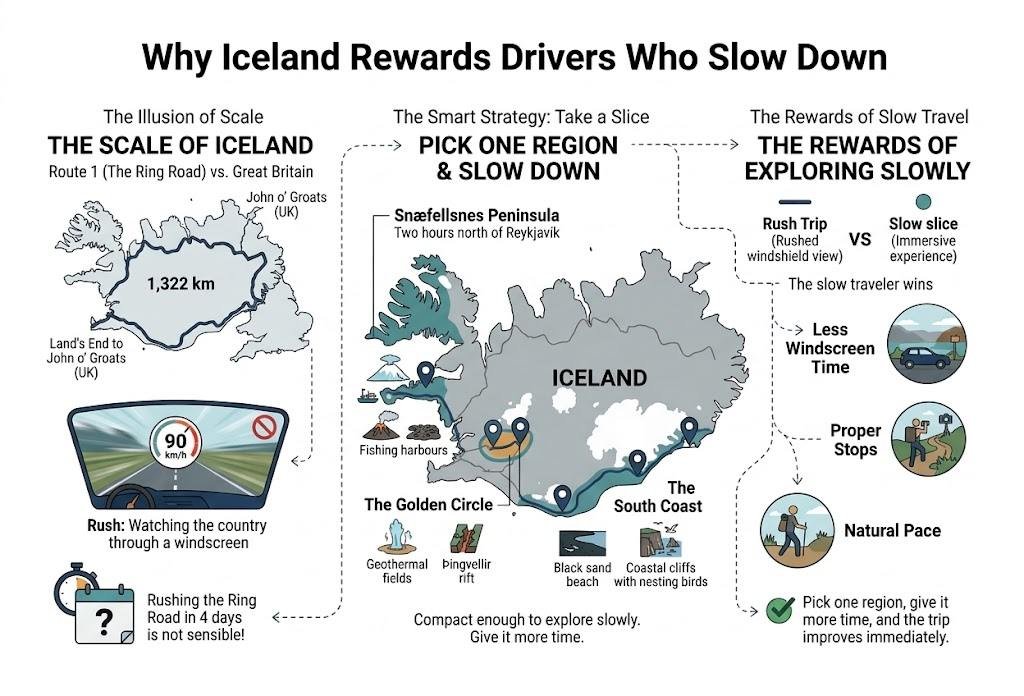
It helps to get the scale straight early, because maps of Iceland lie to the British eye. The Ring Road, Route 1, runs roughly 1,322 kilometres around the island, which makes it a little shorter than driving from Land’s End to John o’ Groats. Nobody sensible attempts that in four days with stops, yet visitors routinely try the Icelandic equivalent and spend the week watching the country through a windscreen at 90 kilometres per hour.
The better approach is to take a slice. The Golden Circle is the obvious opener, with its geothermal fields and the tectonic rift at Þingvellir, and it works precisely because it is compact enough to do slowly. The south coast delivers black beaches and cliffs full of nesting birds. Snæfellsnes, two hours north of Reykjavík, packs fishing harbours, lava fields and a glacier-topped volcano into a peninsula you can circle comfortably in a long day. Pick one region, give it more time than you think it needs, and the trip improves immediately.
British Practicalities Worth Sorting First
Getting there is the easy part. Keflavík is around three hours from London and closer to two and a half from Glasgow or Edinburgh, which puts Iceland nearer than plenty of Mediterranean resorts and makes a five-day trip genuinely viable rather than a stretch.
The paperwork has changed since the days of a quick passport stamp. Iceland sits inside the Schengen area, so British passports now go through the EU’s biometric border checks under the Entry and Exit System, which became fully operational in April 2026 and records a facial image and fingerprints in place of a stamp. The separate ETIAS travel authorisation has not launched yet, so there is nothing to apply for at the time of writing, but the 90-days-in-any-180 rule applies and your passport needs to have been issued within the previous ten years. It is worth reading the Foreign Office guidance for Iceland shortly before you fly, since entry requirements and volcanic activity updates both land there first.
A few small things smooth the first day. Iceland stays on GMT all year, so through British Summer Time it is an hour behind home and in winter it matches. Sockets are European two-pin, so pack an adapter. Cards are accepted almost everywhere, including at unstaffed fuel pumps, but many of those pumps want a PIN rather than a contactless tap, so make sure you know yours before you are standing in horizontal rain at a petrol station outside Vík.
Why A Camper Changes The Rhythm Of The Trip
Where you sleep quietly dictates how you travel. Book a chain of guesthouses and every day acquires a deadline and a destination, which is exactly the thing a British working year already supplies in abundance. Fold the bed into the vehicle and the calculation changes. You can stay at a headland until the light goes, cook pasta while the wind rocks the van, and decide the next morning whether to push east or double back.
The practical upside matters too. Outside the south-west, shops and kitchens thin out fast, and carrying your own breakfast, flask and emergency biscuits removes a real constraint. If your route takes in gravel, interior tracks or the highland F-roads, the vehicle choice stops being about comfort and becomes a question of ground clearance and traction, which is where 4×4 camper rentals in Iceland earn their keep. F-roads are legally restricted to four-wheel-drive vehicles, typically open only from late June until early autumn, and standard insurance generally excludes river crossings, so read the rental terms properly rather than optimistically.
One rule is non-negotiable. Since changes to Iceland’s nature protection law in 2015, sleeping in a camper outside a registered campsite or without the landowner’s explicit permission is prohibited, and the supermarket car park is not a loophole. This is less of a hardship than it sounds, as there are over 200 campsites across the country and the directory at tjalda.is shows which are open in shoulder season. Fines exist, but the better reason to comply is that Icelandic topsoil and moss recover over decades, not summers.
Roads That Do Not Behave Like British Roads
Driving on the right is the adjustment everyone anticipates. The ones that catch people out are smaller. Single-lane bridges, signed einbreið brú, require you to work out who arrived first and yield accordingly. Blind summits, signed blindhæð, hide oncoming traffic entirely. Tarmac turns to loose gravel without ceremony, and braking hard on that transition is how a good proportion of hire-car claims begin. Sheep wander onto carriageways with total confidence. Driving off marked roads is illegal everywhere in the country, with no exceptions for a better photograph.
Check live road conditions on umferdin.is every single morning, not just before long drives. The Icelandic Road and Coastal Administration colour-codes each segment, and a route that was clear at breakfast can close by lunchtime. Satellite navigation will cheerfully route you down a track that is shut.
Wind deserves its own warning. Icelandic gusts regularly exceed anything a British driver has handled, and they do not announce themselves with the usual visual cues of a stormy day. The most common and most expensive mistake is opening a car door into a gust strong enough to bend it backwards, which standard policies often will not cover. Official guidance on travelling in high winds and poor surface conditions is blunt about when to simply stay put, and taking it seriously is the mark of a competent visitor rather than a timid one.
Planning Around The Weather Rather Than Against It
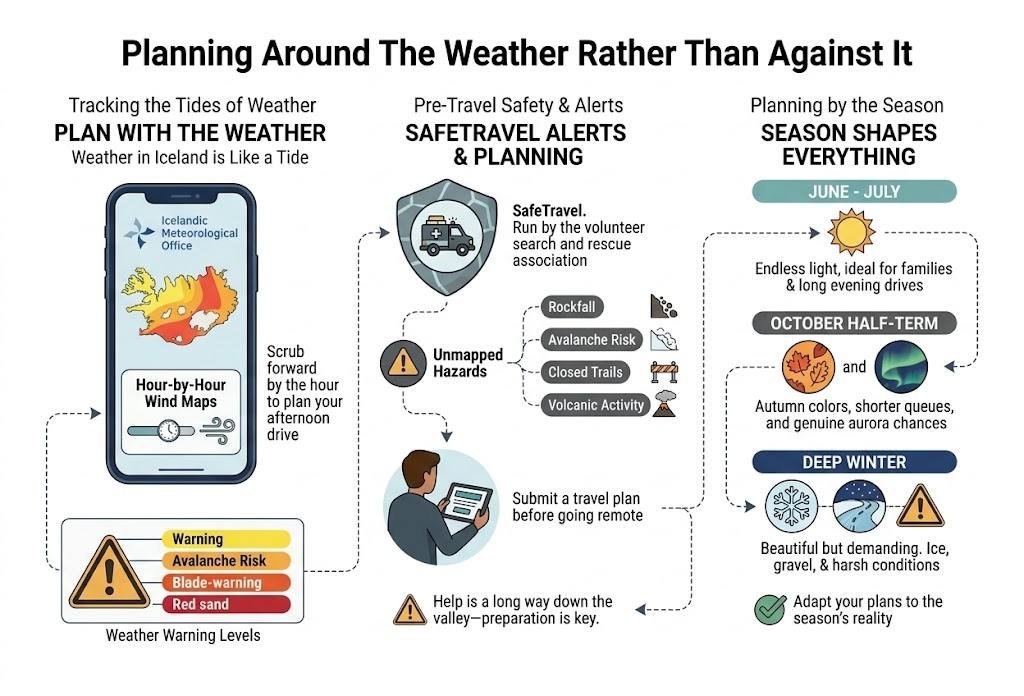
Think of Icelandic weather less like a forecast and more like a tide: something you time your movements around. The Icelandic Meteorological Office publishes the forecasts and the colour-coded warnings that locals actually plan by, including wind maps you can scrub forward by the hour to see what your afternoon drive will involve.
Alongside it, SafeTravel, run by Iceland’s volunteer search and rescue association, carries alerts that never reach the road map, covering rockfall, avalanche risk, closed trails and volcanic activity, and lets you file a travel plan before heading anywhere remote. Anyone who has walked a Scottish Munro in changeable conditions will recognise the logic instantly. The difference is that in Iceland the nearest help may be a very long way down the valley.
Season shapes everything else. June and July bring light that barely fades, which suits families tied to the summer holidays and makes long evening drives a pleasure. October half-term lands in a lovely window of autumn colour, shorter queues and a genuine chance of aurora, which is far more reliable this far north than the occasional display visible from Caithness or Shetland. Deep winter is beautiful and demanding in equal measure, and it is not the season to be learning gravel roads.
Places Worth Building A Trip Around
The famous sights deserve their reputations. Gullfoss is impressive in filthy weather and arguably better for it. Geysir’s neighbouring spout, Strokkur, performs every few minutes. Seljalandsfoss can be walked behind, and Skógafoss can be climbed beside. At Reynisfjara, the black sand beach near Vík, stay well back from the water, as the waves there are genuinely dangerous and have caused deaths.
Further east, the glacier lagoons and ice caves of Vatnajökull National Park cover a vast share of the country and reward a full day rather than a photo stop. Yet the memory most British visitors bring home is usually smaller. It tends to be the municipal swimming pool in a town of 600 people, where you shower properly without a swimsuit before entering, as the signs firmly instruct, then sit in a hot pot at nine in the evening listening to locals argue about football. It costs a few pounds and tells you more about Iceland than any viewing platform.
Leaving Room For The Unplanned
The temptation, having spent money on flights and a vehicle, is to extract maximum value by filling every hour. Iceland punishes that instinct. Weather closes roads, light changes plans, and the best half hour of the holiday is usually one that was never on the list.
Plan three or four things you would be disappointed to miss. Check the forecast and the road map each morning. Build in a spare day that belongs to nobody. Then let the island decide the rest, and come home with something better than a completed checklist.
Disclaimer: This article is for general travel information only. Driving conditions, road closures, weather warnings, entry requirements, and campsite availability can change quickly. Check official Icelandic travel and road safety sources before departure, follow local driving regulations, and confirm your rental vehicle’s insurance coverage and restrictions before travelling.