
At 7.10 on a wet Thursday evening, I pressed play on what was supposed to be the most personal part of my sister’s birthday video. Her photographs moved across the television screen, the candles on the cake were already lit, and twelve relatives had gone unusually quiet.
Then the singer began.
“You light up every room, you make our dreams come true…”
My sister smiled politely. My mum looked at me as though she was waiting for the real Song to start. By the time the chorus repeated the word “special” for the fourth time, my nephew had returned to his crisps.
The track sounded polished enough. The voice was clear, the melody was pleasant, and the arrangement would not have seemed out of place beneath an advert for a family mobile-phone plan. It simply had nothing to do with my sister.
I had spent an entire evening making a Song for her and somehow produced a Song for nobody.
I Mistook a Musical Style for a Personal Story
My first prompt had felt sensible when I wrote it:
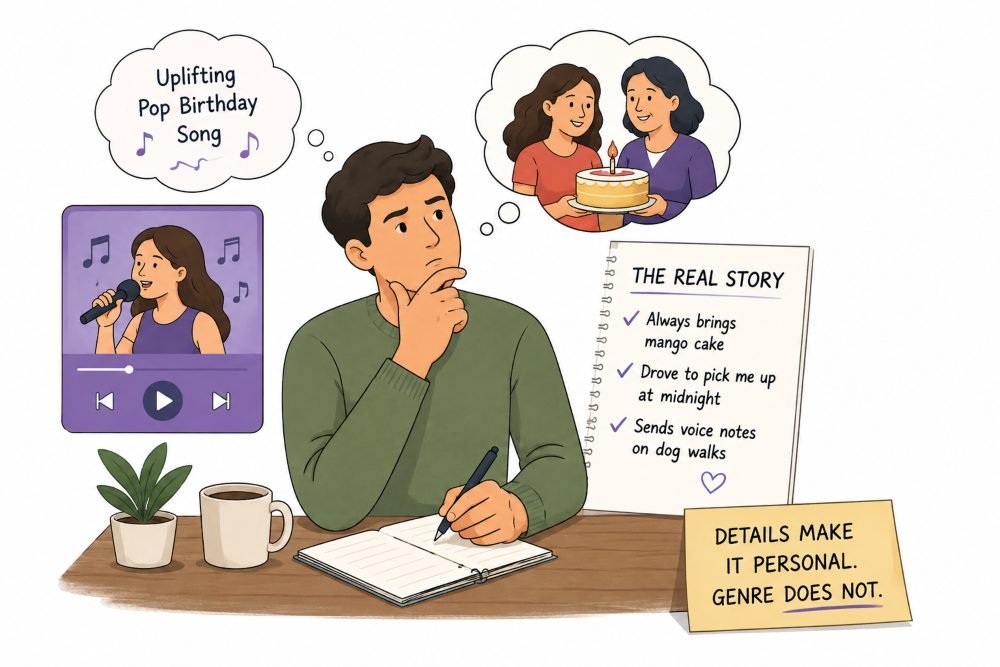
Create an uplifting pop birthday Song for an older sister who is kind, funny and loved by her family.
I selected a cheerful style, requested a female vocal and waited for the system to do the difficult work. I assumed the personal part was already covered because I had included the words “older sister”.
That was my first mistake.
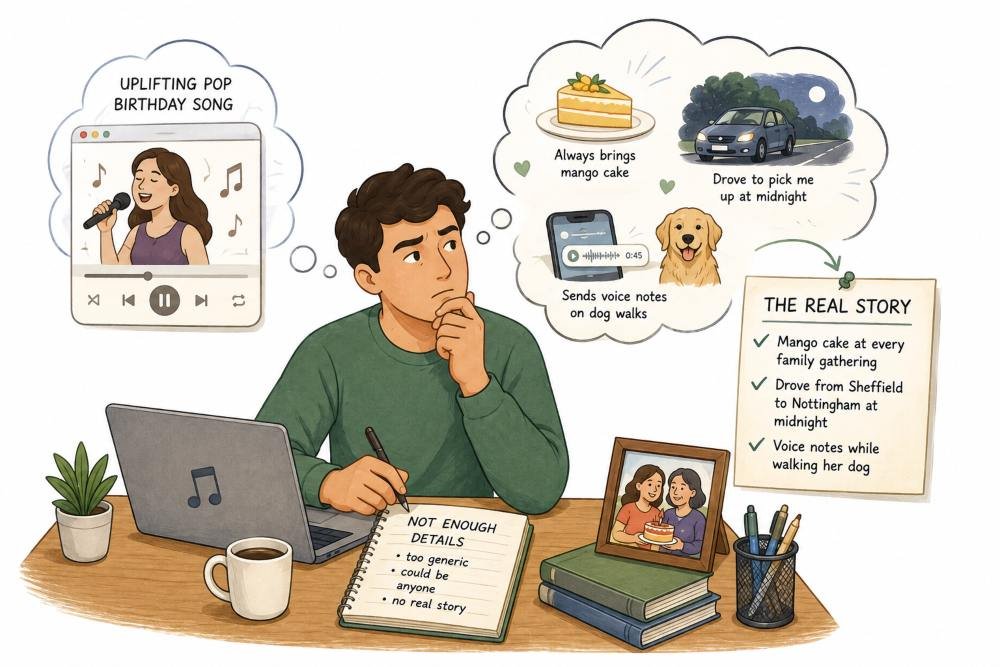
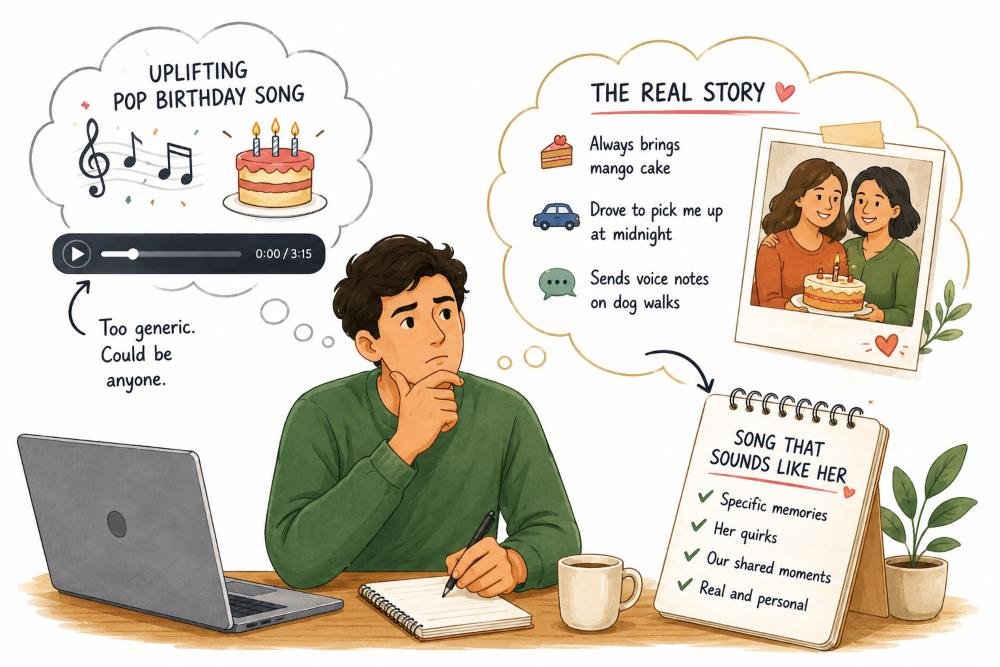
The software had no way of knowing about the mango cake she brings to every family gathering, even when nobody asks her to. It did not know that she once drove from Sheffield to Nottingham at nearly midnight because I had missed the final train. It had never heard the voice notes she sends while walking her dog, complete with traffic noise, heavy breathing and half-finished thoughts.
Those were the details that made her recognisable. I had kept them out because they seemed too ordinary.
Research into music-evoked autobiographical memories has found that music can act as a powerful cue for vivid, personally meaningful memories. My failed Song did the opposite. It removed the memories and kept only the music.
I had treated genre as the main creative decision. It was not. Genre could control the surface of the track, but it could not supply the life underneath it.
Tool Had Followed My Instructions
The morning after the birthday, I opened the project again with the slightly unreasonable anger people often direct at technology when it exposes their own vague thinking.
I listened to the opening verse twice. Every line was technically connected to my prompt. My sister was described as kind. The family loved her. The mood was uplifting. The track was pop.
Nothing had malfunctioned.
I had asked for broad praise and received broad praise.
That realisation was uncomfortable because it removed the easiest explanation. I could not blame a broken feature, poor audio or an ignored instruction. The system had done exactly what I had requested. My brief was the weak part.
There is a useful distinction here that I had missed: a tool can generate a complete Song without understanding the emotional reason for making it. It can arrange words, melody, vocals and instruments, but it cannot decide which memory deserves to become the chorus.
That remains the writer’s responsibility, even when the writer has never produced music before.
My Second Attempt Began on Paper
A few weeks later, one of my closest colleagues announced that he was leaving after five years. Someone suggested another photo montage, and I immediately remembered the birthday Song.
This time, I did not begin by choosing a genre.
I took a sheet of paper and wrote three sentences:
He bought terrible vending-machine coffee every Monday and insisted it was “not that bad”.
He remained calm during a website failure that had the rest of us refreshing the same page every ten seconds.
He had a habit of fixing the office printer by opening every tray, closing every tray and claiming he had used “advanced engineering”.
Those notes gave me more than my first polished prompt ever had.
When I moved to AI Song and opened the more controlled options in the AI Music Generator, I was no longer asking the software to invent the meaning. I already knew what the Song was about. The tool’s job was to help shape that meaning into music.
The platform’s guide separates a simpler description-led workflow from a custom approach that allows greater control over lyrics and structure. That difference mattered because this Song depended on exact details rather than a general mood.
I wrote the first verse myself. It was not clever:
Monday coffee from the machine,
You said it tasted fine.
We watched you take one careful sip,
Then leave the cup behind.
The rhyme was obvious, but it sounded like us. Nobody else’s farewell Song would contain that cup of coffee.
Details Worked Because They Were Small
The improved track was not more personal because I had added dramatic declarations. It became personal because I stopped trying to make the colleague sound extraordinary.
The failed birthday Song had used words such as “inspiring”, “wonderful” and “one of a kind”. Those compliments were pleasant but empty. They asked the listener to accept my judgement without giving any evidence.
The farewell Song used a broken printer.
That ordinary object carried five years of shared frustration, repeated jokes and office routine. One line could bring back a whole set of memories because the people hearing it already knew the story.
This changed how I thought about personal creative work. Specificity does not require exposing someone’s deepest secrets. It usually means choosing one harmless detail that belongs unmistakably to them.
I now avoid feeding unnecessary private information into any online creative service. The Information Commissioner’s Office guidance on data minimisation expresses the principle clearly: use only the personal information needed for the purpose. Although that guidance is written for organisations handling data, it is a sensible rule for individual users too.
A nickname, a shared joke and a familiar habit may be enough. A home address, medical detail, private argument or full account of somebody else’s life probably is not.
Control Became More Valuable Than Speed
My first attempt had felt impressive because the track appeared quickly. I entered a short request and received something that sounded finished.
That speed discouraged me from questioning it.
A polished result creates a strange pressure to accept what is already there. Changing one line can feel like interfering with a completed production, even when that line is wrong. I had to remind myself that a generated Song was still a draft.
For the farewell track, I listened to the words before judging the vocal or instrumentation. One verse made the office closure sound like a major personal tragedy. Another invented a reference to “chasing dreams beneath the city lights”, although our colleague was leaving to work from home in Derby.
I removed both.
I also read each line aloud. That exposed phrases I would never say in a normal conversation. Words such as “destiny”, “eternity” and “our shared journey” sounded large on the screen but false in my mouth.
The strongest version used simpler language. It was warm without pretending that a colleague changing jobs was the ending of a film.
That experience taught me to judge these tools less by the first audio they produce and more by the control they allow afterwards. Can I revise the lyrics? Can I change one section without losing the useful parts? Can I keep track of previous versions? Can I understand what rights I have over the result?
Those questions are less exciting than hearing the first chorus, but they matter more once the Song is intended for real people.
I Had Not Thought About Rights or Public Sharing
The birthday video stayed inside our family WhatsApp group, but the farewell Song was going into a public social post. That difference forced me to read beyond the creation screen.
The UK’s basic copyright guidance for music and sound recordings helped me understand that a Song is not one simple object. Lyrics, musical composition and the sound recording can involve separate rights.
AI makes those questions less settled, not more. The UK government’s report on copyright and artificial intelligence discusses the continuing uncertainty around AI-generated material, including computer-generated works, training data and the different elements protected within a Song.
I am not a lawyer, and I do not claim to be one based on reading one government page. It did, however, change my behaviour. I began checking a platform’s current terms before publishing or using a track commercially rather than assuming that “generated by me” automatically meant “fully owned by me”.
The wider music industry is also asking difficult questions about consent, attribution and payment. The Musicians’ Union briefing on AI-generated music explains concerns from working musicians, while UK Music’s principles for artificial intelligence focus on consent, transparency, proper record-keeping, attribution and fair compensation.
The discussion is not simply “humans against technology”. The more useful distinction is between technology that supports a person’s creative choices and systems that weaken the rights or recognition of the people whose work made those systems possible.
PRS for Music makes a similar distinction in its discussion of how AI is shaping music, including the difference between assistive and generative uses and the importance of transparency when AI is involved.
For a private birthday joke, some of these issues may feel distant. For a business video, monetised channel, advert, podcast or public release, they are part of choosing the tool responsibly.
Where creators genuinely own the necessary rights and want to permit wider reuse, the Creative Commons licence chooser can help them consider how others may share or adapt their work. It does not solve ownership questions, but it is useful once those questions have already been settled.
Moment the Second Song Worked
We played the farewell track during our colleague’s final afternoon. There was no television, decorated room or carefully timed reveal. Someone connected a laptop to a small office speaker that crackled whenever the volume went above halfway.
The opening lines mentioned the vending-machine coffee.
He laughed before the melody had properly settled.
When the printer line arrived, three people joined in because they had already seen the lyrics. The singing was poor, the timing was worse, and one person came in early on every chorus.
It was considerably more moving than the birthday track.
The difference was not production quality. The second Song gave people somewhere to place themselves. They knew the desk, the coffee, the broken printer and the stressful deadline. The music did not instruct them to feel nostalgic. It returned their own memories to them and let the feeling arrive naturally.
Afterwards, my colleague asked for the audio file. He did not praise the mix or ask which model had created the vocal. He said, “I’d forgotten about that coffee.”
That was the response I had been trying to manufacture the first time. It only appeared when I stopped trying to manufacture it.
Final Note
I blamed the software for my birthday Song because admitting the truth was less comfortable. I had wanted a personal result without doing the personal part.
The tool had not attended our family holidays, waited beside me at a deserted station or listened to my sister’s midnight voice notes. I had those memories and chose not to use them. Instead, I supplied three safe adjectives and expected technology to find the emotional centre on my behalf.
I still use generated music as a starting point. I simply no longer confuse a finished-sounding track with a finished piece of communication.
The music can arrive quickly. Meaning usually takes a little longer.