
If there is one thing most parents can agree on, it is that sleep is precious. From the bleary-eyed newborn stage through to the years of early morning school runs, getting a decent night of rest can feel like an impossible dream. But sleep is far more than just a luxury. It is a fundamental pillar of health for every member of the family, and understanding why it matters can help you make it a genuine priority rather than an afterthought. This guide covers the science, the practical steps, the warning signs, and everything in between.
Science Behind Why We Need Sleep
Sleep is when the body does its most essential repair work, and the processes that happen during those hours affect virtually every system in the body. Here is what is actually happening while your family sleeps:
- The brain consolidates memories and processes the events of the day, which is why children who sleep well tend to retain what they learn at school far more effectively than those who do not.
- Growth hormone is released during deep sleep, making adequate rest genuinely essential for children’s physical development, not just their mood.
- The immune system uses sleep time to produce cytokines, the proteins it needs to fight infection and inflammation. Consistently short sleep weakens immune defences in ways that no supplement fully compensates for.
- The cardiovascular system experiences a period of lower blood pressure and reduced heart rate during sleep, which is why chronic sleep deprivation is linked to higher rates of heart disease and stroke.
- Appetite-regulating hormones reset overnight. When sleep is cut short, levels of ghrelin (which increases hunger) rise and leptin (which signals fullness) falls, which is why tired people tend to reach for higher-calorie foods the next day.
- Emotional regulation is restored during sleep, which is why both children and adults are more irritable, reactive, and less able to manage stress after a poor night.
Research consistently shows that chronic sleep deprivation increases the risk of type 2 diabetes, cardiovascular disease, obesity, depression, and anxiety. For parents who are already running on limited reserves, this makes protecting sleep one of the most important health decisions you can make for yourself and your family.
How Much Sleep Does Your Family Actually Need?
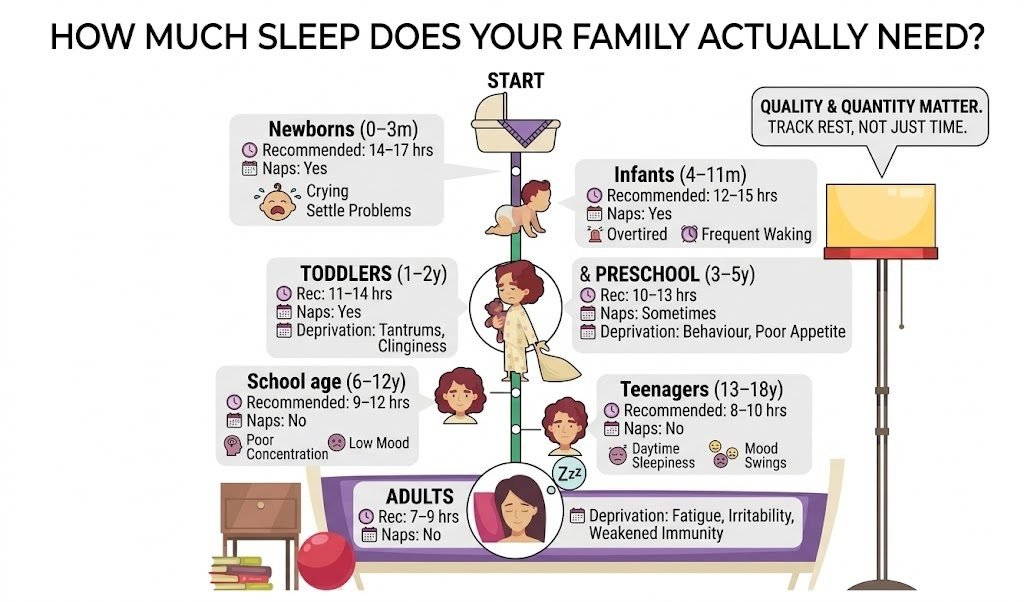
Sleep needs vary significantly by age, and many UK families are operating well below the recommended amounts without realising it. Here is a clear reference guide:
| Age Group | Recommended Sleep | Including Naps | Common Signs of Sleep Deprivation |
|---|---|---|---|
| Newborns (0–3 months) | 14–17 hours | Yes | Difficult to settle, excessive crying |
| Infants (4–11 months) | 12–15 hours | Yes | Overtiredness, frequent night waking |
| Toddlers (1–2 years) | 11–14 hours | Yes | Tantrums, clinginess, hyperactivity |
| Preschool (3–5 years) | 10–13 hours | Sometimes | Behavioural difficulties, poor appetite |
| School age (6–12 years) | 9–12 hours | No | Poor concentration, low mood, poor school performance |
| Teenagers (13–18 years) | 8–10 hours | No | Excessive daytime sleepiness, mood swings, poor decision-making |
| Adults | 7–9 hours | No | Fatigue, irritability, weakened immunity, weight gain |
It is also worth noting that quality matters just as much as quantity. Six hours of deep, uninterrupted sleep can leave you feeling more refreshed than eight hours of broken rest. Tracking not just how long you sleep but how rested you feel in the morning gives you a more accurate picture of where improvements are needed.
Common Sleep Problems Across Different Ages
Sleep difficulties are surprisingly common in UK families and affect every age group differently. Understanding what is typical and what warrants attention can help you respond appropriately:
| Age Group | Common Sleep Issues | Usually Self-Resolving | Worth Seeing a GP |
|---|---|---|---|
| Babies and toddlers | Night waking, difficulty settling, early rising | Often yes, with consistent routine | If snoring loudly or stopping breathing during sleep |
| Preschool children | Bedtime resistance, nightmares, night terrors | Usually yes | If terrors are very frequent or distressing |
| School-age children | Anxiety-related insomnia, nightmares, sleepwalking | Sometimes | If affecting school performance or daily functioning |
| Teenagers | Delayed sleep phase, difficulty waking, oversleeping | Partially, related to biology | If excessive daytime sleepiness persists despite adequate hours |
| Adults | Insomnia, stress-related waking, restless legs | Sometimes with lifestyle changes | If persistent for more than four weeks or affecting daily life |
If you are unsure whether a sleep issue needs professional attention, err on the side of booking an appointment with your GP. Sleep problems that are left unaddressed tend to worsen over time rather than resolve on their own.
How Technology Is Helping Doctors Treat Sleep Disorders
One of the most significant changes in sleep medicine in recent years is how clinicians manage patient care. A sleep consultation involved a paper questionnaire and perhaps a night in a hospital sleep lab. While sleep studies remain important, the tools available to doctors have advanced considerably.
Modern sleep medicine practices increasingly rely on specialised digital systems to coordinate and track patient care. An EMR for sleep allows clinicians to monitor a patient’s sleep data over time, track how they are responding to treatment, flag patterns that might otherwise be missed across multiple appointments, and share information across a care team more efficiently. For families, this means the sleep specialist you or your child sees has a much clearer longitudinal picture of what is going on, rather than relying on what you can recall from memory during a ten-minute appointment.
The practical benefits of this approach include:
- More accurate diagnoses because the clinician can see trends across weeks and months rather than a single snapshot.
- Better-tailored treatment plans because the system tracks how a patient responds to interventions over time.
- Improved coordination between GPs, paediatricians, and sleep specialists when multiple practitioners are involved in a child’s care.
- Reduced reliance on patients accurately self-reporting sleep patterns, which is notoriously difficult to do from memory.
- Faster identification of conditions like sleep apnoea, periodic limb movement disorder, and narcolepsy that might otherwise take years to diagnose.
It is one of those behind-the-scenes improvements in healthcare that you may never directly encounter, but that genuinely raises the standard of care your family receives when sleep problems need specialist attention.
Creating a Sleep-Friendly Home: Room by Room
While specialist care is there for when you need it, there is a great deal you can do at home to support better sleep for the whole family. Start with the environment itself:
Bedroom
| Factor | Ideal Condition | Simple Fix |
|---|---|---|
| Temperature | 16–18 °C for adults, slightly warmer for babies | Use a thermometer and adjust heating, or use lighter bedding |
| Light | As dark as possible during sleep hours | Use blackout curtains or blinds, especially important for children |
| Noise | Quiet, or consistent background sound | White noise machine for babies, earplugs or fan for adults |
| Screens | Removed from the bedroom entirely | Charge phones outside the bedroom, use a traditional alarm clock |
| Air quality | Well ventilated and not too dry | Open a window slightly or use a humidifier in winter |
| Bedding | Appropriate weight for the season | Switch to lighter duvet in summer, heavier in winter |
Rest of the home
The hour before bed matters as much as the bedroom itself. Bright overhead lighting signals wakefulness to the brain. Switching to lamps with warmer, dimmer light in the evening helps the body begin producing melatonin earlier. Keeping the living space calm and reducing stimulating activity, loud television, arguments, or vigorous play, in the final hour before bedtime makes the transition to sleep noticeably smoother for children and adults alike.
Building a Bedtime Routine That Actually Works
A consistent bedtime routine is one of the most evidence-backed tools for improving sleep in children, and it works for adults too. The key is consistency rather than complexity. Here is what an effective routine looks like at different ages:
| Age Group | Routine Length | Key Elements | What to Avoid |
|---|---|---|---|
| Babies (6 months plus) | 20–30 minutes | Bath, feed, quiet song or story, dark room | Stimulating play, bright lights, screens |
| Toddlers | 30–45 minutes | Bath, pyjamas, 2–3 short books, brief quiet chat, lights out | Exciting games, long negotiations, screen time |
| School-age children | 30–45 minutes | Shower or bath, reading, brief wind-down chat, consistent lights-out time | Homework right before bed, screens in bedroom |
| Teenagers | 30 minutes | Phone away, dim lighting, reading or calm music, consistent bedtime | Social media scrolling in bed, energy drinks in evenings |
| Adults | 30–60 minutes | Step away from screens, herbal tea, reading, light stretching or breathing | Work emails in bed, alcohol as a sleep aid, late meals |
The most important element is consistency. Doing the same things in the same order at roughly the same time each evening trains the brain to associate those activities with sleep, making the transition faster and easier over time.
Nutrition, Exercise, and Sleep: What UK Families Need to Know
What you eat and how active you are during the day directly affect how well you sleep at night. The connections are stronger than most people realise:
Foods and drinks that help sleep:
- Complex carbohydrates such as oats, wholegrain bread, and sweet potato support serotonin production and help stabilise blood sugar overnight.
- Foods rich in tryptophan, including turkey, eggs, dairy, nuts, and seeds, support melatonin production.
- Herbal teas such as chamomile, valerian, and passionflower have mild calming effects and make a useful part of an evening routine.
- Magnesium-rich foods, including leafy greens, pumpkin seeds, and dark chocolate, support muscle relaxation and deeper sleep.
Foods and drinks that disrupt sleep:
- Caffeine has a half-life of around five to seven hours, which means a cup of coffee at 3pm can still be affecting your sleep at 10pm. The NHS advises limiting caffeine after midday if sleep is a concern.
- Alcohol may make falling asleep feel easier, but it significantly disrupts sleep architecture, reducing restorative deep sleep and increasing night waking in the second half of the night.
- Heavy or spicy meals within two to three hours of bedtime increase the likelihood of acid reflux and discomfort that interrupts sleep.
- High sugar snacks in the evening cause blood sugar spikes and crashes that can trigger waking during the night.
Exercise and sleep: Regular physical activity, even a brisk 30-minute walk, has been shown in multiple studies to improve both sleep onset and sleep quality. For children, ensuring adequate physical activity during the day is one of the simplest ways to promote better sleep at night. However, vigorous exercise within two hours of bedtime can have the opposite effect by raising core body temperature and adrenaline levels.
Sleep and Mental Health: The Two-Way Connection
Sleep and mental health are deeply intertwined, and the relationship runs in both directions. Poor sleep contributes to anxiety and low mood, and anxiety and low mood contribute to poor sleep. For UK families, where rates of anxiety in children and adults have risen significantly in recent years, understanding this connection is increasingly important.
- Children experiencing anxiety about school, friendships, or family circumstances often show it first through sleep difficulties, bedtime resistance, or increased nightmares.
- Postnatal depression and postnatal anxiety in new mums are both strongly connected to sleep deprivation, and addressing sleep quality is an important part of recovery alongside professional support.
- Teenagers with disrupted sleep are significantly more likely to experience depression and anxiety, and the relationship between late-night screen use, poor sleep, and mental health in adolescents is well established.
- Adults with insomnia are considerably more likely to develop depression and anxiety disorders, and treating the insomnia often produces meaningful improvements in mood even before other interventions are introduced.
If you are experiencing persistent low mood, anxiety, or overwhelm alongside sleep difficulties, speak to your GP. Both issues deserve attention, and treating them together tends to produce better outcomes than addressing only one.
When to See Your GP About Sleep
Many sleep issues improve with the lifestyle and environmental changes outlined in this article. But some problems need professional support, and knowing when to seek help is important:
| Symptom | Who It Affects | Why It Needs Attention |
|---|---|---|
| Loud snoring with pauses in breathing | Adults and children | May indicate sleep apnoea, which affects cardiovascular health and daytime functioning |
| Excessive daytime sleepiness despite adequate hours | Any age | Could indicate narcolepsy, sleep apnoea, or other sleep disorder |
| Persistent inability to fall or stay asleep | Adults and teenagers | Chronic insomnia responds well to CBT-I, a structured psychological treatment |
| Sleepwalking that puts the person at risk | Children and adults | May need investigation and safety management |
| Restless legs or periodic limb movements | Adults, occasionally children | Treatable condition often linked to iron deficiency |
| Night terrors more than twice weekly | Young children | Worth discussing if persistent and distressing |
| Significant changes in sleep pattern without obvious cause | Any age | Can sometimes signal underlying physical or mental health conditions |
The NHS offers access to sleep clinics through GP referral, and cognitive behavioural therapy for insomnia is available through some IAPT services without a referral. CPAP therapy for sleep apnoea, melatonin for children with certain conditions, and other treatments are also available through the NHS when clinically indicated.
Making Sleep a Family Priority: A Practical Starting Point
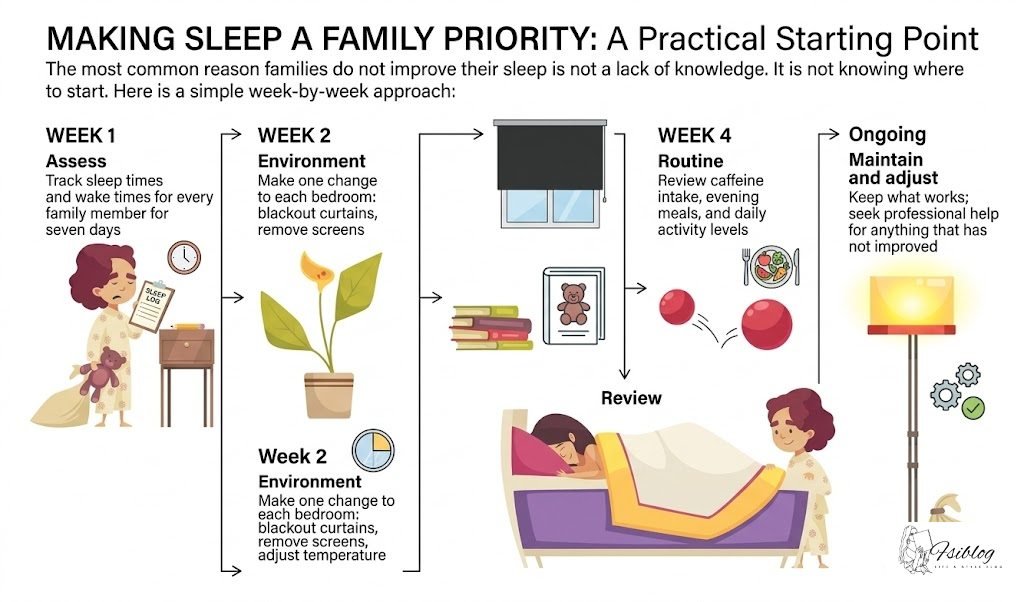
The most common reason families do not improve their sleep is not a lack of knowledge. It is not knowing where to start. Here is a simple week-by-week approach:
| Week | Focus | Action |
|---|---|---|
| Week 1 | Assess | Track sleep times and wake times for every family member for seven days |
| Week 2 | Environment | Make one change to each bedroom: blackout curtains, remove screens, adjust temperature |
| Week 3 | Routine | Introduce or tighten the bedtime routine for children; establish a wind-down habit for adults |
| Week 4 | Nutrition and activity | Review caffeine intake, evening meals, and daily activity levels |
| Week 5 | Review | Compare how the family feels now versus week one and identify what still needs attention |
| Ongoing | Maintain and adjust | Keep what works; seek professional help for anything that has not improved |
Conclusion
Sleep is not something you can earn back later. Every night of poor rest has an immediate cost to your health, your mood, your patience, and your ability to show up fully for your family. And every night of genuinely good sleep is an investment that pays back in energy, resilience, and well-being the very next day.
The good news is that for most families, meaningful improvement is well within reach. It does not require expensive equipment or dramatic lifestyle changes. It starts with understanding what your family actually needs, making a few targeted changes to your environment and routines, knowing when to seek professional help, and treating sleep as the health priority it genuinely is, rather than the first thing you sacrifice when life gets busy.
Start tonight. Turn off the screens a little earlier, dim the lights, and give your body the signal it has been waiting for. You might be surprised at just how much better tomorrow feels.
Disclaimer
The information provided in this article is intended for general informational and educational purposes only. It does not constitute medical advice and should not be used as a substitute for professional medical guidance, diagnosis, or treatment. Sleep needs and sleep disorders vary between individuals and are influenced by age, health conditions, medications, and other factors. Always consult your GP or a qualified healthcare professional if you have concerns about your own sleep or that of a family member, particularly if symptoms are persistent, severe, or affecting daily functioning. Any reference to specific products, services, or technologies in this article is for informational purposes only and does not constitute an endorsement.