
Watching children struggle with friendships, misunderstand classmates, or deeply react to everyday conflicts can be frustrating and confusing. You may notice arguments quickly escalating, feelings easily getting hurt, or teens shutting down rather than talking out problems. Oftentimes, it is not behavior itself, but an inability to understand situations from another’s point of view.
At the same time, changing social pressures, online encounters, and academic pressures lead to more frequent emotional misunderstandings. When children and teens cannot read others’ feelings or intentions, relationships suffer, and self-confidence decreases. The good news is that perspective-taking can help build empathy through practical habits and guidance.
Understand What Perspective Taking Really Means
Perspective taking is the ability to put yourself in another person’s position and imagine how they might think or feel. Instead of reacting solely on their own emotions, children learn to stop and think about how someone else is feeling.
This skill does not come naturally. Young children often think everyone thinks the same way they do. However, as they mature, guided practice helps them to understand that different people have different thoughts, feelings, and motivations.
When children learn to ask, “Why might they feel this way?” conflicts become easier to solve. Instead of blaming or having an impulsive reaction, they start thinking in terms of context. Further, teens who acquire this skill approach peer disagreements, misunderstandings in socializing, and online interactions more thoughtfully. Rather than reacting, they respond.
As a result, empathy naturally increases as understanding of others becomes part of daily thought processes, rather than a reminder only from time to time.
Four Ways Perspective Taking Builds Empathy In Children
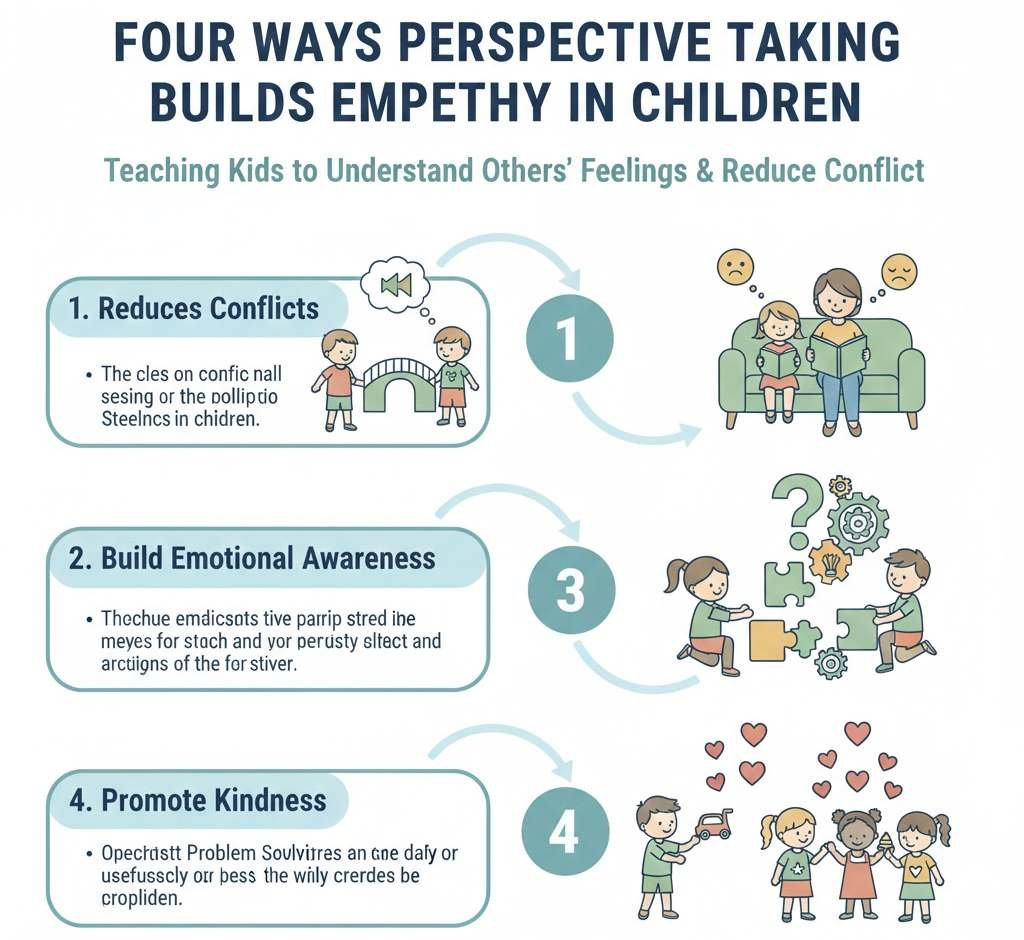
Here is the list of different ways in which perspective-taking builds empathy in children and teens:
1. Reduces Conflicts
Conflicts usually arise when children misinterpret intentions. A classmate’s comment can be perceived as rude, and a sibling’s action can be perceived as unfair, even if nothing bad was intended.
However, when kids learn to approach a situation from a broader perspective, misunderstandings are reduced. They start to understand that behavior often has reasons.
For example, a friend who is behaving distantly might be tired or worried rather than angry. Similarly, a teammate who refuses to share may be feeling insecure rather than selfish.
Therefore, perspective taking helps children stop before acting. They learn to ask questions and seek clarification rather than make negative assumptions.
Over time, this habit leads to calmer conversations, quicker resolutions, and stronger friendships. Teens, in particular, benefit as social dynamics become more complex in adolescence.
2. Build Emotional Awareness Through Everyday Conversations
Empathy is strengthened when children can identify their own and others’ emotions. Yet many children lack the vocabulary or confidence to describe their feelings accurately.
You can support this development by having simple conversations. For example, after watching a movie or reading a story, ask questions such as:
- “Why do you think that character felt upset?”
- “What could they have required at that moment?”
- “What would you do differently?”
These discussions help children become aware of emotional cues and of their own motivation.
Additionally, the day-to-day events can provide natural learning opportunities. When disagreements occur at school or at home, gently guide children to consider how others involved might feel.
Slowly, emotional awareness is integrated into their thinking process. As a result, empathy emerges due to reflection rather than lectures.
3. Encourage Problem Solving Instead of Blame
Children tend to respond to conflict by readily blaming others or defending themselves. However, empathy increases when blame is substituted with solutions.
You can guide children to ask constructive questions:
- What happened from each person’s perspective?
- What feelings were involved?
- What is the solution that works for everybody?
This way, accountability is taught without shame. Children learn that their actions have consequences for others, even as they acknowledge that others have feelings too.
Furthermore, teens who think in a solution-focused way handle disagreements more maturely. They negotiate rather than argue, listen rather than interrupt, and cooperate rather than compete.
In this way, perspective taking transforms everyday difficulties into learning opportunities rather than emotional battles.
Final Thoughts
Perspective-taking is not a single lesson children learn once. It is a skill that develops gradually through daily conversations, guided reflection, and real-life experiences. When children and teens practise pausing, considering another person’s feelings, and looking at situations from multiple angles, empathy becomes a natural response rather than something they are told to show.
Parents, teachers, and caregivers play an important role by modelling calm listening, asking thoughtful questions, and turning conflicts into moments of understanding rather than punishment. Small, consistent guidance helps young people build stronger friendships, communicate more clearly, and manage emotions with greater confidence.
Over time, these habits shape not only kinder behaviour but also emotional resilience and social maturity. By nurturing perspective-taking early, you help children and teens grow into adults who understand others, handle disagreements constructively, and build healthier relationships throughout life.